
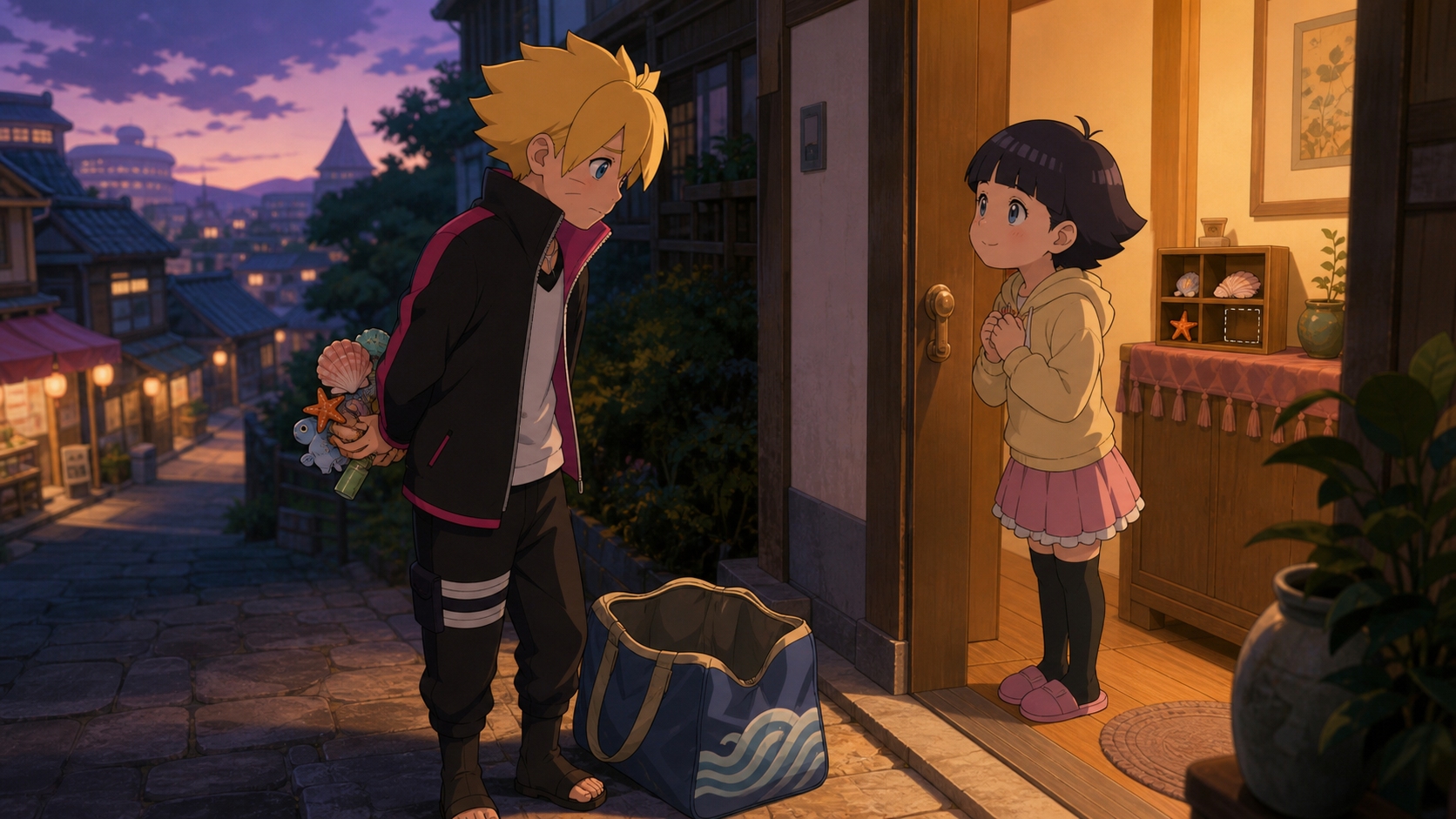
The Quest for Souvenirs!
Boruto forgets Himawari’s souvenir, lies himself into a village-wide candy hunt, and earns the authentic Kiri sweets by refusing to cheat an impossible shopkeeper.
Series: Boruto: Naruto Next Generations
Episode: 32 · The Quest for Souvenirs!
Arc: School Trip Arc
Release: 2017-11-08
Previous: Episode 31 · Boruto and Kagura
Directory: All 293 Boruto episodes
Bottom line
Boruto Episode 32 brings Boruto home after a coup attempt, a sword fight, and an emotional rescue in the Hidden Mist, then nearly destroys him with one disappointed look from Himawari. He promised his little sister a souvenir. He forgot. The brave child who stood against Shizuma cannot say five honest words in a bedroom because Himawari is holding the repaired panda toy connected to one of their family’s most terrifying memories.
So Boruto lies. He says he bought Water Cinnamon Sweets and the package ended up in a classmate’s luggage. That lie sends him through Konoha begging friends for candy they already ate, into Sarada’s secret oddities shop, and across a Shinobi Bout table from an old woman who refuses to sell to him. The episode’s punch line and emotional answer arrive in the same move: Mitsuki notices the woman’s cards reflected in a vase, Boruto refuses the unfair advantage, and the shopkeeper gives him the sweets because his honesty matters more than winning. He returns home with the right gift and finally tells Himawari the truth. The souvenir repairs the promise. The confession repairs Boruto.
Kiri says goodbye without Kagura at the dock
The class prepares to leave Kirigakure while Chōchō arrives late under the weight of many souvenirs. Chōjūrō sees the students off, but Kagura is absent. Boruto notices because the entire trip became personal through him.
Kagura watches from a distance rather than joining the farewell. His shame has not vanished simply because Shizuma lost. The quiet absence gives the return journey a bruise beneath the relief.
Chōchō understood the assignment better than Boruto
Chōchō appears with enough shopping to prove that nobody in her life will accuse her of forgetting them. She treated the souvenir portion of the field trip like a mission with measurable objectives and excellent snacks.
Boruto watches the bags without remembering his own promise. The warning is standing in front of him wearing confidence and carrying merchandise, but his brain remains occupied by Kagura and the rebellion.
Chōjūrō’s letter saves the students from punishment
Back in Konoha, Boruto, Sarada, and Iwabee expect trouble over their unauthorized night battle. Iruka has received a letter from the Mizukage explaining that their actions benefited both the Land of Water and the Land of Fire.
Their faces change when the letter becomes praise instead of disciplinary evidence. These children survived political violence and still look like children caught sneaking out after curfew. That contrast is exactly why the Academy-era episodes work.
Boruto returns home expecting ordinary warmth
The Uzumaki house should be the easy part. Boruto is safe, the trip is over, and Hinata and Himawari are waiting. He removes his shoes, brings in his luggage, and starts settling back into home.
Himawari’s excitement follows the bag in his hand. She asks what he brought, and Boruto hands her dirty clothes. Her face falls. Boruto misses the meaning because big brothers are apparently allowed to survive ninja rebellions without developing basic visual literacy.
Himawari’s disappointment is quiet, which makes everything worse
Himawari does not scream. She does not accuse him in front of the family. She simply becomes less cheerful around him. Boruto can handle open conflict. Quiet disappointment gives him nothing to punch, outsmart, or blame.
The mood bothers him enough to ask Hinata what happened. Hinata reminds him of the promise he made before leaving. The forgotten souvenir returns to his memory all at once.
Hinata does not rescue him from the promise
Hinata explains why Himawari is hurt without immediately fixing Boruto’s mistake. She could invent an excuse or tell Himawari the trip became dangerous. Instead, she lets Boruto face the relationship he damaged.
That restraint is good parenting. Hinata knows her son loves his sister. She also knows love needs follow-through, especially in a household where Naruto’s work already teaches the children how absence can swallow promises.
Boruto intends to confess before fear gets involved
Boruto rushes toward Himawari’s room ready to tell the truth and apologize. For one hopeful second, the episode appears willing to end the problem through a normal conversation.
Then he sees Himawari holding her panda toy. That toy connects to the day her Byakugan awakened and Naruto dropped after stepping between his children. Boruto remembers exactly how dangerous an upset Himawari can become.
The panda turns honesty into a survival calculation
Himawari is not threatening him. The stuffed animal merely exists in her hands. Boruto’s imagination supplies chakra points, pain, and the unforgettable image of Naruto unconscious on inauguration day.
The joke is affectionate because Himawari remains sweet while Boruto mentally transforms her into the final boss. His fear is exaggerated, but the emotional fear beneath the comedy is real. He cannot stand the thought of her learning that she waited for something he forgot.
One lie creates the entire quest
Boruto says he bought Water Cinnamon Sweets from the Hidden Mist, but the package became mixed into a friend’s luggage. The explanation buys him time and creates a specific object he now has to produce.
He could have lied vaguely. Instead, panic gives him a product name, logistics problem, and deadline. Boruto has converted a forgotten promise into a retrieval mission because missions feel safer than apologies.
Water Cinnamon Sweets become the only acceptable evidence
The candy is a recognizable Kiri specialty. Himawari can believe the story if Boruto places the correct package in her hands. Any ordinary gift would expose the lie.
The specificity raises the comedy. Konoha contains countless stores and almost none carry the one item Boruto announced before checking whether any survived the trip.
Every classmate already ate the answer
Boruto runs through the village asking classmates whether they still have Water Cinnamon Sweets. Each possible rescue has already been opened and eaten. Souvenirs become snacks once people reach home, which is exactly what Boruto should have predicted.
The repeated disappointment gives the episode a quest structure without pretending the stakes are larger than family embarrassment. Every empty package moves Boruto closer to the confession he keeps avoiding.
Chōchō probably had enough and still finished them
If anybody returned from Kiri with a supply, Chōchō did. If anybody could eliminate that supply before Boruto arrived, Chōchō also did. Her commitment to tasting a regional specialty remains stronger than his emergency.
I cannot even blame her. Boruto’s failure to plan does not create an obligation for Chōchō to preserve imported candy indefinitely.
Mitsuki finds Boruto at the end of his options
Mitsuki meets Boruto while the search is collapsing. He listens without judging the scale of the problem. For Mitsuki, Boruto wanting sweets from an impossible source is enough reason to join.
That loyalty becomes dangerous at the shop later, but the starting point is tender. Mitsuki does not rank problems by public importance. If Boruto cares, Mitsuki pays attention.
Sarada knows a shop and demands silence about why
Sarada overhears the problem and mentions a store that carries products from many villages. Chōchō introduced her to the strange little place during an earlier quest. Sarada provides the location on one condition: Boruto must not investigate how she knows.
The secrecy is perfect. Sarada wants to help while preserving every ounce of dignity connected to that bizarre shopping history. Boruto accepts because imported candy matters more than gossip for once.
The oddities shop actually has the sweets
Boruto and Mitsuki enter the shop and find a full box of Water Cinnamon Sweets. After hours of failure, the solution is sitting within arm’s reach.
The old shopkeeper refuses to sell. She sees Boruto as a rude child handling merchandise with dirty hands and has no interest in his emergency. Capitalism briefly loses to personal dislike.
Mitsuki offers a response nobody requested
When the shopkeeper swats at Boruto, Mitsuki catches her wrist and asks whether Boruto wants him to kill her. Sir. They are purchasing candy for a small child. Murder would complicate the apology.
Boruto rejects the offer immediately. Mitsuki’s face remains calm because he views protection as a straightforward service. The scene is one of the funniest demonstrations of how far his social calibration still has to travel.
Shinobi Bout creates a route to the box
Cards fall from the woman’s clothing, revealing her interest in Shinobi Bout. Boruto recognizes the game and proposes a match. The shopkeeper agrees to sell the sweets if he wins.
Now the quest speaks Boruto’s language. A direct contest with rules feels manageable. He can earn the candy instead of begging for mercy.
The shopkeeper is much better than expected
The old woman plays seriously and controls the match. Boruto cannot coast on familiarity with the game. The candy remains behind her like treasure guarded by an elderly final boss with excellent card instincts.
Her skill also justifies Sarada’s reluctance to discuss the shop. Every visit can apparently become a personal trial.
Mitsuki notices the reflection
Mitsuki sees the shopkeeper’s cards reflected in the polished vases behind her. Boruto could use the information to win. The opening is quiet, available, and unlikely to be detected.
The temptation mirrors the original problem. Boruto wants a result that will support a false story. Another shortcut could deliver that result faster.
Boruto refuses to win through hidden information
Boruto tells the shopkeeper about the reflection and asks to reshuffle rather than exploiting her exposed cards. The choice costs him the advantage he desperately needs.
That moment reveals why the episode never treats him as fundamentally dishonest. He lied to Himawari out of fear, not because cheating feels natural. When the unfair route becomes clear, his instincts reject the victory.
The shopkeeper recognizes the part of Boruto worth rewarding
The woman ends the game, tells them to leave, and gives Boruto the sweets for free. She was testing character as much as card skill. Boruto receives the box because he protected the fairness of the match even when losing threatened someone he loved.
The reward does not erase his lie. The reward proves he can still choose honesty before the episode ends.
Kagura’s letter reaches him on the way home
Tayori delivers a letter from Kagura. Kagura apologizes to Boruto, carrying shame from the rebellion and gratitude for the friend who refused to abandon him.
The letter parallels Boruto’s own unfinished confession. Kagura faces a painful truth through words rather than hiding until the relationship disappears. Boruto receives the example exactly when he needs one.
The field trip ends through two apologies
Kagura’s apology closes the emotional wound left at the dock. Boruto’s apology will close the smaller wound waiting at home. The scale differs, but both relationships require somebody to speak after fear made silence attractive.
Episode 32 understands that repair belongs in the aftermath of adventure. Saving a friend from a coup does not mean the friendship maintains itself. Returning with candy does not mean a sibling bond can skip honesty.
Boruto gives Himawari the real Kiri sweets
Boruto places the Water Cinnamon Sweets in Himawari’s hands. The gift is authentic even though the original story was not. He worked absurdly hard to obtain something connected to the place he visited.
Himawari’s happiness gives him the easy exit. He could let the candy support the lie and never mention what happened.
He confesses after the problem appears solved
Boruto tells Himawari that he forgot to buy the souvenir during the trip. This is the strongest choice in the episode because he confesses after securing the reward, when concealment would be simplest.
He chooses the relationship over looking like a perfect brother. The sweets show effort. The truth shows respect.
Himawari wanted her brother more than flawless proof
Himawari accepts the confession and the gift. She was hurt because Boruto’s promise made her feel remembered, then his return seemed to forget that shared moment.
His search cannot restore the exact thought he failed to have in Kiri. His honesty creates a new memory: Boruto cared enough to admit the failure and keep trying.
Boruto is more like Naruto than he wants to admit
Boruto criticizes Naruto’s missed family commitments, yet he also lets public crisis crowd a home promise out of his mind. The parallel does not make their failures equal. The parallel gives Boruto a glimpse of how good intentions disappear under pressure.
Unlike Naruto’s larger pattern, Boruto gets the chance to repair this mistake quickly. Learning from the small version may help him understand both his father and himself.
RaeRae’s take
Mitsuki asking whether Boruto wanted an old woman dead over imported cinnamon candy took me out. Nobody in that shop was prepared for the level of loyalty Orochimaru’s child brought to retail conflict. Boruto saying no without needing a second to think was growth for the whole room.
What I love most is that Boruto earns the candy by refusing to cheat, then still tells Himawari the truth. The episode could have let the correct box cover the lie. Instead, his character appears in two decisions made after shortcuts become available. He protects the card game from an unfair win, and he protects his sister from a pretty false story. That is a lovely little ending for the Hidden Mist trip.
Himawari's quiet disappointment reaches Boruto faster than any punishment
Himawari does not yell, accuse, or demand an explanation. She looks at Boruto with the repaired panda in her hands, and his courage disappears. The panda carries the memory of Naruto missing her birthday and Boruto trying to protect her from the disappointment. Boruto knows exactly what a broken promise from an adored family member feels like. Realizing he has repeated that injury makes the room unbearable.
Hinata's refusal to provide an excuse matters. She could smooth the moment by reminding Himawari that the school trip became dangerous or that Boruto had more serious concerns in the Hidden Mist. Both facts would be true. Neither fact changes the promise. Hinata lets Boruto decide whether he will respect his sister enough to admit failure.
The scene also understands why children sometimes lie to the person they most want to protect. Boruto is not trying to exploit Himawari. He wants to restore her happiness before she can decide that his promise meant nothing. The lie offers a temporary version of the brother he wants to be. Unfortunately, maintaining that version requires a real package of sweets, a false luggage story, and cooperation from classmates who have already eaten every available piece.
The candy search turns one bad sentence into a public problem
Boruto's quest grows because lies recruit logistics. He needs the correct regional sweet, the correct packaging, and a believable explanation for the delay. Every classmate becomes a possible witness or supplier. Chōchō's complete destruction of the remaining candy is funny, but her appetite also removes the easiest escape and forces Boruto deeper into the consequences of his choice.
Mitsuki joins without demanding a moral confession. Sarada knows the oddities shop and immediately protects her own reputation, which tells us somebody has an adorable private interest she would rather bury under a fireball. Their involvement keeps the episode rooted in friendship without making friends responsible for fixing Boruto's mistake. They help him search. He still has to choose honesty.
The oddities shop becomes the perfect final obstacle because the owner does not care about Boruto's urgency. A family promise cannot force a stranger to surrender a collectible. Boruto must enter her game, accept her conditions, and risk leaving empty-handed. The episode turns a tiny domestic lie into a full shinobi-style challenge while preserving the emotional scale. Nobody will die if he fails. His sister may trust him a little less, which feels more frightening to him.
Refusing Mitsuki's reflected cards proves Boruto knows fairness when pride is involved
Mitsuki notices the shopkeeper's hand reflected in the vase because Mitsuki notices nearly everything around Boruto. The information would guarantee victory. Boruto wants the sweets badly enough to have spent the day searching Konoha, yet he refuses to use the reflection. That decision reveals a moral instinct stronger than his desire to escape embarrassment.
The contrast with his lie to Himawari is deliberate. Boruto can recognize unfairness immediately when a game provides clear rules. Family honesty feels messier because love, shame, and fear crowd the decision. He is not a hypocrite so much as a child whose ethics work better under external structure than emotional pressure. The shopkeeper rewards the part of him that already knows how to act cleanly.
Her gift does not erase the original lie. The sweets give Boruto another chance to decide what kind of brother he wants to be. He could present the package, preserve the luggage story, and enjoy Himawari's relief. Confessing after obtaining the correct souvenir is harder because the practical problem appears solved. Boruto tells her anyway, which turns the candy from fabricated evidence into an honest attempt to repair harm.
Kagura's letter and Boruto's confession close the school trip through accountability
Kagura cannot reach the dock, but his letter gives Boruto a truthful ending to their friendship. The message acknowledges what happened, carries gratitude forward, and leaves room for another meeting. Boruto does not receive the easy goodbye he wanted. He receives evidence that Kagura chose a different future after their time together.
Himawari receives a similar form of respect when Boruto confesses. He stops controlling the story and allows her to know the brother who forgot, panicked, lied, searched, and returned. Her forgiveness has value because she receives the truth before offering comfort. Himawari wanted a souvenir, but she wanted evidence that Boruto remembered her while he was away. His honesty finally makes that relationship visible.
Both apologies reject perfection. Kagura cannot undo his participation in Shizuma's revolt. Boruto cannot retroactively remember the gift. Each boy can name the failure, act differently, and protect the relationship from a cleaner false story. That emotional symmetry gives a light comedy episode more consequence than the candy-shop plot first suggests.
Sources and lawful viewing
“The Quest for Souvenirs!” is Boruto: Naruto Next Generations Episode 32 and the conclusion of the School Trip arc. Boruto searches Konoha for Water Cinnamon Sweets, faces the oddities-shop owner in Shinobi Bout, receives Kagura’s letter, and confesses the forgotten promise to Himawari.
Official episode reference: Naruto Official episode guide
Licensed episode route: Crunchyroll licensed series page