
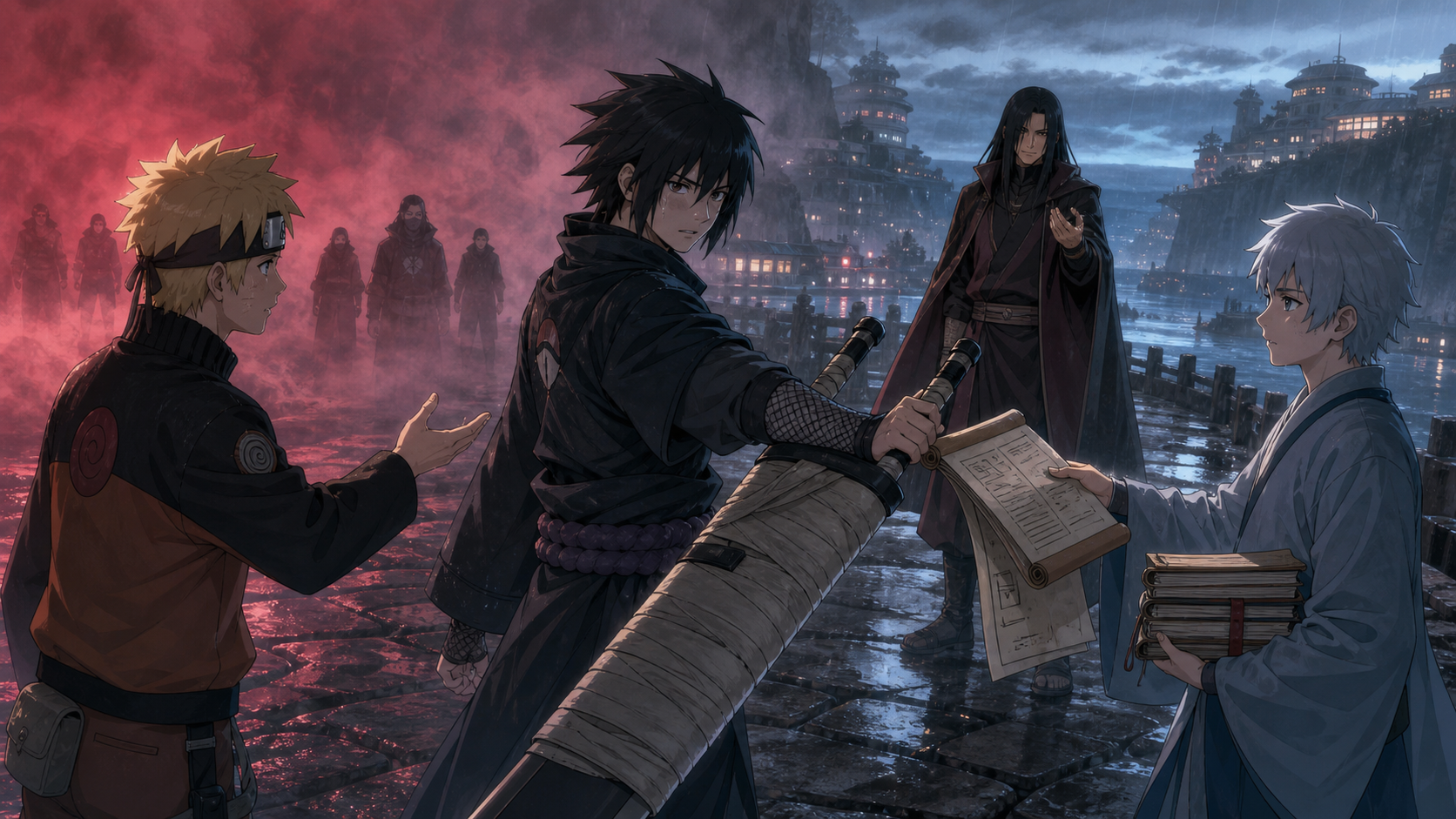
Boruto and Kagura
Mitsuki exposes Shizuma’s assassination conspiracy, Kagura rejects inherited shame, and Boruto joins him at Hiramekarei against a Samehada-fed monster.
Series: Boruto: Naruto Next Generations
Episode: 31 · Boruto and Kagura
Arc: School Trip Arc
Release: 2017-11-01
Previous: Episode 30 · The Sharingan vs. The Lightning Blade, Kiba the Fang!
Directory: All 293 Boruto episodes
Bottom line
Boruto Episode 31 does not rescue Kagura by proving that his fear is fake. Kagura really hurt classmates. He really carries Yagura’s blood and years of terror about becoming a killer. Shizuma wins access by taking those true pieces, arranging them into a cage, and telling Kagura that only the Bloody Mist can accept what he is. Boruto cannot break that story through friendship alone. Mitsuki arrives with evidence that Shizuma’s own people ordered assassinations and exposes the glorious revolution as one man’s appetite for war.
The facts open the cage, but Kagura still has to walk out. He blocks Shizuma’s attack, takes responsibility for Hiramekarei, and chooses a future that does not repeat his grandfather. When Samehada swallows Shizuma and turns him into a chakra-hungry monster, Chōjūrō refuses to steal the decision back from Kagura. Boruto joins Kagura at the blade, their chakra fills Hiramekarei together, and the boys defeat the man who insisted blood decides destiny. That is why the episode works. Boruto reaches. Mitsuki reveals. Chōjūrō trusts. Kagura chooses.
Kagura attacks the friend trying to take him home
Kagura tells Boruto that someone raised outside his history cannot understand. Then he swings Hiramekarei. The blade carries more than chakra. Every attack is Kagura trying to make Shizuma’s verdict feel final.
Boruto refuses to treat violence as proof that Kagura has vanished. He sees conflict on Kagura’s face even while dodging a sword capable of ending the conversation permanently.
The first body Kagura cuts is a shadow clone
Kagura appears to bisect Boruto, but the target dissolves into a shadow clone. Boruto entered the fight ready to survive long enough to keep talking.
The trick also frustrates Shizuma’s desired spectacle. He wants Kagura to prove loyalty through blood. A disappearing clone denies him the clean irreversible moment he keeps demanding.
Shizuma coaches the violence from behind him
Shizuma praises Kagura and urges him to draw more power from Hiramekarei. He does not fight the emotional battle himself. He stands close enough to reinforce every shame-based conclusion while Kagura carries the weapon and consequence.
That is Shizuma’s method across the arc. He makes wounded young people feel chosen, then points their pain toward his political fantasy.
Boruto asks where the Shinobi Bout player went
Boruto reminds Kagura of the person who played cards with them, smiled awkwardly, and wanted to build a different Mist. He refuses Shizuma’s attempt to reduce Kagura to Yagura’s grandson and one childhood outburst.
The memory is deliberately ordinary. Boruto is not arguing that Kagura secretly performed some grand heroic destiny. He is saying the gentle person from their shared afternoon was real too.
Kagura says Shizuma acknowledged him
Kagura explains that he follows Shizuma because Shizuma accepted the violent part everyone else feared. Acceptance becomes powerful when shame has convinced somebody that kindness only survives through ignorance.
Shizuma’s acknowledgment is conditional, of course. Kagura remains valuable while he fights, carries Hiramekarei, and supports the rebellion. Boruto reads the condition in Kagura’s miserable expression before Kagura can admit the truth.
Boruto uses Kagura’s own words against the cage
Earlier, Kagura told Boruto that only he could decide how to live. Boruto returns the statement now. If Kagura meant those words, Shizuma cannot define his future through ancestry or scars.
Boruto is not offering a polished philosophy. He is reminding a friend of the self that existed before Shizuma made fear sound like fate.
The jacket feint gives Boruto one clean hit
Boruto uses three clones and his jacket to distract Kagura, creating an opening to land a strike. The move is scrappy, fast, and very Boruto. He cannot overpower Hiramekarei directly, so he makes Kagura read the wrong body.
The hit proves Boruto is fighting seriously even while holding back from destroying his friend. Compassion does not mean standing still beneath a legendary sword.
Hiramekarei answers Kagura’s conflict with more power
Shizuma wants Kagura to pour himself into the blade. Hiramekarei changes shape through chakra and turns every emotional surge into a larger threat.
Kagura has been taught to fear exactly this capacity. His strength feels like evidence for Shizuma’s story that violence lives in his blood. The tragedy is not that Kagura lacks control. The tragedy is that he believes control can never belong to him.
Boruto trusts Chōjūrō’s choice
Boruto argues that Chōjūrō would never have given Kagura Hiramekarei if the Mizukage believed he was only a killer waiting to emerge. The sword is not merely access to power. The sword is evidence of trust from somebody who knows the Bloody Mist better than Shizuma’s performance does.
Chōjūrō saw Kagura’s fear and still imagined him as a successor. Boruto understands that invitation more clearly than Kagura can while shame is shouting.
Shizuma rewrites Chōjūrō as a secret tyrant
Shizuma claims the peaceful Mizukage secretly assassinates opponents and hides violence beneath reform. The accusation is designed to make every hopeful sign look fraudulent.
If Chōjūrō’s trust is manipulation, Kagura loses the strongest evidence against Shizuma. Closed belief systems survive by teaching followers that contradiction proves the enemy is more deceptive than expected.
Mitsuki enters carrying the receipt
Mitsuki interrupts the argument with the scroll Suigetsu gave him. The intelligence connects Shizuma’s high-level associates to secret dealings with the Land of Waves and confessions about assassinating opponents.
This is not Boruto insisting his friend feels nice. This is documentation that reverses Shizuma’s accusation. The murders used to condemn Chōjūrō belong to Shizuma’s faction.
Suigetsu quietly changes the entire battlefield
Mitsuki met Suigetsu away from the main fight and returned with the one weapon Samehada cannot eat: provenance. Suigetsu’s connection to the Mist swords and Orochimaru’s intelligence network makes the delivery feel perfectly placed.
The arc uses adults best when they supply access without completing the children’s decisions. Suigetsu provides the evidence. Mitsuki interprets the evidence. Kagura decides what the evidence means.
Kagura realizes he was useful, not understood
Shizuma barely cares when the conspiracy is exposed. He admits he did not expect Kagura to follow so far. The acceptance Kagura treasured becomes casual exploitation in one sentence.
That cruelty breaks the romance of being “seen.” Shizuma noticed Kagura’s wound because the wound created leverage. He never loved the person carrying the wound.
Shizuma wants war because war entertains him
Mitsuki asks why Shizuma desires conflict so badly. Shizuma answers that friends turning on one another and killing is fun. The political language falls away, leaving appetite.
Peace did not dishonor him. Peace bored him. Every speech about restoring the Mist existed to decorate a man who wanted permission to watch people bleed.
Red mist turns every wound into Samehada’s meal
Shizuma mixes his blood into the mist, changing the battlefield into a red chakra-draining environment. Samehada absorbs chakra through the students’ wounds.
The technique makes injury cumulative. Boruto and Mitsuki cannot simply trade attacks because every cut feeds the weapon hunting them. Shizuma’s ideology becomes physical: violence sustains his power.
Mitsuki’s Wind Release feeds the wrong mouth
Mitsuki and Boruto attack together, but Samehada absorbs Mitsuki’s Wind Release. The sword’s scales tear through their bandages as the weapon wakes beneath restraint.
Samehada is not a neutral prize obedient to whoever stole the title of swordsman. The blade has hunger, preference, and enough personality to make Shizuma’s control look increasingly foolish.
The throat cut belongs to a water clone
Mitsuki gets close enough to slash Shizuma’s throat, only for the body to dissolve into water. The apparent kill becomes another layer of deception.
Shizuma uses the opening to pin Mitsuki with water spikes. Mitsuki avoids a fatal strike through Wind Release, but the exchange leaves him exhausted.
Mitsuki stays dangerous while barely standing
Even wounded, Mitsuki continues creating openings. His calm has never meant softness. The boy can move from dry observation to lethal precision without changing expression.
His loyalty to Boruto also remains active rather than sentimental. Mitsuki does not simply believe Boruto will save Kagura. He spends blood and chakra making that outcome possible.
Boruto and Mitsuki build the head-first answer
Mitsuki distracts Samehada with a shadow clone while Boruto uses clones and Wind Release to launch himself forward. Boruto slams into Shizuma hard enough to disarm him.
There is something wonderfully Boruto about answering a chakra-eating sword with teamwork and a human projectile. The plan is not elegant. The impact is extremely persuasive.
Kagura refuses Shizuma’s order to kill
Shizuma condemns Kagura for failing to finish Boruto. Kagura’s hesitation has become resistance even before he fully announces a side.
He can no longer pretend obedience is inevitable. Boruto survived because Kagura kept choosing not to cross the final line Shizuma demanded.
Kagura blocks the attack meant for Boruto
When Shizuma attacks again, Kagura moves between them. The defensive choice matters more than a speech because Hiramekarei is finally serving Kagura’s own judgment.
He does not wait for Boruto to defeat his shame. Kagura protects the friend who kept insisting another future remained available.
Samehada rejects the man claiming ownership
Shizuma loses control as Samehada goes wild and swallows him. The stolen legendary weapon does not crown him. The weapon turns his hunger back on his body.
The fusion is grotesque and thematically exact. Shizuma built himself around consuming grievance, blood, and other people’s pain. Samehada makes that appetite visible.
Chōjūrō arrives after evacuating civilians
The Mizukage reaches the battlefield and apologizes for the delay because he was protecting the village. Shizuma spent the arc calling peace cowardice. Chōjūrō demonstrates leadership through priorities.
He could have rushed toward the dramatic duel. He chose the civilians first, trusting the young fighters to hold until the public was safe.
Kagura asks to finish what he helped begin
Kagura tells Chōjūrō he wants to handle Shizuma. He cannot change the past, but he wants to help create the future. The request acknowledges responsibility without accepting Shizuma’s claim that responsibility equals permanent corruption.
Chōjūrō allows him to try. That trust is risk, forgiveness, mentorship, and accountability packed into one decision.
Chōjūrō does not steal Kagura’s redemption scene
The Mizukage could end the fight through superior experience and make the students spectators. Instead, he recognizes that Kagura needs to act with Hiramekarei under his own will.
Adults in Boruto are often strongest when they understand when not to become the center. Chōjūrō protects the boundary and leaves the defining choice with his successor.
Samehada drains Kagura through the clash
Kagura faces the fused Shizuma, but Samehada begins taking his chakra. The fight threatens to repeat his worst fear: power surging beyond control while somebody gets hurt because he held the blade.
This time Kagura is not alone inside that fear. Boruto refuses to watch from safety.
Boruto puts his chakra into Hiramekarei too
Boruto joins Kagura at the sword, adding chakra and force. Hiramekarei becomes the meeting point between their wills rather than the symbol of Kagura’s inherited violence.
The image answers Shizuma directly. Bloodline does not determine the blade’s future. Choice, trust, and shared effort determine what the weapon does now.
Their combined strike defeats Shizuma
Boruto and Kagura overpower the Samehada fusion together. The victory belongs neither to outsider rescue nor solitary redemption. Boruto cannot make Kagura’s choice, and Kagura does not have to prove worthiness alone.
Friendship creates enough shared strength for responsibility to become survivable. That is a much better message than pretending support removes consequence.
Sarada and Iwabee arrive worried about roll call
After legendary weapons, assassination evidence, and a chakra-eating monster, Sarada and Iwabee rush in because the class cannot be late for roll call. The tonal snap is perfect Academy-era Boruto.
These children have just stopped a rebellion during a field trip and still need an excuse for the teacher. Heroism does not cancel attendance policy.
Kagura’s future remains complicated on purpose
Kagura helped steal Hiramekarei and joined Shizuma’s group. Turning against him does not erase those facts. Chōjūrō’s response leaves room for consequence and return rather than demanding either instant absolution or permanent exile.
That complexity makes Boruto’s faith meaningful. Friendship is not a declaration that Kagura did nothing wrong. Friendship is the refusal to define him only by the worst choice Shizuma extracted.
The arc ends with evidence, trust, and agency aligned
Mitsuki’s scroll corrects the factual lie. Boruto’s persistence protects the relationship. Chōjūrō’s restraint protects Kagura’s agency. Kagura’s action converts those supports into a decision.
Remove any one piece and the rescue becomes weaker. Facts without relationship may not reach him. Relationship without facts cannot dismantle Shizuma’s story. Support without Kagura’s own choice would only replace one controller with another.
RaeRae’s take
Shizuma spending an entire arc talking about justice only to admit he wants war because friends killing each other is entertaining made me want Boruto to headbutt him twice. Thankfully Boruto arrived with clones, wind, and the exact amount of reckless momentum required.
Kagura blocking that attack is the moment I keep. Boruto had been arguing for him, Mitsuki had exposed the lie, and Chōjūrō had trusted him with Hiramekarei, but Kagura still needed to move. He moved. Then Boruto put his hands and chakra beside Kagura’s instead of taking the sword away. That is friendship with backbone. Not “you are innocent because I like you.” More like “you can choose better, and you will not have to hold the blade alone.”
Shizuma turns Kagura's shame into a recruitment system
Shizuma does not need to invent Kagura's history. He needs Kagura to believe history has only one interpretation. Kagura lost control during training and injured people. Yagura's name follows him through a village still arguing with the Bloody Mist legacy. His fear of violence is grounded in memory, not superstition. Shizuma takes those facts and removes every path except surrender.
The manipulation works because Shizuma offers acknowledgment before demanding obedience. He tells Kagura that the darkness other people fear can become strength. For somebody who expects rejection, that language feels like acceptance. The price appears later. Shizuma never wants Kagura whole. He wants a skilled heir carrying a famous bloodline, a legendary sword, and enough shame to follow orders.
Boruto's early appeals fail because affection cannot automatically compete with a story Kagura has rehearsed for years. Saying Kagura is a good person may comfort Boruto, but Kagura knows he has caused harm. Mitsuki changes the argument by exposing what Shizuma did. Evidence proves the promised revolution is another hierarchy built around one man's appetite. Kagura can finally compare the mentor who used him with the friends who keep leaving room for his decision.
Mitsuki brings receipts because friendship sometimes needs investigation
Mitsuki's entrance is satisfying for more than timing. Boruto has spent the arc reaching emotionally, while Mitsuki follows the structure of the conspiracy. He traces orders, identifies the killings behind Shizuma's story, and returns with facts strong enough to break the performance. His support complements Boruto instead of duplicating Boruto.
That division of labor previews why their later team can work. Boruto sees the person inside the crisis and refuses to abandon him. Mitsuki sees the mechanism surrounding the person and removes the false information holding the mechanism together. Neither approach finishes the rescue alone. Evidence without relationship might leave Kagura isolated in disgrace. Relationship without evidence might sound like another demand to ignore his own memory.
Mitsuki also refuses Shizuma's theatrical frame. Shizuma wants a grand conflict between the old Bloody Mist and a supposedly corrupt peace. Mitsuki reduces the speech to documented betrayal. Men died because Shizuma needed the conspiracy protected. A revolution that murders its own people for administrative convenience has already revealed the future on offer.
Chōjūrō understands that saving Kagura cannot mean controlling him again
Chōjūrō could end the fight once he arrives. His skill, authority, and relationship to the Seven Ninja Swords place him above everybody still standing. He chooses not to replace Kagura's decision with Mizukage power. That restraint is one of the episode's most important acts.
Kagura's central wound involves other people telling him what his blood means and what kind of fighter he must become. Shizuma pushes him toward violence. Fear pushes him away from Hiramekarei. A rescue where Chōjūrō simply takes the sword and removes every consequence would preserve the same pattern under kinder leadership. Kagura needs to act from a choice he owns.
Chōjūrō trusts him to confront the monster he helped unleash. Trust does not erase accountability. Kagura still participated in the revolt and will face consequences after the battle. The Mizukage recognizes that accountability and agency can exist together. Kagura can answer for the harm while also proving Shizuma does not own the next decision.
Samehada rejecting Shizuma exposes the emptiness behind his Bloody Mist fantasy
Shizuma builds his identity around legendary violence, but Samehada does not care about his speeches. The sword follows hunger, chakra, and instinct. Once the weapon consumes him, the self-proclaimed leader loses even the illusion of control. He wanted the prestige of the old swordsmen without respecting the danger carried by their weapons.
The transformation also makes his philosophy physical. Shizuma has spent the arc feeding on resentment, historical wounds, and younger shinobi who need belonging. Samehada turns that appetite outward until nothing remains except consumption. Kagura can see the future Shizuma offered: power that devours the person claiming to command the power.
Boruto joining Kagura at Hiramekarei provides the opposite image. Their chakra combines without one boy disappearing inside the other. Boruto does not seize the blade or claim the final strike as his victory. Kagura does not need to face the consequence alone. Shared power defeats a man who treated every relationship as ownership.
Kagura's redemption remains credible because the episode does not call him innocent
Kagura's choice matters precisely because he made harmful choices earlier. Boruto never needs to pretend those choices vanished. The episode separates destiny from responsibility. Yagura's blood did not force Kagura into Shizuma's revolt. Fear, manipulation, longing for acceptance, and Kagura's own decisions brought him there. Those same facts mean he can make a different decision once the lie becomes visible.
That distinction protects the arc from an easy friendship cure. Boruto offers belief, but Kagura has to block the attack, reclaim Hiramekarei, and help stop Shizuma. Future consequences remain. Trust must be rebuilt. The victory gives Kagura a direction rather than a clean record.
Sources and lawful viewing
“Boruto and Kagura” is Boruto: Naruto Next Generations Episode 31 and the climax of the School Trip arc. Mitsuki exposes Shizuma’s conspiracy, Samehada consumes its wielder, Chōjūrō trusts Kagura to respond, and Boruto joins Kagura’s Hiramekarei strike.
Official episode reference: Naruto Official episode guide
Licensed episode route: Crunchyroll licensed series page