
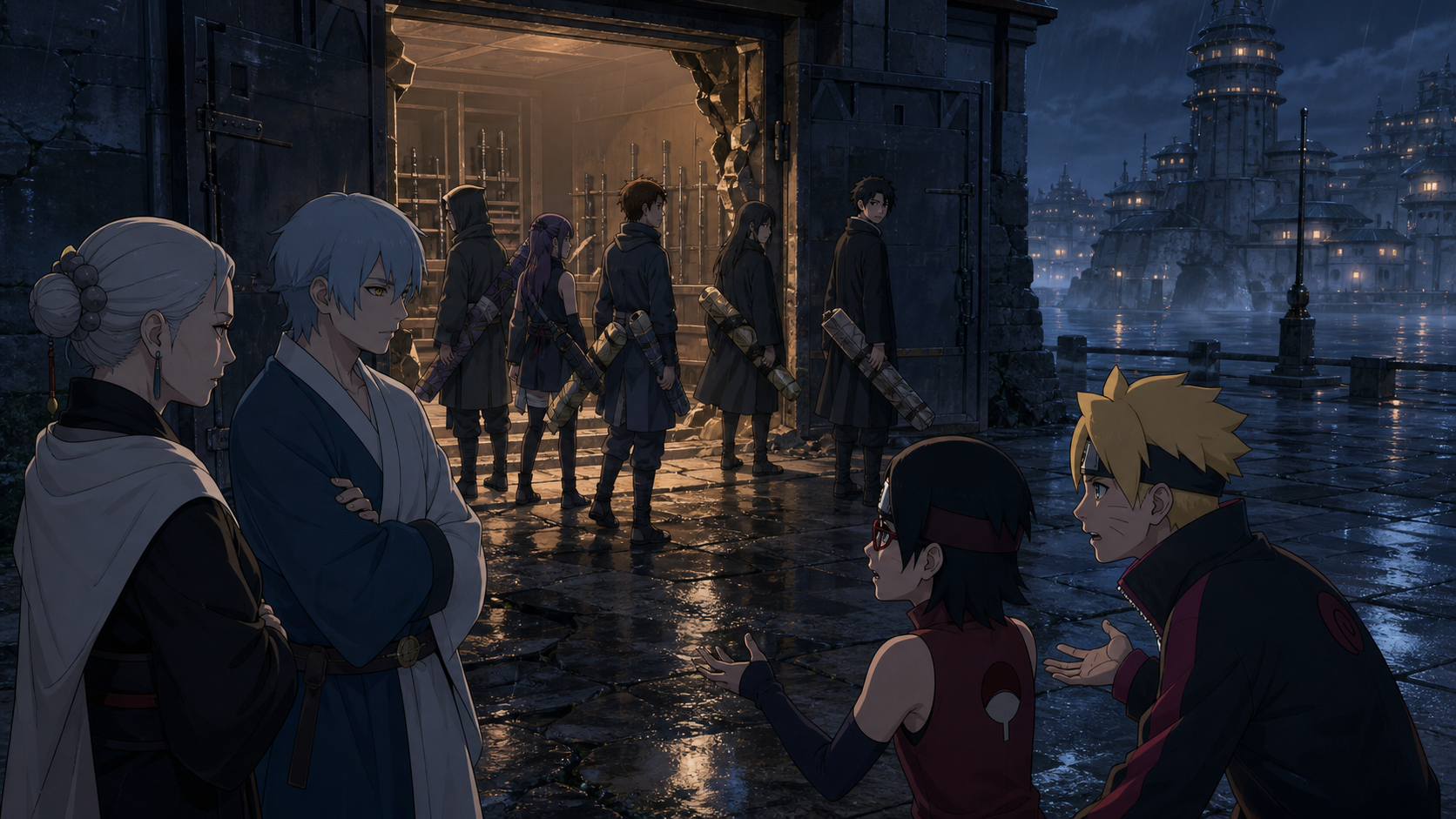
The New Seven Ninja Swordsmen!!
Shizuma steals Kiri’s legendary swords and calls the costume change a revolution, while Boruto, Sarada, and Chōjūrō race to reach Kagura before the performance becomes a war.
Series: Boruto: Naruto Next Generations
Episode: 29 · The New Seven Ninja Swordsmen!!
Arc: School Trip Arc
Release: 2017-10-18
Previous: Episode 28 · A Declaration of War
Directory: All 293 Boruto episodes
Bottom line
Boruto Episode 29 finally lets Shizuma spend the political currency he has been flashing around since the school trip reached the Hidden Mist. He has Kagura, the vault key, six followers, and enough stolen legendary swords to stage a very expensive group photo. He calls the result a revolution. I call the result seven teenagers wearing Kiri’s bloodiest history like borrowed jackets, with only Kagura understanding how much blood those jackets are supposed to carry.
The episode works because the adults refuse to become scenery. Chōjūrō knows Shizuma manipulated Kagura, knows the rebellion could embarrass his administration, and still walks into the fight beside Boruto and Sarada. Mei remembers the Bloody Mist well enough to hear the threat beneath Shizuma’s performance. Suigetsu needs approximately thirty seconds with Mitsuki to expose the entire “new Seven Swordsmen” brand as cosplay without combat experience. The children are brave, but the adults own the historical context.
Then the episode divides the battlefield with purpose. Sarada drops toward Buntan and Kiba. Chōjūrō gets wrapped in Hebiichigo’s wire while three fake legends rush him. Boruto loses sight of Kagura inside the mist. Every pairing asks the same question: does holding a famous sword make somebody worthy of the name attached to the blade? Episode 29 answers with a loud, beautifully disrespectful no.
The sword vault becomes Shizuma’s costume department
Shizuma’s group raids the vault and arms themselves with the Seven Ninja Swordsmen’s weapons. Security puppets activate, which should be the moment everyone realizes this plan has crossed from angry club meeting into treason with props. The group destroys the puppets and treats the victory as proof that history has chosen them.
History has done no such thing. A stolen blade recognizes whoever grips the handle. A vault alarm does not conduct a character assessment before attacking. Shizuma has confused access with inheritance because access photographs better.
Kagura asks the question nobody else wants
Kagura looks at the swords and asks whether stealing weapons can truly create a revolution. Thank you, Kagura. Somebody inside this damp basement needed to notice that a coup requires more than matching accessories.
His doubt also shows that Shizuma has not fully swallowed him. Kagura followed, opened the vault, and accepted Hiramekarei, but his mind keeps testing the story. Shizuma responds by giving him a larger fantasy instead of a better answer.
Shizuma has wealthy people behind the curtain
Shizuma claims supporters connected to the Land of Water’s daimyō oppose Chōjūrō’s moderate government. That detail makes the rebellion more dangerous and more pathetic at the same time. Dangerous, because political money and elite protection can keep a violent movement alive. Pathetic, because Shizuma still needs powerful adults while selling himself as the pure voice of forgotten youth.
The supposed revolution is already sponsored. Somebody should put a tiny disclaimer beneath the blood mist.
Kagura is supposed to become Mizukage
Shizuma tells Kagura that Yagura’s blood should rule Kiri again. This is the trap beneath every other trap. Kagura has spent years fearing that his grandfather’s violence lives inside him, and Shizuma offers to turn that fear into a job qualification.
He does not ask what Kagura wants Kiri to become. He asks Kagura to become a symbol that makes Shizuma’s preferred past look legitimate. Kagura would be the face. Shizuma would remain the voice in his ear.
Acceptance arrives with a throne attached
Shizuma promises Kagura a village that accepts him, but only after Kagura helps destroy the village currently trying to trust him. That is not acceptance. That is emotional extortion with a government title taped on top.
Kagura wants freedom from inherited shame. Shizuma offers inherited power instead. Both choices keep Yagura at the center of Kagura’s identity, which is exactly why the offer feels generous while leaving no room for Kagura himself.
Chōjūrō reads the vault correctly
Chōjūrō and Mei inspect the message left behind and quickly understand how the breach happened. Kagura had the key. Shizuma had access to Kagura’s guilt. The door opened because the emotional lock failed before the metal one.
Chōjūrō does not pretend Kagura had no agency, but he also does not mistake manipulation for ordinary rebellion. His response carries disappointment, fear, and the ugly knowledge that a mentor cannot choose recovery on a student’s behalf.
The gag order protects more than Chōjūrō’s reputation
Chōjūrō suppresses news of the incident and sets a lethal boundary if the group attacks civilians. Secrecy always deserves suspicion in Kiri, especially after a history built on hidden cruelty. Here, the short-term silence also denies Shizuma the public spectacle he wants.
Seven armed kids calling themselves legends need an audience. Chōjūrō refuses to provide one before he reaches them. The danger remains real, but their branding does not get free village-wide distribution.
Boruto arrives ready to argue with a Mizukage
Boruto and Sarada catch up with Chōjūrō and Mei, and Boruto immediately defends Kagura. Kagura joined Shizuma so Boruto would be spared. That choice matters to Boruto because he heard the sacrifice beneath the apparent betrayal.
Boruto does not care that the adults have ranks, policy, or an international incident developing behind their eyes. His friend made one terrible choice while trying to protect him, and Boruto refuses to let that choice become Kagura’s entire identity.
Chōjūrō refuses to erase the consequences
Chōjūrō reminds Boruto that Kagura is a shinobi who understands the rules. The line hurts because Chōjūrō wants Kagura to succeed. Mentorship does not allow him to call a stolen sword and opened vault a misunderstanding.
That refusal gives the rescue emotional weight. Kagura can come home, but home cannot mean pretending nobody was endangered. Boruto has to save a friend who will still face what he did.
Boruto proposes the world’s boldest cover story
Boruto suggests treating the uprising as children getting carried away. Sir, they broke into the legendary sword vault, destroyed security puppets, announced a revolution, and plan to attack the Mizukage. “Kids being kids” is working overtime.
The suggestion is ridiculous, affectionate, and completely Boruto. He reaches for the smallest possible version of the disaster because a smaller disaster leaves Kagura a larger road back.
Mei is not buying the innocent field-trip explanation
Mei objects, naturally. She survived the era these children are romanticizing. She knows the difference between adolescent posturing and weapons capable of making posturing fatal.
Her presence keeps the scene from becoming a simple contest between Boruto’s compassion and Chōjūrō’s authority. Mei carries the memory of what Kiri paid for the symbols Shizuma has stolen.
Boruto threatens diplomacy with a straight face
When kindness does not win immediately, Boruto points to the injury Shizuma gave him and hints that Konoha could treat the matter as a diplomatic incident. Naruto’s son has been in the Hidden Mist for a few days and already discovered international leverage.
The move is shameless. I respect the commitment. Boruto takes the privilege attached to his name and aims every ounce toward Kagura rather than his own comfort.
Chōjūrō joins because friendship needs muscle
Chōjūrō agrees under two conditions: he accompanies them, and the problem gets resolved within a time limit. That is the adult answer the episode needs. Boruto and Sarada bring emotional access. Chōjūrō brings authority, history, and enough strength to stop the rescue from becoming three more hostages.
He does not send troops because an army would turn Shizuma’s fantasy into the civil war he wants. Three people can still reach Kagura before the performance becomes public reality.
Buntan is delighted by the coming violence
Buntan looks forward to the fight while Kagura dreads Boruto’s arrival. Their reactions separate Shizuma’s recruits more clearly than any speech. Buntan wants the legendary battle. Kagura wants nobody else hurt.
Both stand inside the same rebellion, but they are not standing there for the same reason. Shizuma calls them one group because individual motives would weaken his clean little story.
Kagura fears Boruto more than the Mizukage
Boruto’s arrival threatens the version of Kagura that Shizuma has built. Chōjūrō can punish him. Boruto can remind him that another life remains possible.
That is why Kagura dreads the meeting. Fighting an enemy would be easier than looking at a friend who still believes in him after seeing Hiramekarei in his hands.
Denki gets assigned the least convincing alibi
Back at the class lodging, Boruto and Sarada ask Denki to cover their absence during roll call. Denki has the exact face of somebody who knows this excuse will collapse under one follow-up question.
The small scene keeps the school trip alive beneath the coup plot. These children are sneaking out to stop legendary swordsmen and still have to worry about attendance.
Iwabee refuses to stay inside
Iwabee notices Boruto’s absence and starts investigating. His connection to the Mist arc has always been personal because the village’s new image challenges what he learned about strength and peace.
He finds Tsurushi and presses for answers. Iwabee may not know the whole operation, but he knows Boruto does not disappear quietly when a friend is in danger.
Shikadai and Inojin recognize suspicious nonsense
Shikadai and Inojin see enough weird behavior to know something is happening. Shikadai has the curse of being correct whenever everyone else wants a simple day. Inojin follows because friendship in this class often looks like joining the investigation before the explanation arrives.
Their attention matters because Shizuma keeps trying to isolate people. The Konoha students keep noticing missing chairs.
Mitsuki catches Suigetsu following him
Mitsuki confronts Suigetsu, who has been shadowing him and brings instructions to stay out of Kiri’s business. The meeting feels like two different generations of Orochimaru-related chaos comparing notes in an alley.
Suigetsu wants secrecy because his connection to Mitsuki cannot become a diplomatic clue. Mitsuki hears the warning and begins deciding how creatively to ignore the spirit of the order.
Suigetsu destroys the New Seven brand in one conversation
Suigetsu has been away from home, knows the legendary swords, and has lived through actual combat. His opinion of Shizuma’s group is wonderfully unimpressed. They call themselves swordsmen without war experience because the name matters more to them than the work.
Nobody in this episode is better qualified to say the costumes do not fit. Suigetsu once chased those blades with genuine obsession. He recognizes counterfeit swagger on sight.
Mitsuki decides to do whatever Mitsuki wants
Mitsuki accepts Suigetsu’s information and then chooses his own route. This is the quiet joke inside nearly every instruction given to Mitsuki. Adults tell him to avoid involvement. Mitsuki files the sentence somewhere behind his smile and proceeds toward involvement with excellent posture.
Suigetsu hands over a scroll, giving Mitsuki a tool that will matter once Shizuma’s lies need evidence rather than another argument.
Shikadai and Inojin witness the weirdest possible reunion
The boys spy on Mitsuki and Suigetsu until Suigetsu catches them. Any normal classmate would have several questions about why Mitsuki knows a former member of Taka in the Hidden Mist.
There is no time for normal questions. The scene widens the rescue network without turning everyone into one marching squad. Different children gather different pieces of the same crisis.
Shizuma attacks the memorial because symbolism is his favorite weapon
The new swordsmen move against Kiri’s memorial. Destroying remembrance is central to Shizuma’s project because the modern village treats the Bloody Mist as a wound. Shizuma needs the same past recast as glory.
A memorial says people suffered. His revolution says suffering made Kiri strong. The stones have to fall before his sales pitch can stand comfortably.
Boruto interrupts the historical reenactment
Boruto, Sarada, and Chōjūrō arrive before the group can finish. Shizuma finally gets the confrontation he has been staging since he first whispered about Kiri’s weakness.
The visual is delicious: six recruits with stolen legends, Kagura holding Hiramekarei, and the actual Mizukage standing opposite them without needing a dramatic introduction.
Shizuma builds a barrier and congratulates himself
Shizuma raises a barrier and boasts that his mist is superior to Tsurushi’s. Every move comes with commentary because Shizuma cannot merely win. He needs witnesses to understand the brand position.
The barrier blocks reinforcements and divides visibility, which makes tactical sense. The bragging gives away the insecure boy beneath the revolutionary leader costume.
Hebiichigo wraps Chōjūrō in wire
Hebiichigo uses wire to restrain the Mizukage, and the group reads temporary control as proof that Chōjūrō is weak. That assumption will age badly.
Chōjūrō allows them room to speak because he wants to know which grievances belong to the children and which lines came directly from Shizuma. Restraint is not helplessness, especially from somebody who survived the original Seven Swordsmen’s world.
Ichirōta breaks the battlefield beneath Sarada
Ichirōta uses Shibuki to shatter the ground under Sarada, separating her from the others. Buntan follows, eager to test Kiba against the Sharingan.
The split gives Episode 30 its flooded cavern battle, but the setup already tells us why Sarada is the correct opponent. Buntan wants a famous bloodline. Sarada is about to make her earn every assumption.
Hassaku and Kyohō mistake patience for weakness
Hassaku, Hebiichigo, and Kyohō turn their attention toward Chōjūrō. They voice complaints about his peaceful administration and Kagura’s place within the village. Chōjūrō listens more seriously than Shizuma ever does.
That contrast matters. The supposed tyrant accepts criticism while the supposed liberator scripts everyone’s identity. Chōjūrō can admit Kiri still has failures without agreeing that bloodshed is reform.
Ichirōta is the only recruit watching the clock
Ichirōta worries that the others are enjoying themselves while reinforcements get closer. He understands that stolen swords do not erase numbers, logistics, or time.
His concern punctures Shizuma’s grand framing. The New Seven are not an unstoppable historical force. They are a small group inside a barrier, racing a response they cannot survive forever.
Boruto cannot see Kagura through the mist
The episode closes its central tension around visibility. Boruto came because he believes Kagura can still choose differently, but the mist prevents him from seeing Kagura approach with Hiramekarei.
Kagura has become the danger Boruto cannot read. The blade reaches the frame before the conversation, forcing their friendship to pass through combat before either boy can say what he truly came to say.
The swords reveal character instead of granting character
Every weapon in Episode 29 exposes the person holding the handle. Shizuma uses a blade to stage authority. Buntan uses Kiba to chase a legendary fight. Ichirōta sees a tactical deadline. Kagura feels the moral weight of Hiramekarei before he swings.
Chōjūrō needs no stolen symbol because he already earned his place. Suigetsu needs no lecture because he already knows how heavy these names become outside a vault.
Shizuma sells nostalgia to people who never survived the system he romanticizes
Shizuma speaks about the Bloody Mist as if the village lost a glorious age of discipline. The adults around him remember something else: academy students forced to kill classmates, leaders using fear as government, clans hunted, and children shaped into weapons before they could decide what loyalty meant. His revolution depends on turning suffering into branding.
That distortion attracts recruits carrying private injuries. Buntan wants Raiga's blades to recognize a connection her father never gave her. Kagura fears Yagura's blood has already written his future. Ichirōta wants tactical purpose. Hebiichigo, Hassaku, Kyohō, and the others receive famous weapons and a group identity large enough to cover their separate doubts. Shizuma offers each person the same dangerous bargain: surrender your uncertainty, perform the legend, and call the performance destiny.
Mei and Chōjūrō oppose him because reform is not a decorative slogan for them. They inherited a village damaged by policies that treated brutality as strength. Peaceful Kiri remains imperfect, and Shizuma exploits every imperfection as proof that reform was fraudulent. His argument works only if nobody distinguishes unfinished healing from deliberate cruelty.
Boruto's reckless cover story contains a serious diplomatic instinct
Boruto's plan to classify the entire revolt as field-trip nonsense is ridiculous. Seven stolen swords, an attempted coup, and a Mizukage entering battle cannot disappear beneath a teacher's attendance sheet. His proposal still identifies a real danger. If Konoha students officially participate in Kiri's internal conflict, the rescue can become an international incident before anybody reaches Kagura.
He wants to protect Kagura without forcing Naruto and Chōjūrō into a public confrontation. Boruto lacks the authority and patience to design a credible solution, but he understands that political labels change what adults are allowed to do. His threat to handle the matter personally sounds like adolescent arrogance and desperate loyalty at the same time.
Chōjūrō joining the students gives that loyalty adult structure. The Mizukage accepts responsibility for Kiri's security while allowing Boruto and Sarada to reach their friend. Their alliance does not make the mission officially sensible. Their alliance prevents Boruto's emotional certainty from becoming another unsupervised disaster.
Suigetsu punctures the costume because he knows the swords beyond their legend
Suigetsu's brief exchange with Mitsuki destroys Shizuma's branding more efficiently than a historical lecture. Suigetsu has chased the Seven Ninja Swordsmen's weapons, fought beside dangerous people, and carried his own complicated obsession with the title. He recognizes the difference between a sword and the discipline required to survive the sword.
His contempt does not make the old group morally pure. The original swordsmen included killers, opportunists, loyalists, and men shaped by Kiri's worst institutions. Suigetsu's point is narrower and funnier. Stealing the inventory does not inherit the history. Shizuma has assembled props and announced a sequel before proving anybody can carry the role.
Mitsuki takes the useful information and continues his separate investigation because he never accepts the loudest version of a conflict. Boruto focuses on Kagura. Sarada reads the battlefield. Mitsuki looks for the hidden relationship making Shizuma's story possible. The three approaches are already beginning to resemble a team, even before Konoha assigns them one.
Kagura's question reveals that he has not surrendered his judgment completely
Kagura asks what comes after the revolt because some part of him still needs a future beyond the violence. Shizuma answers with status, power, and the promise that Kagura can become Mizukage. The offer sounds like acceptance until the throne appears. Shizuma does not merely want Kagura beside him. He wants Kagura's bloodline and public legitimacy attached to the regime.
That question is Kagura's remaining opening. A person fully committed to Shizuma's fantasy would treat the fight itself as the destination. Kagura wants to know whom the revolution serves and what kind of village follows. Shizuma cannot answer without revealing that Kagura is another instrument.
Boruto reaches for that uncertainty when the mist separates them. He cannot see Kagura clearly, but he keeps talking to the person beneath Hiramekarei. Friendship has not defeated the manipulation yet. Friendship keeps a competing future audible while Kagura decides which story deserves his hands.
Boruto Episode 29 makes history fight the people borrowing history
“The New Seven Ninja Swordsmen!!” is a setup episode with actual teeth. The battles begin, but the sharper conflict concerns who owns Kiri’s past. Shizuma wants the Bloody Mist preserved as a masculine fantasy of strength. Chōjūrō and Mei remember a system that chewed through children. Kagura stands between those stories while holding the sword that can make either future look inevitable.
Boruto does not arrive with a policy solution. Thank goodness. He arrives angry, loyal, reckless, and certain that Kagura is more than Yagura’s blood. Sarada brings steadier judgment. Chōjūrō brings the authority to keep their rescue from becoming another child-led tragedy. Mitsuki works the evidence angle through Suigetsu because of course Mitsuki has a separate plot running behind the plot.
The title calls Shizuma’s group the new Seven Ninja Swordsmen, but the episode spends twenty-three minutes disputing that claim. Famous weapons can be stolen. A violent name can be repeated. History can be edited into propaganda. None of those actions creates the experience, discipline, loyalty, or responsibility that the title once demanded. Shizuma has assembled the silhouette of a legend. Episode 29 begins showing us every empty space inside.
Sources and lawful viewing
Official episode reference: Naruto Official episode guide
Licensed episode route: Crunchyroll licensed series page