
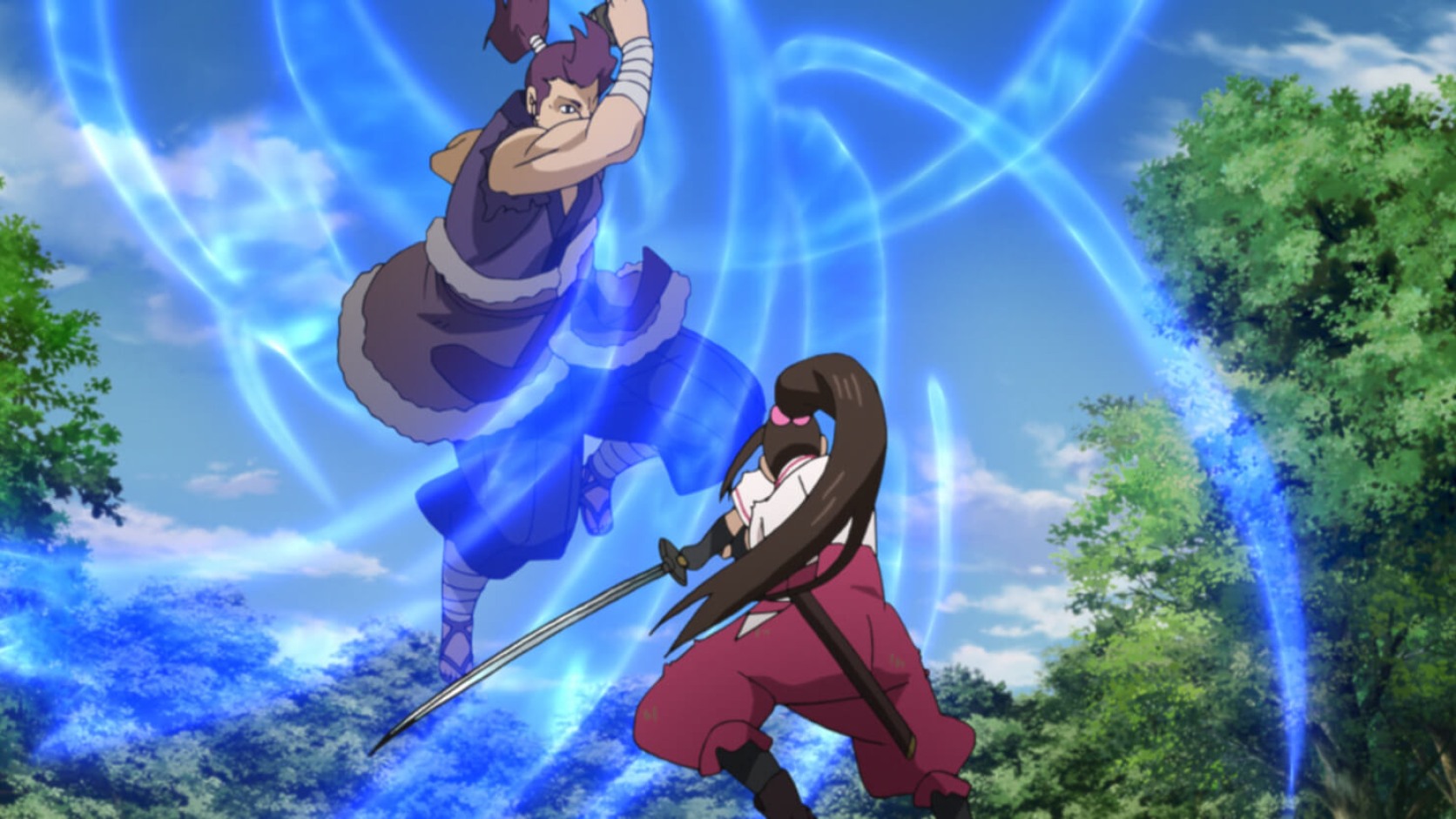
The Rusty Sword
Tsubaki can honor the samurai she once respected without excusing the man who attacked merchants; accountability and rehabilitation both require more than a duel.
Series: Boruto: Naruto Next Generations
Episode: 231 · The Rusty Sword
Arc: Chunin Re-Examination
Release: January 9, 2022
Previous: Episode 230 · A Wish
Directory: All 293 Boruto episodes
Bottom line
Boruto Episode 231 gives Tsubaki a painful reunion with Sazanka, the fellow samurai she once respected, and asks what happens when talent loses direction. His sword may be rusty, but the deeper corrosion started long before the blade. Pride, isolation, resentment, and the refusal to accept help turned a gifted student into a man willing to attack merchants for survival.
Tsubaki does not owe him silence because they share a homeland or history. She does owe him the dignity of being treated as a whole person instead of a fallen-samurai cautionary tale. Accountability must protect the people he harmed, preserve evidence, and leave room for rehabilitation. That balance is harder than a clean duel, which is exactly why this episode matters.
The episode at a glance
- Series: Boruto: Naruto Next Generations
- Episode: 231
- Title: The Rusty Sword
- Arc: Chunin Re-Examination
- Original release: January 9, 2022
- RaeRae rating: Four bowls of ramen out of five
- Core question: Can Tsubaki hold Sazanka accountable without pretending his worst choices erase the person she once knew?
The opening crime is not romantic
Traveling merchants are attacked and robbed. Their fear and material loss cannot become background decoration for a story about samurai honor. Trade routes connect ordinary families to food, tools, medicine, and income. Repeated attacks can make an entire region less safe even when nobody dies during one particular robbery.
Team 15 needs to begin with the harmed people. Names, injuries, stolen property, witness statements, route conditions, and immediate needs should shape the investigation. The mystery surrounding an unusual sword technique may attract shinobi attention, but public safety remains the mission.
Team 15 deserves a real investigation
Wasabi, Namida, and Tsubaki receive more than a combat assignment. They must gather facts, test assumptions, and decide when a clue justifies changing their approach. Those skills rarely receive the same applause as a flashy jutsu, though poor investigation can send young shinobi after the wrong person.
The team should document what each witness actually observed instead of allowing one confident theory to harden into truth. Weapon marks, travel times, stolen goods, likely escape routes, and patterns across earlier attacks can narrow the field without treating rumor as proof.
Tsubaki recognizes more than a technique
The evidence points toward a style connected to the Land of Iron and someone from Tsubaki's past. Recognition carries emotional weight because swordsmanship represents training, identity, discipline, and belonging for her. A familiar technique used against civilians feels like a personal violation even before she confirms the attacker.
That reaction makes sense. Tsubaki still needs space to separate memory from evidence. She may know how Sazanka moved years ago, but people change, injuries alter technique, and imitation exists. Her knowledge should guide the inquiry without becoming the entire case.
Sazanka was once worthy of respect
Tsubaki remembers a talented fellow apprentice, not a cartoon villain waiting to reveal his true nature. That history matters because communities often simplify a person after serious wrongdoing. Former accomplishments become embarrassing, kindness becomes fake, and every earlier relationship gets rewritten as foolish.
Sazanka's later violence does not prove that Tsubaki imagined his skill or that respect made her naive. People can possess discipline in one area while failing elsewhere. They can also deteriorate under pressure, rejection, injury, shame, or isolation. Accurate memory supports accountability better than a convenient lie.
Admiration can make danger harder to name
Tsubaki trembles when she realizes who may stand behind the attacks. Her body responds before a polished explanation arrives. That fear does not make her weak or disloyal. A trusted peer becoming dangerous can fracture the basic assumptions that once made training feel safe.
Young people often struggle to report harm involving someone admired by teachers or respected by a community. Adults must create procedures that do not demand emotional certainty before protection begins. Tsubaki should be allowed to say what she knows, what she suspects, and what she cannot yet process.
Tradition does not guarantee moral character
Samurai discipline can teach patience, control, responsibility, and respect for craft. None of those values automatically prevent cruelty. Institutions become dangerous when they treat membership as proof of virtue and misconduct as an impossible contradiction.
Sazanka's sword training gave him capacity. His choices determine how he used that capacity. The Land of Iron should not defend its reputation by minimizing the attacks, nor should Konoha turn one offender into evidence that samurai culture failed completely. Honest review can protect tradition from becoming public relations armor.
The rusty sword is evidence, not destiny
The title invites judgment. Rust suggests neglect, decline, exposure, and lost care. A damaged blade may show hardship or abandonment, but metal condition cannot diagnose a person's character. Poverty does not create guilt, and a polished weapon does not create honor.
Investigators should ask how Sazanka obtained supplies, where he slept, whether anyone exploited his skills, and why lawful support failed to reach him. Those questions do not excuse robbery. They explain conditions that may need repair if officials want the attacks to stop rather than merely move elsewhere.
Maintenance is part of survival
A sword requires cleaning, oil, storage, inspection, and repair. Those ordinary tasks reveal the resources behind celebrated mastery. Training stories love the final strike and often ignore who provides food, shelter, medical care, equipment, and time to practice.
Sazanka's decline may include personal neglect, but institutions should examine what happened after he left formal training. Did mentors follow up? Could he seek work without surrendering dignity? Was there a route back after failure? A culture that praises excellence without supporting ordinary survival creates predictable cracks.
Talent can become a trap
Gifted students often receive attention for what they can produce rather than care for who they are. When performance falls, praise disappears and shame fills the gap. A young person taught to equate worth with mastery may treat help as humiliation.
Sazanka remains responsible for attacking merchants. His talent still shaped the road toward that violence. If every setback felt like public erasure, resentment may have become easier than admitting need. Teachers should prepare students for plateaus, injury, defeat, career change, and lives beyond exceptional performance.
Tsubaki is not responsible for saving him alone
Shared training does not make Tsubaki Sazanka's counselor, supervisor, guarantor, or final chance. She can care about his future while refusing private responsibility for his recovery. The adults around both samurai should carry most of that work.
Stories sometimes hand a young woman the emotional repair of a troubled man because she once admired him. No. Tsubaki may offer testimony, boundaries, or a conversation if she chooses. Rehabilitation requires trained professionals, material support, accountability, and Sazanka's participation. Friendship cannot replace a system.
Wasabi should not be reduced to backup
Wasabi brings quick judgment, protective instinct, and a willingness to challenge assumptions. Her role matters when Tsubaki's history narrows attention. A teammate can notice present danger while the person closest to the suspect remains caught between memory and evidence.
Good teamwork does not mean silent agreement. Wasabi should be able to question the plan without treating Tsubaki as compromised. She also needs enough information to protect herself and Namida. Withholding key facts in the name of privacy can expose the whole team to a technique they do not understand.
Namida's fear is operational information
Namida often expresses fear more visibly than teammates do. That response can reveal risk that everyone else is trying to suppress. Fear becomes useful when a team names the threat, adjusts distance, checks exits, and requests support.
Mocking fear encourages concealment. Concealed fear can produce freezing, rushing, or poor communication at the worst time. Namida deserves preparation for close combat against a skilled swordsman and permission to say when the plan exceeds the team's safe capacity. Courage includes accurate reporting before danger becomes spectacle.
Team 15 needs adult backup
Three young shinobi confronting an experienced armed attacker should not be treated as routine merely because Tsubaki also carries a sword. Familiarity can increase risk. She may hesitate, overcommit, or attempt a private resolution because shared history creates pressure.
An adult supervisor should establish a containment plan, medical support, arrest authority, and conditions for withdrawal. The team can still demonstrate skill within that structure. Youth development should never depend on adults disappearing until the children prove themselves through preventable danger.
The merchants deserve more than recovered goods
Returning stolen property addresses only part of the harm. Victims may face injuries, missed deliveries, damaged businesses, frightened workers, or future travel costs. Officials should ask what recovery means to them instead of assuming the case closes when the attacker is caught.
Restitution may include compensation, route protection, replacement goods, medical care, and accurate public information. Sazanka can contribute later if rehabilitation makes that safe and meaningful. The burden should not fall on victims to supervise the person who harmed them.
Evidence must survive the duel
A dramatic fight can destroy the scene investigators need. Weapon marks, stolen property, clothing fibers, routes, communications, and witness details may connect Sazanka to other attacks or reveal additional participants. Team 15 should preserve evidence once immediate danger ends.
Tsubaki's recognition cannot be the only foundation for prosecution. Independent evidence protects victims, supports a truthful record, and prevents the entire case from becoming a contest between two personal stories. Strong evidence also protects Sazanka from exaggerated claims unrelated to his actual conduct.
Arrest should not become revenge
Sazanka uses lethal skill against people and resists capture. Team 15 may need force to stop him. Necessary force still has limits. Once he can no longer threaten anyone, punishment belongs to a lawful process rather than the emotional momentum of combat.
Tsubaki may feel anger, grief, humiliation, or betrayal. None of those feelings makes her cruel. Commanders should remove the burden of deciding his immediate fate while adrenaline remains high. Medical assessment, safe restraint, and documented transfer protect everyone involved.
Defeat does not automatically produce insight
Losing to Tsubaki may break Sazanka's certainty, but a stronger sword cannot teach every lesson he avoided. People do not become accountable simply because someone overpowers them. Shame can harden into resentment when nobody helps the person examine choices and consequences.
Rehabilitation should require acknowledgment of harm, participation in repair where appropriate, and sustained behavior change. Counseling, work, education, and community supervision may support that process. A single emotional conversation can begin reflection. A single conversation cannot prove transformation.
The Land of Iron must stay involved
Because Sazanka's background and technique come from the Land of Iron, coordination matters. Officials there may hold training records, family contacts, disciplinary history, or support options. Konoha should not treat him as an exotic outsider whose culture explains the crime.
Jurisdiction needs clear agreements. Victims deserve continuity rather than agencies arguing over custody. Sazanka deserves notice of charges, access to representation, and a process that respects his origin without granting special immunity. Cooperation should serve truth and safety, not institutional pride.
Konoha must avoid cultural theater
The village may be tempted to frame the case as shinobi practicality defeating outdated samurai pride. That story would flatter Konoha and teach nothing. Shinobi institutions have their own record of neglected children, weaponized talent, secrecy, and violence.
Tsubaki's presence should deepen mutual understanding, not become proof that assimilation solved her problems. She can value Konoha friendships and remain connected to samurai identity. The case should examine Sazanka's choices without asking her to publicly reject her homeland for acceptance.
Belonging cannot depend on cultural rejection
Tsubaki lives and trains with Team 15, but she should not have to perform disgust toward Sazanka or samurai tradition to prove loyalty. Complex grief may include affection for earlier memories, anger at his conduct, and concern about what happens next.
Wasabi and Namida can support her without demanding a simple emotional script. Team belonging becomes credible when difference survives conflict. If Konoha only accepts Tsubaki after she denounces every connection to the Land of Iron, the village offers conditional assimilation rather than friendship.
A familiar opponent changes combat
Tsubaki may know Sazanka's habits, reach, timing, and preferred forms. He may know hers too. That mutual knowledge creates tactical advantage and emotional risk. Each fighter may anticipate movements learned beside the other, turning memory into a weapon.
The team should not assume Tsubaki has an easy advantage because she trained with him. Familiarity can freeze decision-making or encourage a dangerous need to prove who understood the tradition correctly. Shared history calls for stronger planning, not less support.
Sword safety needs more than skill
Weapons training should include storage, maintenance, transport, de-escalation, consent, and legal limits. Technical mastery without ethical practice produces capable harm. Schools must evaluate conduct across ordinary days, not only tournament performance.
Instructors also need reporting routes for students showing isolation, threats, fixation, or sudden material decline. Early support should avoid treating distress as guilt. The goal is to offer help before danger grows while preserving fair boundaries for everyone sharing the training space.
Pride can hide material need
Sazanka may have refused help because accepting support felt incompatible with the identity he built. Pride is not a magical cause. Pride grows inside social rules about worth, failure, masculinity, rank, and who deserves care.
Officials should examine whether available aid required public humiliation, obedience, or proof of total collapse. A person can make terrible choices and still expose a badly designed safety net. Services work better when people can ask early, retain dignity, and receive practical options before crisis.
Poverty is not a character flaw
A rusty blade and worn circumstances can invite lazy moral symbolism. Plenty of poor people protect neighbors, share resources, and refuse violence. Plenty of wealthy people cause enormous harm behind polished appearances.
Sazanka's financial or social decline may help explain pressure, but robbery remains a choice affecting other people who may also struggle. Fair analysis avoids both contempt and romanticization. Material assistance should reduce desperation while legal accountability addresses the decisions he made under that pressure.
The episode should not worship the better blade
Tsubaki's maintained weapon may represent discipline and support. Sazanka's rust may represent neglect. The difference does not prove that the person with better equipment has a purer heart. Access shapes condition.
The meaningful contrast lies in how each samurai responds to relationship and responsibility. Tsubaki accepts teammates, questions herself, and acts to protect strangers. Sazanka isolates himself and directs skill toward vulnerable travelers. Ethics appear through choices, not shine.
Tsubaki can mourn without excusing him
She may grieve the person Sazanka was, the future he lost, and the trust his actions damaged. Grief does not require minimizing victim harm. Anger does not require pretending every earlier memory was false.
Adults should let Tsubaki hold those truths without forcing a quick verdict about forgiveness. She can hope he changes while maintaining distance. She can refuse contact now and reconsider later. Boundaries remain valid even if Sazanka enters a genuine rehabilitation program.
Forgiveness belongs to the harmed people
Tsubaki can decide what forgiveness means for their personal history. She cannot forgive attacks committed against merchants on their behalf. Public stories often allow a friend or rival to grant emotional absolution while victims disappear.
The merchants retain their own voices. Some may want restitution, some may want distance, and some may never feel safe around Sazanka again. Rehabilitation does not require victims to offer access or comfort. Change belongs to the offender; forgiveness remains a choice for each harmed person.
Restorative justice needs consent
A restorative process could help if victims freely choose participation and trained facilitators manage safety. Sazanka would need to hear concrete consequences, answer questions honestly, and contribute to repair without demanding emotional reward.
Nobody should pressure merchants to participate because reconciliation makes a more inspiring ending. Traditional legal safeguards remain necessary, especially where violence and weapons created fear. Restorative work can complement accountability. Restorative language must never become a shortcut around consequences.
Rehabilitation needs a life to return to
Telling Sazanka to choose better means little without lawful ways to survive. A credible plan could include secure housing, medical assessment, counseling, monitored employment, equipment rules, and a mentor who does not confuse discipline with humiliation.
Work involving weapons may require restrictions until sustained progress appears. Other skills from samurai training, including observation, maintenance, physical conditioning, teaching fundamentals, or logistics, could support a different path. Rehabilitation becomes real through ordinary structure across time.
The teachers need to review their part
Mentors may not have caused Sazanka's crimes, but they should examine warning signs, competition culture, support after failure, and how students learned to interpret worth. A review should seek improvement rather than one convenient adult scapegoat.
Teachers also owe Tsubaki support. Discovering a former peer in crisis can destabilize her relationship with training itself. A trusted mentor should discuss technique, ethics, grief, and boundaries without turning her into a public example of the correct samurai.
Team 15 needs a protected debrief
After the confrontation, Wasabi, Namida, and Tsubaki need medical checks and separate factual interviews. Separate accounts reduce accidental coordination and allow each teammate to describe what she saw. Officials should explain how statements will be used.
The emotional debrief should remain distinct from discipline or grading. If students believe honesty will cost status, they may hide fear, mistakes, or uncertainty. Supervisors need the full picture to improve future missions. Care and accurate evidence support one another.
Tsubaki should not be graded on composure
Her voice may shake. She may cry later, become quiet, or focus intensely on cleaning her sword. None of those reactions determines professional fitness. Composure during one crisis can reflect training, shock, or habit rather than wellness.
Evaluation should focus on communication, threat assessment, protection of civilians, teamwork, proportional force, and willingness to review decisions. Emotional expression belongs outside simplistic pass-or-fail judgments. A disciplined person still deserves care.
Wasabi and Namida may need repair too
They could feel frightened by what Tsubaki did not initially explain, helpless during a personal confrontation, or guilty for doubting her. Friendship does not erase those reactions. A good team names tension before resentment settles in.
Tsubaki can share what feels safe without disclosing every memory. Wasabi and Namida can state what operational information they needed. An adult facilitator may help them rebuild procedures for personal conflicts, sensitive intelligence, and withdrawal signals on future missions.
A report should name system failures
The mission report should cover more than successful capture. Officials need the pattern of attacks, route vulnerabilities, victim losses, intelligence gaps, cross-border coordination, and the risks created by assigning young shinobi to an armed suspect.
Recommendations should have owners and dates. Extra patrols may offer short-term protection, while safer trade routes, communication points, emergency signals, and merchant support address broader risk. Reports matter only when somebody tracks whether promised changes happen.
Merchant routes are public infrastructure
Konoha may treat roads as background until bandits interrupt a mission. Residents experience those routes as access to work, care, family, and supplies. Safety planning should include the people who travel them every day.
Merchants can identify dangerous stretches, seasonal changes, common delays, and practical warning systems. Their knowledge should shape policy rather than appear only as witness testimony after harm. Public investment can reduce dependence on armed escorts for every ordinary journey.
Security should not become surveillance
Officials may respond with checkpoints, searches, or constant monitoring. Those measures can burden the same merchants the policy claims to protect. Security needs evidence, limits, review dates, and accessible complaint routes.
Targeted lighting, communication stations, coordinated patrols, road maintenance, and rapid response may improve safety without treating every traveler as a suspect. Community trust produces better reporting than intimidation. Fear of robbery should not become an excuse for permanent control.
Sazanka's name should not become a slur
Communities sometimes use one offender as shorthand for every struggling student, outsider, or former trainee. That reaction spreads stigma and makes early help harder to seek. Officials should discuss conduct precisely: armed robbery, assault, threats, and resistance.
Precision protects victims because clear language records what happened. Precision also protects unrelated people from collective blame. Tsubaki should not face suspicion simply because she shares training traditions with Sazanka. The Land of Iron should not be reduced to his worst acts.
Public information needs restraint
Residents deserve accurate safety information, known routes, and updates about the investigation. They do not need sensational details about Tsubaki's private history or dramatic footage of the duel. Public spectacle can retraumatize victims and turn Sazanka into entertainment.
A designated official should correct rumors, protect identifying details where needed, and explain what support is available. Transparency means telling the truth about institutional decisions, not distributing every personal detail for curiosity.
The sword can be preserved without glorification
If Sazanka's rusty weapon becomes evidence, authorities should document and store the blade securely. Later decisions about return, disposal, or cultural handling should involve lawful procedure and Land of Iron consultation.
The sword should not become a trophy for Team 15 or a dramatic display stripped of victim context. Objects tied to harm can teach history only when interpretation names consequences and avoids worshiping the person who wielded them.
Tsubaki's future should remain open
This encounter may change how she understands home, competition, friendship, and her own ambitions. The episode should not lock her into permanent responsibility for preventing every samurai from falling. She deserves goals beyond repairing Sazanka's choices.
Team 15 can help her return to ordinary life through training, meals, jokes, missions, and quiet company. Recovery does not need to become a public speech. Predictable friendship may matter more than one perfect conversation.
The episode gets the emotional recognition right
The strongest choice centers Tsubaki's immediate recognition and unease. A familiar face can create more fear than an unknown attacker because memory keeps insisting that safety once existed. Her response gives the conflict weight beyond technique.
The episode also lets Wasabi and Namida witness a part of Tsubaki's life that Konoha training alone could not explain. That knowledge can deepen friendship if they treat her history with respect rather than curiosity or suspicion.
The episode needs more institutional follow-through
The story moves efficiently from clue to confrontation, which leaves adult systems at the edges. Viewers need more than arrest and personal resolution. Victim recovery, mission review, Land of Iron coordination, and rehabilitation determine whether the same conditions return.
Boruto often understands growth through individual courage. Episode 231 works best when courage becomes the beginning of collective responsibility. Tsubaki can stop immediate harm. Adults must build what comes after.
RaeRae verdict
Boruto Episode 231 earns four bowls of ramen out of five. Tsubaki's conflict lands because admiration, fear, anger, and responsibility occupy the same space. She does not defeat a stranger. She confronts a person connected to her training and refuses to let shared history excuse present harm.
The rusty sword should not become a cheap label for a ruined man. Sazanka made serious choices that endangered merchants and his former friend. Accountability must be real. So must the question of how a talented student reached isolation, desperation, and violence without an effective route back. Konoha and the Land of Iron owe answers larger than a duel.
Before the next episode
Episode 232, “Captain Denki's First Mission,” shifts toward leadership, technical knowledge, and the pressure placed on a new captain. Watch how adults define success when young shinobi must protect people, manage uncertainty, and make decisions outside a classroom.
Denki's title should bring support, not an invitation for adults to disappear. Leadership develops through practice, feedback, honest limits, and backup that arrives before tragedy.
Sources and lawful viewing
The official Naruto site provides the Episode 231 synopsis and gallery. Crunchyroll carries “The Rusty Sword” where regional availability permits. Release and streaming details can vary by country.
Official episode reference: Naruto Official episode guide
Licensed episode route: Crunchyroll licensed series page
After watching, ask whether Sazanka received a future beyond punishment and whether the merchants received support beyond recovered property. Tsubaki winning the fight cannot finish either responsibility.