
The Night Before the Final Round
The finalists receive one day to prepare, but training is only part of the work when pressure, unequal access, health, and a revised tool rule enter the arena first.
Series: Boruto: Naruto Next Generations
Episode: 222 · The Night Before the Final Round
Arc: Chunin Re-Examination
Release: October 31, 2021
Previous: Episode 221 · The Chunin Exams Resume
Directory: All 293 Boruto episodes
Bottom line
Boruto Episode 222 gives the finalists one day to rest and train before individual matches decide promotion. That sounds generous until every teenager starts calculating how much improvement can fit inside twenty-four hours. The night becomes a pressure chamber full of pride, nerves, family expectation, teammate loyalty, old embarrassment, and the quiet fear that somebody else’s visible strength proves your own growth does not count.
The revised rules allow Scientific Ninja Tools created by the candidate. Good. Technology was never the moral failure in Boruto’s first Chunin Exam. Deception was. He used a prohibited device, hid the assistance, and claimed output that did not reflect his demonstrated skill. A transparent rule can reward engineering, accessibility, and tactical judgment without pretending every tool creates the same advantage. Konoha needs disclosure, inspection, safety standards, and equal access, or “innovation” will become a prettier word for whoever can afford better equipment.
The title lives inside anticipation
“The Night Before the Final Round” pauses between qualification and performance. Nothing has been won, and every possibility feels louder.
Preparation reveals character because nobody can hide behind the result yet.
One day is rest and pressure
The schedule gives finalists time to recover, study, and prepare. The same deadline can encourage panic training.
Adults should say clearly that sleep matters more than one desperate new technique.
Rest is part of performance
Muscles, chakra, attention, and judgment need recovery after the forest round. Exhaustion increases injury and poor choices.
Professional discipline includes stopping.
Teenagers may not believe adults about rest
Shinobi stories praise training past limits and winning through pain. One lecture cannot erase that culture.
Coaches should model boundaries rather than celebrate collapse later.
Team 7 faces individual competition
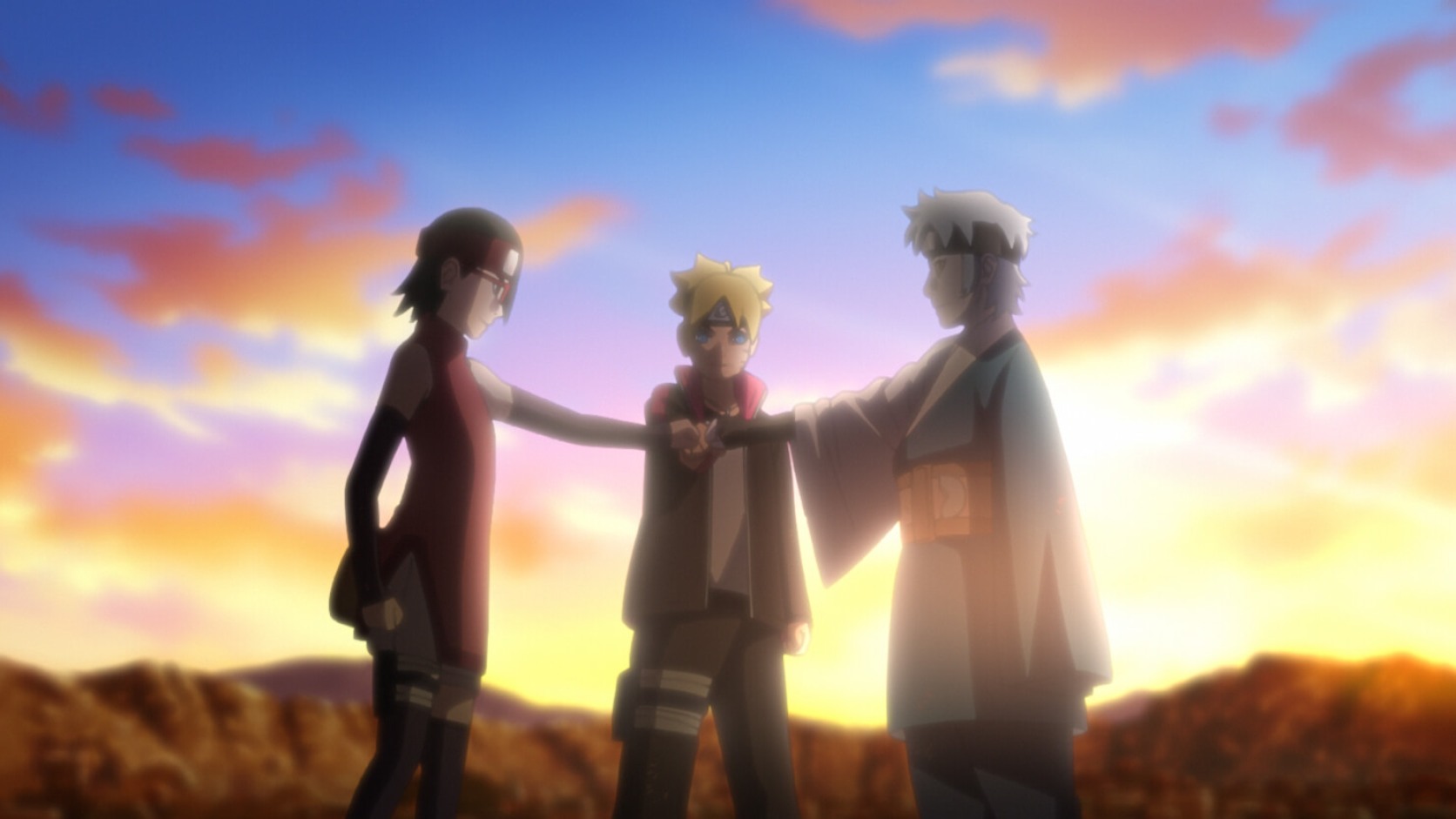
Boruto, Sarada, and Mitsuki support one another while knowing only individual matches determine promotion. Friendship and ambition share the same night.
Competition does not require emotional distance.
The hand stack matters
Team 7’s gesture confirms that personal advancement does not erase collective history. They arrived through missions completed together.
Rank may separate roles without ending relationship.
Sarada has wanted command for a reason
She aims toward the Hokage position and has already practiced leadership under danger. The final offers formal recognition.
One match still cannot contain her entire record.
Boruto wants honest redemption
His previous exam ended in public disqualification after hidden tool use. Returning under clear rules gives him a chance to compete without deception.
Redemption should measure growth rather than demand a flawless spectacle.
Mitsuki chooses participation for himself
His attachment to Boruto once shaped many decisions. The exam offers another chance to test desire beyond following someone else.
Autonomy can include friendship without becoming dependence.
The finalists represent wider growth
Students who never reached the earlier final now stand ready. Their progress did not wait for the main cast’s attention.
The village’s future needs an ensemble.
Inojin brings communication power
Mind techniques, sensory support, and artistic jutsu can serve a team beyond direct damage. A one-on-one match may reward only part of that value.
Promotion decisions should include mission evidence.
Houki brings unknown experience
His team has worked with the Anbu, creating skills and habits classmates may not recognize. Mystery can create intimidation.
Secrecy should not become automatic proof of superiority.
Wasabi carries speed and responsibility
Fast movement can control a match, rescue someone, or create reckless overextension. Leadership depends on when speed serves the goal.
Performance should reveal judgment, not only pace.
Iwabe carries physical confidence
Earth Release and strength make his abilities visible. Earlier academic insecurity shaped how others saw him.
One kind of competence should not erase another.
Cho-Cho deserves serious preparation
Her confidence often becomes comedy for people around her. Confidence can be real and still sit beside nerves.
The exam should treat her ambition as professional rather than a punchline.
Denki brings engineering into the rules
Allowing self-created tools makes his technical skill directly relevant. That recognition is overdue.
Technology should expand what counts as shinobi competence.
Tsubaki brings samurai discipline
Her training tradition differs from Konoha’s, which gives the final a wider idea of professional skill.
Fair rules should not demand cultural sameness.
Scientific tools are not cheating
A tool can amplify skill, compensate for disability, gather data, protect teammates, or create new tactics. Ethical judgment depends on rules and representation.
Objects do not commit fraud. People make claims.
Boruto’s old violation was deception
He used a prohibited device and let observers believe the techniques came from his own demonstrated capacity. The lie undermined assessment.
Naming the actual breach allows policy to evolve without hypocrisy.
Rule changes should acknowledge history
Konoha should explain why candidate-created tools are now allowed and how the standard differs from the earlier exam. Silence invites confusion.
Institutional learning deserves public language.
Candidate-created needs a definition
Did the finalist design, build, code, modify, or merely assemble the tool? How much help can teachers or family provide?
Vague authorship rules favor students with hidden resources.
Disclosure should be mandatory
Candidates need to declare each device, function, limitation, and outside contributor before the match. Proctors can verify compliance.
Transparency turns tools into assessed choices rather than concealed advantages.
Safety inspection matters
A prototype can malfunction, injure spectators, expose data, or create effects the candidate cannot stop. Technical creativity needs review.
Innovation does not excuse preventable harm.
Equal access matters
Students from wealthy families, research divisions, or technical clans may access better materials and mentors. Self-created does not mean independently resourced.
Konoha should provide common workshops, components, and instruction.
Accessibility tools need protection
A device used for mobility, communication, sensory access, or medical safety should not consume the same competitive allowance as an optional weapon.
Accommodation is not advantage.
Denki should not need to become a fighter stereotype
His engineering can make him a capable shinobi without imitating Iwabe’s physical style. The revised rule opens that possibility.
Promotion should reward the leader he can become.
Tool failure should test response
A candidate who adapts safely after malfunction may demonstrate stronger judgment than someone whose device works perfectly.
Assessment should include contingency planning.
Cybersecurity belongs in ninja tools
Connected or programmable devices can leak information, receive interference, or be hijacked. Candidates need basic security standards.
A tool becomes a liability when opponents control its instructions.
Data privacy belongs in the rules
Sensors may collect biometric, location, or tactical data about candidates and spectators. Collection should be limited and disclosed.
Competition does not erase privacy.
Ownership of inventions needs clarity
The village should not claim a teenager’s design automatically because the device appeared in an official exam. Credit and future use require consent.
Talent development should not become extraction.
Commercial pressure could follow success
A standout device may attract companies, researchers, or military offices. Young inventors need guidance and protection from exploitative agreements.
Promotion should not open a sales floor around them.
Family resources shape preparation
Some finalists train with experienced shinobi relatives, private space, clan techniques, or specialized equipment. Others rely on public facilities.
Merit never grows in a vacuum.
The exam should see structural advantage
Acknowledging unequal resources does not erase individual effort. Honest evaluation considers access and opportunity.
Fairness needs more than identical rules on paper.
Parents can encourage without directing
Family advice may steady a finalist. Family ambition can also take over the child’s goal.
The candidate should own the decision to compete and how to prepare.
Clan reputation creates extra weight
Sarada, Inojin, Cho-Cho, and others carry famous family names. Public expectation can make one match feel like judgment on a lineage.
Children are not clan report cards.
Non-clan candidates carry another burden
Students without inherited techniques may believe every mistake confirms they do not belong. Engineering or original tactics can widen opportunity.
Institutions should value created skill alongside inherited power.
The night invites comparison
Finalists study opponents, imagine brackets, and measure visible strengths. Comparison can guide strategy and damage confidence.
Coaches should separate useful analysis from self-erasure.
Film study needs ethical boundaries
Reviewing public match footage differs from accessing private medical data or classified mission records. Preparation should respect information rules.
Winning does not justify every method.
Anbu experience needs careful disclosure
Houki’s team may have classified techniques or missions. Proctors need enough knowledge to assess safety without exposing operational secrets.
Secrecy and fairness need a documented boundary.
Finalists should know match rules early
Victory conditions, prohibited conduct, time limits, ring boundaries, tool rules, and medical stoppage need clear communication.
Surprise belongs in opponents, not basic governance.
Referees need stopping authority
Young competitors may continue through concussion, chakra collapse, or panic because quitting feels shameful. Officials must protect them.
Safety decisions should not depend on a child admitting defeat.
Medical teams need candidate profiles
Relevant allergies, conditions, medications, prior injuries, and emergency contacts should be available confidentially.
Preparation includes care before the first strike.
Boruto’s medication needs privacy
He may require scheduled dosing or monitoring around the final. Staff should arrange support without announcing his condition.
Medical accommodation cannot become gossip.
Karma needs an emergency protocol
Stress and chakra use may affect Boruto’s condition. Proctors need warning signs, evacuation rules, and nonlethal response.
The crowd should not become an unplanned containment zone.
Participation does not prove zero risk
Medical clearance means risk is managed enough for the event, not that Momoshiki disappeared. Everyone involved should understand the distinction.
Confidence should remain evidence-based.
Boruto can compete without becoming a symbol
The village may frame his participation as proof that Konoha recovered. That story can pressure him to hide symptoms.
He is a candidate, not a morale poster.
Sarada may feel responsible for Team 7’s image
As an aspiring leader, she may believe she must represent the team perfectly. That pressure can narrow judgment.
Leadership includes accepting imperfection.
Mitsuki may understate his power
Concerns about revealing abilities or harming opponents can affect his preparation. Clear rules help him choose safely.
Restraint should receive credit rather than suspicion.
Teammates should not share private strategies without consent
Friendship gives Team 7 deep knowledge of one another’s habits. Individual competition changes how that knowledge gets used.
Trust deserves boundaries.
Helping a teammate train can still be fair
Shared practice develops both people and reflects real shinobi collaboration. Assistance does not become cheating merely because opponents prepare alone.
The rules should define prohibited coaching clearly.
Rivalry can strengthen respect
Preparing seriously for a friend treats that person as capable. Holding back from pity can feel insulting.
Respect also means stopping when injury crosses the line.
Winning is not the only useful outcome
A finalist can demonstrate judgment, adaptation, communication, and restraint in defeat. Proctors should assess the whole performance.
Promotion should not become a bracket prize automatically.
Losing should not erase qualification
Reaching the final already reflects skill. A bad matchup or one mistake cannot define a career.
Feedback should preserve the path forward.
The final round needs transparent scoring
If match victory and promotion differ, candidates deserve to know how leadership qualities influence the result.
Secret criteria create resentment even when evaluators mean well.
Appeals protect legitimacy
Tool rulings, safety stoppages, or scoring errors may need review. A limited process supports trust.
Authority should remain correctable.
Spectators need safety information
Crowds should know exits, medical locations, prohibited areas, and emergency signals. Recent invasion makes complacency reckless.
An exciting event can still be prepared.
Security should not criminalize the crowd
Code remains a threat, but aggressive screening can make residents feel suspected during a morale event. Measures should be proportional and accessible.
Safety works best when people understand the purpose.
The venue needs technology safeguards
Candidate devices, broadcast equipment, barriers, and communications may interfere with one another. Testing reduces surprises.
Technical coordination belongs behind the spectacle.
The night should include ordinary food
Finalists need meals, hydration, and sleep more than another motivational lecture. Bodies carry ambition.
Care can look wonderfully boring.
Anxiety deserves support
Nerves before public combat are normal. Breathing support, private space, trusted adults, and clear schedules can help.
Telling teenagers to toughen up wastes energy.
Confidence does not need performance
Cho-Cho may joke, Boruto may act casual, and others may go quiet. Each person manages pressure differently.
Adults should look beyond presentation.
The night belongs to non-finalists too
Students who failed earlier stages may feel disappointment while supporting friends. Their development continues.
The village should offer feedback and future opportunities rather than abandoning them outside the spotlight.
Teams need room for mixed feelings
Pride, jealousy, relief, and sadness can coexist when one teammate advances and another does not. Honesty protects relationships.
Forced cheerfulness can create resentment.
Coaches should avoid prediction theater
Declaring a favorite may increase pressure and devalue other finalists. Preparation should focus on controllable choices.
Nobody knows the whole match before the bell.
The rule change can repair institutional trust
Konoha punished Boruto under the old standard and now permits a narrower form of tool use. Explaining the change shows learning rather than inconsistency.
Institutions earn trust when they admit development.
The rule change can also create hypocrisy
If officials pretend technology suddenly became ethical without naming deception, Boruto’s history gets simplified unfairly.
Clear reasoning protects him and future candidates.
Innovation should serve people
Scientific tools can reduce injury, expand access, and solve mission problems. Flashy combat output should not become the only valued use.
Engineering ethics belong in shinobi education.
Finalists need ownership of their work
Candidates should explain design choices, risks, testing, and limitations. Understanding matters more than pressing a button.
The exam can assess both invention and judgment.
The village should audit outcomes
After the finals, officials should review injuries, tool incidents, scoring consistency, accommodations, and candidate feedback.
The exam itself needs evaluation.
Promotion needs mentorship afterward
New chunin will still be teenagers learning command. First assignments should include supervision and review.
A title cannot replace support.
The episode values preparation without pretending control
Every finalist can train, study, rest, and talk with people they trust. None can guarantee the match.
Preparation builds options rather than certainty.
What the episode gets right
Episode 222 gives the wider class emotional space before combat. The finalists feel like young people with relationships, not bracket labels.
The scientific-tool revision also opens a useful distinction between innovation and fraud.
Where the episode needs care
Allowing self-created tools without addressing unequal resources could make the final less fair. Disclosure and access need substance.
Boruto’s medical risk also should not disappear because competition feels normal and hopeful.
RaeRae verdict
Boruto Episode 222 earns four bowls of ramen out of five. The best part is not a secret technique. The best part is everybody trying to decide who they want to be before a result tells the village who won. Team 7 can support one another without shrinking individual ambition, and the other finalists finally get room to carry their own histories into the arena.
Konoha’s tool rule is the right correction if the village says the quiet part clearly. Technology did not betray the old exam. Boruto did when he hid assistance and claimed borrowed output. Let inventors build. Make them disclose, test, explain, and own their choices. Give everyone access to resources. Then tomorrow’s matches can measure judgment instead of pretending bare hands are the only honest form of skill.
Before the next episode
Episode 223, “Inojin vs. Houki,” opens the final round while Boruto and Mitsuki notice suspicious people on the way to the venue. Watch how the story weighs official competition against an unscheduled duty to protect others.
Leadership may appear most clearly when the exam is no longer watching.
A final round measures the village too
Konoha likes to describe the Chunin Exams as a test of individual readiness, but Episode 222 quietly exposes the institution standing behind every candidate. One student arrives with a famous clan, a private training ground, and adults who understand the exam. Another may have talent without money, family instruction, specialized equipment, or a household that can turn the night before into protected preparation time. The match begins long before anybody steps into the arena.
That does not mean every advantage must disappear. Different teachers, histories, bodies, and techniques are part of the point. Fairness is not sameness. Fairness means the village can explain which differences the exam intends to test and which differences merely reflect unequal access. If Scientific Ninja Tools are permitted, candidates need shared workshops, ordinary materials, technical guidance, and enough notice to create something safely. A surprise permission mainly rewards people who already had resources.
The same standard applies to recovery. Rest is not wasted time, and exhaustion should not become proof of commitment. A teenager who trains through pain because every adult praises sacrifice may arrive weaker, less focused, and more vulnerable to injury. Coaches should make sleep, food, medical review, and emotional regulation part of preparation. Discipline includes knowing when another hour of practice will do more harm than good.
Promotion should follow evidence, not spectacle
The final round attracts attention because direct combat is easy to watch. A clean victory looks decisive. Chunin work, however, is rarely a tournament bracket. A leader must read incomplete information, protect a team, change plans, communicate under pressure, and recognize when finishing a mission as imagined would endanger everyone involved. The loudest technique in the arena may reveal very little about those responsibilities.
Judges therefore need written standards that value decision-making alongside outcome. Why did a candidate choose a particular approach? Did they notice risk to spectators or an injured opponent? Could they adapt when the first plan failed? Did they understand the limits of a tool or technique? A loss can contain stronger command judgment than a reckless win. If promotion depends mainly on applause, the village will select performers and call them leaders.
Episode 222 works because the waiting period lets those questions breathe. Every finalist can imagine a win, but each also has to live with uncertainty. That is where character becomes visible. Some students seek company. Some train. Some joke. Some carry anxiety so quietly that adults could mistake silence for readiness. The night is not empty space before the important episode. The night is part of the assessment, even if no official records that truth.
Boruto deserves accountability without permanent humiliation
The changed tool rule also gives the village a chance to handle Boruto's history with maturity. He cheated. The harm was real because he concealed assistance and accepted recognition for a performance he did not produce under the stated rules. Naming that choice matters. Turning the choice into his permanent identity does not.
A healthy institution can punish misconduct, repair the rule, and still allow a young person to grow. Boruto should be able to understand why the earlier act was wrong without hearing that curiosity, invention, or needing help is shameful. The new policy can make that distinction public: permitted support is disclosed, inspected, understood, and available under a known standard. Hidden support becomes fraud because the candidate lies about what the performance demonstrates.
That lesson reaches beyond ninja tools. Shinobi already depend on teachers, teammates, medical care, intelligence networks, inherited techniques, and equipment. Nobody succeeds alone. Honesty about support is more valuable than a fantasy of perfect self-sufficiency. Boruto's failure can become useful if Konoha builds a clearer, fairer system instead of preserving his embarrassment as entertainment.
The quiet night deserves a place in the story
Fandom naturally remembers the matchups, finishing moves, and promotions. Episode 222 asks us to notice the hours when young people are not performing for an arena. Those hours hold doubt, tenderness, rivalry, appetite, jokes, family pressure, and the tiny choices that shape what happens next. The pause gives the supporting cast room to exist as more than opponents arranged around Boruto.
That is why this episode belongs in the larger Chunin Exam conversation. A tournament story needs combat, but a coming-of-age story needs the night before. The finalists are still children trying to translate expectation into action. Their worth will not begin with victory or disappear with defeat. The most responsible adults around them should say so before the crowd gets loud enough to make a result feel like destiny.
Sources and lawful viewing
The official Naruto site provides the Episode 222 synopsis and gallery. Crunchyroll carries “The Night Before the Final Round” where regional availability permits. Release and streaming details can vary by country.
Official episode reference: Naruto Official episode guide
Licensed episode route: Crunchyroll licensed series page
After watching, ask whether every finalist received a fair chance to prepare. Equal rules mean little when access, privacy, health, and support remain unequal.