
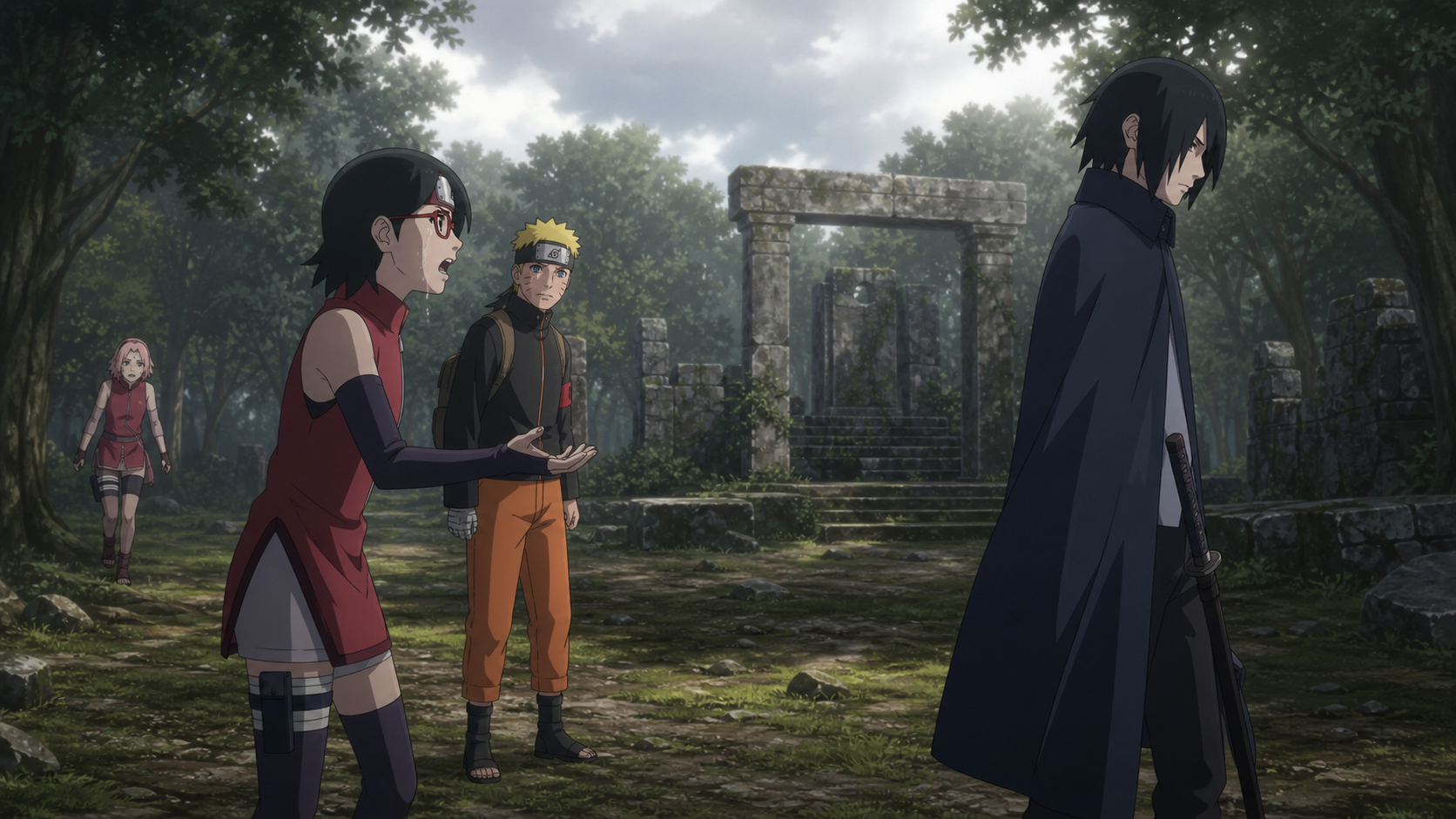
Sasuke and Sarada
Sarada finally reaches her father, Sasuke proves that battle instincts are not parenting skills, and Sakura answers Shin with the punch this reunion desperately needed.
Series: Boruto: Naruto Next Generations
Episode: 21 · Sasuke and Sarada
Arc: Sarada Uchiha Arc
Release: 2017-08-23
Previous: Episode 20 · The Boy with the Sharingan
Directory: All 293 Boruto episodes
Bottom line
Boruto Episode 21 gives Sarada the reunion she crossed half the country to reach, and Sasuke manages to make the whole thing worse before he says five useful words. He nearly attacks his own daughter, fails to recognize her, asks why she came, and then acts surprised when the child does not accept mission business as a complete explanation for twelve years of silence. Sir. She did not ask for Kaguya's coordinates. She asked whether Sakura is her mother.
The episode works because Sarada's pain never becomes childish impatience. Every adult around her has treated basic family history like classified material. Sasuke has been absent. Sakura fainted rather than finish the conversation. Naruto knows more than he wants to say. Sarada finally reaches the one person who should be able to answer, and he gives her another wall. Shin's attack turns the reunion into a battle, but the fight does not erase the original failure. Sasuke can stop a blade in midair and still cannot meet his daughter's eyes.
Then Sakura arrives with one punch, because somebody in this family knows how to make an entrance. Her rescue of Sarada and her fury at Sasuke are emotionally satisfying even before Shin's creature abducts her. The family spends the episode failing to talk, yet every body on that battlefield exposes the truth. Sasuke shields Sarada. Sakura crosses distance and danger to reach her. Sarada runs toward Sakura. Love is present. Communication remains an absolute mess.
Sasuke lowers the sword and leaves the wound open
Sarada identifies herself, and Sasuke finally understands that the girl in front of him is his daughter. The immediate danger ends. The emotional danger does not. He reaches toward her without knowing what that gesture should mean after years away, while Sarada stands there processing the fact that her father looked at her Sharingan and saw an enemy before he saw her face.
That mistake cannot be waved away as reasonable caution. Sasuke has spent years hunting threats connected to Kaguya and the Uchiha name, so his instincts make sense. Sarada also has every right to feel crushed. Parents do not get to turn a child's hurt into proof that the child failed to appreciate adult circumstances.
Sarada asks the question Sakura could not answer
Sarada asks whether Sakura is her real mother. The question lands hard because Sasuke knows exactly where the doubt came from: the old Team Taka photograph, Karin standing beside him, Sakura's missing wedding records, and his own complete absence from Sarada's memory.
He does not answer. That silence gives Sarada more information than any sentence could have given her. Sasuke may believe he is avoiding a dangerous or complicated conversation, but Sarada hears confirmation that the family story cannot survive one direct question.
Sasuke asks why she came as though the answer is mysterious
Sasuke wants to know why Sarada followed Naruto. She tells him plainly. She wanted to meet her father and ask about her mother. The simplicity makes his distance look even stranger. Sarada did not arrive demanding a grand Uchiha ceremony. She wanted recognition and truth.
Sasuke responds from the mind of a shinobi on assignment. Sarada speaks from the life of a daughter. Both occupy the same tower, but they are having different conversations. The episode lets that mismatch sit there without rescuing Sasuke from the embarrassment.
Sarada's tears are anger before they are sadness
Sarada does not melt because Sasuke touched her shoulder. She demands answers. She asks why he never came home, why Sakura never speaks clearly, and why every fact about her birth appears to be missing. Years of restraint come out at once because she has finally reached the person everybody else used as the reason for waiting.
Her tears sharpen the accusation rather than weakening the scene. Sarada is not confused about what she needs. The adults are confused about how long they can postpone giving her what she needs.
Sasuke's silence has always been sold as protection
Sasuke's mission matters. The threat tied to Kaguya and other dimensions is real, and secrecy protects Konoha from enemies who could use his family as leverage. None of those facts require total emotional disappearance. A coded letter, a scheduled visit, a message carried by Naruto, or one honest explanation would not expose the mission.
The franchise has always romanticized lonely men protecting people from far away. Episode 21 puts a child in front of that fantasy and asks what the protection feels like from home. Sarada's answer is not gratitude. She feels abandoned.
Naruto and Chōchō witness the world's worst reunion
Naruto arrives with Chōchō and immediately understands that the tower has become a family disaster zone. Chōchō came along because she believes her own parents may be impostors, so she watches Sarada's real crisis through the lens of her much sillier personal theory.
Her presence keeps the episode from drowning in Uchiha grief. Chōchō cannot fix the conversation, but her loyalty matters. She followed Sarada into danger and stays beside her while three legendary adults fail at basic sentences.
Naruto cannot translate Sasuke into a father
Naruto knows Sasuke better than almost anyone. He understands the mission, the guilt, and the habit of carrying every burden alone. That history gives him context, not magic. Naruto cannot explain Sasuke's absence in a way that makes Sarada stop hurting.
He tries to comfort her after she runs from the tower, but he does not tell her to be quiet or grateful. Naruto recognizes the loneliness because he grew up asking why nobody would tell him the truth about his own life. That shared wound makes him the right adult to sit beside her, even when he lacks the answer she wants.
Sarada runs because staying would mean begging
Sarada leaves before Sasuke can produce another non-answer. The choice protects the last piece of her pride. She crossed the distance, opened the conversation, and named the problem. Chasing him around the tower for basic recognition would make her carry even more of the relationship.
The episode understands that leaving can be an honest response. Sarada wants a father, but she does not want to audition for the position of daughter.
Sakura learns where Sarada went
Back in Konoha, Shizune tells Sakura that Sarada followed Naruto to meet Sasuke. Sakura's fear is immediate because she knows the family mystery has collided with Sasuke's dangerous mission.
Sakura has spent years holding the household together, and that labor matters. Her choice to hide the full story still helped create the crisis. Love and bad judgment can share the same room. Episode 21 refuses to make either fact cancel the other.
Shin attacks when the family is already exposed
The younger Shin and the adult Shin strike while Sarada is separated from Sasuke. Their timing turns private hurt into physical vulnerability. The Uchiha name has drawn another enemy, exactly as Sasuke feared, but the attack does not prove that silence was the only responsible choice.
Secrecy did not prevent Sarada from becoming a target. Secrecy only ensured she entered the danger without understanding the history surrounding her.
The adult Shin treats a child as equipment
Shin speaks about the Uchiha, evolution, and conflict as though children exist to extend an idea. The younger Shin stands beside him with the same name, the same eyes, and no protected childhood. When the fight turns, the adult uses the boy's body without hesitation.
That cruelty creates a sharp contrast with Sasuke. Sasuke's parenting has failed through absence. Shin's version of fatherhood erases the child completely. The contrast does not excuse Sasuke. The contrast shows how many different ways adults can call control or distance a form of purpose.
Sasuke and Naruto fall back into perfect battle rhythm
The family conversation is awkward, but Sasuke and Naruto still understand each other in combat almost instantly. Their bodies remember years of rivalry and war. Naruto's chakra arms restrain attackers. Sasuke reads the weapon pattern and moves to protect the children.
Watching them coordinate is satisfying and a little irritating. Sasuke can communicate an entire tactical plan through one glance, yet Sarada cannot get a straight answer about her mother. Competence is highly selective around here.
Shin's weapon control turns every blade into a threat
Shin marks weapons and manipulates them remotely, allowing discarded blades to change direction after everybody thinks the strike has ended. The technique makes the battlefield feel unsafe from every angle. A weapon does not become harmless merely because the first swing missed.
The direction uses that uncertainty well. Sarada cannot read the whole fight, and the adults cannot afford to explain while attacks keep changing course. For once, the lack of conversation comes from immediate necessity rather than emotional avoidance.
Sasuke protects Sarada before he knows how to comfort her
When Shin redirects a blade toward Sarada, Sasuke puts himself between the attack and his daughter. The action answers one question clearly: he cares whether she survives. His body moves before pride or explanation can interfere.
Sarada needs that proof, but physical protection cannot complete the relationship. A shield is not a conversation. Sasuke has mastered the first role and barely begun the second.
Sakura arrives angry at the correct person
Sakura reaches the battlefield and sees Sarada in danger. Her punch caves Shin into the ground before he can finish his grand speech. Thank you, Sakura. The episode has spent long enough listening to men explain why their choices are necessary.
Her anger also turns toward Sasuke because Sarada should never have reached this point without answers. Sakura understands the mission and shares responsibility for the silence, but she refuses to let Sasuke pretend his absence carried no domestic cost.
The punch restores Sakura's place in the family story
Sarada has spent several episodes staring at Karin's photograph and wondering whether Sakura belongs in her own family. Sakura's entrance provides a different kind of record. She crosses the distance, enters a battlefield, and attacks the person threatening her child without a second thought.
Biology remains unresolved, but motherhood is not abstract in that moment. Sakura shows up. The tragedy is that Shin's creature steals her away before mother and daughter can hold onto the proof.
Shin uses the younger clone as a shield
The adult Shin places the wounded younger Shin between himself and danger. He does not hesitate because he does not regard the boy as a separate person with claims on him. The clone is replacement tissue, camouflage, and labor.
Boruto often asks what the next generation owes the old one. Shin offers the ugliest answer: everything, including the body. Naruto, Sasuke, and Sakura all have failures as parents, but each reacts to a child's danger as a reason to protect. Shin reacts as though the child is inventory.
The creature changes the battlefield with one opening
Shin's small space-time creature waits for confusion, then opens an escape route. Naruto and Sasuke have the attackers contained for a moment, but one strange ability is enough to break the advantage.
The creature also reminds viewers that this enemy network extends beyond the two visible Shins. Sasuke's larger investigation was not paranoia. Something organized, experimental, and deeply connected to stolen Sharingan is operating outside Konoha.
Sakura pushes Sarada clear
The teleportation field reaches for Sarada, and Sakura knocks her daughter out of danger. No speech. No hesitation. Sakura takes the position that would have swallowed Sarada.
That choice becomes the emotional answer Episode 21 can provide before the biological answer arrives. Sakura may have hidden facts. She may have made terrible communication choices. When danger demands a cost, she pays with her own body.
Sakura disappears with the enemy
The creature transports Sakura, the adult Shin, and the younger Shin away. Sasuke loses his wife moments after seeing her for the first time in years. Sarada loses her mother moments after questioning whether she can use that word.
The cliffhanger is cruel because the family has no time to repair anything. They must rescue Sakura while every unanswered question remains active. Crisis does not heal the argument. Crisis carries the argument into the next episode.
Sarada's fear confirms what doubt could not erase
Sarada's reaction to Sakura's abduction is immediate. She does not stand there calculating bloodlines or photographs. She wants her mother back. The body knows the relationship before the records do.
That emotional truth should not be used to scold Sarada for asking questions. Loving Sakura and needing accurate information can exist together. The adults created a false choice between trust and truth. Sarada deserved both.
Sasuke finally has to face the family cost
Sasuke can no longer separate his mission from home. Shin targeted Sarada, wounded him, and abducted Sakura. The danger he kept at a distance has arrived inside the family anyway.
His investigation remains necessary. His old method no longer works. Protecting the village now requires rescuing Sakura, answering Sarada, and accepting that distant sacrifice did not spare the people he loved from pain.
The episode belongs to Sarada
Sasuke's return draws attention, Naruto carries the fight, and Sakura owns the best entrance. Sarada remains the center because every scene changes what she believes about family. She begins with hope, receives rejection, demands truth, runs in anger, watches her parents protect her, and ends with Sakura gone.
The episode never asks her to process those changes neatly. She can love, doubt, rage, and fear at once. That emotional disorder feels more honest than a tidy reunion would have.
Boruto Episode 21 makes protection prove love and expose failure
“Sasuke and Sarada” gives viewers the Uchiha reunion and refuses to make the reunion comfortable. Sasuke does love his daughter. His blade, body, and attention prove that love when Shin attacks. The same episode proves that love kept at a distance can leave a child unable to recognize the relationship.
Sakura's punch and sacrifice answer the question of who has been Sarada's mother in every practical sense. Her silence still deserves criticism. Naruto understands the loneliness but cannot speak for either parent. Chōchō stays close because friendship sometimes means standing beside somebody while their legendary family embarrasses itself in public.
Shin escapes with Sakura, which gives the adults another urgent mission. Episode 22 will test whether urgency becomes another excuse. Sarada has already done her part. She found Sasuke, asked the questions, and told him exactly what his absence cost. Now the adults have to rescue Sakura and finally stop treating the truth like a weapon Sarada cannot be trusted to hold.
Sasuke mistakes secrecy for protection because secrecy once kept people alive
Sasuke's mission concerns threats connected to Kaguya, hidden enemies, and information dangerous enough to place his family at risk. Keeping distance has tactical logic. His life trained him to survive through compartmentalization, silence, and carrying danger alone. The problem begins when a wartime survival method becomes a twelve-year parenting plan.
Sarada experiences none of the protective intent. She experiences an empty place, a photograph she does not understand, and adults who change the subject when she asks direct questions. Sasuke believes absence shields her from his enemies. The absence also prevents her from knowing the father she is supposedly being protected for.
The episode refuses to choose between mission necessity and family consequence. Sasuke's work matters. Sarada's wound remains legitimate. Protection cannot be evaluated only by whether the enemy reached the house. Protection also has to account for what secrecy does inside the house.
Sarada asks about Sakura because the question has become larger than DNA
Sarada wants to know whether Sakura is her biological mother, but the question carries years of accumulated doubt. Why did Sasuke never return? Why does Sakura possess so little evidence of their shared history? Why did the family photograph conceal another woman? Why does every answer arrive as reassurance without detail?
Sasuke hears a factual question during a dangerous mission. Sarada asks whether the entire story of her childhood can be trusted. His inability to recognize the scale makes the reunion collapse. Asking why she came sounds absurd because the journey itself is the answer: no adult gave her a safer route toward the truth.
Her anger protects dignity. Sarada refuses to stand in front of an absent father and beg for affection he should already understand how to offer. Running from the tower is not childish avoidance. Staying would mean accepting another silence as though silence were an adequate parental response.
Naruto can understand Sarada's loneliness without repairing Sasuke's relationship for him
Naruto recognizes the expression of a child who believes family bonds may be fabricated. He can stay beside Sarada, defend Sasuke's larger character, and refuse to abandon her during the crisis. He cannot supply memories Sasuke never created.
That limitation matters because Naruto often solves emotional conflicts by translating pain across people. Sasuke's fatherhood cannot be outsourced to his best friend. Naruto can prevent the worst interpretation from becoming permanent. Sasuke still needs to speak, return, and accept that the mission did not absorb every responsibility.
Chōchō's presence gives Sarada another kind of support. She does not have the answers or the historical context. She remains near her friend while legendary adults turn a family reunion into a disaster. Sometimes the most useful person in the room is the one who does not demand immediate emotional clarity.
Sasuke protects Sarada instinctively because his body knows what his words cannot express
When Shin attacks, Sasuke moves between danger and Sarada without hesitation. The response proves attachment more clearly than his reunion dialogue. He tracks the blades, shields her, and coordinates with Naruto before fear can become another explanation.
The instinct is real love. The instinct also exposes how much easier Sasuke finds combat than comfort. A visible weapon gives him a problem with known rules. Sarada's questions require vulnerability, apology, and a willingness to describe feelings without hiding behind mission classification.
The episode lets protection count without allowing protection to settle the argument. Sarada sees that Sasuke will risk his life for her. She still deserves a father who can recognize her before the blade appears.
Sakura's arrival restores agency after an episode built around other people's secrets
Sakura enters already understanding that Sarada followed Naruto and reached Sasuke. She is angry because her daughter is endangered and because Sasuke has again handled family communication like a man trying to lose an argument on purpose. Her punch interrupts Shin and the emotional paralysis surrounding the reunion.
The strength is satisfying, but Sakura's most important act comes when she pushes Sarada away from the space-time creature. She chooses the child's safety before knowing where the teleportation will take her. The decision makes motherhood visible through action while the biological question remains unresolved.
Her sacrifice does not excuse the earlier secrecy. Sakura helped maintain a family story so incomplete that Sarada doubted her own birth. Love and failure can occupy the same relationship. Episode 21 becomes stronger when the rescue proves one without erasing the other.
Shin uses his child as a shield because he cannot imagine a bond without utility
The adult Shin treats the younger clone as equipment, medical supply, and disposable cover. His behavior places Sarada's family conflict beside a brutal alternative. Sasuke and Sakura make damaging choices while trying to protect their daughter. Shin damages a child because the child has no value beyond use.
That difference should not silence Sarada's criticism. A parent does not become adequate merely by being better than a monster. The contrast clarifies the moral stakes. Family bonds require seeing a child as a person whose questions, safety, and future matter independently.
Shin's escape with Sakura also reverses his assumption. He takes the adult he considers useful and leaves behind a family immediately organizing a rescue. Sakura is not an isolated body in his laboratory. She belongs to relationships that act.
Sarada's fear after Sakura disappears confirms the bond before any test can
Sarada has spent the episode questioning whether Sakura is truly her mother. The moment Sakura vanishes, fear answers faster than theory. Sarada does not pause to calculate biology. She wants Sakura back.
That reaction does not make the unanswered question irrelevant. Sarada still deserves accurate information. The fear shows that the relationship already exists beneath the uncertainty. Doubt can injure a bond without proving the bond was false.
Episode 22 will place a misleading laboratory result against that emotional knowledge. Episode 21 prepares the stronger evidence first: Sakura protects Sarada, Sarada fears losing Sakura, and the family moves toward rescue despite every failure in communication.
Sources and lawful viewing
Official episode reference: Naruto Official episode guide
Licensed episode route: Crunchyroll licensed series page