
The Boy with the Sharingan
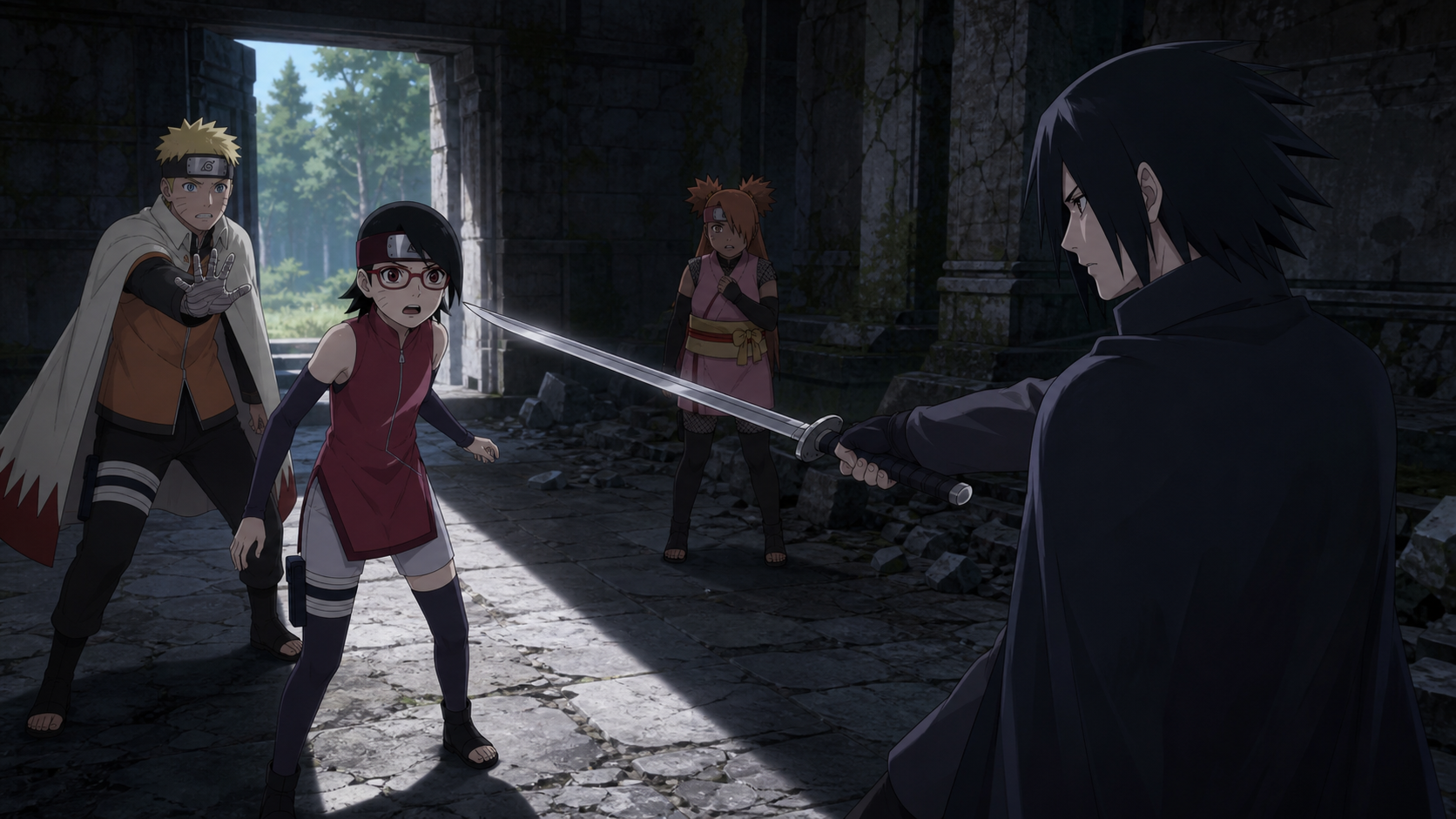
Shin carries a Sharingan that should not exist, Sarada follows Naruto toward the truth, and her joy at finding Sasuke ends at the point of his sword.
Series: Boruto: Naruto Next Generations
Episode: 20 · The Boy with the Sharingan
Arc: Sarada Uchiha Arc
Release: 2017-08-16
Previous: Episode 19 · Sarada Uchiha
Directory: All 293 Boruto episodes
Bottom line
Boruto Episode 20 takes Sarada's very reasonable plan to meet her father and turns the road trip into an attack by a strange child with the Sharingan, a surprise lunch with Naruto, and the worst possible reunion at an abandoned tower. Sasuke sees a girl with Uchiha eyes running toward him and draws his sword. Sarada sees the father she has imagined for years and learns that he does not recognize her. Somebody should invoice the entire village for therapy, but the episode earns the pain by showing exactly how the family reached this point.
Sasuke has a real reason to be cautious. A boy calling himself Shin just attacked him with the Sharingan, something that should belong only to Sasuke and Sarada. He reports the threat to Naruto and chooses an isolated meeting place. None of that changes what Sarada experiences. She follows Naruto because every adult keeps refusing to explain her family, awakens her Sharingan from the excitement of finally seeing Sasuke, and reaches him only to become a target.
The cruel joke is that Sarada's eyes should identify her immediately. Instead, the Sharingan becomes the detail that makes Sasuke suspicious. Years of distance have turned their shared bloodline into evidence against her. Episode 20 does not need a speech about parental absence. One drawn sword says enough.
Sasuke meets another Sharingan before he meets his daughter
The episode opens with Sasuke encountering a pale boy who carries the Uchiha name and wields the Sharingan. Sasuke knows the clan's surviving family line. A stranger with those eyes means theft, experimentation, deception, or a hidden branch of history that should not exist.
Shin attacks without offering useful context, then escapes before Sasuke can settle the question. The encounter puts Sasuke into threat-assessment mode before Sarada reaches him. That sequence explains his mistake later without asking viewers to pretend the mistake is harmless.
Shin wears the Uchiha name like stolen clothing
Shin calls himself an Uchiha, but the name does not come with family memory, grief, or responsibility. He treats the clan as power and symbol. Sasuke immediately recognizes the gap because he has spent his whole life carrying the cost behind that name.
Sarada has the opposite problem. She inherited the name and the eyes but received almost none of the history. One child claims the Uchiha identity too easily. The other has to chase her own father for permission to understand hers.
Sasuke sends Naruto the warning
Sasuke uses a hawk to alert Naruto that somebody else possesses the Sharingan. Naruto understands the scale immediately. Peace has not removed the old danger surrounding bloodline abilities, and a mystery tied to Sasuke may point toward a much larger threat.
Their communication works because they have an established system. That efficiency also exposes the family failure. Sasuke can send Naruto urgent intelligence across distance. Sarada has grown up without a message that says her father remembers her birthday.
Naruto leaves to meet Sasuke
Naruto prepares to meet Sasuke and investigate the new enemy. The Hokage role pulls him away from Konoha again, but Sarada hears the one detail she needs: Naruto knows where her father will be.
She does not wait for another adult to decide when she deserves answers. After Sakura's collapse and the Team Taka photograph, waiting sounds like another word for never.
Sarada and Chōchō turn the mission into a chase
Sarada follows Naruto, and Chōchō joins because she has decided that Chōji and Karui cannot possibly be her real parents. Chōchō's theory is ridiculous, but her willingness to accompany Sarada is genuine. She does not demand a perfect explanation before showing up for her friend.
The pairing keeps the story human. Sarada carries a painful question about birth and belonging. Chōchō carries snacks and supreme confidence. Both girls believe the adults have hidden something, although only one of them has found actual evidence.
Chōchō's joke protects Sarada from pity
Chōchō never treats Sarada like a tragic Uchiha case file. She assumes they are partners on parallel searches for the truth. Her wrong conclusion gives Sarada room to keep moving without narrating every fear aloud.
That friendship matters because the adults keep making Sarada's questions feel dangerous. Chōchō makes the journey feel possible, even when her own contribution is mostly chaos and potato chips.
Naruto knows the girls are following
Sarada and Chōchō believe they are tracking the Hokage. Naruto notices them. Of course he does. He has sensory abilities, battlefield experience, and enough parenting practice to recognize children attempting stealth with more determination than subtlety.
Instead of humiliating them, he controls the situation. Naruto understands that forcing Sarada home will not remove the need driving her forward. She will keep looking for another route.
Lunch becomes the first honest pause
Naruto shares food with the girls and gives Sarada a chance to speak. The small break does more emotional work than another grand lecture could have done. She is tired, angry, and scared that the answers will confirm her worst suspicion.
Naruto does not have permission to reveal every part of Sasuke's mission or Sarada's birth. He can still listen. The episode shows how much basic attention matters when a child has spent days getting deflection from adults.
Naruto tells Sarada who Sasuke was
Naruto describes Sasuke as a brilliant student, a rival, a difficult friend, and somebody whose path went very wrong before he chose to help protect the world. He does not pretend Sasuke has always been noble or easy to love.
That honesty gives Sarada a fuller father than the silent heroic figure hanging over her house. Sasuke made choices, hurt people, changed, and accepted a mission that keeps him away. Sarada finally receives history with edges.
Naruto remembers Sakura as part of the same story
He also talks about Sakura's strength and the bond that survived Team 7's worst years. Sarada needs that context because Karin's photograph has made her wonder whether Sakura was ever truly connected to Sasuke.
Naruto cannot answer the biological question, but he can confirm that Sakura's place beside Sasuke was not imaginary. Their family grew from a relationship with a long, painful history, not a photograph assembled to comfort a child.
Shin attacks Sarada and Chōchō
The younger Shin finds the girls on the road and attacks with the Sharingan. Sarada has barely begun understanding her own eyes, while this stranger uses the same power as a weapon against her.
The encounter turns the clan mystery outward. Sarada's family questions are not only domestic. Somebody is copying or collecting Uchiha power, and that person already knows enough to target her.
Naruto's chakra catches the attack
Naruto shields Sarada and Chōchō with Kurama's chakra. The defense is immediate, oversized, and reassuring. Sarada has spent the episode chasing one father and finds herself protected by another.
Naruto's instinct is worth noticing because he does not ask whether the girls disobeyed before saving them. Consequences can wait. The children come first.
Shin recognizes the Seventh Hokage
The attacker identifies Naruto, which confirms that the ambush was not random. Shin knows the people connected to Sasuke and understands Konoha's leadership. The boy may look young, but somebody has prepared him for a specific mission.
His confidence also feels borrowed. Shin speaks and fights like a child carrying an adult's obsession. The episode has not introduced the older Shin yet, but the lack of ordinary childhood is already visible.
The strange creature provides an escape
A small one-eyed creature uses space-time ninjutsu to remove Shin from the fight. Naruto cannot capture him or trace the destination before the opening closes.
That escape expands the threat beyond a lone boy. Somebody has access to Sharingan, marked weapons, and dimensional movement. Sasuke was right to call an urgent meeting. Sarada was also right to follow, because the danger has already found her.
Naruto allows the girls to continue
After the attack, sending Sarada home alone would be less safe than keeping her nearby. Naruto brings Sarada and Chōchō toward the meeting with Sasuke.
The practical decision also respects Sarada's determination. Naruto does not promise that the reunion will answer everything. He stops blocking the path to the person she needs to confront.
Sarada's excitement awakens the Sharingan
As the tower comes into view, Sarada's anticipation becomes strong enough to awaken her Sharingan. The eyes arrive through love and hope, not hatred. That detail matters in a franchise that spent years treating Uchiha power as a product of pain.
Sarada believes she is about to meet the missing part of her family. Her body responds before her mind can organize the feeling. The moment should be beautiful. The next scene turns the beauty against her.
She runs ahead because twelve years have been long enough
Sarada leaves Naruto and Chōchō behind and rushes into the tower. Caution loses to longing. She has waited her entire remembered life for Sasuke to come home, so the final stretch feels unbearable.
Viewers know Sasuke has just fought a Sharingan user. Sarada does not. The gap in knowledge creates the disaster, and the adults created that gap by keeping her outside the family truth.
Sasuke sees the eyes before he sees the girl
Inside the dark tower, Sasuke notices an approaching figure with the Sharingan. He assumes Shin or another related enemy has found him. His sword comes out before Sarada can explain.
The tactical logic is clean. The emotional result is filthy. Sasuke's mission has trained him to recognize threats faster than his own child.
Sarada calls him Papa
Sarada's voice stops the attack. One word forces Sasuke to reconsider everything he thinks he sees. She has imagined this address for years, and the first use comes while a blade points toward her.
That is the kind of memory a child carries forever. Sasuke can lower the sword in the next second. He cannot give her a first meeting that did not begin with fear.
The failed recognition is bigger than one mistake
Sasuke has been away so long that Sarada cannot recognize his habits and he cannot recognize her face. Their biological connection exists, but the relationship lacks the repeated contact that turns knowledge into instinct.
The episode refuses the easy fantasy that blood will solve the distance on sight. Shared eyes do not create shared memory. The Uchiha name gets Sarada into danger before the family bond can protect her.
Sasuke's caution and Sarada's hurt can both be true
Shin's earlier attack explains why Sasuke reacted. Sarada's arrival still exposes the cost of the system he chose. Viewers do not need to pick one truth and erase the other.
Good drama lives in that collision. Sasuke is not a monster for being cautious. Sarada is not unreasonable for experiencing the sword as rejection. The next episode has to deal with both.
Naruto arrives too late to protect the reunion
Naruto reaches the tower after the damage has already landed. He can stop a fight, explain a mission, and defend Sarada from Shin. He cannot manufacture twelve years of family familiarity in one hallway.
His presence matters because somebody else witnessed the moment. Sasuke cannot later reduce Sarada's reaction to misunderstanding. Naruto saw what absence looked like when the missing father and waiting daughter finally occupied the same room.
Boruto Episode 20 turns the Sharingan into a family test
“The Boy with the Sharingan” introduces Shin as a threat to the Uchiha legacy, but Sarada carries the harder question. What does the legacy mean when a child inherits the name, the eyes, and the danger without access to the father who understands them?
Naruto gives her pieces of history. Chōchō gives her company. Kurama's chakra gives her protection. Sasuke gives her a blade before recognition. Every part of the journey confirms that Sarada's need for answers was never a phase or a tantrum.
The cliffhanger hurts because Sarada's Sharingan awakened from joy. She ran into the tower expecting the father from Naruto's stories and met the operative shaped by years of isolation. Episode 21 must lower the sword, but lowering the sword will not be enough. Sasuke has to look past the eyes, see his daughter, and answer why she had to chase him to be seen.
Shin wears the Uchiha name because stolen identity can still create real danger
Shin's Sharingan and Uchiha claim confront Sasuke with a legacy detached from family, village, and consent. The boy possesses the visual marker Sarada inherited, but he uses the name as affiliation with violence. The contrast asks who gets to define what Uchiha means after the clan's destruction.
Sasuke responds as a threat analyst before he responds as a father. Another Sharingan suggests enemies, experiments, surviving conspiracies, and information Naruto needs immediately. His caution is rational inside the mission. The same caution becomes catastrophic when Sarada enters the tower carrying similar eyes.
The episode places both children in Sasuke's path so the visual resemblance cannot answer identity. Shin looks like danger because of what he does. Sarada looks like family because of who she is and the life connected to her. Sasuke fails the first moment because years of isolation trained him to read the eye before the person.
Chōchō keeps the journey from turning Sarada into a lonely mystery object
Chōchō follows Sarada while insisting she may also discover her real parents. The theory is hilarious, but the humor protects Sarada from traveling under constant pity. Chōchō treats the search as something they can survive together, with snacks, complaints, and enough confidence for both girls.
Her presence also stops the family crisis from becoming a sealed Uchiha chamber. Sarada has a friend who sees the questions, the attack, the anticipation, and the failed reunion. Chōchō cannot solve the history. She can confirm that Sarada's reaction belongs to a real child rather than a plot device built around famous adults.
When danger arrives, Chōchō remains part of the stakes. Naruto protects both girls because both matter. Sarada's family search does not make her companion expendable, and Chōchō's comedy never cancels her loyalty.
Naruto tells Sasuke's history without pretending history excuses the absence
The lunch gives Sarada a pause where she can hear about Sasuke from somebody who knew him as a boy, rival, enemy, and friend. Naruto describes courage, pain, ability, and the difficult road back toward Konoha. Those stories fill spaces Sakura could not safely or comfortably explain.
Naruto's admiration helps Sarada imagine a father larger than the empty chair. The history also risks making Sasuke's suffering another shield against criticism. Episode 20 avoids that outcome through the tower. Whatever Sasuke survived, Sarada still experiences the blade and failed recognition.
Context can explain why a parent learned distance. Context cannot make the child's need disappear. Naruto becomes most useful when he carries both truths instead of asking Sarada to admire the legend until the wound feels impolite.
Kurama's chakra protects Sarada before she understands how much Naruto is carrying
Naruto intercepts Shin's attack with power Sarada knows mostly through the Hokage's public identity. The chakra cloak turns a family search into a reminder that global threats and old enemies still move around the adults. Sarada sees the leader's strength at close range and receives protection without needing to earn the attention.
That experience helps explain why Naruto becomes her leadership model. He notices the girls following, keeps them alive, shares food and history, and allows the journey to continue once the immediate threat is contained. Authority feels personal because Naruto uses power to create room for their questions.
His care also sharpens the contrast awaiting the tower. Sarada receives more recognition from the Hokage during one trip than she receives from Sasuke during the first seconds of reunion. Naruto cannot replace her father, but he demonstrates what being seen can feel like.
Sarada's Sharingan awakens through hope before the tower turns hope into pain
The eye appears as Sarada runs toward Sasuke with excitement. That detail refuses the idea that Uchiha power belongs only to hatred or death. Love, anticipation, and the overwhelming possibility of connection can awaken the same inheritance.
The joy makes the sword more devastating. Sarada has no emotional distance left when Sasuke reacts. Her body has already announced how much the meeting means. The father interprets the visible sign as possible danger while missing the feeling that brought the sign forward.
Future episodes will connect the Sharingan to betrayal, fear, and determination too. Episode 20 gives the eye a first emotional record centered on wanting family. That origin belongs to Sarada even after the reunion contaminates the moment.
Sasuke's failed recognition is institutional failure as well as personal failure
Sasuke chose distance, but the village also accepted a system where his daughter had almost no safe information about his work or whereabouts. Sakura carried the household and the secrecy. Naruto knew the mission context. Nobody built a family plan capable of surviving twelve years without turning basic questions into danger.
Security may require hidden locations and restricted intelligence. Security does not require a child to wonder whether her mother gave birth to her or whether her father would know her face. The adults treated every detail as though partial honesty would collapse the mission.
Sarada's pursuit exposes the weakness. A child denied appropriate answers will search through photographs, gossip, abandoned towers, and dangerous people. Secrecy did not keep her away from the threat. Secrecy sent her toward the threat without preparation.
Naruto arriving late makes him witness rather than rescuer
Naruto cannot prevent Sasuke from drawing the sword. His late entrance removes the comforting possibility that the scene will become a misunderstanding nobody else saw. He witnesses Sarada's hope, Sasuke's response, and the silence afterward.
That witness matters when the adults begin explaining. Sarada will not have to prove the emotional facts to a room invested in protecting Sasuke's image. Naruto knows his friend loves his family. Naruto also knows exactly how that love appeared from the child's side of the blade.
The next episode can address the enemy attack, but the family damage now has an accountable observer. Friendship with Sasuke should require Naruto to tell him when the mission logic has become cruelty at home.
Sources and lawful viewing
Official episode reference: Naruto Official episode guide
Licensed episode route: Crunchyroll licensed series page