
Delta
Boruto and Kawaki turn matching marks into chosen practice while Delta closes in on a household whose fragile trust Kara still treats as stolen property.
Series: Boruto: Naruto Next Generations
Episode: 197 · Delta
Arc: Vessel
Release: May 2, 2021
Previous: Episode 196 · A Binding Force
Directory: All 293 Boruto episodes
Bottom line
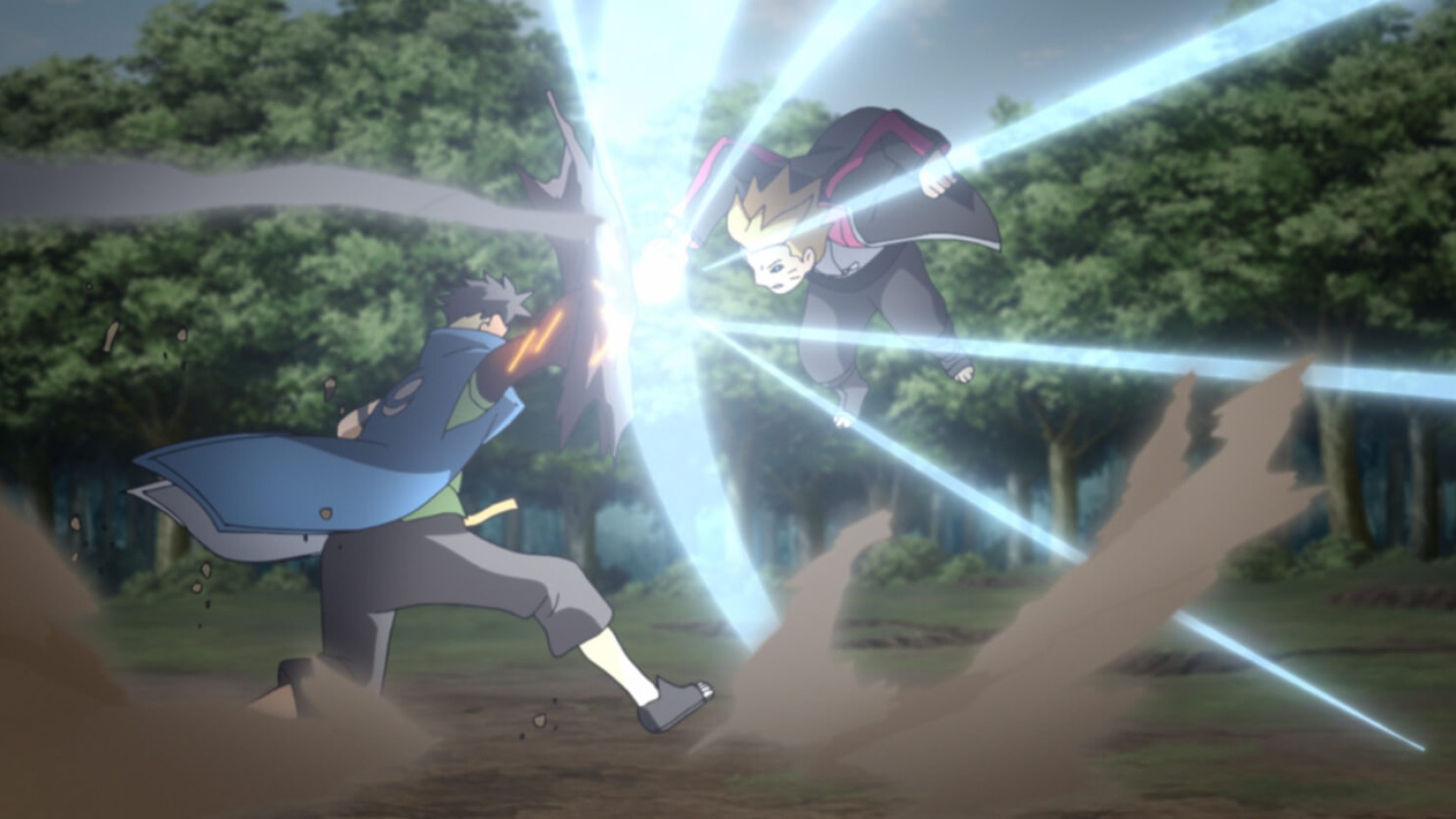
Boruto Episode 197 gives Boruto and Kawaki the controlled Kāma test they asked for, then places Delta just outside the circle of trust they are building. The boys fight under Naruto’s supervision while Himawari watches, which changes combat from Kara’s language of ownership into a lesson with rules, witnesses, and an ending. Kawaki provokes Boruto because he knows urgency can force the mark awake, but his method also shows how quickly survival training can reproduce manipulation. Their reconciliation seal matters because both choose to close the match as shinobi rather than remain trapped as rival vessels. Outside Konoha, Delta grows furious while Kashin Koji moves through the village unseen. Her impatience turns the episode’s fragile domestic progress into an approaching threat.
Delta names the danger before she arrives
The episode is titled for a woman who spends much of the story outside the immediate family scene. That choice makes Delta pressure rather than background. Boruto, Kawaki, Naruto, and Himawari can train in sunlight, yet Kara’s claim on Kawaki remains close enough to cross the horizon.
Delta also represents a competing model of power. Naruto supervises and allows questions. Delta demands access, obedience, and immediate results. Both are strong enough to dominate children. Only one adult treats restraint as part of strength.
The glue still waits at home
Kawaki has not forgotten Himawari’s vase or Boruto’s offer to repair the original. The unfinished object remains a quiet measure of whether he can practice patience after choosing a faster replacement.
Training with Boruto becomes another repair process. Their relationship has cracks, sharp edges, and missing trust. A dramatic declaration cannot fuse those pieces. Repeated action, honest boundaries, and chosen cooperation can begin holding them together.
Boruto agrees to a realistic test
Boruto and Kawaki need more than observation to understand how their Kāma marks interact. A controlled spar offers information without placing the village inside an uncontrolled emergency.
Agreement matters. Kara experimented on children without meaningful consent and treated survival as successful data. Here the boys know the purpose, Naruto watches, and either participant can end the session. The same body can experience research as violation or agency depending on who controls the conditions.
Naruto builds a safer container
Naruto does not remove every risk because learning Kāma without any activation would be impossible. He reduces risk through location, supervision, experience, and clear attention to both boys.
A safe container is not a promise that nothing uncomfortable will happen. A safe container means adults anticipate foreseeable harm, intervene when needed, and do not punish honest limits. Naruto’s presence makes experimentation possible without pretending Kāma has become harmless.
Himawari watches from the boundary
Himawari’s presence gives the match a family context. She is not another scientist studying Kawaki. She watches her brother and the boy now living in her home work through a dangerous connection.
Her safety still deserves careful thought. A child should not become proof that Naruto trusts Kawaki. Supervision has to protect her as a person, not use her closeness as a symbolic certificate of rehabilitation.
Kawaki activates the mark by choice
Kāma once represented Jigen’s control over Kawaki’s body. Voluntary activation during training does not erase that history, but choice changes the immediate meaning. He uses the mark for information he wants, against a peer who agreed, under an adult who will stop the fight.
Reclaiming a body often begins through small decisions about when, why, and around whom a feared response occurs. The mark remains invasive. Kawaki’s choice belongs to him anyway.
Boruto’s mark needs a trigger
Boruto cannot always summon Kāma on demand. That lack of control frightens him because power arriving only under stress means danger controls access.
Training aims to move activation from accident toward intention. The goal is not simply stronger attacks. Reliable control would let Boruto recognize warning signs, choose proportionate force, and stop before another presence uses his body.
Kawaki knows pressure works
Kawaki understands that fear, anger, and urgency can force a response from the mark. His knowledge comes from an abusive system that treated distress as a tool.
When he pushes Boruto toward that state, the tactic produces useful data and raises an ethical problem. Survival knowledge can save someone while carrying the shape of the institution that taught the lesson. Healing requires examining method, not only outcome.
Provocation is not the same as teaching
A coach can challenge a learner without manufacturing panic. Kawaki has not yet learned that distinction because Kara made panic routine. He reaches for the method most available to him.
Naruto needs to name the difference. If activation depends on emotional threat, future practice should build safer cues rather than celebrating the trigger as clever. Results do not automatically justify training conditions.
Boruto’s anger has a real boundary
Boruto becomes fierce when Himawari appears threatened. His response shows love and reveals how easily family can become leverage. Kawaki understands that lever because captors used personal vulnerability to control behavior.
Even inside an agreed spar, threatening a bystander crosses a line unless every participant understood the exercise. Boruto has a right to object after the match. Caring about Kawaki’s history should not require pretending the choice was harmless.
Himawari should never become bait
The story gains tension from Boruto’s protective response, but Himawari’s personhood matters more than her usefulness as a trigger. No child should be placed near danger so someone else can access power.
If Kawaki only creates the appearance of threat, the emotional effect remains real. Responsible training avoids turning a family member into an instrument without consent. Naruto’s future safety planning should make that rule explicit.
Kāma makes their bodies answer each other
When both marks activate, Boruto and Kawaki enter a shared field of information. Their speed, absorption, timing, and power become easier to compare.
That resonance can feel intimate without being chosen. Bodies can share a mechanism while the people inside remain uncertain, angry, or cautious. The episode wisely lets connection develop through behavior rather than claiming matching marks make them brothers.
Boruto fights like himself
Kāma increases Boruto’s options, but his movement still carries the imagination and rhythm viewers recognize. He adapts, presses, and looks for a route around Kawaki’s defenses.
Power becomes character when choices shape use. A mark cannot replace judgment. Boruto’s growth depends on integrating the ability into his existing skill rather than letting alien power become his entire identity.
Kawaki fights like survival is immediate
Kawaki’s attacks carry directness learned from environments where hesitation invited pain. He reads openings quickly and commits without the social cushioning Boruto expects from practice.
That intensity makes him dangerous and understandable. Naruto’s task is not to remove every survival instinct. He must help Kawaki distinguish a training partner from a captor and proportion force to the actual setting.
Naruto observes more than strength
Naruto watches activation, absorption, emotional triggers, coordination, and the point where intensity threatens control. A responsible supervisor studies behavior around power, not only power output.
He also watches how the boys treat each other after mistakes. Technical mastery without relational accountability would leave the larger danger untouched. Kāma control includes the ability to listen when someone says a line was crossed.
The spar gives both boys a mirror
Boruto sees someone who understands his mark but carries far deeper trauma around the same mechanism. Kawaki sees someone with family protection, formal training, and enough security to argue openly.
Each can envy and misread the other. The match turns assumptions into evidence. Similar power does not create similar lives, but honest comparison can weaken isolation.
Competition can become collaboration
At first the boys try to prove who understands the mark and who can control the exchange. Gradually their attention shifts toward what each response teaches.
Healthy competition creates information both people can use. Unhealthy competition makes one person’s loss the only measure of another’s worth. Naruto keeps the session close enough to the first model.
A win does not settle the relationship
Who lands the final move matters less than how the boys end. Combat can reveal skill, not moral authority. The winner does not gain ownership of the loser’s story or decisions.
Kara uses rank to determine whose will dominates. Shinobi training at its best uses a result to guide the next lesson. The episode places that distinction inside a simple ending ritual.
The reconciliation seal changes the meaning
The traditional seal after a spar acknowledges that conflict occurred inside a shared practice. Opponents close the exercise as people responsible to each other.
For Kawaki, the gesture offers a fighting culture with an exit. Kara’s violence never truly ended because every defeat reinforced captivity. A shinobi match can stop, be discussed, and leave both participants free to return tomorrow.
Kawaki hesitates around ritual
A ritual only works when participants understand the meaning. Kawaki did not grow up inside the Academy, so an expected hand sign may look arbitrary or even suspicious.
Naruto and Boruto should explain rather than shame him for not knowing. Cultural belonging grows through invitation. Nobody arrives with every local code installed.
Boruto extends his hand again
The reconciliation gesture echoes the glue from Episode 195. Boruto offers a practical route forward without declaring every grievance resolved.
His hand says the match is over and cooperation remains possible. That boundary is more believable than instant affection. Trust gains strength through specific promises people can keep.
Kawaki accepts a shinobi identity in miniature
Completing the seal does not make Kawaki a Leaf shinobi. The gesture lets him participate in an ethic where combat includes mutual recognition.
Kara called him a vessel, reducing identity to future use. A shinobi ritual addresses him as an opponent, learner, and person capable of ending conflict through choice.
Naruto teaches through culture and conduct
Naruto’s lesson is not limited to chakra mechanics. He models how Leaf training should handle power: establish consent, supervise risk, acknowledge the other person, and close the encounter.
Institutions fail when values live only in slogans. Kawaki needs to experience the difference in adult conduct. Naruto’s credibility comes from what happens when the lesson becomes messy.
The family moment remains unfinished
One successful spar does not solve the vase, privacy, public reflexes, or Kāma. The household still has work.
That incompleteness protects the story from perfection. Healing accumulates through several ordinary and difficult moments. No single scene bears the impossible burden of curing childhood abuse.
Kashin Koji keeps moving inside Konoha
Koji searches for Kawaki while the family trains. His access exposes the weakness introduced in Episode 196: the sensory system treats familiar chakra as safe enough to pass.
The village cannot rely on reputation or recognition alone. Threat assessment needs behavior, location, authorization, and context. Familiar credentials can belong to someone serving a hostile purpose.
Security built on identity can be fooled
Konoha’s barrier asks whether chakra belongs. Koji’s presence turns that question into a trap. A system that recognizes origin without checking current intent confuses familiarity with trustworthiness.
The failure has human consequences because Kawaki’s home location and routine could become visible. Technical design always reaches somebody’s body eventually.
Koji’s patience is tactical power
Koji does not rush because waiting gives him information. He allows ordinary village rhythms to hide his movement and lets Delta’s impatience create noise elsewhere.
Patience here serves surveillance rather than repair. The episode shows the same trait can support care or harm depending on purpose. Slow action is not automatically ethical.
Delta hates being excluded
Delta waits outside while Koji enters alone. Her anger comes partly from concern about the mission and partly from losing control over information.
Kara’s members do not trust one another enough to share uncertainty. Their hierarchy produces cooperation without security. Everyone watches everyone else for betrayal, status, and leverage.
Her impatience threatens the plan
Koji’s delay becomes unbearable to Delta because waiting requires accepting another person’s judgment. She would rather force access than tolerate not knowing.
That impulse makes her dangerous to Kawaki and inconvenient to her own organization. Power without regulation can sabotage strategy. The story does not treat aggression as competence simply because Delta looks formidable.
Delta sees Kawaki as recoverable property
Her mission language reduces Kawaki to an asset that left custody. She does not approach Konoha as someone searching for a frightened child.
That framing makes the coming conflict unavoidable. Naruto protects a person whose choices matter. Delta retrieves property whose resistance proves defect. Their powers collide because their definitions of Kawaki cannot coexist.
Naruto’s home is becoming a counterclaim
Every meal, errand, lesson, and boundary inside the Uzumaki household tells Kawaki that his body belongs to him. The family does not need to announce a grand rescue philosophy. Daily conduct builds the claim.
Delta’s arrival will test whether Konoha defends that principle when defense becomes costly. Hospitality means little if the village returns a child once the owner appears.
Himawari raises the stakes without becoming a symbol
Delta approaching the village endangers everyone near Kawaki, including Himawari. The story must protect her as a child with her own life, not only as Naruto’s daughter or Kawaki’s evidence of belonging.
Her proximity also reveals why security planning matters. Care for Kawaki cannot ignore risks brought to the household. Care for Himawari cannot require Kawaki’s abandonment. Adults must hold both responsibilities.
Boruto now knows more about the mark
The training produces practical knowledge about activation, reaction, absorption, and control. Information reduces helplessness even when answers remain incomplete.
Boruto also learns something about Kawaki’s methods. Shared expertise does not guarantee shared ethics. Future training will need clearer rules if their cooperation is going to protect both boys.
Kawaki now knows more about trust
He provokes Boruto, fights hard, and still receives the reconciliation gesture. The match ends without punishment, captivity, or abandonment.
That outcome gives his nervous system evidence that conflict can close. A lesson becomes believable only after repetition, but one completed cycle matters: tension rose, adults stayed, the other boy remained a person, and nobody lost home.
The episode links repair to regulation
Episode 195 used glue to show that repair requires patient hands. Episode 197 uses combat to show that relationship repair also requires control under pressure.
Apologies without regulation leave people waiting for the next break. Regulation without accountability can become polished avoidance. Kawaki needs both: the ability to stop and the willingness to face whose safety was affected.
The visual contrast does thematic work
The sunny training ground makes the boys’ match open, supervised, and communal. Koji’s hidden movement and Delta’s waiting position belong to secrecy and exclusion.
Light does not make the spar harmless, and shadow does not explain every motive. The contrast organizes who gets to see, consent, and respond. Transparency becomes part of safety.
Fandom should resist instant brotherhood
Boruto and Kawaki are moving toward a powerful bond, but calling them brothers too early can erase the work. Boruto still has boundaries. Kawaki still tests those boundaries through manipulation and fear.
Chosen family becomes meaningful because choice continues after the first welcome. Each boy has to decide repeatedly whether shared power will become mutual care.
Fandom should also resist permanent condemnation
Kawaki uses a harmful trigger because harmful systems shaped his instincts. That choice deserves criticism without declaring growth impossible.
Accountability asks what he learns next. If every mistake proves permanent corruption, repair has no role. If trauma excuses every mistake, other people lose safety. The episode lives between those failures.
Delta approaches a bond she cannot understand
Delta knows Kāma as Kara technology and Kawaki as Jigen’s investment. She has no framework for glue, sibling anger, supervised practice, reconciliation seals, or a child watching family training.
Her ignorance is strategic weakness. She understands the mark’s power better than the household does, yet she underestimates what belonging can make someone defend.
The coming conflict has already started
No attack needs to land for danger to shape the episode. Koji’s surveillance and Delta’s impatience already compress the time available for safe learning.
That pressure makes every small gain valuable. Boruto and Kawaki do not know how soon cooperation will become survival. Their training creates shared language before crisis arrives.
A training record should guide the next session
Naruto now has evidence that Boruto can activate Kāma under pressure, Kawaki can help interpret the response, and emotional provocation creates unnecessary risk. The responsible next step would preserve the useful observations while changing the trigger. Practice should become more repeatable, less dependent on fear, and clearer about which tactics remain outside the agreement.
The boys also need time to describe what activation felt like from inside their bodies. Spectators can measure speed and force, but sensation, loss of control, pain, and unwanted thoughts remain private unless Boruto and Kawaki choose to report them. Their testimony belongs beside every visible result.
RaeRae’s verdict
“Delta” uses an approaching villain to sharpen what the boys are building. Boruto and Kawaki activate matching marks, but the real connection comes from agreed practice, difficult correction, and a ritual that lets combat end. Naruto supervises without treating either child as laboratory property. Himawari’s presence reminds everyone that household safety must include the quietest person nearby.
Kawaki’s provocation remains the uncomfortable center. He knows how to force a response because adults forced responses from him. Growth will require learning that useful results do not erase harmful methods. The reconciliation seal gives him another model: power can meet power, both people can remain whole, and conflict can close through mutual recognition. Delta is coming because Kara cannot tolerate that kind of freedom. The episode makes sure viewers understand exactly what her arrival threatens.
Sources and lawful viewing
Official episode reference: Naruto Official episode guide
Licensed episode route: Crunchyroll licensed series page
The official guide identifies Episode 197 as “Delta” and summarizes Boruto and Kawaki’s realistic Kāma training under Naruto and Himawari’s observation, Kashin Koji’s entry through Konoha’s sensory system, and Delta losing patience while waiting outside. Crunchyroll lists the licensed episode with a May 2, 2021 release date. Availability and language options can vary by region.