
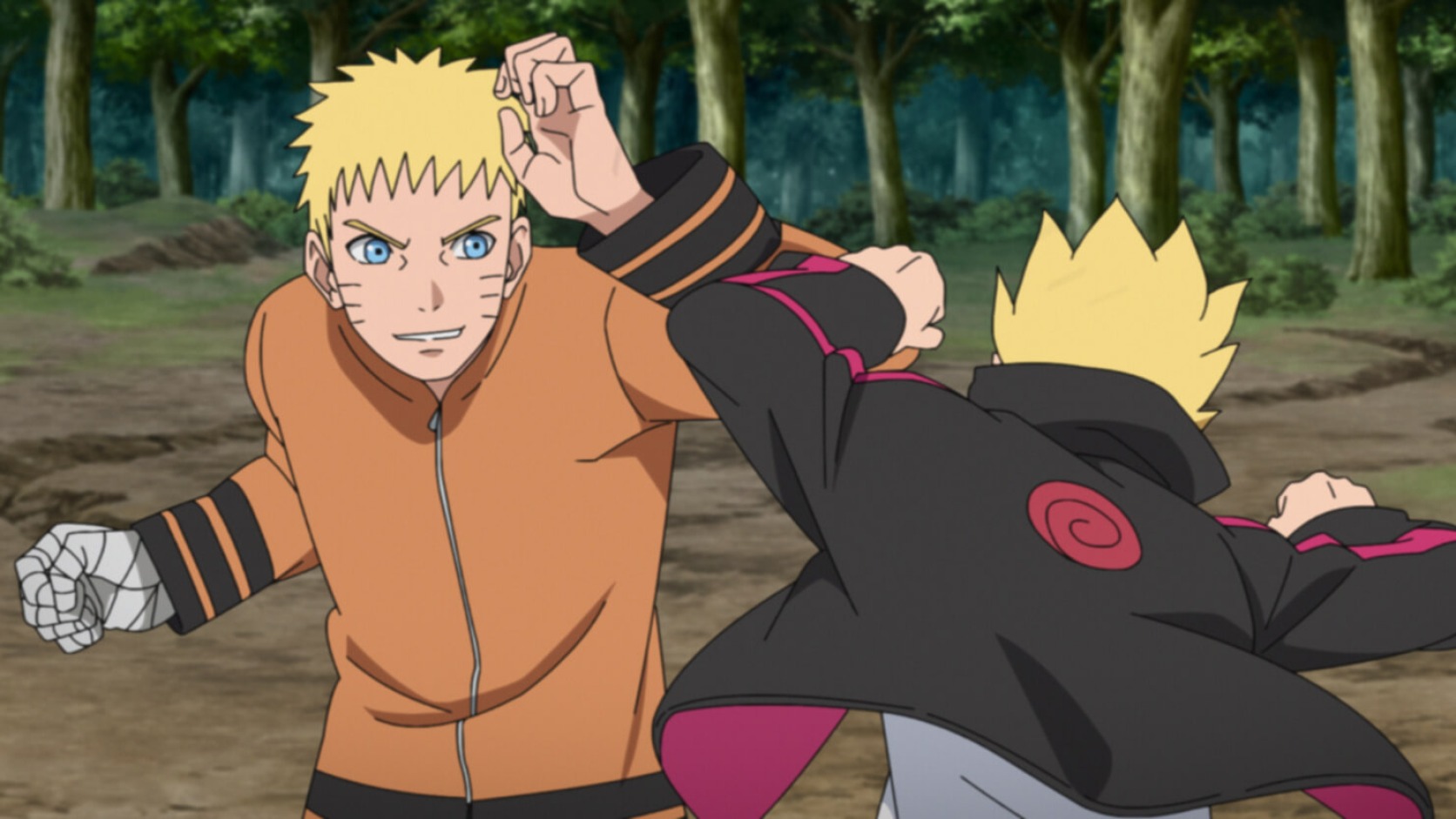
A Binding Force
A father-son spar gives Kawaki a new language for chakra, choice, and shared power while Koji proves that familiar connections can also hide a threat.
Series: Boruto: Naruto Next Generations
Episode: 196 · A Binding Force
Arc: Vessel
Release: April 25, 2021
Previous: Episode 195 · A Vase
Directory: All 293 Boruto episodes
Bottom line
Boruto Episode 196 turns a father-son spar into Kawaki’s first useful lesson about power that does not begin with domination. Naruto asks Boruto to train, Boruto struggles against the obvious gap between them, and Kawaki pushes him to activate Kāma so both boys can learn. The mark still comes from violence, yet their decision to study the mark together changes the relationship around that violence. Naruto then explains chakra as a binding force created through connection, experience, and the willingness to understand another person. Meanwhile, Kashin Koji slips through Konoha’s sensory barrier, reminding viewers that warm lessons do not cancel real security failures. The episode holds both truths: human bonds can create strength, and institutions still need competent safeguards.
The title names more than Kāma
“A Binding Force” could describe the two Kāma marks reacting to each other. The phrase reaches further. Chakra binds shinobi through shared labor, training, memory, and risk. Family binds Naruto and Boruto even when their communication becomes competitive. Emerging trust binds Kawaki to a household he still expects to lose. Surveillance binds him to the Hokage in a less comforting sense.
The title refuses one easy definition because connection itself is not automatically good. A bond can protect, teach, restrict, exploit, or expose. Episode 196 asks which forces give people agency and which forces turn people into property.
The glue remains beside Kawaki
Kawaki’s attention returns to the glue Boruto offered for Himawari’s broken vase. That small object carries unfinished accountability from Episode 195. Nobody has granted him a clean emotional reset just because a new episode began.
The glue also prepares the larger metaphor. Bonding does not erase cracks. Connection asks separate pieces to hold pressure together while their damaged edges remain visible. Kawaki can repair the vase only by slowing down enough to handle fragile material, and he can build trust only through the same patience.
Sarada and Mitsuki come to see him
Sarada and Mitsuki visit Boruto because the mysterious boy inside the Uzumaki home affects their friend, their village, and their missions. Curiosity is reasonable. Kawaki remains a person, not a public exhibit, so the household still needs boundaries around access and questions.
Their presence widens the social circle without pretending everyone has become friends. Team 7 observes, evaluates, and reacts from different positions. Boruto carries household frustration. Sarada remembers Kawaki’s public outburst. Mitsuki studies unfamiliar dynamics with his usual calm attention.
Boruto cannot summarize Kawaki cleanly
When friends ask how Kawaki is doing, Boruto has no simple answer. Kawaki can be rude, traumatized, dangerous, useful, lonely, observant, and capable of effort during the same week. A clean label would protect Boruto from ambiguity but would flatten the person living beside him.
That ambiguity is healthy for the story. Fandom conversations often sort characters into innocent victim or unforgivable threat. Episode 196 keeps the harder middle, where Kawaki deserves protection and must also learn how to protect others from his reactions.
Naruto chooses a practical lesson
Naruto proposes a shinobi hand-to-hand match with Boruto partly so Kawaki can observe. He does not begin with a classroom lecture on chakra theory. Movement gives Kawaki a language he already understands while changing the purpose of that movement.
Kara used combat to rank bodies, punish weakness, and prepare a vessel. Naruto uses combat to teach, measure, and communicate. Similar motions can carry completely different ethics depending on who controls the lesson, whether refusal is possible, and what happens after someone loses.
Consent changes training
Boruto agrees to spar with his father. Kawaki chooses to watch. The session has goals that participants can name. Nobody threatens food, shelter, or bodily safety if performance disappoints.
Those conditions may look basic, yet they distinguish training from abuse. Skill development should challenge a learner without making belonging conditional. Naruto can overpower Boruto at any moment, but he uses that advantage to create a safe ceiling rather than to prove ownership.
Boruto wants to impress two people
Boruto faces his father while Kawaki watches from the side. He wants Naruto’s recognition and does not want Kawaki judging him as weak. That audience turns a familiar family spar into a performance carrying pride.
His competitiveness is not empty vanity. Boruto has spent years trying to separate his identity from the Hokage’s reputation while still craving attention from Naruto the father. Kawaki’s arrival adds another boy whose opinion now matters more than Boruto wants to admit.
Naruto controls the pace without humiliating him
The difference in experience remains enormous. Naruto reads Boruto’s approaches, handles shadow clones, and makes control look casual. A parent can expose that gap cruelly or use the gap to create room for learning.
Naruto does not need to celebrate himself. The value comes from showing Boruto which choices remain predictable and which combinations create openings. Good instruction makes expertise visible without turning the learner into a joke.
Shadow clones become family language
Kawaki notices that both father and son rely on shadow clones. The technique is more than a signature move. Naruto’s entire life changed through a forbidden scroll, an impossible number of clones, and the first adult who protected him after recognizing his effort.
Boruto inherits the technique without inheriting the same loneliness. Their shared move therefore carries resemblance and difference. Kawaki sees a family language passed through practice rather than genetics alone.
A clone represents divided attention
Naruto’s shadow clones can work, train, gather information, and care for multiple responsibilities. Boruto has also experienced the painful limit of that solution when a clone replaced his father at Himawari’s birthday and disappeared.
The technique binds their history because the same power expresses devotion and absence. Episode 196 lets the visual shorthand return in a healthier setting where Naruto’s original body is present with his son.
Kawaki studies instead of dismissing
Kawaki’s interest in shadow clones reveals curiosity that Kara never encouraged for its own sake. He watches how Naruto and Boruto create, coordinate, and learn from duplicates. The question is not simply whether the technique wins.
Curiosity gives him a future-oriented posture. A vessel waits to be used. A student asks how something works and imagines gaining a skill. Every honest question moves him a little further from the identity Kara assigned.
Boruto struggles because talent is not mastery
Boruto is gifted, versatile, and inventive. None of those qualities erase Naruto’s decades of experience. The match makes the gap visible without declaring Boruto a failure.
Fandom often confuses potential with entitlement to immediate dominance. Training should reveal limits. A limit gives the learner information about timing, stamina, strategy, and control. Shame only says the learner should never have tried.
Kawaki tells Boruto to use Kāma
Kawaki pushes Boruto toward the power both boys fear because observation alone cannot answer their questions. His suggestion is practical and risky. Kāma connects them to enemies who treated their bodies as containers.
Using the mark voluntarily inside a supervised match changes the context. Boruto is not activating power for Jigen, Momoshiki, or Kara. He chooses a controlled experiment with his father ready to intervene and Kawaki ready to compare what he sees.
Boruto has the right to hesitate
Kāma is not a neutral tool. Boruto’s mark arrived through a lethal battle and carries implications nobody fully understands. Excitement about new strength cannot overrule fear about bodily autonomy.
Kawaki knows more about the mark, but expertise does not give him ownership of Boruto’s decision. Naruto’s presence helps ensure the suggestion remains a suggestion. Ethical training leaves space for hesitation, questions, and a safe stop.
Research happens inside relationship
The boys do not have a complete scientific protocol, yet their exchange creates useful observation. Kawaki knows how activation feels. Boruto can describe changes from another body. Naruto provides a stable opponent able to absorb mistakes without turning the session deadly.
Shared inquiry begins to replace secrecy. Kara hoarded information so subjects could not understand what had been done to them. Boruto and Kawaki gain power by comparing knowledge openly.
Kāma amplifies a familiar fighter
Activation does not erase Boruto’s established habits. His movement, clones, timing, and determination remain recognizable while speed and force rise. The mark changes capacity without supplying wisdom.
That distinction matters. Power cannot decide when use is justified or who deserves protection. Boruto still needs judgment, training, and people willing to challenge him. Kāma is an amplifier, not a moral education.
Naruto becomes the safest possible opponent
Few people in Konoha could test Kāma without placing Boruto or bystanders at unacceptable risk. Naruto’s strength lets him hold the encounter below a dangerous threshold while still giving Boruto meaningful resistance.
Safety does not mean softness. Naruto can press Boruto hard because he possesses the control to stop. Responsible power includes knowing how much force another person can absorb and refusing to make injury the price of useful data.
Kawaki becomes a coach from the sidelines
Kawaki’s comments show that he is no longer only the object adults study. He contributes knowledge. That role can restore dignity because lived experience becomes expertise rather than evidence against him.
The episode avoids making him grateful for trauma. Knowing Kāma comes from terrible conditions. Still, he can decide how to use that knowledge now. Agency grows when survivors control the meaning and destination of what they learned.
Boruto accepts help from someone he resents
Boruto does not need to like every part of Kawaki’s delivery to recognize useful guidance. Accepting help becomes another small repair after the vase conflict.
This exchange carries more weight than an easy friendship speech. Trust often begins through bounded competence: one person knows something, another listens, and the result proves useful. Emotional warmth can follow later.
The father-son match gives Kawaki a window
Kawaki watches Naruto challenge Boruto without contempt. Boruto can complain, fail, adapt, and try again without fearing abandonment. Their banter shows a relationship sturdy enough to hold competition.
For a child raised by abuse, ordinary family conflict can look miraculous. The revelation does not require everyone to behave gently every second. Security becomes visible when affection survives irritation and authority does not weaponize defeat.
Himawari watches beside Kawaki
Himawari’s presence near Kawaki signals cautious household inclusion after the vase incident. That image should not be read as proof that all risk has vanished. Adults remain responsible for safety.
Her company also gives Kawaki a model of watching family training without needing to earn a place through performance. He can sit beside someone, ask questions, and exist within the scene. Belonging begins through participation in small routines.
Naruto explains chakra as connection
Naruto tells Kawaki that chakra is a binding force. The explanation reaches back through the franchise, where chakra carries physical energy, spiritual energy, inherited history, and the traces people leave with one another.
Naruto’s authority comes from lived experience. He has met enemies through combat, felt their pain through exchanged blows, and changed because those encounters became understanding. Connection never excused harm, but understanding created routes violence alone could not find.
A bond is not automatic obedience
Calling chakra a binding force could sound sentimental if binding means everyone must agree. Naruto’s best relationships contain refusal, argument, distance, and return. Connection gains value because people remain distinct.
Kawaki needs this distinction. Kara called domination destiny and treated bodily invasion as an inevitable bond. A humane bond allows choice. People can care for him without owning his body or future.
Shared power can become shared language
Boruto and Kawaki’s Kāma marks give them an unwanted common experience. Neither boy chose the original connection. They can still choose how to respond together.
Their shared language includes activation, pain, fear, tactical knowledge, and questions adults cannot fully answer. Peer understanding does not replace adult care, but peer recognition can reduce isolation. Nobody else has to pretend complete understanding.
Similar pain does not make them identical
Boruto received Kāma after defeating Momoshiki. Kawaki endured years of conditioning, experimentation, and Jigen’s direct control. The marks connect them without making their histories interchangeable.
Good solidarity respects difference. Boruto should not claim Kawaki’s trauma because their palms carry related symbols. Kawaki should not dictate Boruto’s emotions because his suffering lasted longer. They can compare without competing.
The spar teaches reciprocal observation
Kawaki watches Boruto use Kāma, while Boruto can later learn from Kawaki’s activation. Each boy becomes observer and observed. Reciprocity reduces the hierarchy that Kara built around secret research.
Consent must remain part of that exchange. Shared marks do not create unlimited access to each other’s bodies or memories. Healthy collaboration names which information belongs to the individual and which information they choose to share.
Naruto makes room for knowledge he lacks
The Hokage is the strongest person present, but Kawaki knows more about Kāma’s practical behavior. Naruto does not need to pretend omniscience to preserve authority.
Competent leadership recognizes expertise wherever expertise lives, including inside a traumatized child. Listening does not weaken Naruto. Listening improves safety and shows Kawaki that adults can learn without punishing the person who corrects them.
Kashin Koji enters the village
While the household builds trust through training, Kashin Koji searches for Kawaki inside Konoha. His movement creates a deliberate contrast. The village feels safe enough for family lessons while an enemy crosses the perimeter.
Warmth cannot substitute for infrastructure. Naruto’s care matters, and Konoha still needs systems capable of detecting a sophisticated infiltrator. Personal goodness does not repair every institutional gap.
The sensory barrier has a dangerous exception
Koji bypasses Konoha’s sensory network because his chakra does not trigger the expected warning. The security system depends on assumptions about who counts as foreign.
Any filter built around familiar identity can fail when an attacker carries familiar credentials, origins, or signals. Institutions should test exceptions rather than treating a quiet alarm as proof of safety. Trust architecture needs layers.
Familiarity can hide a threat
The same episode celebrating chakra as connection shows how recognized chakra can become camouflage. A binding force helps people know one another, but recognition without context can open a gate.
That tension keeps the theme honest. Connection is not magic protection. Knowledge, consent, judgment, and accountability determine whether familiarity becomes care or access.
Koji watches rather than announces himself
Koji’s patience differs from Delta’s frustration. He gathers information and moves through systems while others continue ordinary life. Quiet surveillance can be more dangerous than an open attack because targets cannot respond to a threat they cannot perceive.
Kawaki has already lived under constant observation. The village must protect him without recreating the same loss of privacy. Koji’s infiltration makes that balance harder and more urgent.
Delta waits outside the boundary
Delta cannot follow Koji through the same route and resents losing control over his movements. Her frustration reveals fractures inside Kara. Members cooperate through hierarchy, rivalry, and suspicion rather than trust.
Their organization has bindings, but those bindings depend on fear and power. The contrast with Naruto’s training field could not be clearer. One group shares knowledge to expand agency. The other hoards knowledge to preserve advantage.
The episode places education beside surveillance
Naruto teaches in the open while Koji spies in secret. Both men gather information about Kāma. Their methods create the ethical difference.
Naruto involves Boruto and Kawaki in the process, gives them meaningful choices, and keeps the exercise proportionate. Koji treats Kawaki’s location and condition as intelligence owed to Kara. Research becomes care or extraction based on consent and purpose.
Boruto’s progress belongs to Boruto
Kawaki’s advice improves the session, and Naruto provides the opponent, but Boruto performs the work. Collaboration should not erase individual effort.
That balance mirrors the title. Binding forces connect people without dissolving them. Boruto can learn from his father and from Kawaki while keeping ownership of his choices, risks, and growth.
Kawaki’s progress includes watching safely
Kawaki does not need to fight in every episode to prove development. He watches a match, notices a technique, asks questions, offers knowledge, and receives an explanation. Those actions show regulation and participation.
Recovery stories become shallow when progress means only greater combat strength. The ability to remain present during excitement without treating every movement as a threat is also progress.
Naruto gives him a different inheritance
Jigen tried to make Kāma Kawaki’s inheritance, a future already written into his body. Naruto offers a competing inheritance through ideas, techniques, relationships, and choices.
Chakra as connection tells Kawaki that what passes between people need not be ownership. A lesson can be received, questioned, adapted, and passed forward. The recipient remains a person.
The training field becomes a family room
Naruto, Boruto, Himawari, Kawaki, Sarada, and Mitsuki gather around a lesson that moves between combat and conversation. The group does not share one legal family structure, yet the scene performs community.
People watch, challenge, learn, and remain. Kawaki’s place is not secured through a declaration. Presence accumulates through repeated moments where nobody sends him back to Kara.
Connection requires boundaries
The episode’s warm language should never be used to argue that every bond deserves preservation. Kawaki’s bond to Jigen must be broken. Boruto’s bond to Momoshiki threatens bodily autonomy. Koji’s familiar chakra exploits village access.
Healthy connection supports personhood. Harmful binding consumes personhood. The difference lies in consent, reciprocity, transparency, and the freedom to leave.
Strength can come from refusing isolation
Kara isolated Kawaki so every need would point back toward his captors. Boruto’s household and team create multiple relationships, which reduces any single person’s control.
Naruto connects him to training. Himawari connects him to ordinary family rhythm. Boruto connects him to peer conflict and shared research. Sarada and Mitsuki connect him to a broader generation. A network can protect where one savior cannot.
The episode keeps danger in the frame
Koji’s presence prevents the family material from becoming a fantasy of instant safety. Kawaki’s enemies are searching. Konoha’s systems have gaps. Kāma remains poorly understood.
Hope gains weight because the danger stays visible. The household is not healing in a sealed world. Everyone is building trust while threats actively test the perimeter.
RaeRae’s verdict
“A Binding Force” earns its title by making power relational. Boruto becomes stronger through Kawaki’s knowledge, Naruto’s controlled challenge, and his own willingness to try. Kawaki learns that a technique can connect father and son without turning either person into property. Naruto gives him language for bonds rooted in mutual recognition rather than forced destiny.
The episode also refuses a sugary conclusion. Koji crosses Konoha’s barrier while the family trains, proving that connection can become both protection and vulnerability. The best bond is not the tightest restraint. The best bond lets people remain whole, share knowledge freely, challenge each other safely, and leave room for boundaries. Kawaki has spent his life being bound to somebody else’s plan. Here, for a few quiet minutes, he helps build a connection he can actually choose.
Sources and lawful viewing
Official episode reference: Naruto Official episode guide
Licensed episode route: Crunchyroll licensed series page
The official guide identifies Episode 196 as “A Binding Force” and summarizes Naruto and Boruto’s hand-to-hand training, Kawaki’s suggestion that Boruto activate Kāma, Kawaki’s interest in shadow clones, and Kashin Koji’s search inside the village. Crunchyroll lists the licensed episode with an April 25, 2021 release date. Availability and language options can vary by region.