
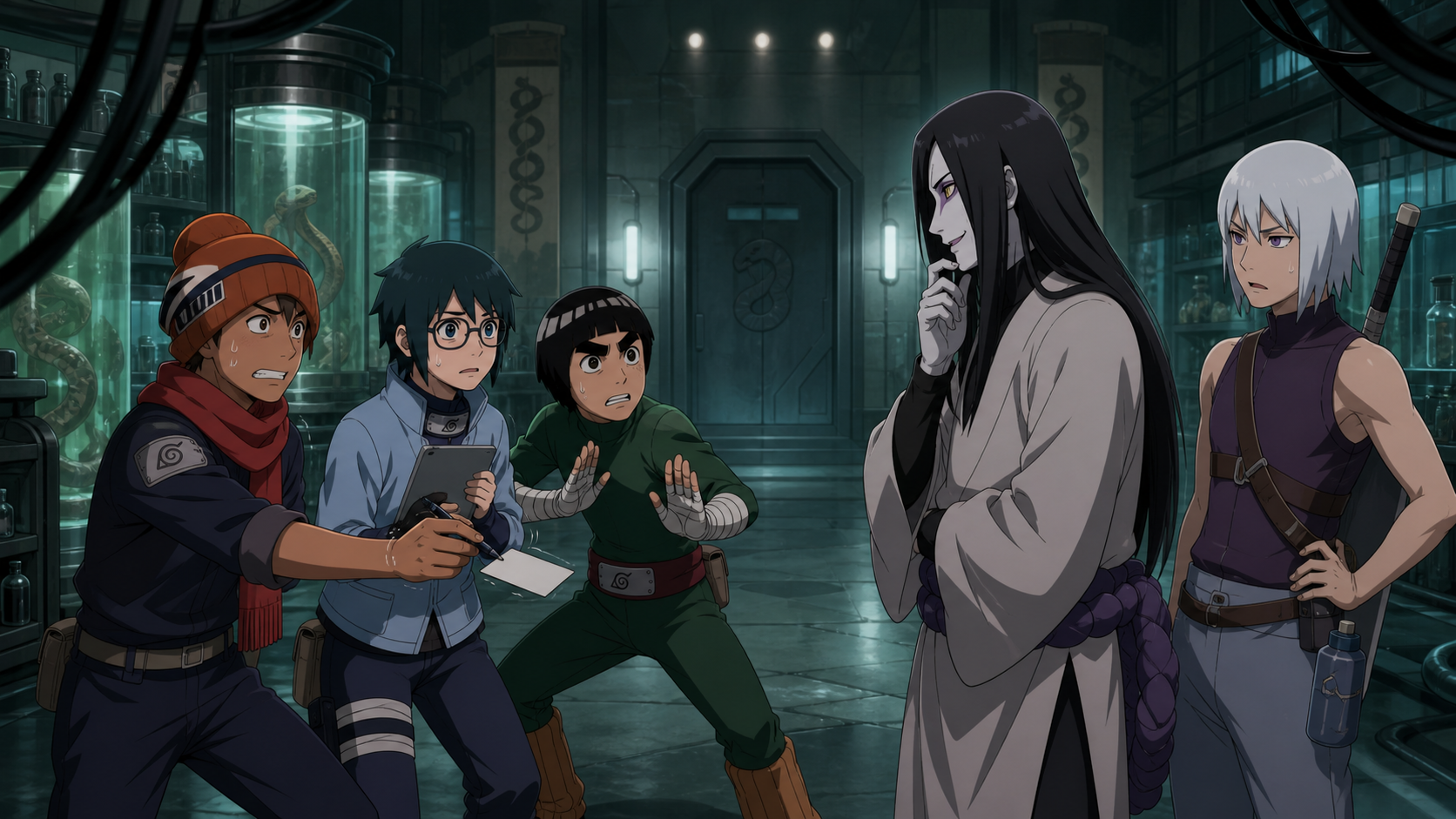
A Signature of Fear
Nattou turns surgery terror into a dare, Team 5 carries that dare into Orochimaru’s hideout, and one ridiculous autograph proves courage can tremble without surrendering.
Series: Boruto: Naruto Next Generations
Episode: 172 · A Signature of Fear
Arc: Kara Actuation
Release: 2020-11-01
Previous: Episode 171 · The Results of Training
Directory: All 293 Boruto episodes
Bottom line
Boruto Episode 172 builds a comedy errand around three different kinds of fear. Nattou fears surgery, so he turns terror into pranks and dares. Team 5 fears Orochimaru because the village’s history gives them excellent reasons. Orochimaru fears almost nothing, yet the discovery that Mitsuki has friends beyond Boruto catches him more honestly than any attack.
“A Signature of Fear” works when the joke never erases the truth underneath. Iwabe, Denki, and Metal walk into Orochimaru’s territory for a hospital patient they barely know. They admit they were scared rather than pretending courage means an empty nervous system. Orochimaru signs a trading card, but one polite autograph does not revise the human experimentation, invasions, murders, and stolen bodies attached to his name.
The episode also puts Boruto back in a hospital bed because his new Rasengan has a cost. Kakashi warns that compression can damage his arm. Sarada brings her own training progress. Konohamaru and Mugino watch Victor prepare for an inspection. What looks like a side-story autograph hunt quietly ties fear, recovery, friendship, and hidden laboratories into one argument: bravery requires knowing what can hurt you and moving with care anyway.
Boruto lands in the hospital after progress
Boruto’s High Compression Rasengan passed the Shojoji test and sent its user straight into medical care. That outcome keeps the upgrade honest.
Training produced greater force, but Boruto’s body still absorbs recoil. A technique cannot protect Team 7 if one use removes Boruto from the rest of the fight.
The hospital visit reminds viewers that success and safety are separate measurements. Boruto achieved the intended result. He has not mastered the cost.
Kakashi gives the warning after the applause
Kakashi does not deny Boruto’s breakthrough. He identifies the next problem: greater compression places greater strain on the arm.
That order matters. Good teachers can celebrate progress without hiding danger. Boruto deserves pride and limitation in the same conversation.
Kakashi’s warning also echoes Naruto’s Rasenshuriken history. A family technique can become powerful enough to injure the person carrying the legacy.
Team 5 shows up with friendship, noise, and food
Iwabe, Denki, and Metal visit Boruto because friendship includes inconvenient hospital rooms. Their energy does not cure him, but presence keeps recovery from becoming isolation.
Iwabe tries a Lightning Burger as bait. The plan is ridiculous and completely believable for teenagers who do not know what useful comfort should look like.
They also ask about Mitsuki. Team 7’s missing member has become a concern across the class, which makes Orochimaru’s later reaction land harder.
Nattou turns fear into chaos
Nattou throws food, antagonizes people, runs from staff, and acts as though every boundary is a personal challenge. The behavior creates comedy and exhausts everyone around him.
Then the nurse explains the coming operation. Nattou has not made peace with a procedure he cannot control. Acting impossible lets him control the room for a few minutes.
Understanding the fear does not make the behavior harmless. The adults still need boundaries. Compassion explains the explosion without asking nurses and patients to absorb every consequence.
The surgery deserves plain language
Children often hear adults talk around medical procedures, then fill the silence with worse possibilities. Nattou needs honest explanation suited to his age.
He also needs permission to say he is scared without converting fear into a performance of toughness. A dare cannot replace informed support.
The episode uses the autograph mission to redirect him, but the emotional need remains larger than a collectible card. Someone must help him face the operation after Team 5 returns.
Nattou chooses Orochimaru because fear has status
Orochimaru represents the ultimate scary ninja in village memory. An autograph becomes proof that Team 5 can approach the person everyone warns them about.
Nattou uses the request to test their courage and distract from his own. If they face Orochimaru, perhaps he can face surgery.
The logic is childish, but the emotional trade makes sense. People borrow bravery from stories when direct fear feels too large to name.
Team 5 does not owe a stranger an impossible errand
Iwabe, Denki, and Metal initially refuse, and that boundary is reasonable. Nattou manipulates them through pride.
Learning about the operation changes their decision, but sympathy should not erase consent. They choose the risk because they want to help and because Mitsuki’s condition gives them another reason to travel.
The episode works best when Team 5’s choice remains generous rather than mandatory proof of masculinity.
Denki researches before anyone walks into danger
Denki searches village records and helps locate Orochimaru’s hideout. Information turns a reckless dare into a planned visit.
His skill matters because courage without preparation would only deliver three children into a restricted site. Denki treats fear as a reason to gather facts.
The files also expose the gap between younger villagers and the adults who survived Orochimaru’s crimes. Team 5 knows the reputation. Records reveal why the reputation persists.
Konoha still watches Orochimaru
The surveillance shinobi near the hideout confirms that trust has limits. Orochimaru operates under monitoring because past crimes and current research justify oversight.
Yamato’s absence for a report does not mean the site becomes unrestricted. The remaining guard hesitates, which increases Team 5’s anxiety.
That hesitation is telling. If trained adults treat the entrance carefully, three genin should not interpret fear as cowardice.
Suigetsu protects the boundary badly
Suigetsu tries to dismiss Team 5 and the misunderstanding becomes a fight. He can neutralize ordinary attacks through his liquid body, making escalation pointless.
The children exploit a damaged power line, showing quick coordination, but the electricity only annoys him. Their plan creates danger without securing access.
Suigetsu’s response also shows why clear communication at restricted sites matters. Nobody benefits when a request for information turns into children attacking a guard.
Orochimaru stops the fight before comedy becomes injury
Orochimaru interrupts before Suigetsu retaliates seriously. The intervention shifts the scene from combat threat to social absurdity.
Team 5 finally states the request: they want an autograph. Orochimaru’s surprise is earned because nobody enters this hideout for fan service.
The pause also reveals power. Orochimaru does not need to threaten anyone. Everyone understands the danger already.
The autograph does not equal redemption
Orochimaru signs the card. The gesture helps a frightened child. Both statements can be true without producing absolution.
One moment of kindness cannot balance experiments on children, body theft, the Konoha invasion, or the lives destroyed through obsession. Redemption requires accountability far beyond a signature.
The scene becomes richer when viewers hold history beside present behavior instead of choosing only monster or eccentric parent.
Fear of Orochimaru is rational
Team 5 admits they were scared. Good. Pretending otherwise would be foolish.
Fear communicates threat. Their bodies recognize that Orochimaru’s calm does not erase capability or history. Courage means continuing with preparation while respecting the signal.
The episode rejects the idea that bravery belongs only to people who never tremble. Those people usually lack information.
Mitsuki’s other friends surprise Orochimaru
Team 5 asks about Mitsuki and learns that treatment remains critical but hopeful. Their concern reaches Orochimaru differently from Boruto and Sarada’s bond.
Mitsuki has built a wider community. Classmates notice his absence, travel to a dangerous hideout, and ask for news without being sent.
Orochimaru created Mitsuki to choose a path. Friendship beyond the expected pair proves that choice has developed roots Orochimaru cannot script.
Orochimaru’s pleasure is real and still complicated
Orochimaru appears pleased that Mitsuki has more friends. That reaction resembles parental relief.
The warmth should not be mocked away, nor should viewers use the warmth to sanitize control over Mitsuki’s body and origin. Care and possession remain tangled.
Boruto-era Orochimaru becomes interesting when the story allows emotional growth without rewriting the record.
Nattou receives proof that fear can be crossed
Team 5 returns with the signed card and tells the truth: they were frightened. That admission gives the gift meaning.
If they claimed the errand was easy, Nattou could dismiss the comparison. Hearing that fear remained present shows courage as action rather than personality.
The card becomes a physical reminder that terror does not automatically decide the next step.
A collectible cannot replace medical support
The autograph may help Nattou feel brave, but the hospital still owes him preparation, pain management, explanation, and emotional care.
Children should not have to perform fearlessness before receiving treatment. Nattou deserves support even if he cries, argues, or changes his mind repeatedly.
The best outcome is not a perfectly stoic patient. The best outcome is a child who understands enough to participate safely.
Boruto and Sarada compare progress without competing
Sarada meets Boruto in the hospital and they discuss training. Both have moved forward through different teachers and different risks.
The conversation does not need a winner. Boruto gained penetrating force and arm strain. Sarada gained sharper combat response and a clearer path through Sakura’s training.
Team 7 benefits when teammates share information instead of protecting ego.
Anato’s ring brings responsibility back
Boruto shows Sarada the ring belonging to Anato. They decide to return the item to Mia.
That choice reconnects training to the people harmed by Victor’s operation. Power upgrades cannot become the only response to tragedy.
Mia deserves truth, property, and recognition that Anato’s life mattered beyond the Hashirama cell plot.
Victor prepares a performance for the daimyō
Konohamaru and Mugino watch Deepa return to Victor’s company without the puppet. Victor has another problem: an inspection by the Land of Valleys’ ruler.
The company must appear legitimate while experiments approach their final stage. Corporate normality becomes camouflage again.
Inspections help only when officials can reach hidden rooms, verify records, and resist staged tours. Victor plans around predictable oversight.
Deepa reports failure without remorse
Deepa blames interference for the missing puppet. Team 10 and Team Shinki nearly died, yet his report reduces the encounter to an incomplete collection task.
That language exposes Kara’s moral emptiness. People become obstacles. Artifacts become inventory. Loss matters only when the organization loses value.
Shinki’s decision to destroy the puppet now looks even stronger. Deepa cannot hand Victor a consolation prize.
Konohamaru and Mugino see the inspection as an opening
The daimyō’s visit may disrupt routines and create access to areas hidden during the earlier tour. Konohamaru and Mugino plan to use the moment.
Their strategy depends on patience. Charging through the company would expose them and allow Victor to destroy evidence.
Observation becomes action only when the inspection changes the security pattern enough to justify the risk.
The funny episode keeps the Kara arc moving
An autograph errand may look detached from the main story. The episode actually advances several recovery lines.
Boruto learns the new Rasengan cannot be spammed. Sarada and Boruto decide to return Anato’s ring. Team 5 confirms Mitsuki’s critical treatment and wider friendships. Konohamaru and Mugino identify the inspection window.
Side-character comedy can carry plot when consequences remain visible.
Fear needs context, not shame
Nattou fears surgery. Team 5 fears Orochimaru. Sakura fears Sarada’s ambition may become self-damage. Konohamaru and Mugino fear what Victor hides.
None of those fears should be mocked out of existence. Each fear contains information about vulnerability.
Episode 172 is strongest when characters respond with research, friendship, supervision, and honest admission rather than hollow confidence.
The signature means more because everyone trembled
Orochimaru’s name on a card is a small object carrying a ridiculous journey. Team 5 crosses records, surveillance, Suigetsu, and their own imagination to obtain the mark.
Nattou receives more than celebrity proof. He receives evidence that three frightened people acted for him after he behaved terribly toward them.
That generosity does not make fear vanish. The operation remains. Mitsuki remains under treatment. Boruto remains injured. Victor remains active. Courage here is temporary, imperfect, and shared. For a fandom story about children living beside legendary monsters, that answer feels exactly right.
Nattou's care team needs to repair trust after the prank cycle
Nurses have probably explained rules, removed thrown food, chased Nattou through corridors, and tried to prepare him while he turns every conversation into a fight. Staff frustration is human. The next useful step is not another lecture about good behavior.
One adult should sit with him, name the surgery plainly, ask what image scares him most, and correct the parts his imagination made worse. The team can offer small choices about timing, comfort objects, visitors, and how he receives information. Choice cannot cancel medical necessity, but choice gives a frightened child somewhere safe to place control.
Boundaries still matter. Nattou cannot endanger other patients or abuse staff. Compassion becomes stronger when care protects everybody in the room, including the workers expected to absorb his fear.
Team 5 turns a dare into mutual responsibility
The errand begins because Nattou pushes their pride. The boys could complete the task, return the card, and enjoy proving themselves. Their best choice is telling him they were scared too.
That honesty refuses the masculinity trap inside the dare. Iwabe does not need to pretend toughness means fearlessness. Metal does not need to hide anxiety behind technique. Denki does not need to make research sound like cowardice beside physical courage.
Each boy contributes a different survival tool: preparation, persistence, coordination, and the willingness to admit the risk was real. Nattou receives a model of courage broad enough to include his own shaking body.
Yamato's surveillance cannot become ceremonial punishment
Konoha monitors Orochimaru because the risk remains serious. Surveillance only protects people when observers have clear authority, staffing, reporting routes, and access to independent review. One exhausted shinobi stationed outside a hideout can become a symbol that reassures the village without constraining much.
Yamato's personal history makes the assignment especially heavy. Orochimaru's experiments altered his body as a child. Asking that survivor to spend years watching the person responsible may serve security while also extending the original harm.
Konoha should rotate qualified staff, support Yamato's mental health, and ensure his consent matters. Accountability for Orochimaru cannot depend on making one former victim the permanent lock on the door.
Suigetsu exposes the danger of informal security
Suigetsu guards access through personality, reputation, and force rather than a visible procedure. Team 5 has no clear desk, contact, or request process. Confusion escalates because every participant assumes the other should already understand the boundary.
A restricted research site needs posted limits, an emergency contact for Konoha, and a way for minors seeking medical information to receive an answer without approaching the entrance. Security by intimidation invites dares and mistakes.
Suigetsu also deserves instructions that distinguish trespass, urgent news about Mitsuki, and harmless requests. Power can end a confrontation, but protocol prevents the confrontation from becoming necessary.
Orochimaru's autograph creates a debt the story should not overstate
Signing the card costs Orochimaru almost nothing and helps Nattou face a frightening day. The gesture is kind in effect. The scale matters because fandom loves turning one funny kindness into proof that a former villain has completed redemption.
Accountability lives elsewhere: disclosure of experiments, repair for survivors, limits on research, protection for Mitsuki, and cooperation that does not depend on Konoha ignoring the past. A signature cannot perform those obligations.
Viewers can enjoy the absurdity without flattening history. Orochimaru can make one frightened child smile and remain responsible for harm no collectible can balance.
Mitsuki's medical privacy still belongs to Mitsuki
Team 5 cares, and Orochimaru's answer offers relief. Concern does not grant classmates unlimited access to details about organs, treatment, or prognosis. Mitsuki should decide what information travels when he can participate.
Orochimaru has to balance reassurance with privacy, a strange responsibility for somebody who created Mitsuki and still controls specialized care. Saying treatment remains critical but hopeful gives friends enough to understand the absence without turning Mitsuki's body into public class news.
When Mitsuki returns, nobody should demand a complete medical story as the price of friendship. Support can begin with asking what he needs and accepting the boundary he sets.
Boruto's injury needs a technique-development record
Kakashi knows the High Compression Rasengan works and knows recoil damaged Boruto's arm. Konoha should document formation time, chakra demand, tissue strain, recovery, and conditions that make the technique unsafe.
That record protects Boruto from repeating the same injury and protects future students from copying a spectacular result without seeing the hospital visit. Shinobi culture often preserves successful jutsu while hiding the damaged bodies produced during invention.
Boruto also needs a safer training progression. More compression cannot remain the automatic next goal. Efficiency, bracing, alternate delivery, and conditions for refusing use matter as much as penetration power.
The daimyō's inspection needs people Victor cannot control
Konohamaru and Mugino see an opening because the official visit disrupts routine. The inspection becomes meaningful only if the ruler brings independent guards, technical advisers, and authority to enter spaces Victor did not prepare.
Victor controls employees, demonstrations, and the public story. A guided tour through approved rooms will certify whatever Victor wants certified. Surprise access and private worker interviews are necessary because polished transparency can be another security layer.
The Land of Valleys also needs a protected channel for employees to report danger before a ruler arrives. Oversight should not depend on one ceremonial visit discovering a hidden floor by luck.
Fear can be shared without becoming contagious panic
Team 5 names fear after the errand, and that admission helps Nattou. Honest fear differs from spreading catastrophic predictions. The boys explain what scared them, what preparation helped, and how they continued without claiming safety was guaranteed.
Medical staff can use the same pattern. Name likely pain, explain protection, describe what happens before and after, and answer questions without promising a perfect experience. Information gives fear boundaries.
The episode's strongest lesson is not “do the scary thing.” The lesson is that people can carry fear together, reduce avoidable risk, and refuse shame when the body reacts honestly.
After surgery, the same adults should return, answer new questions, manage pain, and prove that support was never conditional on Nattou acting brave before the procedure.
Sources and lawful viewing
Official episode reference: Naruto Official episode guide
Licensed episode route: Crunchyroll licensed series page