
The Results of Training
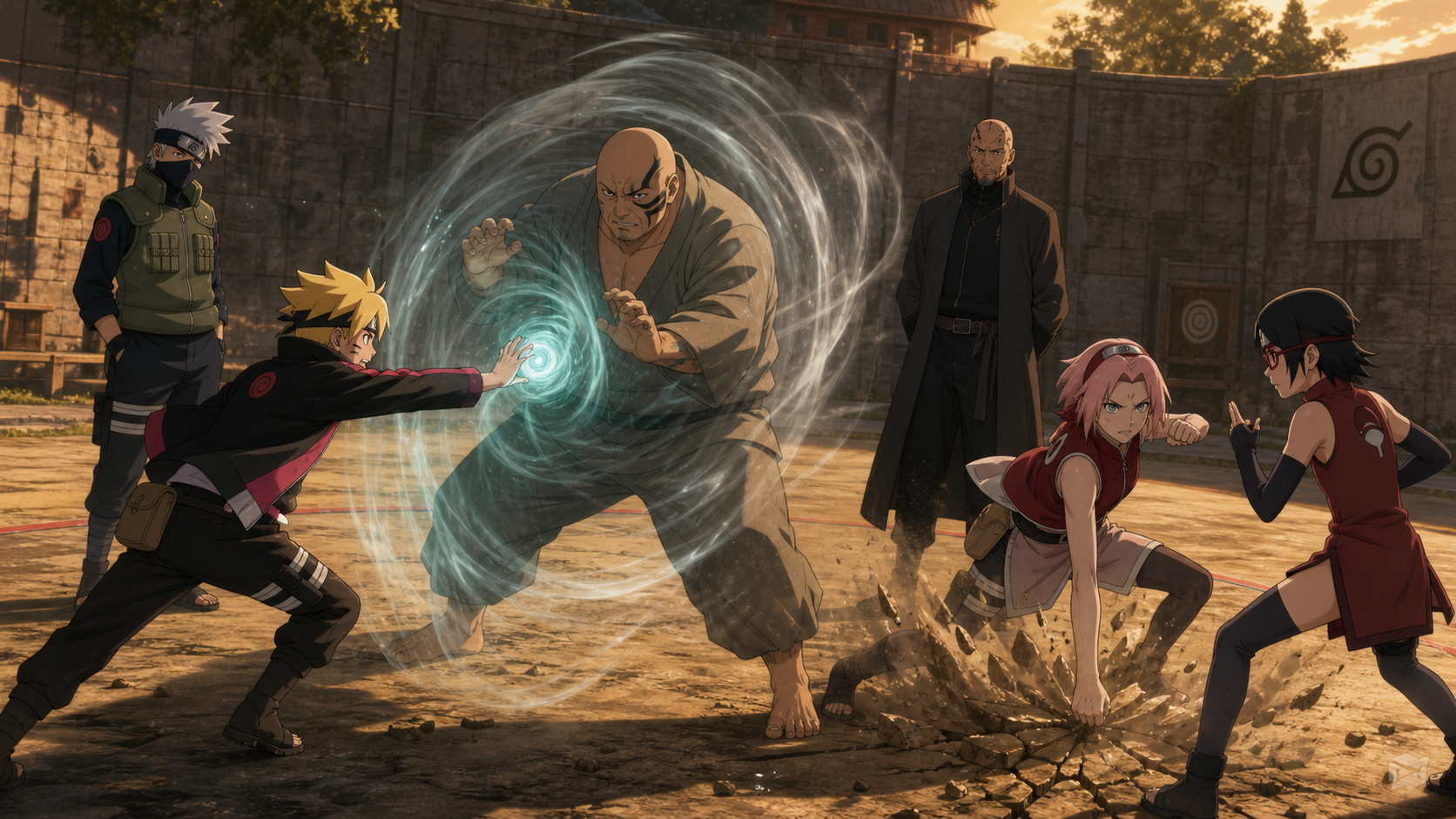
Boruto’s new attack breaks a defense that stopped him before. Sakura gives Sarada the harder result: sharper eyes still need a body, judgment, and chakra control capable of answering what they see.
Series: Boruto: Naruto Next Generations
Episode: 171 · The Results of Training
Arc: Kara Actuation
Release: 2020-10-25
Previous: Episode 170 · A New Rasengan
Directory: All 293 Boruto episodes
Bottom line
Boruto Episode 171 finally puts training in contact with resistance. Boruto’s High Compression Rasengan breaks through Shojoji’s wind shield, proving that the small sphere carries more than pretty chakra effects. Sarada spars with Sakura and discovers that seeing movement does not mean controlling the fight. Both students improve. Neither receives permission to pretend the work is finished.
“The Results of Training” also corrects a long-running imbalance. Sasuke can teach Sarada what the Sharingan reads, but Sakura teaches her what a body does with that information. Sakura’s chakra control, evasive timing, medical knowledge, and monstrous strength are not the less interesting half of Sarada’s inheritance. They are the reason Sarada can become more than a young Uchiha waiting for another tomoe.
Boruto gets the flashier breakthrough. Sarada gets the deeper lesson. Kakashi builds a controlled test around a known defense. Sakura becomes the opponent her daughter cannot flatter, copy carelessly, or defeat through anger. Good training reveals what changed and what still fails. Episode 171 does both.
Shojoji is a benchmark, not a punching bag
Kakashi chooses Shojoji because the Mujina Bandits leader already resisted Boruto’s earlier Rasengan with a wind shield. The rematch creates a clear comparison.
Shojoji remains a prisoner and a dangerous criminal. Those facts do not make him disposable training equipment. Kakashi and Ibiki supervise the arrangement, establish an incentive, and keep the confrontation bounded.
The ethical line matters. Boruto needs an opponent who fights back, but proving a jutsu cannot become an excuse for punishment disguised as education.
A reduced sentence changes Shojoji’s motivation
Shojoji agrees because victory may reduce his sentence. He has a reason to resist seriously rather than play along.
That incentive gives the test value. A friendly sparring partner might unconsciously leave openings. Shojoji wants the promised benefit and knows Boruto’s previous habits.
The deal still demands oversight. Prisoners operate under unequal power, and adults cannot wave away coercion because the participant is unpleasant. Kakashi’s certainty that the agreement will be honored must carry institutional weight.
Boruto faces an old fear under new conditions
Shojoji is not a random target. He kidnapped Tento, used Corpse Clone, and pushed Boruto into a frightening confrontation before Kara dominated the story.
Facing him again tests emotional control. Boruto cannot let memory turn a technical benchmark into personal revenge.
The new Rasengan needs clean execution. Anger that distorts timing or wastes chakra would prove that Boruto upgraded force without upgrading judgment.
The Wind Style Rasengan is the first answer
Boruto begins with wind nature integrated into the sphere. The technique shows deliberate control rather than the accidental lightning transformation behind the Vanishing Rasengan.
Purpose matters. Boruto now understands why the change occurs and which problem the wind quality should solve.
Shojoji’s shield provides the correct test because wind meets wind. Raw elemental labeling will not decide the exchange. Shape, density, timing, and control determine whether Boruto’s attack penetrates.
High compression changes the argument
The High Compression Rasengan concentrates chakra into an even tighter form. The sphere does not look enormous because scale is no longer the point.
Boruto’s innovation answers his actual reserves. He cannot manufacture Naruto’s Giant Rasengan through stubbornness, so he builds force through efficiency.
That solution feels like Boruto. Quick analysis produces the idea. Repetition makes the idea dependable. Combat proves whether intelligence survived pressure.
Shojoji’s shield finally gives way
The compressed attack punches through the wind defense that stopped Boruto before. That moment provides measurable progress instead of vague praise.
Kakashi can compare the old result and the new result against the same opponent. Boruto earns the breakthrough because the benchmark remains stable.
Breaking the shield does not prove the Rasengan can pierce Deepa’s carbon armor. Different materials, chakra properties, and combat speeds remain. The test confirms direction, not final victory.
Recoil keeps the upgrade honest
High compression creates force Boruto must contain and deliver. The technique risks injuring the user or losing stability.
That cost prevents the attack from becoming a free answer to every opponent. Boruto needs accuracy, timing, and support when recoil threatens his body.
Team 7 cannot replace one emergency sacrifice with another. Mitsuki’s injury should teach Boruto that a useful technique must leave the user capable of protecting friends afterward.
Kakashi stops celebration at the correct point
Kakashi recognizes success without declaring Boruto ready for Deepa. That balance is excellent teaching.
Students need evidence that work produced change. They also need adults willing to distinguish one passed test from mastery.
Boruto defeated a known shield under supervised conditions. Deepa moves differently, attacks lethally, and controls carbon across offense and defense. The next benchmark must account for those differences.
Sakura becomes Sarada’s necessary opponent
Sakura tells Sarada to fight her, turning parental concern into direct instruction. She does not ask Sarada to abandon ambition. She asks Sarada to show what current training can actually do.
The spar resolves their earlier argument through evidence. Sarada believes determination and Sharingan practice are enough to justify her pace. Sakura demonstrates the gaps without belittling the goal.
Parents can support a dream while refusing to pretend the child has already earned every dangerous step.
Sakura’s strength is not only one giant punch
People reduce Sakura to ground-cracking power because the spectacle is easy to remember. Her real threat begins with chakra control, footwork, timing, medical anatomy, and the judgment to place force precisely.
Sarada must read subtle movement before the fist lands. Sakura can feint, redirect, evade, and punish commitment.
The spar reminds viewers that raw strength without delivery would never have made Sakura a top combat medic or war veteran.
Sarada’s Sharingan sees more than her body can answer
Sarada tracks Sakura’s motion and still struggles to control distance. The eye supplies information. The rest of her has to convert information into safe action.
That gap is the same lesson Sasuke began with projectiles, now intensified by an opponent who adapts.
A kunai follows a trajectory after release. Sakura watches Sarada watch her, then changes rhythm. Human intelligence turns perception training into combat training.
Copying movement is not copying mastery
The Sharingan can imitate visible motion, but Sarada cannot copy years of chakra control, conditioning, tactical experience, and medical knowledge in one glance.
This distinction protects the dojutsu from lazy storytelling. An eye may show the shape of a technique. The body still needs the foundation.
Sarada can learn from Sakura’s movement without pretending inheritance replaces practice.
Sakura knows exactly how hard to hit
The spar looks fierce because Sakura’s power makes every impact frightening. Her control is the safety mechanism.
She can crack the ground without striking Sarada lethally. That precision separates teaching from venting parental fear.
Sakura does not lose control because the earlier argument hurt. She turns emotion into a structured test, which models the discipline Sarada needs.
Sarada stops hearing concern as disbelief
Facing Sakura lets Sarada understand that her mother’s caution comes from knowledge, not contempt.
Sakura knows what Sarada can become. She also knows the distance between potential and readiness.
The spar converts “I am worried” from a vague emotional barrier into specific combat feedback. Sarada can work with specifics.
Sasuke and Sakura teach different halves of one fighter
Sasuke trains the Sharingan, lightning prerequisites, and Uchiha combat logic. Sakura trains chakra control, strength, evasion, endurance, and medical awareness.
Sarada does not need to choose which parent supplies the more prestigious inheritance. Her future style can join both.
That combination also serves her Hokage goal. A leader needs perception and force, but also control, survival knowledge, and the ability to assess injuries beyond personal pride.
The episode gives Sakura earned authority
Sakura survived the Fourth Shinobi World War, trained under Tsunade, mastered the Strength of a Hundred Seal, and became one of Konoha’s leading medical authorities.
Her daughter should learn from that record. The strange choice would be leaving Sakura outside the training arc while Sarada seeks only Uchiha techniques.
Episode 171 finally treats motherhood as an expansion of Sakura’s authority, not a replacement for her combat identity.
Boruto’s result is easier to display
Boruto breaks a shield and knocks down a known enemy. Viewers can point to the exact frame where progress becomes visible.
Sarada’s growth appears through improved reading, endurance, and the decision to accept another training route. Those results are less explosive but no less important.
Power scaling conversations often privilege whatever leaves the largest crater. The episode asks for a wider definition of improvement.
Sarada does not receive a free tomoe
The spar does not magically add another tomoe because Sarada worked hard and loves her mother. Good.
Sharingan evolution follows emotional conditions that cannot be scheduled like a fitness goal. Immediate reward would flatten both the eye and the training.
Sarada instead gains clarity about what she can strengthen now. Controllable progress matters more than waiting for trauma to unlock a bloodline stage.
Deepa remains beyond the test
Neither Shojoji nor Sakura recreates Deepa. The training results are pieces of an answer.
Boruto now possesses a more penetrating attack. Sarada improves the chain between sight and movement. Team 7 still lacks Mitsuki, battlefield coordination, and evidence that either upgrade can survive carbon cubes.
Confidence should return carefully. Deepa punished confidence that outran information.
Mitsuki’s absence prevents easy triumph
Boruto and Sarada celebrate progress while their teammate recovers away from the village. That absence keeps the training arc from becoming a victory lap.
Team 7’s result cannot be measured only by individual techniques. The team must reunite without asking Mitsuki to destroy his body again.
Every new skill should reduce the likelihood that one member becomes the emergency exit.
Results create responsibility
Boruto now knows the High Compression Rasengan can break a serious defense. Sarada knows her Sharingan training works and knows where her body still falls behind.
Knowledge removes excuses. Boruto must manage recoil and choose targets carefully. Sarada must continue foundations rather than chasing Chidori through impatience.
Progress does not reduce responsibility. Progress increases the harm a careless choice can cause.
Training ends only on paper
Kakashi’s test concludes. Sakura’s spar identifies the next direction. The episode can call these “results” without claiming either student is complete.
Real training cycles through attempt, evidence, correction, and another attempt. Deepa forced the first correction. Shojoji and Sakura provide evidence that the correction has begun working.
The next fight will expose another layer. That is not failure. That is how skill grows when nobody pretends perfection arrived early.
The results belong to the whole support system
Boruto formed the attack, but Kakashi designed the progression, Shikadai offered observation, Ibiki controlled the test, and earlier lessons from Konohamaru and Sasuke shaped the Rasengan history.
Sarada did the visual work, but Sasuke established the prerequisite and Sakura turned perception into live combat understanding.
Training stories become shallow when every breakthrough is credited only to individual will. These children improve because experienced adults invest time, boundaries, knowledge, and care.
Results are not revenge
The most important change is emotional. Boruto does not use Shojoji as a substitute for Deepa. Sarada does not strike Sakura to win their argument.
Both tests remain about information. Can the new Rasengan break a known wind shield? Can Sarada’s eye and body respond to an adaptive elite opponent?
Episode 171 answers yes and not yet. Boruto’s technique works. Sarada’s direction works. Deepa remains dangerous. Mitsuki remains absent. Nobody becomes perfect, and nobody needs perfection to prove that disciplined effort moved Team 7 forward.
Shojoji's participation needs a written boundary
The reduced-sentence offer gives Shojoji a reason to fight seriously, but prison incentives can become coercive when terms remain vague. He should know the exact benefit, who authorized the agreement, what conduct ends the test, and what medical care follows an injury.
Boruto also needs to understand that Shojoji's criminal history does not make unlimited force acceptable. The goal is penetrating a defense, not adding punishment to a sentence already imposed. Kakashi and Ibiki must stop the exchange once the benchmark is met.
Clear rules protect everybody. They preserve the value of the result, prevent revenge from hiding inside training, and ensure Konoha can explain why using a prisoner served a legitimate educational purpose.
Kakashi chooses a benchmark with memory
Shojoji does more than reproduce a wind shield. He remembers Boruto's habits, emotional tells, and earlier limitations. The test includes an opponent who can update strategy instead of standing like laboratory equipment.
That memory makes Boruto's control more important. He cannot rely on surprise alone or assume the same opening will appear. He has to form the compressed sphere while managing a person who wants the sentence reduction and knows exactly why the test exists.
Deepa will be faster, deadlier, and less contained. Shojoji cannot simulate every condition, but a resisting mind provides better evidence than another rock face ever could.
Boruto needs a failure procedure for the new technique
Compression can destabilize before release. Boruto should know where to vent chakra, how teammates recognize a dangerous wobble, and when to abandon formation rather than force completion. A finishing move without a safe failure procedure threatens the people protecting the preparation window.
Kakashi can teach that discipline because the Chidori required conditions and carried serious risk before Sharingan support. Powerful techniques often demand rules about timing, line of sight, and withdrawal.
Boruto's intelligence should appear in the safety plan as clearly as the attack design. The smartest invention is not only the one that works. The smartest invention fails without taking the team with the user.
Sakura teaches Sarada that perception includes the whole body
The Sharingan draws attention toward the eyes, but Sakura's spar makes Sarada feel information arriving through feet, balance, breath, pain, and distance. A fighter reads the ground and the opponent together.
Sakura can alter terrain with one strike, forcing Sarada to adjust footing while tracking the next movement. Medical training also gives Sakura precise knowledge of joints and vulnerable angles. Sarada cannot solve that pressure by staring harder.
Hokage-level awareness needs the same breadth. Sarada will have to notice systems and people outside the most dramatic threat. Her mother's training begins that habit through combat.
Sakura's concern includes knowledge Sarada does not possess yet
Sakura has treated shinobi who pushed through warning signs, hidden injuries to remain useful, and discovered too late that determination did not protect tissue. Her caution comes from a hospital record Sarada has never had to read.
The generation gap can make that experience sound like fear of ambition. Sarada hears a parent saying no. Sakura sees the likely patient after a reckless yes.
The spar helps translate medical knowledge into sensation. Sarada understands the delay between seeing danger and controlling the body because Sakura gives her a safe version of the consequence.
Sarada's Hokage path needs recovery discipline
Leadership culture often rewards the person who keeps standing. A future Hokage also has to model rest, report injury honestly, and prevent subordinates from treating self-damage as loyalty.
Sarada can begin by tracking visual strain, muscle fatigue, chakra depletion, and the recovery required after strength training. Those records help Sakura adjust the program and help Sarada distinguish normal effort from a warning.
Recovery does not sit outside training. Recovery determines whether today's result becomes tomorrow's foundation or a chronic problem hidden under pride.
Shikadai's observation carries real value
Shikadai can notice formation time, Shojoji's reactions, and Boruto's tendency to chase the satisfying angle. Watching from outside the exchange gives him information Boruto cannot collect while controlling compression.
Team-based development should use that perspective. Boruto can explain what the technique felt like while Shikadai explains what the field looked like. Neither account is complete alone.
The habit will matter against Deepa. A teammate who identifies armor timing or projectile rhythm may create more value than another person throwing power at carbon.
The hospital should see the breakthrough before the rematch
Once the test confirms penetration, Boruto needs examination before another field use. Medical staff can compare grip strength, swelling, nerve response, and chakra-pathway stress against the pre-test baseline.
That information tells Kakashi whether the technique is sustainable and tells Boruto which symptom means stop. Without the examination, the village learns only that the shield broke. The body may be carrying a different result.
Scientific ninja tools receive testing because hidden failure becomes dangerous. A new jutsu deserves the same seriousness when a child supplies the hardware.
Mitsuki's absence should change the team plan now
Boruto and Sarada cannot wait until Deepa appears to decide how they will fight without Mitsuki. Their standard formation, reconnaissance, elemental combinations, and emergency extraction all relied on him.
Training should identify which roles remain uncovered and whether another shinobi can support the mission temporarily. Pretending Team 7 remains tactically complete places extra pressure on the two members present and invites them to overuse new techniques.
Friendship honors Mitsuki by refusing to treat his body as an assumed resource. The team can miss him, plan for his recovery, and still build a safe formation for the current reality.
The episode makes “not yet” sound like useful information
Sarada does not defeat Sakura. Boruto does not prove the Rasengan against carbon armor. Those limits do not cancel the results. Each test narrows the next question.
Boruto needs recoil control and a delivery plan under lethal pressure. Sarada needs faster physical response around improved perception. Team 7 needs coordination that protects Mitsuki from becoming the emergency answer.
Good training replaces vague insecurity with specific work. “Not yet” becomes direction instead of humiliation when teachers explain what changed and what the next safe step requires.
Boruto and Sarada also need to explain those limits to each other before the rematch. Sarada should know how long compression takes and which sign means Boruto must stop. Boruto should know when visual strain or fatigue makes Sarada's tracking unreliable. Shared limits become tactical information, not private weaknesses teammates discover after the plan has already failed.
That conversation is another result of training: power becomes safer when the people building a plan understand the cost carried by every teammate.
Sources and lawful viewing
Official episode reference: Naruto Official episode guide
Licensed episode route: Crunchyroll licensed series page