
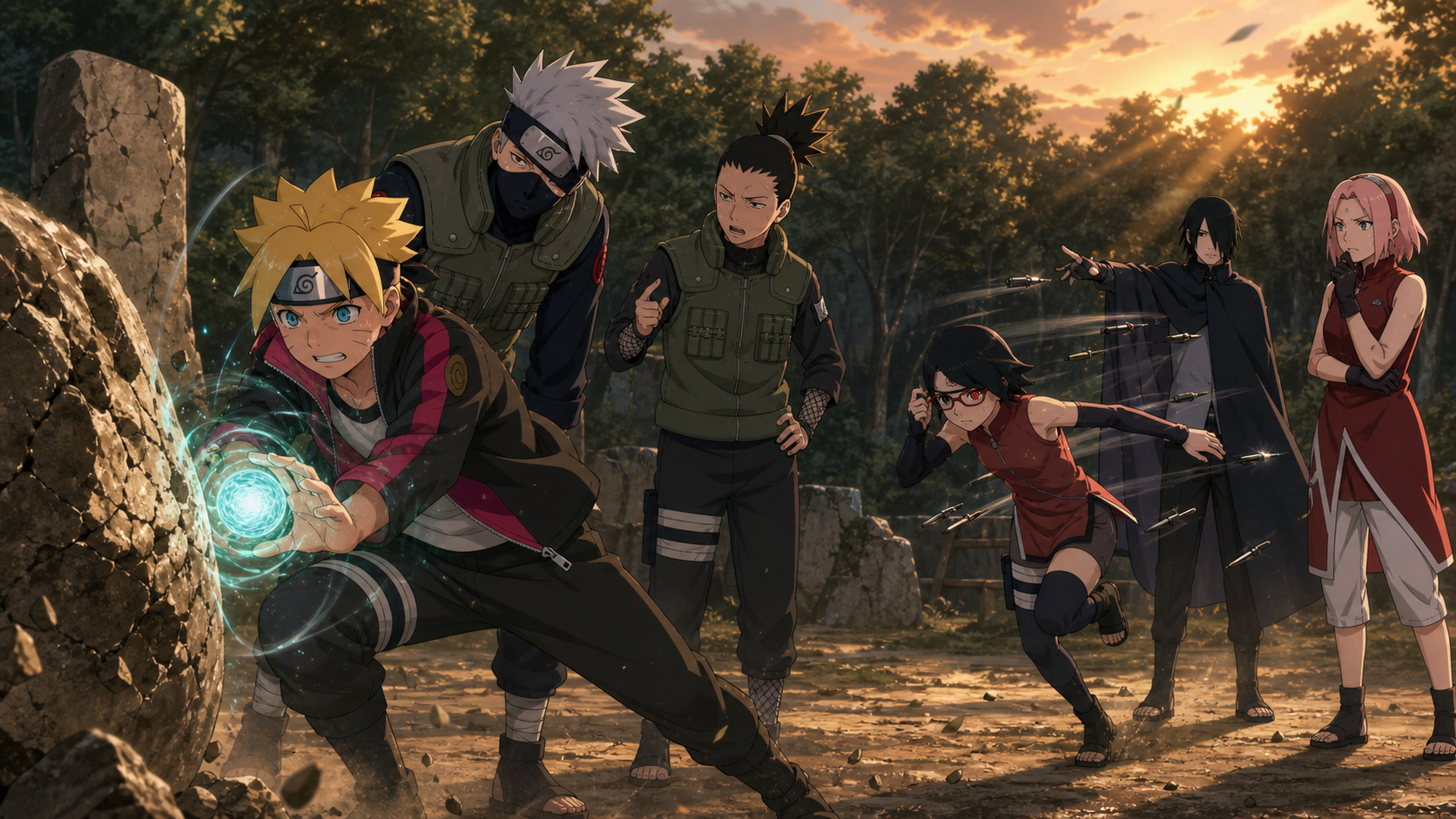
A New Rasengan
Boruto’s answer is not bigger. Compression makes a small sphere dangerous, Sarada builds the perception Chidori requires, and Kakashi refuses to let a broken boulder certify combat readiness.
Series: Boruto: Naruto Next Generations
Episode: 170 · A New Rasengan
Arc: Kara Actuation
Release: 2020-10-18
Previous: Episode 169 · A Joint Mission With the Sand
Directory: All 293 Boruto episodes
Bottom line
Boruto Episode 170 makes the smart choice and refuses to unveil the finished attack simply because the title says “A New Rasengan.” Boruto spends the episode learning compression, failing against stone, listening to Shikadai, and discovering that his clever shortcut creates its own danger. Sarada improves her Sharingan endurance while Sakura watches determination drift toward self-punishment. Kakashi ends the hour by arranging a real test against Shojoji, because a crater in a boulder cannot tell Boruto whether his technique survives an opponent who fights back.
The episode is about measurement. How much chakra can Boruto compress before control breaks? How long can Sarada maintain visual focus before exhaustion creates mistakes? How far should a parent let a child push after a near-fatal mission? When does training prove readiness, and when does training merely produce a prettier failure?
Nobody receives a perfect answer. That uncertainty makes the chapter useful. Deepa exposed Team 7’s limits through violence. Kakashi, Sasuke, Sakura, Shikadai, and Boruto now turn those limits into specific questions. Progress finally has something better than optimism behind the effort.
The Giant Rasengan fantasy is gone
Boruto has accepted that Naruto’s chakra budget does not belong to him. Episode 170 begins after that ego correction, which matters because training can only become honest once imitation stops controlling the goal.
The answer is not “try harder until you become Naruto.” Boruto needs to use the chakra he owns with greater efficiency. A smaller sphere can carry greater force when compression increases density.
That direction fits Boruto’s established intelligence. He has always succeeded through speed, observation, and unusual applications. The new challenge asks him to make cleverness reliable rather than accidental.
Compression turns small into dangerous
The Rasengan already depends on shape transformation. Boruto pushes the principle further by forcing chakra into a tighter space.
The result looks modest beside Naruto’s giant versions. Visual size no longer communicates threat. A compact sphere can concentrate force enough to pierce or shatter what a broader impact only strikes.
That design directly answers Deepa’s armor. Boruto does not need to cover more surface. He needs to push through one point before carbon can distribute the damage.
A boulder cannot flatter Boruto
Kakashi gives Boruto stone because stone provides immediate evidence. The boulder does not care about famous parents, fast learning, or determination.
Every failed attempt leaves a mark Boruto can inspect. Too little compression produces insufficient damage. Too much instability wastes chakra and threatens control. The target converts feelings into data.
Boruto’s frustration remains real, but frustration no longer gets final authority. The rock answers every claim.
Shikadai brings the outside eye Boruto needs
Shikadai visits and sees the problem without carrying Boruto’s emotional urgency. That distance lets him notice patterns Boruto misses.
Friends are useful in training when they do more than cheer. Shikadai can say that an approach looks inefficient, ask what Boruto is trying to accomplish, and recognize progress without pretending the technique is finished.
His involvement also connects the training to the larger generation. Shikadai has just faced Deepa in the desert. He understands why Boruto refuses to remain satisfied with the old Rasengan.
Deepa has become a shared warning
Shikadai’s encounter confirms that Team 7 did not exaggerate Deepa’s power. Two teams and Shinki’s Iron Sand still failed to defeat him.
That information should frighten Boruto, but fear now arrives with tactical value. Deepa’s defense remains consistent. Compression targets the exact problem multiple teams could not solve.
The danger is obvious: Boruto can let comparison push him into rushing. A technique built to defeat one man still needs to remain safe and useful beyond that rematch.
Kakashi teaches through boundaries
Kakashi does not hover over every movement. He establishes the problem, watches Boruto work, and refuses to certify progress prematurely.
That method respects Boruto’s intelligence while preventing self-deception. Kakashi knows a prodigy may solve technical puzzles quickly and still misunderstand combat readiness.
His calm can look detached, but the structure is careful. He keeps Boruto away from a live target until the shape, nature, and compression stop behaving like guesswork.
The new Rasengan can hurt its user
Compression creates recoil and control risk. More force inside less space means Boruto’s hands and body must contain the technique long enough to deliver the strike.
That danger stops the upgrade from becoming free power. A jutsu that destroys Boruto’s arm or destabilizes before contact cannot protect teammates.
Naruto learned similar lessons through the Rasenshuriken. A devastating attack may demand delivery changes, medical caution, and restraint. Family history should help Boruto avoid repeating every injury personally.
Sarada trains the eye she has
Sarada still wants Chidori, but Sasuke has made the prerequisite clear. Her one-tomoe Sharingan needs greater perception and endurance before extreme speed becomes remotely safe.
She therefore continues projectile drills. Tracking many moving objects forces her to process direction, timing, and threat while her body responds.
The exercise lacks Chidori’s glamour. That is why the work matters. Foundations rarely look like the dream technique they make possible.
Seeing danger and moving safely are separate skills
Sarada can identify projectiles without automatically escaping every trajectory. Her muscles, balance, and reaction patterns must catch up to her eye.
Episode 166 proved the gap. Sarada saw Deepa’s attacks and still lacked enough physical response to avoid all damage. Better vision alone would merely show failure in sharper detail.
Sasuke trains integration. The eye reads. The mind selects. The body commits. Any delay between those stages becomes an opening.
Sakura’s concern is not anti-ambition
Sakura worries because Sarada recently left the hospital and now pushes through punishing drills. That reaction does not mean she wants a weak daughter.
Sakura knows battlefield medicine, overtraining, and Sasuke. She recognizes the Uchiha tendency to turn pain into proof of seriousness. She also knows Sarada’s Hokage goal deserves a body capable of reaching adulthood.
Fandom often treats the cautious parent as an obstacle until somebody collapses. Sakura deserves better. Her concern belongs inside the training plan, not outside the story.
Sarada hears fear as doubt
Sarada interprets Sakura’s worry through the rawness of recent defeat. Any request to slow down sounds like a suggestion that she cannot become strong enough.
That misunderstanding feels painfully familiar. A teenager focused on proving ability may hear love as lowered expectations.
Sakura and Sarada are not fighting over whether Sarada should grow. They disagree about what responsible growth looks like after trauma.
Sasuke cannot be the only parenting language
Sasuke expresses care through rigorous instruction and direct prerequisites. Sarada values that language because the goal feels concrete.
Sakura brings another form of expertise: medical limits, emotional knowledge, and long memory of what obsession did to Sasuke. Her voice complicates the clean teacher-student dynamic.
Sarada needs both parents, even when their lessons do not arrive in the same tone.
Ino and Hinata give Sakura room to speak
The adults’ conversation lets Sakura admit fear without turning the entire household into an argument. Ino and Hinata understand children, shinobi work, and the helplessness of watching someone you love choose danger.
That friendship matters. Parents need witnesses who can hear concern without instantly labeling the child reckless or the parent controlling.
The scene also keeps women’s emotional labor visible. Training arcs often give every meaningful conversation to male teachers. Sakura’s uncertainty deserves equal narrative space.
Boruto’s solution uses brains before reserves
Boruto begins manipulating compression with the kind of lateral thinking Kakashi expected. He cannot add endless chakra, so he changes how existing chakra behaves.
That answer differentiates him from Naruto without insulting Naruto’s method. Father and son solve different versions of the same technique using different physical resources.
Boruto’s intelligence becomes valuable when discipline supports his thinking. A clever idea still needs repetition, control, and evidence.
Breaking stone proves only one thing
The damaged boulder shows that Boruto increased destructive force. That result is real and worth acknowledging.
Stone does not dodge, counter, shield itself with wind, exploit hesitation, or threaten Boruto’s friends. Training targets isolate variables. Combat recombines every variable at once.
Kakashi refuses to confuse a laboratory result with full readiness. The distinction protects Boruto from celebrating too early.
Shojoji is an ugly but logical test
Kakashi asks Ibiki to arrange a confrontation with imprisoned Mujina Bandits leader Shojoji. The choice sounds wild until the tactical reason appears.
Shojoji uses a powerful wind shield capable of resisting Boruto’s earlier Rasengan. He already knows Boruto’s habits, and Boruto knows his cruelty. The opponent provides a measurable benchmark.
If the compressed Rasengan cannot break that defense, Deepa’s carbon armor remains a fantasy target.
A prisoner should not become disposable equipment
The training arrangement deserves scrutiny. Shojoji is dangerous and convicted, but incarceration does not erase every ethical question.
Kakashi and Ibiki must control the conditions, prevent lethal force, and avoid treating reduced sentencing as coercion without boundaries. Boruto also needs to remember that proving a jutsu does not authorize execution.
The next episode must earn the fight through clear safeguards rather than asking viewers to cheer because Shojoji is unpleasant.
Kakashi chooses an opponent with consequences
A sparring partner from the village might hold back or unconsciously help Boruto succeed. Shojoji has incentive to resist and enough experience to punish sloppy timing.
The test therefore measures more than impact. Boruto must manage distance, fear, memory, and a human defense.
Kakashi is moving him from controlled repetition to constrained combat, the correct next stage once the boulder stops providing new information.
Progress does not erase Mitsuki’s cost
Boruto and Sarada improve because Mitsuki’s injury made their weakness impossible to ignore. The training should never turn that cost into a cheerful motivational prop.
Mitsuki remains absent from the field. His body still recovers elsewhere. Every improvement carries the uncomfortable truth that he paid for the time they now use.
The proper response is not permanent guilt. The proper response is refusing to waste the survival he purchased.
The episode separates effort from punishment
Boruto and Sarada both work hard, but their families and teachers keep circling the line where effort becomes self-harm.
That line moves with injury, control, and emotional state. No slogan can locate the boundary for every person. Good training requires observation and adjustment.
Neither child benefits from adults who confuse suffering with commitment. Kakashi measures output. Sasuke watches perception. Sakura notices physical and emotional strain. Those perspectives create a safety net without making the work easy. Difficulty remains necessary. Unexamined damage does not.
Deepa punished them. Training should prepare them. When training merely repeats punishment, the enemy still controls the lesson.
A new technique needs a new responsibility
Boruto’s compressed Rasengan may become strong enough to penetrate defenses that stopped him before. Greater concentration also increases the consequence of missing, losing control, or striking the wrong target.
Power does not arrive alone. Accuracy, judgment, and restraint must grow beside the new force.
Kakashi’s test will reveal whether Boruto understands that responsibility under pressure.
The title promises direction, not completion
“A New Rasengan” names the work before viewers see the final performance. The episode ends at the threshold of proof.
That restraint is welcome. Boruto has created a promising answer. Sarada has improved her visual stamina. Neither student has demonstrated readiness against Deepa.
Episode 170 gives progress enough room to remain imperfect. The boulder breaks, the Sharingan lasts longer, Sakura still worries, and Shojoji waits behind a controlled test. Training has produced possibility. Episode 171 must determine whether possibility survives contact.
Compression needs repeatability before Boruto calls the technique ready
One successful strike against stone proves possibility. Boruto needs repeated attempts that produce similar force without increasing hand injury, formation time, or instability. A technique that works once through perfect concentration may fail when smoke, noise, pain, and teammates crowd the field.
Kakashi should record how many attempts succeed, how long each sphere takes, and which warning signs appear before control breaks. Repeatability separates a discovery from a dependable jutsu.
Boruto loves the moment when an idea clicks. The less glamorous work begins after that moment: performing the same control while tired, stopping safely after a mistake, and accepting that a lower-power version may be the responsible choice.
Boruto's hands are part of the training equipment
Stone can be replaced. Boruto's wrists, nerves, joints, and chakra pathways cannot. Compression places the technique's pressure directly against the body containing the sphere.
Medical checks should establish a baseline before repeated testing. Swelling, numbness, grip weakness, or delayed pain may reveal damage Boruto ignores while adrenaline makes the breakthrough feel worth any cost.
Konoha would never test a scientific ninja tool without examining heat, recoil, and failure. A child developing a jutsu deserves at least the same care as a prototype built in a laboratory.
Kakashi understands invention because his own signature technique had rules
Chidori gave Kakashi speed and piercing force, then exposed him to counterattack because tunnel vision narrowed awareness. The Sharingan later addressed part of the danger. The technique did not become safe merely because the first strike worked.
That history makes Kakashi the correct teacher for Boruto's compressed Rasengan. He knows innovation can produce a genuine advance and a new vulnerability in the same afternoon.
His restraint is not generic caution. He is asking Boruto to discover the condition the attack requires before an enemy discovers that condition first.
Shikadai helps translate frustration into a problem statement
Boruto can feel that the attack remains wrong without knowing which variable causes failure. Shikadai's questions separate size, density, stability, delivery, and target effect.
That translation matters because “try harder” offers no useful direction. Naming the variable gives Boruto something he can adjust and measure. The outside observer also notices habits, such as adding force when control is the actual problem.
Shikadai does not steal the breakthrough by contributing analysis. Collaborative thinking strengthens authorship. Boruto still performs the work, while a friend helps him see the work accurately.
Sarada needs a safer way to train moving threats
Projectile drills improve visual processing, but exhaustion can turn a controlled exercise into a preventable injury. Sasuke should vary speed, number, angle, and duration while preserving a stop signal and protected recovery space.
Sarada also needs movement patterns that let the body respond without always relying on last-second evasion. Footwork, positioning, and reading the thrower's setup can reduce how much pressure reaches the eye.
The goal is not maintaining Sharingan until collapse. The goal is recognizing the point where accuracy drops and building endurance without crossing that line blindly.
Sakura sees the patient hiding inside the ambitious student
Sarada sees herself as a future Hokage proving readiness. Sakura also sees a recently hospitalized child whose fear of another defeat may make pain feel necessary.
Medical experience teaches Sakura that motivated patients can hide symptoms better than reluctant patients. A teenager may insist everything is fine because admitting strain sounds like surrendering the dream.
Sakura's responsibility is therefore uncomfortable: support the training while refusing to let Sarada's determination become the only safety assessment. Love does not require choosing between belief and boundaries.
Ino and Hinata prevent isolation from making the argument sharper
Sakura needs adults who understand why pride and fear can coexist. Speaking with friends gives her time to separate the medical concern from the emotional sting of Sarada hearing caution as doubt.
Ino knows clan inheritance and the pressure children feel around family techniques. Hinata knows what rigid expectations did inside the Hyūga. Neither woman needs to issue a verdict for the conversation to help.
Support lets Sakura return to Sarada with clearer language: the dream remains valid, the current risk remains real, and the plan can change without becoming rejection.
Shojoji must remain a person under Konoha's control
The proposed test creates an obvious power imbalance. Shojoji can consent to a sentence incentive, but prison officials still control movement, food, safety, and whether the promised benefit appears later.
Ibiki should document the terms, allow Shojoji to ask questions, define the maximum force permitted, and provide medical evaluation after the fight. Boruto needs the same rules before entering the room.
Ethical treatment does not require pretending Shojoji is harmless. Ethical treatment means Konoha refuses to become careless with a captive because viewers already dislike him.
The rematch plan needs more than one penetrating attack
Deepa controls ranged carbon cubes, armor, pressure, and the pace of engagement. Even a Rasengan capable of cracking defense cannot reach him without a formation that protects Boruto during compression.
Sarada can read trajectories, but reading every cube will drain her. Mitsuki remains absent. Konohamaru cannot assume the children will reproduce a training-room sequence while Deepa attacks civilians or changes terrain.
The team needs scouting, distraction, extraction, and a withdrawal threshold. The new Rasengan should occupy one place inside the plan rather than becoming the plan.
Progress should reduce Mitsuki's future burden
Boruto and Sarada began this training because Mitsuki spent Sage power and nearly destroyed his organs to save them. The ethical result is not simply becoming strong enough to avenge that moment.
Their techniques should change how risk is distributed when Mitsuki returns. Boruto can threaten armor without demanding forbidden power. Sarada can protect formation through better perception. Both can recognize when their teammate's body reaches a limit.
If the rematch still depends on Mitsuki sacrificing himself, the team learned damage output without learning the lesson the injury provided.
The compression window belongs to the whole formation
Boruto cannot watch every angle while maintaining a dense sphere. Teammates must know where he will stand, how long formation normally takes, which attack interrupts the process, and how to signal withdrawal without startling him into losing control.
Sarada can use improved perception to guard the most dangerous line, but one person should not absorb every projectile while Boruto prepares. Decoys, terrain, clone movement, and Konohamaru's direction can divide the pressure.
The formation also needs a plan for a failed sphere. Protecting Boruto on approach means nothing if unstable chakra injures the people standing closest. Shared training should include safe spacing and immediate medical response before the technique enters another real mission.
Sources and lawful viewing
Official episode reference: Naruto Official episode guide
Licensed episode route: Crunchyroll licensed series page