
A Joint Mission With the Sand
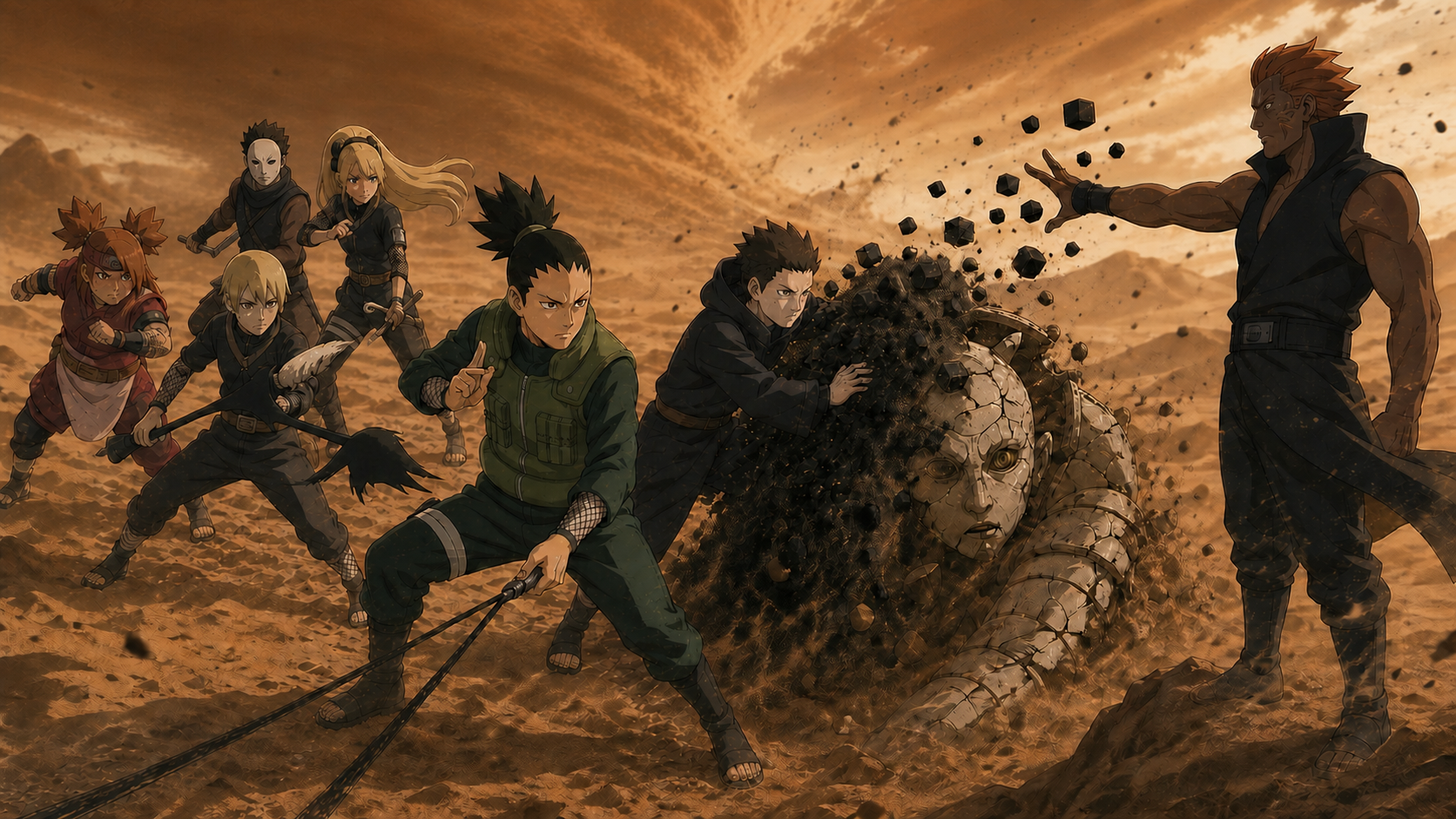
Six talented genin cannot make Deepa ordinary. Shikadai creates time, Shinki holds the line, and destroying the puppet becomes the only victory Kara cannot steal.
Series: Boruto: Naruto Next Generations
Episode: 169 · A Joint Mission With the Sand
Arc: Kara Actuation
Release: 2020-10-11
Previous: Episode 168 · Training Begins!
Directory: All 293 Boruto episodes
Bottom line
Boruto Episode 169 sends six talented teenagers into the desert to retrieve one broken Ōtsutsuki puppet and lets Deepa turn the mission into another warning. Team 10 and Team Shinki coordinate, adapt, and refuse to hand over dangerous technology. They still cannot beat him. The difference between this fight and Team 7’s disaster is not that the new group possesses a secret answer. Shinki recognizes when victory has become impossible and destroys the objective before Deepa can claim the prize.
“A Joint Mission With the Sand” understands mission success better than many louder episodes. The teams fail to bring the puppet home. Deepa defeats them. Shinki collapses. Yet the enemy also leaves without the technology he came to steal. Nobody gets the clean result promised by the briefing.
That mess feels honest. Joint operations involve clashing leadership, unfamiliar techniques, old rivalries, and six people learning each other while danger is already moving. Shikadai and Shinki do not become best friends. Cho-Cho does not stop being Cho-Cho. Deepa does not suddenly respect teamwork enough to lose. Everyone reveals character through choices made after the original plan dies.
The puppet is not harmless wreckage
The mission begins with an object left behind after Urashiki’s attack. A damaged puppet in the desert can sound like cleanup duty, but Ōtsutsuki technology is never ordinary debris.
The Sand wants the puppet recovered because knowledge matters. Konoha sends Team 10 because Shikadai knows the location and history. The assignment joins two villages around shared risk rather than ceremonial diplomacy.
That context gives the object political weight. Whoever studies the puppet may gain insight into an enemy whose technology and chakra science exceed normal shinobi understanding. Leaving the machine buried does not make the danger disappear. Someone else can dig.
Team 10 brings memory the Sand team needs
Shikadai previously encountered the puppet during the Urashiki conflict. His memory provides the route and situational context. Inojin and Cho-Cho bring complementary tracking, restraint, range, and power.
The Leaf team is not present because the Sand lacks capable ninja. They possess information the Sand cannot reproduce. That distinction matters in a joint mission. Cooperation works when each side brings a real need, not when one village arrives to supervise another.
Shikadai also carries the burden of recognizing old danger before everyone else. Familiar ground can create confidence, but returning to a battlefield often reveals how little the first encounter actually explained.
Shinki does not mistake cooperation for friendship
Shinki remains blunt, focused, and skeptical. He does not perform warmth because the mission briefing says “joint.” His priority is the puppet and Sand security.
That attitude can grate against Shikadai’s own leadership instincts, yet neither boy needs to become softer for the partnership to function. Professional cooperation begins with reliable decisions, not forced bonding.
Shinki’s distance also reflects responsibility. He knows Ōtsutsuki weapons touched his village and that failure could deliver valuable material to an unknown enemy. Casual energy feels inappropriate to him because he carries the mission as a threat assessment.
Cho-Cho refuses to become background muscle
Cho-Cho brings appetite, humor, confidence, and combat strength without apologizing for occupying space. The episode lets her personality remain loud even when the plot turns dangerous.
Fandom has a bad habit of treating her food jokes as the whole character. Look past the snack and watch the mission. Cho-Cho follows the team into uncertain territory, supports coordinated attacks, and does not freeze when Deepa appears.
Her presence also stops the episode from turning six teenagers into identical grim professionals. Real teams contain different coping styles. Cho-Cho’s openness does not equal a lack of seriousness when action becomes necessary.
Inojin works between art and intelligence
Inojin’s techniques provide range and flexibility, which become essential against an opponent who controls lethal projectiles. His Super Beast Scroll is not decorative flair. The ability lets the group test distance, create openings, and communicate movement.
He also inherited a family tradition built around information. Recovery missions depend on noticing the scene before disturbing evidence. Inojin’s value begins before the fight.
Deepa’s arrival overwhelms those advantages, but failure against a Kara-level body does not erase the logic of the team composition. Genin should not be graded as worthless because an adult monster invades their assignment.
Yodo and Araya deserve their names
Yodo and Araya are not Sand-colored wallpaper standing behind Shinki. Yodo’s enhanced hearing and speed support awareness. Araya’s masked reserve and sword skill add another layer of defense.
Joint-team episodes can reduce secondary characters to reaction shots while two designated rivals handle the plot. Episode 169 gives the wider group enough function to show why both villages sent full teams.
Their limitations matter too. Six specialized fighters still lack shared practice against Deepa. A roster of useful skills does not automatically become seamless coordination during first contact.
The food stop should feel ordinary
The team’s stop before the mission turns violent gives the episode necessary normal life. Teenagers travel, complain, eat, tease, and notice strangers. Then Deepa passes through the same public space.
That proximity is disturbing because Kara does not operate only in hidden laboratories. Deepa can sit near civilians, satisfy a craving, and move toward his next target without looking like a battlefield announcement.
Ordinary spaces do not become safe because the heroes are off duty. The episode uses casual rhythm to show how quickly danger can enter the same door as lunch.
Deepa treats violence as appetite
Deepa’s relationship with food, taste, and destruction remains grotesque. He pursues sensation as though the world exists for his palate, then applies the same entitlement to people and technology.
He does not need the puppet for a noble ideology. Kara assigned a collection task, and Deepa expects weaker people to surrender the object because his strength makes refusal inconvenient.
That attitude connects his cruelty. He consumes experiences, dismisses lives, and grows bored when resistance stops entertaining him. Nothing outside Deepa carries inherent value unless he wants the flavor.
Shikadai recognizes Deepa before the team understands
Shikadai knows Boruto and Sarada are training after a devastating defeat. Meeting the man responsible turns that distant report into immediate danger.
Recognition changes the mission. This is no longer a recovery operation with ordinary opposition. Deepa has already broken Team 7 and forced Mitsuki into catastrophic overuse.
Shikadai cannot retreat freely because the puppet would fall into Deepa’s hands. Leadership becomes a choice between protecting six people and protecting whatever the enemy plans to build from the technology.
Two teams do not equal twice the readiness
On paper, Team 10 plus Team Shinki sounds stronger than Team 7. Six fighters offer more angles, combinations, and reserves. Deepa still controls the encounter.
Numbers help only when attacks can penetrate his carbon armor and defense can survive his cubes. The allied teams lack full knowledge of his body, and their first joint mission has not produced deep coordination.
The episode avoids a childish equation where six genin must outperform three. Team 7 trains together constantly and included Mitsuki’s hidden extraction power. Team 10 and Team Shinki are assembling cooperation during the fight.
Iron Sand gives Deepa a real obstacle
Shinki’s Iron Sand provides the strongest defensive answer. The dense material can intercept carbon cubes, shape barriers, and attack from multiple directions.
Deepa notices. That reaction matters because Shinki forces him to increase effort rather than dismissing every move immediately. The Sand technique belongs in the same tactical conversation as Deepa’s carbon manipulation.
Resistance is not victory. Repeated impacts strain Shinki and break through protection. The scene respects Iron Sand without pretending one powerful bloodline technique solves Kara.
Shadow binding creates time, not a miracle
Shikadai’s shadow techniques aim to restrict Deepa and open a window. Against ordinary opponents, that control can decide a fight. Against Deepa, the window remains painfully narrow.
The tactic still demonstrates good leadership. Shikadai does not chase personal damage when restraint better serves the team. His job is to create time for other specialists.
Fans often celebrate finishing blows and ignore the person who made the finishing blow possible. Episode 169 shows the value of control even when no finishing blow arrives.
Deepa wants the puppet intact
Deepa’s objective clarifies why the teams survive as long as they do. He wants the recovered technology, and the children stand between him and the prize.
Their leverage comes from possession, not combat superiority. As long as the puppet remains salvageable, Deepa must consider how his attacks affect the object.
That does not make him safe or merciful. Deepa has already shown willingness to kill for convenience. The mission target simply shapes his priorities until Shinki removes the option.
Shinki chooses denial over pride
Shinki’s best decision is also the most painful. He destroys the puppet with Iron Sand rather than let Deepa take the technology.
The mission ordered recovery. Destroying the target can look like failure, especially to a young shinobi trained to complete objectives exactly. Shinki understands that orders exist to serve security, not the reverse.
Once retrieval becomes impossible, denial becomes the responsible outcome. He sacrifices the village’s chance to study the puppet so Kara cannot use the same machine against far more people.
Destroying the prize is a form of victory
No celebration follows the puppet’s destruction. Shinki collapses, the teams remain injured, and Deepa walks away. Still, Kara gains nothing from the encounter.
That result deserves recognition. Victory in intelligence and recovery work rarely resembles a tournament bracket. Preventing enemy acquisition can matter more than defeating the collector.
Shinki refuses to let pride turn the artifact into bait. He would rather return empty-handed than hand a dangerous weapon to Deepa while preserving the fiction that recovery remained possible.
Deepa leaving alive is not mercy
After the puppet breaks, Deepa abandons the fight. His departure feels strange because he could continue hurting the teams.
Calling that mercy would give him moral credit he has not earned. His objective failed, the sandstorm offered cover, and further violence no longer promised useful reward. Deepa’s boredom can spare a life without becoming compassion.
The surviving teens should not read escape as proof that Deepa has boundaries they can trust. Unpredictability is part of his danger.
Shikadai receives Boruto’s warning firsthand
Boruto’s defeat could have remained a story Shikadai heard after the fact. Facing Deepa makes the warning physical.
Shikadai now understands why Boruto and Sarada returned so shaken and why Mitsuki required extraordinary treatment. Deepa’s armor, projectiles, speed, and casual cruelty are no longer exaggerated details from a friend nursing wounded pride.
That knowledge may change how the wider generation sees Team 7’s loss. They did not fail because they lacked heart. They encountered a category of threat the village has barely begun to define.
The Sand alliance exists beyond the Chunin Exams
Konoha and Sunagakure have shared history shaped by betrayal, invasion, reconciliation, and genuine friendship between Naruto and Gaara. Episode 169 shows the alliance operating through the next generation.
Joint missions turn diplomatic promises into daily practice. Young shinobi must exchange information, accept unfamiliar leadership styles, and trust techniques they did not train beside.
The teams do not need a speech about village unity. Their refusal to surrender the puppet proves cooperation through action.
Failure has several measurements
The mission report will contain bad news. The puppet was not recovered. Multiple shinobi were injured. Deepa escaped. Those facts cannot be polished away.
The same report should also state that Kara failed to obtain the target, both teams survived, and the villages gained direct intelligence about Deepa’s capabilities. Honest evaluation holds every truth at once.
Shonen stories grow stronger when characters can lose a fight without the narrative labeling every decision useless. Episode 169 lets strategic success exist inside tactical defeat.
Boruto and Sarada are not the only children facing Kara
The episode expands Kara’s impact beyond Team 7. Deepa can collide with any mission, any village, and any young squad assigned work that once sounded manageable.
Boruto’s training does not pause the world. While he shapes chakra with Kakashi and Sarada sharpens perception with Sasuke, their friends encounter the same man in the desert.
That overlap creates urgency without dragging Boruto into a premature rematch. The threat continues moving while the protagonists remain unready.
Joint mission means shared consequence
Team 10 and Team Shinki leave with bruises, new information, and a clearer understanding of Kara. Neither village owns the lesson alone.
Shikadai’s tactical mind and Shinki’s decisive denial prevent a worse result. Cho-Cho, Inojin, Yodo, and Araya help keep the group functioning long enough for that choice to happen.
Episode 169 refuses an easy hero pose. Six capable teenagers meet Deepa, lose control of the fight, and still deny him the prize. That outcome is not glamorous. That outcome is professional growth arriving through sand, fear, and one destroyed puppet.
The briefing should have named the destruction threshold
Recovery missions involving dangerous technology need a clear rule for the moment retrieval becomes impossible. Shinki should not have to invent the denial policy while Deepa breaks through the formation.
The villages could define conditions before departure: confirmed hostile acquisition, loss of transport control, evidence of activation, or damage that makes containment unsafe. A designated leader would then have authority to destroy the target without fearing punishment for disobeying the original wording.
Shinki makes the correct decision under pressure. Better planning would make that decision institutional responsibility rather than one teenager's personal gamble.
The puppet required containment before transportation
Finding Ōtsutsuki technology is only the first problem. The teams need a sealed container, remote-handling tools, chakra monitoring, and a route that keeps the object away from civilians. Nobody knows whether damage can trigger an attack, signal, or contamination.
The mission appears focused on reaching the location and carrying the puppet home. A proper recovery plan should assume the artifact may remain active or attract another party tracking the same technology.
Deepa proves the attraction risk immediately. The villages need to ask how Kara located the puppet and whether any signal from the wreckage exposed the team before first contact.
Shikadai and Shinki need one shared command rule
Both boys lead capable teams and both have reasons to protect village interests. Without a prearranged command structure, disagreement can consume the seconds needed for movement.
A joint mission does not require one leader dominating every choice. The briefing can assign Shikadai navigation and tactical coordination while Shinki controls artifact security and Sand territory decisions. Emergency succession should also be explicit if either leader becomes injured.
Their tension carries useful information. Shikadai reads group movement; Shinki reads the political danger of the object. A command plan should combine those perspectives rather than force one into silence.
Cho-Cho's confidence supports morale without denying danger
Cho-Cho jokes, eats, and refuses Deepa the satisfaction of making everyone emotionally small before the fight begins. Humor can keep a team breathing when fear starts narrowing attention.
That role should not become an excuse to overlook her tactical contribution. Expansion techniques can shield teammates, disrupt terrain, and create force at the moment control techniques hold an opponent.
Cho-Cho also deserves recovery attention after the mission. The teammate who keeps energy high may still carry fear and pain once the group reaches safety. Confidence is a coping style, not proof that harm bounced off.
Yodo's hearing needs protection in a carbon storm
Enhanced hearing can locate movement and attacks before others react. Repeated impacts, wind, sand, and sudden explosions can also overwhelm the same sense that gives Yodo an advantage.
The joint plan should include signals that do not rely on sound alone and a way for Yodo to report overload without losing status inside the formation. Sensory ability becomes dangerous when teammates assume greater input always means greater awareness.
Deepa's cubes create chaotic noise alongside lethal trajectories. Protecting Yodo's hearing preserves both the shinobi and the intelligence the technique supplies.
Araya's puppet body adds another layer to recovery risk
Araya fights through a puppet while protecting his own position, which gives the group range and misdirection. The technique also complicates formation when an unfamiliar allied puppet and an Ōtsutsuki puppet occupy the same battlefield.
Teams need clear visual and chakra identification so nobody mistakes Araya's movements for activation from the recovered object. Deepa can exploit confusion by attacking the controller, the artifact, or the wrong body at once.
Joint training before deployment would expose those recognition problems safely. First contact with an enemy should not be the first time allies learn how another team's remote technique behaves.
Deepa's food scenes make entitlement look ordinary
Deepa moves from casual appetite to lethal acquisition without changing his basic relationship to the world. Food, people, combat, and technology become experiences he expects to consume.
The public setting makes that entitlement more disturbing. Civilians see a traveler with unusual taste, not a Kara operative preparing to attack children in the desert. Threat does not announce itself through constant villain performance.
The teams therefore need witness descriptions and route information after the encounter. Ordinary workers who served or noticed Deepa may hold the timeline that explains how he tracked the mission.
The after-action report should preserve the failed combinations
Every attack that fails against Deepa still supplies data. Iron Sand resists certain cube impacts, shadow binding creates a limited window, ranged art changes his movement, and coordinated pressure forces him to respond.
The teams should document distance, duration, armor changes, projectile patterns, and the exact moment each defense broke. Memory after injury can blur sequence, so separate accounts should be collected before the villages merge conclusions.
Boruto and Sarada need that report before a rematch. Their friends paid for the information with real injuries. Using the evidence responsibly is part of honoring the cost.
Denial protects more than one village
Sunagakure loses a research opportunity when Shinki crushes the puppet. Konoha loses access to technology connected to an enemy threat. Both villages accept that loss so Kara cannot gain a weapon that may harm people far beyond either border.
That choice makes alliance concrete. Shared security sometimes requires surrendering an advantage rather than racing an ally to claim the object first.
The villages should state that principle in the report. Shinki did not destroy Sand property or Leaf evidence. He denied a transnational threat an asset under conditions where safe recovery had ended.
Sources and lawful viewing
Official episode reference: Naruto Official episode guide
Licensed episode route: Crunchyroll licensed series page