
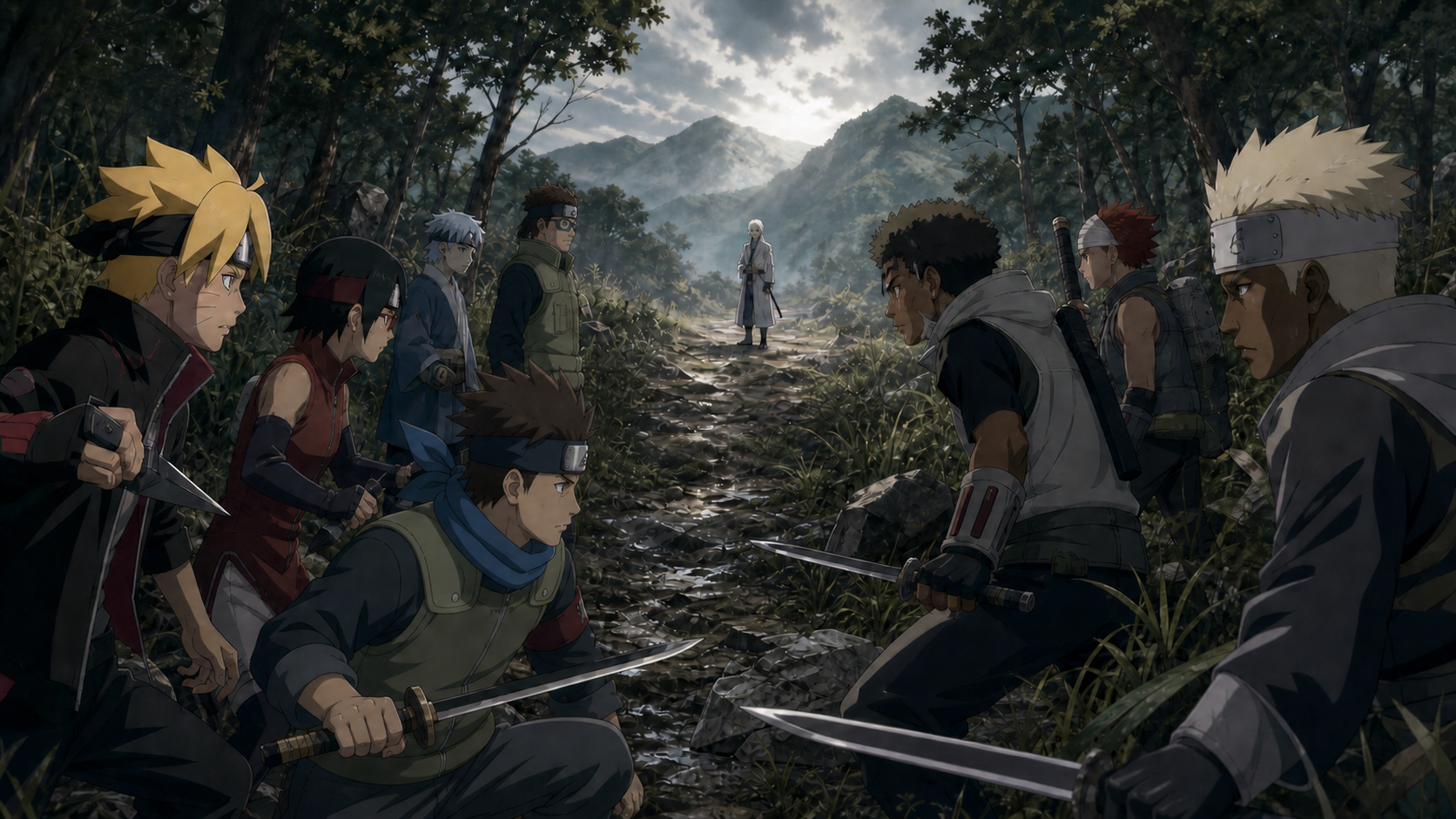
The Pursuers
Omoi does not clear Team 7 because allied villages are supposed to trust each other. He checks the poison, listens to the medical evidence, and changes course. Then Deepa shows how little Kara cares about anybody’s jurisdiction.
Series: Boruto: Naruto Next Generations
Episode: 163 · The Pursuers
Arc: Kara Actuation
Release: 2020-08-30
Previous: Episode 162 · Escaping the Tightening Net
Directory: All 293 Boruto episodes
Bottom line
Boruto Episode 163, “The Pursuers,” finally puts Team 7 in front of shinobi who can evaluate evidence instead of another gang that profits from a rumor. Omoi and the Hidden Cloud team arrive expecting to arrest the people blamed for Sakuya’s murder and the stolen Hashirama cell. Weapons come out because Konoha’s explanation cannot erase what the Cloud squad has already heard. The confrontation changes only when both teams compare what they know: a poisoned weapon, the unstable cell, the thieves’ route, and the purpose behind the frame.
That is the satisfying part. Nobody wins trust by announcing friendship between villages. Trust becomes possible because professional shinobi ask whether the accusation explains the physical evidence. Then Deepa walks onto the road and exposes how temporary that cooperation will be. Konoha and the Cloud can build a joint pursuit. Kara needs one man with a smile and absolutely no respect for the bodies standing between him and what he wants.
Omoi is anxious because he understands consequences
Omoi has always been easy to reduce to the man who imagines every possible disaster. That joke works because his brain refuses to stop calculating what could go wrong. In this episode, anxiety is not incompetence. Anxiety is one reason he pauses long enough to hear Team 7.
The Cloud has a missing biological weapon, a murdered buyer, and a Konoha squad at the center of the accusation. Treating that situation casually would be irresponsible. Omoi knows that attacking allied shinobi on bad information could create a diplomatic crisis while letting the real thieves escape.
His caution has value because the stakes are real. He worries, checks, and revises.
The first confrontation has earned its hostility
Team 7 has been chased through the Land of Silence and cannot assume the next armed group wants a conversation. Omoi’s squad has been following people accused of murder and theft. Both sides raise weapons based on information that makes sense from their position.
That does not make both positions equally correct. Team 7 is innocent. The point is that innocence alone cannot communicate across a road full of drawn blades.
Konohamaru and Mugino do the necessary adult work. They recognize the Cloud uniforms, stop the encounter from becoming a battle, and provide an account detailed enough to test.
Evidence changes the room
The poisoned weapon recovered from Sakuya’s murder gives Omoi something stronger than reputation. He recognizes the poison and the method as connected to shinobi from the Land of Haze.
That receipt matters because the Haze brothers tried to make the crime look complete. Dead witnesses, a stolen cell, and visible Konoha shinobi should have closed the story. One material detail opens the case again.
Facts do not magically defeat propaganda. Facts need people with enough knowledge and authority to interpret them. Omoi provides both.
The Cloud team does not demand blind deference
Omoi could insist that his rank or village gives him final control. Instead, the teams share information and build a common route forward.
That cooperation respects difference. The Cloud squad has poison knowledge and its own mission. Team 7 has direct knowledge of the Haze brothers, Yubina’s medical assessment, and the Land of Silence escape network. Neither group holds the whole picture.
Allied shinobi should work this way more often. Cooperation means combining expertise, not waiting for one village to claim the microphone.
The unstable cell controls everybody’s speed
Yubina’s warning becomes operational intelligence. The Hashirama cell cannot be shaken or rushed without risking an uncontrolled biological reaction. The thieves therefore need a careful route and slower movement.
That restriction gives the pursuers a map. Roads suitable for speed matter less than paths suitable for fragile cargo.
The cell has become the arc’s silent commander. Sakuya built a castle around the sample. The Haze brothers sacrificed family to steal the sample. Team 7 and the Cloud now shape their route around the sample’s instability. Hashirama died generations ago, yet pieces of his body still decide where living people can move.
National desperation does not make stolen tissue harmless
The Haze brothers believe the cell can benefit their homeland. Their mission has a national purpose rather than Sakuya’s personal fear or Victor’s private profit.
That difference deserves attention. A small or struggling nation may see biological power as a way to survive among stronger countries. The great villages have spent decades controlling bloodlines, weapons, and military knowledge while lecturing weaker places about rules.
None of that makes murder, human experimentation, or stolen tissue clean. A justified grievance can produce an unjustifiable method.
The route exposes the hierarchy between villages
Konoha and the Cloud can field trained squads across borders. Their headbands carry recognition. The Haze brothers speak for a land with less power and apparently fewer options.
Naruto’s world keeps showing small nations absorbing the consequences of decisions made by larger villages. Rain became a battlefield. Valleys and border territories become laboratories, markets, and transit routes. The Land of Haze wants enough leverage to stop being ignored.
The tragedy is that the brothers pursue leverage through the same body economy used by the powers they resent.
Boruto wants to clear his name and catch the thieves
Boruto’s anger is personal. He was framed, hunted by dogs, dropped into sewage, and turned into a moving target for an entire village. Catching the Haze brothers would restore the truth.
The mission is larger than his reputation, though. The cell can kill people, transform bodies, and feed Kara’s research. Team 7 cannot make the pursuit only about proving Boruto did nothing wrong.
Boruto does not fully separate those motives, and that feels human. Personal outrage can propel necessary action as long as the action remains accountable to something larger.
Sarada watches the adults build a coalition
Sarada wants to become Hokage. Episodes like this matter for that goal more than another chance to announce the ambition.
Leadership here requires hearing an accusation without surrendering, presenting evidence without escalating, and accepting help from shinobi who began the encounter with weapons pointed at your team. Nobody gives Sarada a speech about diplomacy. She watches the work happen under pressure.
Her future cannot rest only on combat strength. A Hokage must know how to keep one bad report from turning allies into enemies.
Mitsuki brings information instead of demanding attention
Mitsuki rejoins the group with Yubina’s conclusion about the cell. His medical detour now shapes the pursuit.
That contribution fits Mitsuki’s quieter presence. He does not need to dominate the conversation for his information to change every next step.
His body has already survived the cell’s effects, helped Yubina treat Kona, and generated knowledge about the sample. Mitsuki remains connected to the biological stakes in a way the episode could acknowledge more directly.
Mugino treats cooperation as field work
Mugino does not need the Cloud squad to like Team 7. He needs everybody to stop wasting time and move toward the actual thieves.
That practical focus has defined him throughout the Land of Silence material. Mugino enters sewage, works criminal contacts, and changes plans without protecting his dignity. A joint pursuit is another tool.
His maturity balances Boruto’s need for vindication. Mugino cares about clearing the team, but he refuses to let wounded pride set the pace.
Omoi’s team deserves names and purpose
Kakui and Marui are not decorative bodies standing behind Omoi. They are Cloud shinobi taking on a mission involving stolen tissue, cross-border crime, and suspected murder.
The episode gives Omoi most of the recognition and dialogue, which makes sense for a returning character, but the squad works because his teammates hold the line with him. Their presence turns his judgment into an institutional decision rather than one man changing his mind.
Fandom pages should name supporting people when the story gives them a job. “Two Cloud ninja” is how useful characters disappear.
Deepa arrives without respecting anybody’s jurisdiction
Deepa does not care whether Konoha and the Cloud have reached an agreement. He does not recognize their missions, ranks, or alliance as meaningful constraints.
That disregard makes Kara frightening. The organization moves through national systems while behaving as though every border belongs to somebody else. Deepa sees trained shinobi as obstacles between him and the Hashirama cell.
His calm is worse than shouting. Violence looks ordinary to him.
The Cloud team holds Deepa so Team 7 can continue
Omoi, Kakui, and Marui take responsibility for the immediate threat while Team 7 keeps pursuing the cell. That division is not a surrender of importance. The Cloud squad chooses the opponent most likely to stop everybody.
Their decision proves the new alliance through action. Minutes earlier, they suspected Team 7 of murder. Now they trust Konoha to continue the joint objective while they absorb Deepa’s attack.
Trust built from evidence becomes trust tested by risk.
Deepa makes the power gap obvious
The Cloud team consists of trained shinobi, and Deepa still treats the encounter like an inconvenience. His durability and appetite for violence distort the normal scale of the mission.
Team 7 has been chasing thieves who sacrificed one brother to penetrate a barrier. Deepa represents another level of threat, one where sacrifice may not even slow the person demanding the prize.
That gap prepares the arc for the beating ahead without pretending the younger shinobi can solve every problem through confidence.
Yuuga repeats the family’s logic of sacrifice
One Haze brother remains behind so the others can move the cell toward home. Yuuga accepts the role because the mission ranks above individual survival.
The brothers’ willingness to die can look noble from a distance. Up close, the pattern is terrifying. Their homeland’s future has become a debt collected from their bodies one brother at a time.
The mission never asks whether the nation could be served without consuming the people claiming to save that nation.
Pursuit changes when the target wants to be caught
Yuuga does not merely fail to escape. He creates a confrontation to delay Team 7. That changes the tactical question from “Can we catch him?” to “How much time does he plan to steal?”
Every minute spent fighting lets the remaining brothers carry the unstable cell farther along the safe route. Victory over Yuuga can still produce strategic failure.
Mugino understands that problem immediately. Boruto has to learn that defeating the person in front of him may serve the people running away.
The episode builds two kinds of alliance
Konoha and the Cloud cooperate through evidence, shared objectives, and professional judgment. The Haze brothers cooperate through blood, national duty, and promised sacrifice.
Both groups trust one another. The moral difference lies in what that trust demands.
The allied squads distribute expertise and risk so more people can continue. The Haze mission distributes death so the cargo can continue. One alliance treats members as partners. The other keeps converting brothers into time.
RaeRae’s verdict
Episode 163 does the unglamorous connective work an arc needs. Team 7 cannot remain wanted fugitives forever, so the story gives them a credible way to clear the immediate accusation. Omoi does not believe them because friendship demands belief. He examines a poisoned weapon, compares routes, listens to Yubina’s assessment, and recognizes a Haze method.
That is how you make a misunderstanding useful instead of irritating. The confrontation reveals character, politics, and evidence. Then Deepa arrives and reminds everybody that solving the accusation does not solve Kara.
The strongest thread belongs to the Haze brothers. Their national purpose is more serious than greed, but seriousness cannot clean the bodies left behind. Yuuga prepares to spend himself so his brothers can carry Hashirama’s stolen tissue home. Another small nation is trying to buy security with human material, and the price keeps being paid by the very people the mission claims to protect.
Clearing Team 7 requires more than one roadside agreement
Omoi accepts the evidence and joins the pursuit, but the accusation has already moved through the Land of Silence. Local guards, brokers, and civilians may still believe Konoha murdered Sakuya and stole the cell.
The Cloud and Leaf need a joint notice identifying the corrected suspect description, the poisoned weapon, and the current danger without exposing medical details that could help another buyer. Team 7 also deserves an official record showing why the accusation changed.
Otherwise, Boruto can leave the road and remain guilty inside every copied report. Corrections need to travel at least as far as the original claim.
Evidence custody matters because every village has an interest
The poisoned weapon, witness accounts, and Yubina's findings connect the Haze brothers to the frame. Each item needs a documented chain of custody so no government can later claim Konoha invented the evidence to protect its own squad.
Omoi can verify the poison knowledge from the Cloud side. Mugino and Konohamaru can preserve the recovery location. Yubina can document the cell's instability and medical effects. Separate sources strengthen the shared conclusion.
Professional trust grows when evidence remains testable after the people on the road have moved to the next emergency.
Yubina's medical conclusion should shape containment policy
The unstable cell cannot become ordinary cargo once recovered. Konoha needs a sealed carrier, vibration limits, remote monitoring, and a route that avoids populated areas.
Medical staff should also prepare for transformation symptoms in any person exposed during transport. Kona's condition proves that proximity and handling can become a patient problem before anyone understands the mechanism.
Pursuit speed matters, but safe retrieval remains part of the objective. Catching the brothers only to trigger the cell would reproduce the danger Team 7 is trying to stop.
Omoi's anxiety supports verification when the team respects the signal
Omoi imagines consequences quickly, which can become exhausting when every branch receives equal emotional weight. In this encounter, the habit makes him unwilling to accept the first convenient story.
His teammates can help separate plausible risk from spiraling possibility by asking which evidence supports each concern. That teamwork keeps anxiety useful without letting anxiety control every decision.
Kakui and Marui do more than stand nearby. Their presence gives Omoi colleagues who can confirm observations, challenge assumptions, and carry the mission if his mind stalls on the worst outcome.
The joint pursuit needs one communication plan
Once the Cloud squad holds Deepa and Team 7 continues, both groups need a signal for retreat, reinforcement, casualty, or change in the target route. Splitting without communication turns trust into guesswork.
Deepa can exploit that separation by blocking messages or feeding false information. A coded confirmation, timed check-in, and fallback rendezvous would let either group recognize when the original division no longer works.
Omoi's team chooses to buy time. Team 7 owes them a way to report whether that time still serves a reachable objective.
Kakui and Marui should not receive the most dangerous role by default
The returning character receives most of the dialogue, but his teammates stand in the same lethal path. Leadership means distributing exposure according to technique and condition, not leaving supporting shinobi to absorb whatever the named character cannot handle.
Omoi should explain why the Cloud team can delay Deepa, identify the withdrawal threshold, and ensure Kakui and Marui know that survival outranks a doomed hold.
Their later deaths will prove how high the cost becomes. Episode 163 already contains the moment when adults could have named that cost before courage made retreat feel impossible.
Deepa's arrival should change the threat classification immediately
Team 7 knows only fragments about Kara, but Deepa displays interest in the cell, unusual durability, and complete disregard for allied shinobi. The encounter is no longer a regional theft with one armed buyer.
Konoha and the Cloud should classify the event as possible clandestine-organization involvement and notify intelligence units. The name Kara may remain unconfirmed, yet the behavior warrants a wider search for funding, transport, and connected operatives.
Waiting for Deepa to identify his employer gives the organization time to convert local chaos into a clean acquisition.
The Land of Haze deserves direct contact before another brother dies
If Konoha or the Cloud can reach Haze authorities, they should report the unstable cell, Sakuya's murder, Deepa's pursuit, and the evidence that the brothers are being hunted by a stronger party.
The contact may fail or expose political complications. Silence guarantees that the surviving brothers continue under a threat estimate that no longer matches the road.
Warning the homeland does not excuse the theft. The warning recognizes that preventing more deaths and recovering dangerous tissue can serve accountability at the same time.
Sarada learns that diplomacy includes correcting your own side
Sarada watches Leaf adults explain the frame without demanding automatic trust. A future Hokage will need the same discipline when Konoha appears guilty or when an ally brings evidence the village dislikes.
Leadership cannot mean defending the headband before examining the facts. Loyalty to Konoha should include protecting the village from false certainty and repairing harm when the evidence points inward.
This case clears Team 7. The process still matters because the next case may not.
Both teams need medical thresholds before splitting
The pursuit has already involved poison, animal attacks, unstable biological material, and exhaustion. Omoi's squad and Team 7 should compare injuries before assigning one group to Deepa and another to the brothers.
A shinobi who can still stand may not be fit to hold an unknown Kara operative. The teams need a clear withdrawal condition, field treatment, and a way to request extraction without interpreting the request as abandoning the alliance.
Shared risk becomes fair only when each village receives honest information about the bodies carrying that risk.
The correction should reach Sakuya's household too
Sakuya's staff and surviving associates may still believe Team 7 committed the murder. They also possess access records, witness statements, and security details that could strengthen the case against the Haze brothers.
Officials should deliver the corrected finding without asking the household to forget Sakuya's black-market conduct. Victim status and criminal participation can coexist.
The goal is an accurate record: Sakuya trafficked dangerous tissue, the Haze brothers killed her, Team 7 was framed, and Kara now threatens everybody pursuing the cell.
Sources and lawful viewing
Official episode reference: Naruto Official episode guide
Licensed episode route: Crunchyroll licensed series page