
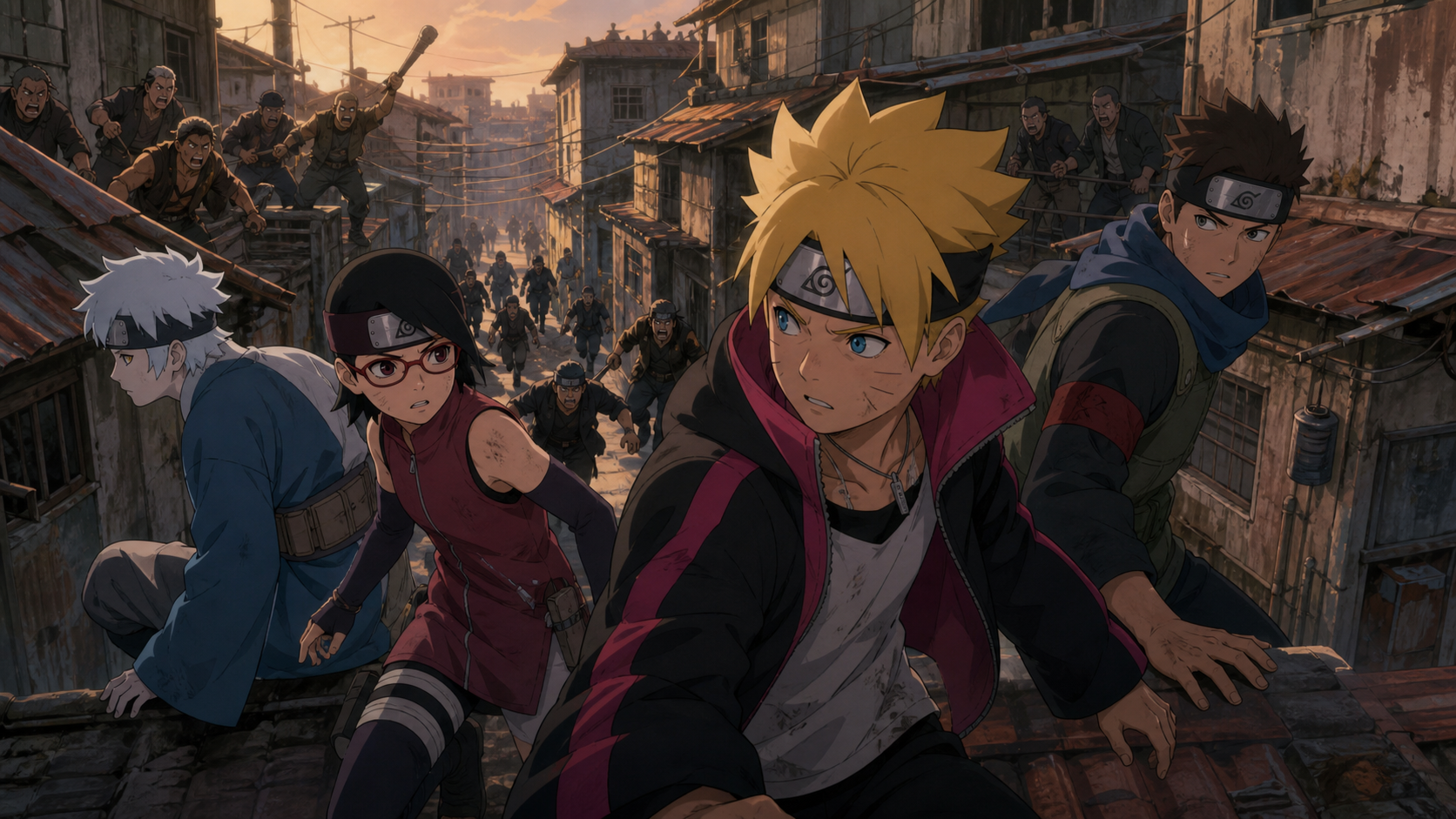
Escaping the Tightening Net
The Haze brothers do not need evidence when every gang profits from the same accusation. Team 7 has the truth, Boruto smells like a tracking device, and poor children know the only route adults forgot to control.
Series: Boruto: Naruto Next Generations
Episode: 162 · Escaping the Tightening Net
Arc: Kara Actuation
Release: 2020-08-23
Previous: Episode 161 · The Castle of Nightmares
Directory: All 293 Boruto episodes
Bottom line
Boruto Episode 162, “Escaping the Tightening Net,” understands something ugly about a place built on illegal trade: innocence has almost no market value. Sakuya is dead, the Hashirama cell is gone, and the men who committed both crimes have already supplied a convenient story. Team 7 becomes guilty because the accusation is useful, not because anybody has examined evidence. Every gang in the Land of Silence gets a target, the real thieves get distance, and frightened residents get an answer simple enough to repeat.
The chase works because Team 7 cannot solve that problem with one dramatic declaration. Boruto smells like the perfume bomb used to mark him. Konohamaru and Sarada need information from a shopkeeper who profits from selling information. Mugino has to choose survival over dignity and jump into sewage without a committee meeting. Their eventual escape depends on Katara and Kona, two children whose knowledge network exists below the respectable economy. Adults with money created the crisis. Poor children build the route out.
A bought accusation travels faster than evidence
Nobody in the village needs a trial. Sakuya’s death, the missing cell, and Konoha forehead protectors make a story that people can recognize at a glance. Recognition becomes certainty before Team 7 can establish where the Haze brothers went.
That speed matters. False accusations do not spread only because people are gullible. They spread because different groups find different uses for the same claim. A gang can justify a bounty. A merchant can sell a location. A frightened witness can avoid becoming the next suspect. The Haze brothers understand the local economy well enough to give every interested person permission to chase somebody else.
Team 7 enters the episode with truth and almost no control over distribution. The thieves have a lie and an entire town ready to distribute that lie for free.
The Land of Silence has no neutral public square
Konoha has institutions that can fail, protect status, and make terrible decisions, but the village still has recognizable authority. The Land of Silence has fragmented power. Gangs control streets. Brokers control information. Criminal doctors move through private rooms. Wealthy buyers hide behind household security.
Calling the place lawless misses the structure. Rules exist everywhere. The question is who writes them and who pays when those rules change. A street belongs to whichever armed group can hold the entrance. A rumor becomes official when enough buyers reward repetition. A child survives by learning tunnels that adults ignore.
Team 7 cannot walk into an office and present evidence. Every route to safety crosses somebody’s private territory.
Boruto has been turned into a tracking device
The perfume bomb from Fushū Castle looks ridiculous until every pursuer can follow Boruto through alleys. Smell becomes a cheap surveillance system. The gangs do not need sensory ninja, cameras, or a formal intelligence service. They need dogs and a marker their target did not notice soon enough.
That indignity suits the episode. Boruto wants a clever shinobi solution, but the practical answer involves drainage water and a smell worse than the perfume. Mugino understands the hierarchy of problems immediately. Pride sits far below survival.
Boruto’s disgust is funny. His delay is also a reminder that talent does not automatically produce field discipline.
Mugino jumps before Boruto finishes complaining
Mugino does not romanticize shinobi labor. If sewage can break the scent trail, he gets into the sewage. No speech, no performance, no need to look cool for the younger ninja standing beside him.
That choice tells us more about Mugino than another résumé paragraph could. He treats the mission as work. Bodies get dirty. Plans become embarrassing. The correct option can smell terrible.
Boruto eventually follows because Mugino makes hesitation look more foolish than the drainage ditch. The comedy lands, but the adult example matters. Mugino teaches by moving.
Splitting the team is a risk, not automatic stupidity
Boruto and Mugino handle the scent problem while Konohamaru and Sarada pursue information about the Haze brothers. Splitting a hunted group creates danger, yet staying together would place every objective behind Boruto’s perfume trail.
The decision gives each pair a job that fits their strengths. Mugino can keep Boruto alive while refusing his complaints. Konohamaru can wear Kirisaki’s identity again. Sarada can observe a room, recognize a trap, and create an exit when the disguise collapses.
Good tactics do not remove risk. They distribute risk according to purpose.
Konohamaru spends Kirisaki’s face one more time
The information broker recognizes Kirisaki as a buyer with criminal money. Konohamaru uses that expectation to ask about the brothers carrying the Hashirama cell.
The disguise works only while the broker believes profit outweighs suspicion. Once word arrives that the real Kirisaki has been found, the room changes. Nobody needs to verify which man is genuine. The broker simply chooses the version that creates less danger for his business.
Konohamaru’s transformation is clever, but a disguise cannot fix a collapsing information environment forever. Borrowed credibility expires the moment another seller offers a more profitable truth.
Sarada does not wait politely inside the trap
Sarada recognizes that the interview has become an ambush and breaks through the ceiling to create movement. That response fits her better than standing behind Konohamaru until an adult assigns a task.
Her value in this sequence comes from timing. A clean exit no longer exists. She makes a dirty one before the broker’s people can tighten the room.
Sarada does not receive a huge fight showcase here, but competence does not always require a victory pose. Seeing the trap, breaking the geometry, and keeping the mission alive counts.
The airship plan is ridiculous enough to work briefly
Boruto and Mugino steal an unmanned airship and pull Konohamaru and Sarada out of the street. The move removes Boruto’s scent from ground level and gives the group a faster route beyond the village.
For a few minutes, the episode lets improvisation feel glorious. Then the pursuers shoot the craft down.
That failure improves the plan rather than making the plan meaningless. The airship creates distance, reunites the separated pairs, and breaks the immediate enclosure. A solution can accomplish something without solving everything. Shinobi work would become nonsense if every useful idea had to remain useful forever.
The people hunting Team 7 have their own logistics
The gangs coordinate dogs, weapons, lookout points, and routes through the village. They are not random bodies spawned for a chase scene. Their organization explains why leaving becomes so difficult.
Criminal networks often survive because they perform state-like functions for selected people. They share warnings, enforce boundaries, collect payment, and punish targets. Residents may hate those networks while still depending on them for work or protection.
Team 7 is facing a local system, not merely a crowd. The tightening net has knots, messengers, and incentives.
Katara remembers who protected him
Katara could have watched Team 7 get captured. Adults in this village have given him plenty of reasons to avoid their problems. Instead, he shows the group an underground escape route.
Boruto protected Katara earlier without knowing that help would become useful. That detail keeps the rescue from feeling like a transaction disguised as kindness. Boruto acted because a child was vulnerable. Katara later acts because he remembers who treated him as a person.
Fandom stories love announcing that kindness returns. The stronger point is that respect creates relationships beyond official power. Boruto cannot purchase Katara’s loyalty the way Sakuya purchased services. He earned trust in a moment when no reward was visible.
Poor children built an intelligence network adults overlooked
Katara’s underground friends know who moves through the Land of Silence and where suspicious strangers have gone. Their information exists because children excluded from formal systems watch the edges of adult life.
That knowledge is impressive and infuriating. Children should not need tunnel routes, informal surveillance, and mutual warning systems to survive. Their competence does not make the conditions acceptable.
Adults see disposable street kids. Team 7 discovers witnesses, guides, siblings, and people with better local intelligence than armed professionals.
Kona connects Mitsuki’s medical detour to Boruto’s escape
Mitsuki returns with Kona, the girl Yubina treated using knowledge gained from his Hashirama-cell exposure. The episode closes a relationship that could have remained a stray medical subplot.
Kona’s recovery matters to Katara. Katara’s help matters to Team 7. Mitsuki’s willingness to assist another patient therefore affects the mission without turning care into a calculated exchange.
The connection also exposes how often vulnerable people save one another while wealthy adults trade biological material as property. Yubina’s clinic and Katara’s tunnels operate with fewer resources than Fushū Castle, yet both spaces preserve more human life.
Mitsuki sniffing Boruto is exactly the laugh the episode needs
After perfume, sewage, dogs, gunfire, and a crash, Mitsuki gets close enough to confirm that Boruto smells awful. The joke works because Mitsuki delivers curiosity with a straight face while Boruto has reached the limit of his dignity.
Comedy does not weaken the danger. A short laugh releases pressure and restores Team 7’s chemistry after an episode spent in separated pairs.
Boruto wanted to escape as a brilliant young ninja. He arrives underground smelling like evidence from three different crimes. That feels honest.
The Hashirama cell cannot simply be rushed across the border
Mitsuki brings the medical fact that changes the pursuit. Yubina determined that the stolen cell is unstable. The Haze brothers cannot carry the sample carelessly or move at full speed.
That explains the frame. Killing Sakuya was not enough. The thieves needed every gang focused on Team 7 so they could transport a dangerous biological sample slowly.
The cell continues to control the arc without speaking or acting. Everybody reorganizes around what Hashirama’s body might provide: healing, power, profit, national advantage, or leverage. A dead man’s tissue keeps producing living victims.
The Haze brothers grieve and continue the mission
The surviving brothers acknowledge the sibling sacrificed at Fushū Castle. Their pause confirms that the dead brother was loved, not treated as an anonymous tool.
They continue anyway.
That combination makes their duty more disturbing. A cold operative can dismiss a casualty. These men feel the loss and still accept the system that required the loss. They believe returning the cell to their homeland will justify the cost.
Love does not automatically protect people from exploitation. Sometimes love becomes the language an organization uses to demand another sacrifice.
Team 7 escapes because every member contributes something different
Mugino supplies field discipline. Boruto finds the aerial route and refuses to abandon vulnerable people. Konohamaru manipulates the criminal information market. Sarada creates an exit when the market turns hostile. Mitsuki brings medical intelligence and Kona back into the group.
No single character wins the episode. Their survival comes from combining incomplete answers.
That balance gives the chase more weight than another sequence where Boruto solves every obstacle with a louder attack. Team 7 functions as a team because nobody possesses the entire map.
The episode’s real escape route is social, not physical
The airship fails. Rooftops expose them. Alleys narrow. The drainage system removes one tracking method without stopping the gangs.
Katara’s trust succeeds where machinery and disguise fail. The underground route exists physically, but Team 7 gains access through a relationship.
That is the cleanest answer to the Haze brothers’ frame. They weaponize strangers who know only an accusation. Boruto survives because a child knows his behavior.
Evidence means almost nothing until somebody can carry the evidence safely
Team 7 knows several facts that should matter. Sakuya hired Kirisaki because she wanted the Hashirama cell. Konohamaru impersonated the doctor. The Haze brothers attacked the castle, took the sample, killed Sakuya, and left Boruto marked with perfume. None of those facts can defend the team while every street belongs to somebody who profits from the accusation.
The episode separates possessing evidence from controlling a story. Konoha trains shinobi to gather intelligence, yet intelligence still needs a trusted route, a receptive audience, and enough safety for a witness to speak. Katara can identify Boruto as the person who protected him, but Katara also lives in a system where speaking to the wrong adult could cost food, shelter, or life. A witness without protection becomes another available target.
That problem reaches beyond this one chase. Hidden villages constantly classify information as though secrecy guarantees security. The Land of Silence shows the opposite failure: information is everywhere, sold to everybody, and protected by nobody. Team 7 needs more than the correct account. They need to survive long enough to bring the account somewhere capable of acting on the truth.
The perfume bomb turns humiliation into crowd-sourced policing
The marker works because the Haze brothers do not need to command every pursuer. One smell gives gangs, dogs, brokers, and bystanders a shared identifier. Anybody can participate. Nobody needs the full story.
That design feels uncomfortably modern even without cameras or phones. A target gets reduced to one recognizable signal, and recognition replaces investigation. Boruto becomes “the boy who smells like the marked suspect.” His face, conduct, and explanation matter less than the identifier attached to his body.
The sewage gag therefore carries more than slapstick. Removing the marker means making Boruto socially and physically repulsive in a different way. He cannot preserve dignity and escape the surveillance network at the same time. Mugino accepts the trade because Mugino knows that an enemy will happily use embarrassment as a restraint. Boruto has to learn that looking ridiculous for five minutes is cheaper than letting pride deliver the whole team to a bounty collector.
What works: the chase keeps changing the kind of danger
The episode avoids stretching one pursuit across twenty minutes. Dogs threaten the scent trail. The broker threatens Konohamaru’s disguise. Armed gangs threaten the streets. Gunfire threatens the airship. The unstable cell limits the thieves. Each problem changes what Team 7 needs next.
That variation gives every character useful work. Boruto improvises transport. Mugino handles ugly survival. Sarada reads the room. Konohamaru gambles with identity. Mitsuki returns with medical context rather than a convenient finishing attack. Katara supplies access that rank cannot purchase.
The structure also keeps victory modest. Team 7 escapes the immediate net, learns why the thieves cannot move quickly, and regains a trail. They do not clear their names in front of the village, arrest every gang, or recover the cell. The episode understands that one hour of competence cannot repair an economy built to reward the wrong story.
What does not: the Land of Silence still becomes background when the plot needs speed
The village has a sharp premise, but many residents remain interchangeable pursuers. We see gangs, brokers, children, and a wealthy household without learning enough about how ordinary families navigate the criminal economy. The episode gestures toward a whole political order and then races through the most useful corridors.
Katara and Kona help correct that problem because their relationship gives the setting a human memory. Even so, the children risk becoming proof that Team 7’s earlier kindness was narratively profitable. Their help deserves more space as a choice made by people with their own fears, not a reward token that drops because Boruto completed a good deed.
The airship sequence also moves with cartoon convenience. Finding a usable unmanned craft exactly when the ground search tightens is a lucky break, and the episode barely pauses over who owns the machine or how Boruto gets control. The crash prevents the escape from feeling free, but the setup still announces the writers’ hand.
Those weaknesses do not ruin the chase. They mark the places where a solid episode could have become a great political episode.
Hashirama’s body has become infrastructure for other people’s ambition
Nobody treats the cell as ordinary evidence. Buyers see medicine, military power, prestige, and national survival. Doctors see a dangerous biological problem. Thieves see a mission valuable enough to trade a brother’s life. Team 7 sees an object that must be recovered before another country weaponizes the theft.
Hashirama is long dead, yet the shinobi world keeps assigning jobs to his body. His cells heal, mutate, empower, destabilize, and tempt. Every new use turns one historical man into a resource deposit that nations believe they deserve to mine.
The arc rarely stops to ask who could consent to that extraction because shinobi governments already normalize ownership of bodies. Clans guard bloodlines. villages weaponize children. corpses hold techniques. Scientific value becomes an excuse that arrives after power has already decided to take.
The Land of Silence removes official language from the transaction. Nobody can pretend that a respectable laboratory makes the trade clean. Sakuya buys stolen tissue. The Haze brothers steal the stolen tissue. Gangs chase the people blamed for losing the stolen tissue. The entire market depends on treating a body as property and then arguing only about possession.
Katara and Kona deserve futures bigger than being useful to shinobi
The siblings’ reunion brings genuine relief, but survival should not be the final measure of what children deserve. Katara has learned to read criminals, maintain hidden routes, and bargain with danger. Kona reaches medical care because strangers happen to cross her path. Their competence keeps them alive inside a structure that has already failed them.
Anime often turns neglected children into tiny professionals and asks viewers to admire the result. I admire Katara. I do not admire the conditions that trained him. A child knowing every tunnel is impressive. A child needing every tunnel is an indictment.
Team 7 owes more than gratitude. Once the cell mission ends, somebody should ask whether the siblings have food, stable shelter, schooling, medical follow-up, and adults who will not sell their names. Protection cannot mean accepting help from poor children during an emergency and forgetting those children when the official report gets filed.
Boruto’s friendship with Katara matters most if that relationship survives beyond usefulness. Otherwise the village system will repeat the same habit under a kinder face: take what a vulnerable person can provide, call the exchange meaningful, and leave the underlying danger untouched.
RaeRae’s verdict
Episode 162 is a chase episode with enough mess to feel earned. The perfume marker is petty and effective. Mugino diving into sewage is disgusting, practical, and funny. Sarada refuses to become furniture during Konohamaru’s information play. The airship rescue gives Boruto a flashy idea without pretending flashy ideas cannot be shot out of the sky.
Katara and Kona carry the emotional center. Their help is not proof that suffering makes children noble. Their network proves that neglected kids still build community while adults with more power build markets for stolen bodies.
The Haze brothers escape the village with the cell, but their frame no longer owns the whole story. Team 7 has witnesses, medical information, and a direction. Truth has finally gained a route. Now they have to catch the men who got a head start by turning an entire town into unpaid accomplices.
Sources and lawful viewing
Official episode reference: Naruto Official episode guide
Licensed episode route: Crunchyroll licensed series page