
To the Land of Silence
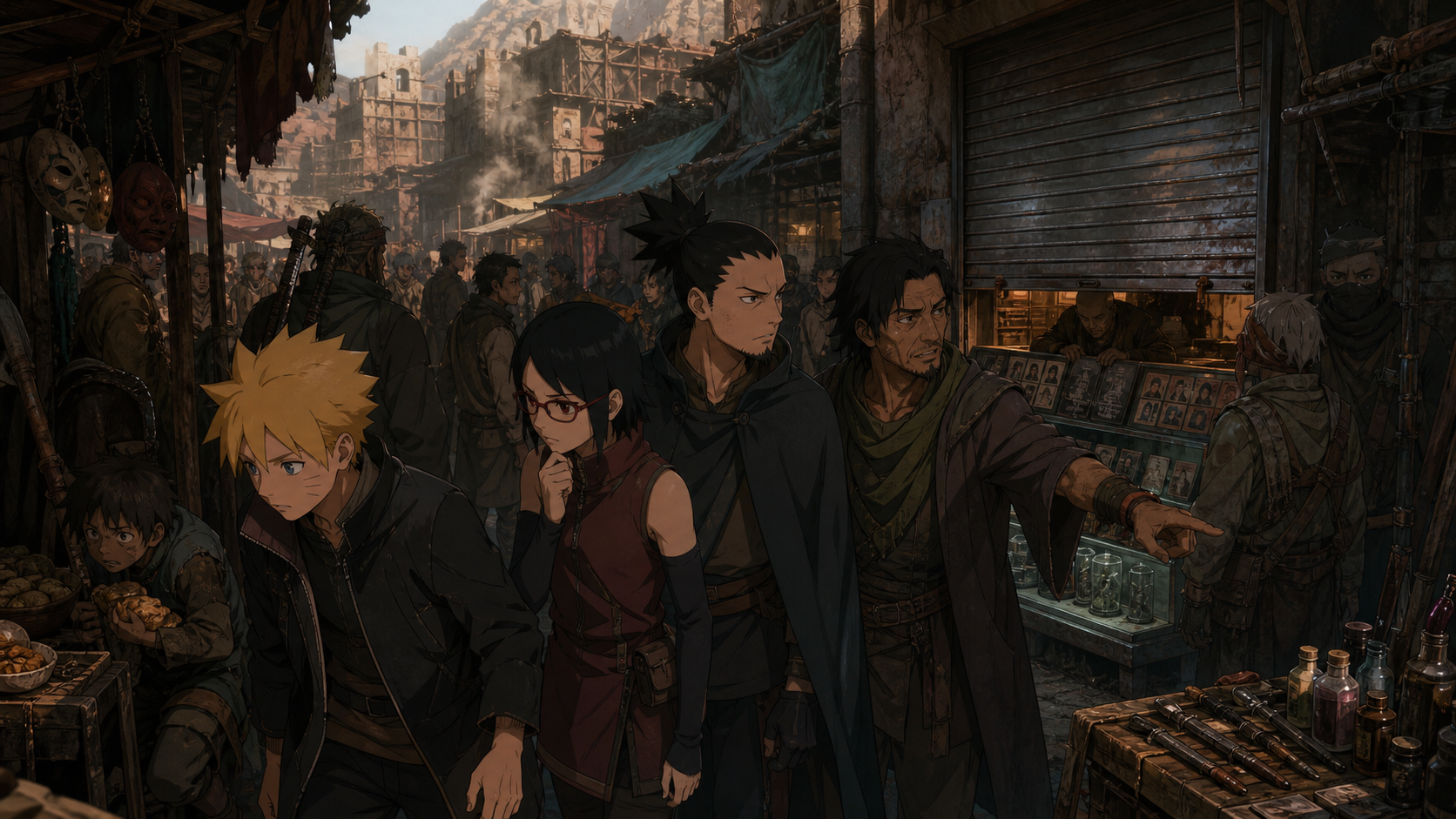
The stolen Hashirama cell enters a market built from broken gates, discarded shinobi, hungry children, fake identities, and every failure the great villages call somebody else’s problem.
Series: Boruto: Naruto Next Generations
Episode: 160 · To the Land of Silence
Arc: Kara Actuation
Release: 2020-08-09
Previous: Episode 159 · The Hashirama Cell
Directory: All 293 Boruto episodes
Bottom line
Boruto Episode 160, “To the Land of Silence,” sends Boruto, Sarada, Konohamaru, and Mugino into a black market built from everything the shinobi system discards. Rogue ninja sell weapons, identities, medicine, secrets, and stolen biological material beneath gates left broken after the Land of Silence lost any meaningful public authority. The group removes its Konoha forehead protectors because a great-village symbol offers no protection there. The symbol would only announce wealth, enemies, and a government worth ransoming.
The episode gives Boruto a necessary lesson in undercover work and then keeps letting him ignore the lesson. He forces information from a shopkeeper, exposes himself to help a hungry child, and uses a transformation to approach Kirisaki inside an adult venue. His instinct to protect vulnerable people remains worth preserving. His belief that a good reason cancels operational consequences does not. Mugino understands that one exposed identity can endanger the child, the team, the source, and everybody who helped them after they leave.
Mitsuki stays with Yubina because recovery is work
Mitsuki remains at Yubina’s clinic after the Hashirama-cell extraction. The team cannot drag him into a black market simply because he usually provides tracking and restraint.
Recovery requires observation for renewed growth, immune reaction, fever, and tissue damage. Rest is not a narrative benching when his body has just survived an invasive biological event.
Leaving him with an independent physician also keeps Victor’s company away from the evidence inside Mitsuki’s body.
Boruto turns guilt into another mission promise
Boruto wants to retrieve the stolen cell because Mitsuki became infected and Anato died. He frames pursuit as a way to stop another victim.
That motivation is honest and dangerous. Guilt can sustain courage while making every delay feel like betrayal.
Mugino keeps reminding him that urgency does not replace planning. A reckless recovery attempt could deliver the sample and four additional bodies to the same market.
The Land of Silence exists because authority collapsed
The Land of Silence has no stable hidden village protecting residents or regulating shinobi work. Missing-nin, mercenaries, merchants, and gangs fill the spaces where public systems failed.
Money and force become the local credentials. A person with neither depends on somebody stronger deciding not to exploit them.
The episode presents lawlessness as an economy, not a personality trait shared by everyone born there.
Shikamaru already learned what the region can hide
The Land of Silence carries history from Shikamaru’s postwar investigation into Gengo and the community of disaffected shinobi gathered under his influence.
Gengo understood that abandoned ninja could be recruited through resentment toward the great villages and the new political order.
Years later, the market still collects people the peace did not reintegrate. Removing one leader did not repair the conditions that made his movement possible.
The ruined gate announces the political reality
Boruto notices damaged entrances and a settlement that no recognized shinobi authority maintains.
A gate usually marks who controls entry, collects information, and claims responsibility for what happens inside. A broken gate means movement without accountability.
Contraband thrives when nobody can reliably inspect cargo and nobody trusts the inspector who might appear tomorrow.
Forehead protectors become liabilities
Konohamaru orders the group to remove Konoha symbols before entering. The forehead protector represents affiliation, legal authority, training, and national power.
Inside the market, the same symbol marks them as outsiders connected to a wealthy village with active Bingo Book targets.
Undercover work begins when characters understand that identity can change how every witness behaves before a word is spoken.
The Bingo Book walks through the street
Mugino and Konohamaru recognize wanted shinobi moving openly among the stalls. People hunted elsewhere can buy, sell, recruit, and disappear here.
The market supplies more than hiding places. Forged records, medical services, weapons, food, and intelligence let fugitives build operational lives.
Arresting one face does little when the local economy depends on serving the next face.
The Hashirama cell is valuable because everybody imagines a different miracle
Medical buyers see regeneration. Military buyers see endurance, Wood Release, or modified soldiers. Wealthy clients see restored youth and delayed death.
Researchers see data. Kara sees technology, compatibility knowledge, and leverage.
One sample attracts every market at once, which makes recovery far more difficult than following a single thief.
Stolen identities travel beside stolen bodies
The team learns that an employee from Victor’s company sold an identification card. The card provides facility access, professional credibility, or proof that can be attached to another person.
Identity trafficking makes corporate security part of the biological breach. A sample does not walk through a checkpoint by itself.
Victor’s company needs to explain how staff credentials are issued, disabled, audited, and connected to specimen custody.
The first thief is also a hungry child
Boruto notices a young thief stealing food. The act breaks market rules and reveals basic need.
Calling the child a criminal without asking why he is hungry would reproduce the system that created the market. Ignoring theft entirely can place shop workers and the child in greater danger.
Boruto sees the person quickly. He does not yet see every consequence surrounding the intervention.
Mugino understands that visible mercy can expose a source
Helping the child in public tells observers that Boruto has money, sympathy, and a connection worth following.
The child may be beaten for speaking to outsiders, pressured for details, or used to draw Boruto into another trap.
Good intentions require operational protection. Mugino’s caution protects the person Boruto wants to help after the team leaves the street.
Boruto breaks formation at the information shop
The group reaches a merchant reported to know the market’s latest transactions. The shopkeeper dismisses questions from people who are not buying.
When the metal gate drops, Boruto dives beneath and becomes separated from Sarada, Konohamaru, and Mugino.
He gets inside, but his success depends on defeating whoever waits beyond the gate without support or a clean exit.
The shopkeeper sells information according to market rules
Questions carry value. A source who gives answers freely loses bargaining power and attracts dangerous attention.
The shopkeeper’s hostility does not prove ignorance. His refusal establishes a price and tests whether the strangers understand the environment.
Boruto answers with force, gaining facts while also teaching the source that Konoha will ignore local boundaries when urgency feels sufficient.
Winning the scuffle does not make the entry smart
Boruto defeats the guards and subdues the shopkeeper. Physical victory confirms that he can survive the immediate mistake.
Survival is not the same as good intelligence work. The team needs accurate information from someone who now has reason to lie, retaliate, or warn the market.
A clean operation measures what happens after the punch as carefully as the punch itself.
Sarada reads the room Boruto keeps charging through
Sarada observes wanted faces, transactions, exits, and the team’s changing risk. Her attention complements Boruto’s willingness to act.
She also has to manage the fact that every visible Uchiha feature or recognizable technique could reveal their origin.
An undercover Sarada cannot solve every problem with the Sharingan if using the eye identifies her more loudly than a forehead protector.
Konohamaru carries responsibility for bringing genin inside
Mugino questions whether Boruto and Sarada should participate in a mission among missing-nin and black-market traders.
Konohamaru believes experience must be gained through supervised missions, not postponed until danger becomes polite.
That decision requires active supervision, clear abort conditions, and consequences when Boruto ignores orders. Trust without boundaries becomes negligence.
Mugino is not trying to crush Boruto’s empathy
His warnings can sound cynical because he focuses on traps, cover, and the cost of hesitation.
Mugino has spent years around people forced to weaponize generosity and suspicion. He knows kindness can remain real while the situation around kindness becomes dangerous.
The lesson is not “stop caring.” The lesson is “care far enough ahead to protect the outcome.”
The adult venue creates the wrong kind of comedy
The team traces Kirisaki to an establishment where adult men pay for company. Boruto uses a transformation to approach him in a feminine form.
The sequence relies on the old franchise habit of treating Sexy Technique as harmless access to adult desire.
Boruto is a child manipulating an adult sexual context. The operation should have assigned an adult operative or used a different disguise and approach.
Konohamaru should have handled Kirisaki
Konohamaru knows transformation techniques, has undercover experience, and is legally an adult. He is the obvious person to approach Kirisaki without placing a child inside sexualized interaction.
Comedy does not remove the safeguarding problem. A mission leader should not let a genin become bait for an adult suspect because the audience recognizes the gag.
The same information could come through staff observation, a staged purchase, surveillance, or an adult transformation.
Kirisaki connects the market to the next buyer
Kirisaki’s involvement gives the team a path from Victor’s missing credential and specimen toward the people currently holding the cell.
Information changes hands through brokers because each layer protects the seller and buyer from direct exposure.
The team has moved from company evidence to criminal logistics. Every new contact increases the chance that Victor, Kara, or competing buyers learn that Konoha is close.
The Land of Silence turns dispossession into commerce
Weapons stolen from villages, medicine denied through official channels, identities separated from workers, and knowledge gathered through violence all become merchandise.
Markets do not create every demand. They make demand efficient and give exploitation a price.
Destroying stalls without addressing poverty, exile, and unequal access would push the trade into another alley.
A black market still has rules, workers, and customer service
The Land of Silence does not operate through random chaos. Sellers protect reputations. Brokers price risk. Lookouts watch entrances. Stolen identities reduce friction. Information shops decide which questions cost money and which questions bring armed attention.
That structure matters because Team 7 cannot defeat an economy by winning one scuffle. Every person they pressure has another reason to stay quiet: fear of a gang, dependence on a shopkeeper, debt to a broker, or the need to eat tomorrow. The village has enforcement without public accountability and commerce without consumer protection.
Boruto enters expecting criminals who will reveal themselves through cruelty. The child thief complicates that expectation immediately. Hunger can produce theft without turning a hungry child into the architect of the system. Mugino understands the distinction, but he also knows that rescuing one child publicly can expose where the child sleeps and who supplied the information.
The episode becomes strongest when compassion and caution stop looking like opposites. Compassion asks what the child needs. Caution asks what happens to the child after the shinobi leave.
Konoha benefits from borders that dump unwanted people somewhere else
The great villages can call the region dangerous while using the region as evidence that their own order works. That story ignores how official systems create the traffic feeding the market. Missing-nin come from villages. Stolen techniques come from villages. Bingo Books turn human beings into priced targets. Restricted medicine gains value because legitimate access remains unequal.
The Land of Silence receives consequences that stronger governments prefer to export. Criminals hide there, but so do people who cannot enter a respectable clinic, obtain papers, or survive under a former allegiance. Treating every resident as a threat makes intelligence worse and repeats the abandonment that keeps the market staffed.
Konoha has a genuine reason to recover Hashirama’s cell. The sample can mutate bodies and destabilize countries. Recovery still does not grant moral innocence to the village that stores, studies, and deploys inherited biological power through secret channels.
Team 7 carries Konoha’s symbol even after hiding the forehead protectors. Residents will judge the team through everything that symbol has meant to them, including decisions Boruto never made. A uniform can inherit political debt along with authority.
The child thief is a source, a victim, and a person before any of those roles
Boruto sees hunger and reacts before completing a risk assessment. His instinct is humane. His method could get the child hurt.
Shinobi stories often reward a hero for offering food, receiving a clue, and moving toward the next fight. Episode 160 nearly falls into that transaction. A vulnerable child should not have to purchase kindness with intelligence. Food cannot become an unofficial interrogation fee simply because Boruto means well.
Mugino’s warning gives the scene needed weight. Helping privately may protect the child better than announcing protection in front of adults who track debts and loyalties. Asking fewer identifying questions can be safer than collecting a complete backstory. A responsible team would also plan follow-up through somebody trusted locally rather than assuming one meal closes the problem.
Boruto’s heart is not the error. The missing safety plan is the error. Compassion without continuity can make the helper feel righteous while the person helped remains exposed.
The Sexy Technique operation is a failure of adult leadership
The episode reaches backward for a familiar Naruto joke and lands in a situation the adults should have stopped. A child transforms into a sexualized woman to manipulate an adult suspect in an adult venue. Calling the disguise a ninja technique does not remove the sexual context.
Konohamaru has the transformation skill, experience, and legal responsibility for the genin under his command. He should handle Kirisaki or choose another route. Sarada should not have to watch a teammate perform sexual availability as mission labor while adults frame the sequence as comic embarrassment.
The problem is bigger than whether Boruto feels awkward. Commanders decide which risks children are asked to normalize. A village that assigns minors covert work owes those minors stricter boundaries, not looser ones.
Nostalgia cannot be the entire defense. Naruto used the technique as childish disruption and sometimes as tactical distraction. Boruto Episode 160 places a child in sustained proximity to an adult whose response is the point of the disguise. The context changed, so the ethical reading has to change with the context.
Recovery without containment is another version of carelessness
Mitsuki’s illness establishes that exposure can become a medical emergency. Yubina can treat him because she understands the sample’s effects and has a clinic. Team 7 leaves that medical support behind while entering a crowded settlement to chase the same hazardous material.
Where is the sealed carrier? Who confirms that the recovered sample has not leaked, degraded, or been altered? Which member monitors exposure? What happens if a thief breaks the container in a market full of civilians? The mission behaves as though possession automatically equals safety.
That assumption mirrors the buyers’ arrogance. Sakuya believes money can turn unstable tissue into youth. Victor believes research can turn risk into power. Konoha believes trained shinobi can carry danger home because the mission report says “recovery.” Different motives do not eliminate the shared need for containment.
A credible operation would include a medical protocol, protective equipment, a quarantine route, and authority to destroy the sample if transport becomes impossible. Chasing faster cannot substitute for planning what happens after capture.
Sarada’s observation should shape the plan before Boruto breaks the plan
Sarada notices the room, the people watching, and the cost of drawing attention. The episode gives her the correct read but rarely lets her analysis redirect the team before trouble starts.
That pattern undervalues a skill the mission desperately needs. Sharingan combat matters, but social observation keeps cover intact. Sarada could identify surveillance, map exits, or warn which seller is performing indifference while tracking customers. Those contributions belong at the center of infiltration, not beside Boruto’s latest impulsive reveal.
Boruto should remain impulsive because growth needs friction. The writing still has to let other characters’ competence change outcomes. If Sarada warns him and he ignores the warning every time, her intelligence becomes commentary instead of power.
Konohamaru carries responsibility here. A leader can assign Boruto a bounded task, give Sarada explicit authority over cover discipline, and let Mugino manage local-risk decisions. Teamwork needs roles strong enough to survive personality.
The episode understands the symptom better than the repair
Ruined gates, false papers, hungry children, and wanted shinobi create a convincing diagnosis. The region has absorbed people and transactions rejected by stronger systems. Everybody sells access because stable public access barely exists.
The story offers no easy repair, which is honest. Konoha cannot walk in, appoint an administrator, and call the village rescued. Outside control could reproduce the same hierarchy under a cleaner banner.
Still, the absence of an easy answer cannot become permission to retrieve Konoha’s property and forget the residents. Repair would require legitimate clinics, food routes, identity documentation, safe exits for defectors, witness protection, and local leadership with resources beyond gang money. None of that fits one episode. All of that belongs in the moral ledger created by the episode.
The Hashirama-cell chase matters because the sample can hurt people. The people already living inside the fallout matter before the sample arrives.
What Episode 160 gets right
The episode expands the shinobi world beyond legal villages. Wanted ninja need food, papers, treatment, weapons, and networks, which creates an entire service economy.
Mugino gives the mission adult caution. Sarada practices observation. Boruto’s compassion remains valuable even when his execution creates problems.
The stolen cell also travels through believable intermediaries rather than jumping directly from Victor to a final villain.
What Episode 160 mishandles
The Sexy Technique operation places a child in a sexualized encounter with an adult suspect. Nostalgia for an old gag does not make the choice appropriate.
Boruto breaks cover repeatedly without a meaningful operational consequence, which weakens Mugino’s warnings.
The team also needs a clearer plan for transporting the cell safely if they find the sample. Retrieval without containment could reproduce Mitsuki’s exposure.
Konoha sent shinobi to recover hazardous tissue without a sealed carrier, independent medic, or stated quarantine route. A successful chase could still become a biological failure during the trip home. The mission needs to protect the pursuers and every civilian standing between the market and Yubina’s clinic.
RaeRae’s read
The Land of Silence is not silent. The market is loud with every failure the great villages prefer not to hear: hungry children, discarded shinobi, broken gates, stolen medicine, fake names, and people selling danger because danger pays better than peace.
Boruto wants to protect the child and stop another Mitsuki. Keep that heart. He also needs to learn that an exposed face can get a child punished, a source killed, and a team followed. Mugino is teaching him how compassion survives past the first brave gesture.
Konoha cannot arrest its way out of this economy while benefiting from the political order that produced the customers. Retrieve the Hashirama cell, absolutely. Then ask why one of the world’s most dangerous biological materials found a smoother distribution network than food, medicine, and legitimate work.
Sources and lawful viewing
Official episode reference: Naruto Official episode guide
Licensed episode route: Crunchyroll licensed series page