
The Hashirama Cell
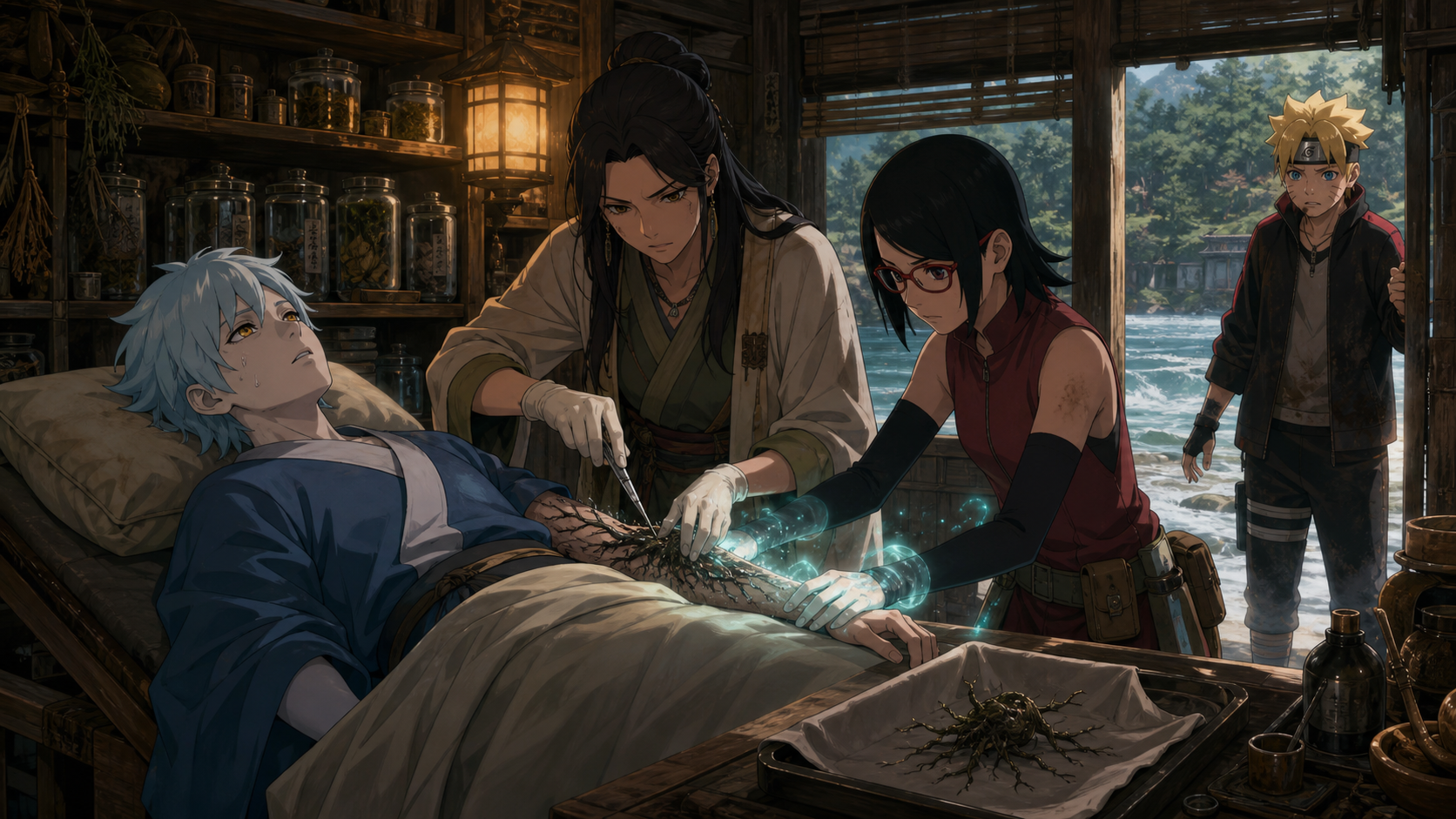
Victor takes Anato and controls the death story, but Yubina saves Mitsuki by treating Hashirama’s stolen biological legacy as a medical hazard instead of a miracle upgrade.
Series: Boruto: Naruto Next Generations
Episode: 159 · The Hashirama Cell
Arc: Kara Actuation
Release: 2020-08-02
Previous: Episode 158 · The Man Who Disappeared
Directory: All 293 Boruto episodes
Bottom line
Boruto Episode 159, “The Hashirama Cell,” turns Anato’s rescue into a corporate cleanup. Team 7 tries to restrain the altered researcher because Boruto promised Mia they would bring her husband home. Victor watches the attempt fail, orders his shinobi to attack Anato with Lightning Release, removes the body, and later tells Boruto that the researcher died. By the time Mitsuki collapses from the same invading tissue, Victor’s company has already taken the patient, the evidence, and control of the story.
The episode also reminds everyone why Hashirama’s cells should never be treated like magical upgrade paste. His extraordinary life force can regenerate, overwhelm, mutate, or kill depending on compatibility and control. Yubina saves Mitsuki because she treats the growth as a medical emergency rather than a prize. Victor wants the missing sample because scarcity, profit, war trauma, and Kara have turned one dead Hokage’s body into an industry. Hashirama won peace and still cannot rest in peace.
Boruto keeps the promise Mia actually heard
Boruto enters the fight insisting that Team 7 must bring Anato back alive. Mia did not hire Konoha to recover research property or confirm a death. She asked them to find her husband.
That promise makes Boruto resist Mugino’s harsher conclusion that Anato may need to be killed before somebody else gets hurt.
Boruto’s compassion is not tactical experience, but the mission would become morally empty if the team stopped seeing a person beneath the roots.
Anato is dangerous without becoming disposable
The altered researcher lashes out with abnormal strength and root growth. He does not recognize Team 7 clearly enough to cooperate.
Immediate danger requires restraint. Danger does not erase his right to treatment, evidence collection, or an honest explanation for Mia.
The difference between patient and monster depends partly on who controls the language. Victor benefits when everyone calls Anato an uncontrollable specimen before asking what his company exposed him to.
Mugino says the ugly field truth
Mugino warns that Boruto’s hesitation could get the team killed. A shinobi in active combat sometimes has seconds to choose between one compromised person and several uninfected teammates.
His position is not cruelty. Years in conflict zones have taught him that good intentions cannot reverse every biological or tactical failure.
Mugino still needs more information before death becomes the only option. Victor’s arrival ensures that independent assessment never happens.
Konohamaru looks for a third choice
Konohamaru proposes sealing Anato rather than killing him. The plan respects Boruto’s promise while acknowledging the threat.
Sealing is exactly the kind of shinobi tool that should exist for dangerous medical containment. Restraint can create time for diagnosis and evacuation.
The failure of the attempt does not make the approach foolish. The team lacks preparation for a Hashirama-cell incident because Victor concealed the actual research objective.
Team 7 cannot restrain growth they do not understand
Boruto, Sarada, and Mitsuki coordinate attacks against roots that regenerate and change direction. Ordinary combat assumptions collapse when damage stimulates more uncontrolled growth.
The team entered a rescue mission without protective equipment, medical specialists, sealed transport, or a warning about biological exposure.
Calling their failure inexperience would let the company escape responsibility. Victor sent a search party toward a known research hazard and shared none of the necessary safety information.
Victor watches before he intervenes
Victor observes Team 7 fighting Anato long enough to learn how the growth behaves and how the Konoha shinobi respond.
The delay feels less like uncertainty than field testing. He gains information while other people absorb the danger.
An ethical executive would identify the suspected agent immediately, order distance, and provide containment instructions. Victor waits until he can take control of the outcome.
Lightning becomes corporate euthanasia without consent
Victor’s shinobi fire repeated Lightning Release attacks into Anato and finally stop his movement. The method looks brutal because the company chooses force over medical containment.
Victor later says Anato died. Team 7 never receives an independent examination, verified time of death, body-release documentation, or opportunity to tell Mia what they witnessed before the company removes him.
Whether the attack killed Anato or merely created cover, Victor controls every fact required to answer the question.
Mia loses her husband behind another closed door
Mia waited through company silence, hired Konoha, and trusted Boruto’s promise. The rescue reaches Anato and still leaves her outside the truth.
Victor can now present the death as a tragic research accident involving a dangerous condition. That explanation protects the institution from questions about exposure, consent, and the missing sample.
Mia deserves more than condolences written by the same company that withheld the route.
Mitsuki takes the contamination into his own body
During the fight, root material enters Mitsuki’s body. His artificial physiology delays the worst response but does not make him compatible.
The infection demonstrates how easily field contact can become a second patient. Team 7 had no decontamination protocol because nobody warned them.
Mitsuki’s collapse is not random suspense. The medical consequence proves that Anato’s condition could spread through direct exposure.
Boruto carries Mitsuki because friendship becomes the mission
When Mitsuki can no longer continue, Boruto carries him. Kara, Victor, and the lost sample recede behind the immediate need to keep his friend alive.
The physical act answers some of Boruto’s earlier impatience. He wanted to hunt Kara. Now he is walking under the weight of one consequence connected to Kara’s research network.
Understanding an enemy includes caring for the people harmed before the final fight arrives.
Yubina provides medicine outside Victor’s control
The team finds Yubina, an independent physician willing to examine Mitsuki. Her clinic lacks Victor’s polished corporate presentation and possesses the one resource the team needs: judgment that does not answer to his company.
She identifies the invasive matter and treats the condition as a compatibility crisis.
Independent medicine matters because Victor cannot be both suspected source and sole medical authority.
Sarada assists instead of standing outside the room
Sarada has limited medical-ninjutsu experience and helps Yubina remove the growth. She does not suddenly become Sakura.
Her chakra control and foundational knowledge make her useful under a more experienced physician’s direction.
The scene respects training as cumulative. A skill can save a teammate before the student masters an entire profession.
Sarada also learns the difference between combat precision and medical precision. An enemy can be stopped with force. A patient requires enough control to remove the threat without damaging the body already fighting for balance. Sakura’s discipline becomes visible in Sarada before the daughter inherits her mother’s full skill set.
Compatibility decides whether regeneration becomes invasion
Hashirama’s cells carry exceptional vitality. In a compatible host under controlled conditions, the tissue can support healing or new biological function.
In an incompatible body, the same energy overwhelms existing systems. Growth becomes mutation, immune crisis, or death.
The power is not automatically good or evil. Dose, host, preparation, consent, and monitoring decide what the biological material does.
Naruto’s prosthetic arm is not proof of universal safety
Boruto knows Hashirama cells are associated with Naruto’s prosthetic arm. That successful use can create the impression that the cells are established medicine.
Naruto’s physiology, Uzumaki vitality, chakra, medical supervision, and the arm’s construction are not ordinary conditions. A controlled prosthetic interface is also different from uncontrolled tissue entering a body.
One exceptional patient should never become the safety trial for everyone else.
Konoha owes the public a clearer explanation of what Naruto’s arm contains, how contact is controlled, and why the same treatment cannot simply be copied. Silence invites desperate patients and ambitious researchers to assume the village is hoarding a miracle rather than containing a hazard.
Hashirama’s body has been exploited for generations
Orochimaru, Danzō, Madara, Obito, White Zetsu experiments, prosthetics, and countless unauthorized projects have used Hashirama’s cells after his death.
The First Hokage’s body became a strategic resource because his power remained biologically reproducible.
Nobody asks what consent means when a nation repeatedly harvests and distributes a dead leader’s tissue. Respect disappears whenever military advantage enters the room.
The cell functions like radioactive contraband
Hashirama tissue can heal, mutate, weaponize, and contaminate. Possession creates scientific, military, and black-market value.
That combination resembles controlled hazardous material more than a secret jutsu scroll. Every sample requires chain of custody, containment, certified handling, and incident reporting.
The fact that a viable sample can vanish into trade networks exposes a failure far larger than one missing researcher.
Victor’s medical dream creates the perfect excuse
Victor says he wants to regenerate organs and limbs for people injured by war. The goal could save thousands of lives.
Hashirama cells offer a shortcut toward that dream, especially for an aging man who lost a leg and fears death.
The personal need does not excuse experimenting on workers or hiding casualties. Medical urgency can sharpen ethics or become the excuse for abandoning them.
The missing sample reveals a second operation
Victor discovers that the amount of Hashirama material recovered does not match what should remain. Someone removed a sample during the chaos.
The theft means Anato’s expedition was not an isolated company disaster. Other buyers, shinobi, or Kara-connected actors understand the value and know how to move the material.
Recovering the sample becomes urgent because every incompatible host can produce another Anato.
The sample also carries information about Konoha’s greatest biological asset. A buyer could study regeneration, Wood Release, graft survival, or compatibility markers. The threat includes mass harm and a quieter theft of knowledge that took generations of unethical experiments to accumulate.
Victor wants the sample for more than public safety
His company claims medical purpose, but Victor’s Kara connection gives the search another layer. He needs the material for research, influence, and his position inside the organization.
A missing sample threatens both commercial control and secrecy. Reporting the theft to Konoha would invite oversight Victor cannot manage.
He treats retrieval as a private problem because public investigation might expose the original crime.
Team 7’s failed mission should trigger a formal inquiry
The official result is ugly: Anato died, Mitsuki became infected, and a hazardous sample disappeared.
Konoha should quarantine every exposed person, preserve Mitsuki’s extracted tissue, interview Victor’s staff separately, notify Mia, and request complete expedition records.
Sending the same team after the stolen sample without adult medical and intelligence support would repeat the negligence that created the incident.
Victor’s company should not investigate itself. Konoha may lack direct jurisdiction in the Land of Valleys, but the village can condition further assistance on shared evidence, invite local authorities, and document every refusal. Diplomacy becomes meaningful when powerful allies use leverage for accountability instead of convenience.
Boruto chooses recovery over surrender
Mitsuki must remain with Yubina while Boruto and the others consider the stolen cell. Leaving a teammate behind feels wrong, especially after a failed rescue.
Mitsuki’s treatment requires rest, monitoring, and a doctor. Carrying him into another pursuit would turn loyalty into danger.
Boruto can honor their friendship by making sure the next victim never reaches Yubina’s table.
The arc finally connects science to ordinary bodies
Scientific ninja tools often appear as weapons, prosthetics, or tournament controversy. Episode 159 makes biological research hurt workers, spouses, genin, and doctors.
Anato does not volunteer to become a test case. Mia never consents to corporate silence. Mitsuki becomes exposed while performing contracted rescue work.
Innovation cannot call itself progress when everybody carrying the risk stands outside the decision.
Anato’s death cannot be accepted as a company press release
Victor arrives, uses overwhelming force, removes Anato, and later supplies the account of what happened. The same executive controls the personnel, the research site, the rescue narrative, the body, and the information released to the family. That is not independent evidence. That is monopoly control over a death story.
Team 7 witnessed enough to demand records. Who authorized the expedition? What protective equipment did Anato receive? When did staff first suspect Hashirama-cell exposure? What samples remain? Who examined his body after Victor took him? Which employee notified Mia, and what exactly did the company tell her?
Anato’s violence created an immediate emergency. His condition did not erase his rights as a patient, worker, husband, or witness. Victor treats incapacity as permission to decide everything. The episode should make viewers suspicious of that efficiency, especially after the opening mystery established deliberate secrecy.
Mia deserves truth before Boruto deserves another mission
Boruto made a promise to find Anato. A promise to a spouse is not satisfied by privately deciding that the search ended badly and racing toward the next clue.
Mia needs direct notification, a truthful timeline, access to whatever remains of her husband, and a chance to ask questions without Victor’s employees managing the room. She also needs material support. If Anato died during company work, wages, medical records, benefits, and liability cannot disappear behind the word “accident.”
Keeping her offscreen protects the episode’s pace, but the absence repeats the company’s behavior. Men make decisions around Anato’s body while Mia waits for information. Boruto’s grief matters. Her legal and emotional relationship to the dead man matters more than the young shinobi’s desire for closure.
The next mission should begin after somebody sits with the person who has to live with the outcome.
Mitsuki’s survival is not proof that the exposure was manageable
Mitsuki has an artificial body with unusual resilience, access to elite teammates, and the luck to reach Yubina. He still collapses. A civilian exposed to the same material might die before understanding what entered the body.
That distinction should shape every decision after treatment. Mitsuki needs observation beyond the moment symptoms ease. Yubina should document the extraction, preserve samples safely, and communicate possible delayed effects. Sarada and Boruto need exposure screening because close contact and combat placed them near contaminated tissue.
Stories often use recovery as a reset button. Medical recovery is usually a process full of monitoring, uncertainty, and informed choices. Mitsuki’s calm personality cannot substitute for informed consent. Somebody owes him a complete explanation of what Yubina removed and what nobody can yet predict.
Hashirama’s cells expose the lie of clean scientific inheritance
The shinobi world speaks about Hashirama’s power as legacy, almost like later generations inherited a public gift. Nobody inherited consent to harvest, transplant, copy, sell, or weaponize his tissue.
Once the first experiment produced useful results, every later user could point backward and call the practice established. Established harm remains harm. A prosthetic success does not cleanse the failed subjects. A military advantage does not make the body source public property. A medical possibility does not authorize a private company to experiment on workers.
Episode 159 places the accumulated ethical debt inside Anato and Mitsuki. Their bodies reveal what the phrase “Hashirama cell” conveniently hides: tissue from a person, altered by researchers, moved through institutions, and imposed on people who may never know the history entering their bloodstream.
Science deserves precision. The language surrounding this science has been designed to make ownership sound natural.
What works: care interrupts the corporate chain of control
Yubina does not answer to Victor. That independence lets her treat Mitsuki as a patient instead of an asset, liability, or research opportunity. Sarada contributes medical skill under direction. Boruto carries his friend because speed matters more than pride. Konohamaru seeks an option beyond killing Anato.
None of those actions produces a grand victory. Together, they create the episode’s moral alternative. Care shares information, responds to the actual body, and keeps the patient visible inside the emergency.
Victor’s method centralizes authority and removes witnesses. Yubina’s method depends on observation, assistance, and a willingness to say what she does not know. One model protects the institution. The other protects the person.
The contrast explains why Mitsuki survives without pretending survival was guaranteed. Team 7 reaches somebody whose first question concerns treatment rather than ownership.
The stolen sample needs a chain of custody, not another heroic handoff
If Team 7 recovers the container, nobody should pass the sample from hand to hand while celebrating. Every transfer can contaminate evidence, expose another body, or let a bad actor replace the material. The team needs photographs of the container as found, names and times for every person who touches the package, sealed transport, and independent confirmation of the contents.
Chain of custody sounds boring beside a pursuit. Boring procedure is how investigators stop Victor from claiming that Konoha lost his property, changed his research, or invented the theft. Procedure also protects Team 7 from becoming the next convenient suspects.
The sample carries two kinds of evidence: dangerous biology and proof of a hidden operation. Destroying the tissue might become medically necessary, while preserving records of the container, route, sellers, and exposure remains essential. Those goals can coexist if somebody plans before the next fight.
Boruto wants to recover what hurt Mitsuki. Accountability requires recovering the story around the sample too. Without that record, powerful people will call every victim an isolated accident and begin the experiment again under a new project name.
What Episode 159 gets right
The episode treats the Hashirama cell as dangerous biology rather than free power. Mitsuki’s artificial body offers resistance without granting immunity.
Yubina and Sarada make medical skill central. Boruto’s promise to Mia gives the failed restraint emotional weight.
Victor also remains plausible enough to manipulate the scene. His public mission and private conduct occupy the same body.
What Episode 159 rushes past
Anato’s death requires more scrutiny. Team 7 accepts Victor’s account despite witnessing a violent company intervention and already experiencing corporate secrecy.
Mia’s reaction remains outside the episode, which protects viewers from the human cost of the failed mission.
Konoha also needs immediate notification once Hashirama tissue is identified. A genin pursuit should not replace a biological incident response.
RaeRae’s read
Hashirama wanted to build a village where children would not die for adult ambition. Decades later, adults are still cutting pieces from his legacy, placing those cells in workers, soldiers, experiments, prosthetics, and black markets.
Anato becomes another body consumed by somebody else’s promise of progress. Mitsuki survives because Yubina removes the material and Sarada helps her. The difference is not destiny. The difference is medical independence, fast action, and a team that still sees a patient.
Victor takes Anato and controls the death story. He cannot be allowed to control the stolen sample story too. Boruto wanted Kara’s footprints. Episode 159 puts one on his friend’s body and dares Konoha to keep treating Victor like a helpful executive.
Sources and lawful viewing
Official episode reference: Naruto Official episode guide
Licensed episode route: Crunchyroll licensed series page