
The Man Who Disappeared
Mia wants her husband back, Victor wants control of the research story, and Boruto learns that Kara can hide behind a medical company’s clean lobby and noble promises.
Series: Boruto: Naruto Next Generations
Episode: 158 · The Man Who Disappeared
Arc: Kara Actuation
Release: 2020-07-26
Previous: Episode 157 · Kara’s Footprints
Directory: All 293 Boruto episodes
Bottom line
Boruto Episode 158, “The Man Who Disappeared,” begins as a missing-husband case and ends with Team 7 staring at what Victor’s medical company did to Anato. Mia waited three weeks beyond her husband’s promised return while his employer hid behind trade secrets, vague assurances, and a private search party. Mitsuki steals the location the company refuses to provide, Mugino keeps warning Boruto that respectable people can lie, and Victor arrives in the field wearing the face of a generous executive personally searching for an employee.
The episode works because every answer raises a nastier question. Anato is alive, but roots have altered his body. Victor claims to heal limbs and organs after losing a leg in war, yet his company controls the evidence, the staff, and the story Mia receives. Boruto wants Kara so badly that he could miss the corporate system already standing in front of him. Sasuke tells him to stop hunting a name and become capable of surviving the truth. Episode 158 proves why.
Boruto trains because Karma has made waiting unbearable
Boruto practices shurikenjutsu alone while thinking about Kara and the mark in his palm. Shojoji connected the organization to Karma, and Sai and Sasuke confirmed that Kara exists.
Information has made him more anxious rather than more prepared. He wants to move because action feels better than wondering whether Momoshiki left a weapon, infection, tracking device, or future claim on his body.
The fear is reasonable. Charging into Kara without understanding the organization would give that fear control over the mission.
Sasuke gives Boruto the advice he learned too late
Sasuke warns Boruto that seeking an enemy without enough information can lead to death. The sentence carries the weight of his own adolescence.
He left Konoha to hunt power, trusted Orochimaru as a temporary route, and spent years letting revenge define which danger looked acceptable. Sasuke admits that he is not the cleanest person to lecture anybody about patience.
That honesty makes the advice useful. He is not claiming superior teenage judgment. He is showing Boruto the scar left by ignoring the same warning.
The glove protects privacy without solving Karma
Sasuke gives Boruto a dark glove to cover the seal. The glove reduces unwanted questions and keeps strangers from noticing a mark connected to an unknown enemy.
Covering Karma also risks turning secrecy into isolation. Boruto needs a small circle of adults and teammates who understand the danger well enough to recognize changes.
Privacy is not denial when the village lacks safe public answers. The glove buys time. Training and investigation must decide how that time gets used.
Shikamaru assigns a mission Boruto considers too ordinary
Team 7 receives a missing-person assignment in the Land of Valleys. Boruto wants Kara, conspiracies, and answers about Karma. A researcher who failed to return from work sounds unrelated.
That impatience is exactly why the mission matters. Kara does not announce every operation with a black cloak and secret meeting room. Organizations hide inside businesses, contracts, research programs, and people who disappear during routine travel.
Following one missing worker may reveal more than chasing the name Kara across a map.
Mugino arrives with the experience Team 7 lacks
Mugino joins Konohamaru and Team 7 because he knows the region. His blunt manner irritates Boruto, who reads caution as unnecessary pessimism.
Mugino has spent years mediating conflicts among smaller nations. He has watched promises fail after the great powers leave, and he knows that a peaceful border on Konoha’s map can still contain hunger, armed groups, and institutions nobody fully controls.
The mission needs that memory more than another flashy jutsu.
Smaller nations keep paying for larger wars
Mugino explains that conflict did not end everywhere when the Fourth Shinobi World War ended. Smaller countries continue dealing with political instability, resource pressure, and violence that rarely becomes a great-village emergency.
Episode 157 showed Amegakure’s abandoned infrastructure. Episode 158 sends Team 7 through another small nation where a major company can control information because the state has limited reach.
Peace looks different depending on who owns roads, hospitals, and the authority to demand answers.
Mia is not an impatient wife making a scene
Mia hired Konoha after Anato failed to return from a month-long research trip and remained missing three weeks beyond the expected date. His employer would not tell her where the team traveled.
She is frightened, angry, and tired of polite delay. The company treats that response as disruption rather than evidence that its process has failed.
Family members should not need to hire foreign shinobi to learn where an employee disappeared during company work.
Trade secrets become a shield against basic accountability
The medical company refuses to disclose Anato’s location because the research concerns proprietary information. That excuse may protect formulas, samples, or commercial methods. The excuse should not erase a worker’s whereabouts.
A responsible company can tell Mia where her husband was sent, when contact stopped, which search teams deployed, and what hazards the assignment included without handing her a research archive.
Secrecy becomes abuse when the institution uses intellectual property to block a family’s right to know whether somebody is alive.
The receptionist offers process instead of information
Company staff promise updates and explain that an internal search is underway. The language sounds professional because professionalism can turn refusal into a calm voice and clean lobby.
Mia has already waited. Repeating the process does not answer the question.
The scene understands how institutions exhaust people. Every representative can remain courteous while the person asking for help leaves with nothing new.
Mitsuki sends a snake where transparency should have worked
Mitsuki quietly uses a snake to gather the location the company will not provide. The tactic violates the company’s preferred boundary and restores information the employer should have shared voluntarily.
Espionage is not a healthy substitute for labor regulation. Team 7 has a client in immediate distress and credible reason to believe delay could cost a life.
Mitsuki’s choice moves the mission forward while exposing how thoroughly the company controls the official route.
Boruto mistakes friendliness for evidence
Boruto wants to believe people who speak openly, appear generous, and share a sympathetic reason for their work. Victor knows how to present exactly that person.
Mugino warns him not to hand out trust before checking what actions support the story. Suspicion does not require treating everyone as guilty. Suspicion requires allowing facts to outrank charm.
Boruto’s empathy is a strength. Kara will exploit that strength if he never pairs empathy with verification.
Victor enters as the executive who came personally
Victor appears with a search party and orders his shinobi to stand down when they surround Team 7. He presents his presence as proof that Anato matters to the company.
A president personally joining the search looks admirable. The choice also gives Victor direct control over evidence, witnesses, and whatever the searchers find.
Leadership can mean responsibility. Leadership can also mean staying close enough to manage the story before anybody else speaks.
Victor’s war injury makes his medical mission persuasive
Victor describes losing a leg during the Fourth Shinobi World War and wanting medical research to restore limbs, organs, and life for people harmed by conflict.
That goal addresses a genuine failure in the shinobi world. Medical ninjutsu can perform miracles, but access remains unequal and many injuries exceed what ordinary treatment can repair.
The moral language is powerful because the need is real. A noble need does not guarantee noble methods.
Regeneration research carries enormous promise
Restoring damaged organs and limbs could change civilian medicine, veteran care, disability, and emergency response across every nation.
Research at that scale needs informed consent, independent oversight, long-term monitoring, and a clear separation between patient care and military experimentation.
Victor’s company appears to hold the research, search operation, field samples, and employee information under one authority. That concentration should worry everyone before Kara enters the conversation.
The search parties exchange information on Victor’s terms
Victor and Konohamaru compare areas already covered and narrow the remaining route. Cooperation seems efficient.
Team 7 still depends on records Victor controls. Nobody outside his company can confirm how many people joined the original expedition, what they were collecting, or what hazards Victor knew before dispatch.
An honest search requires a shared map. An accountable investigation requires access to the source records behind the map.
Mugino keeps the mission grounded in behavior
Mugino watches Victor, the company shinobi, and the changing story instead of arguing with Boruto about instinct.
His caution comes from field experience rather than automatic cynicism. People in unstable regions learn that aid organizations, businesses, militias, and governments can share the same roads and sometimes the same personnel.
He does not need proof that Victor is Kara to notice that the executive has too much control over the scene.
Konohamaru manages two generations of concern
Konohamaru trusts Mugino’s experience while protecting Team 7’s ability to learn. He lets Boruto question, Sarada observe, and Mitsuki gather information without turning every disagreement into an order.
The mission also reconnects him with a colleague whose work has largely happened outside the village’s spotlight.
Konohamaru knows courage can look like a loud attack or years spent mediating conflicts nobody celebrates.
The cave turns medical research into body horror
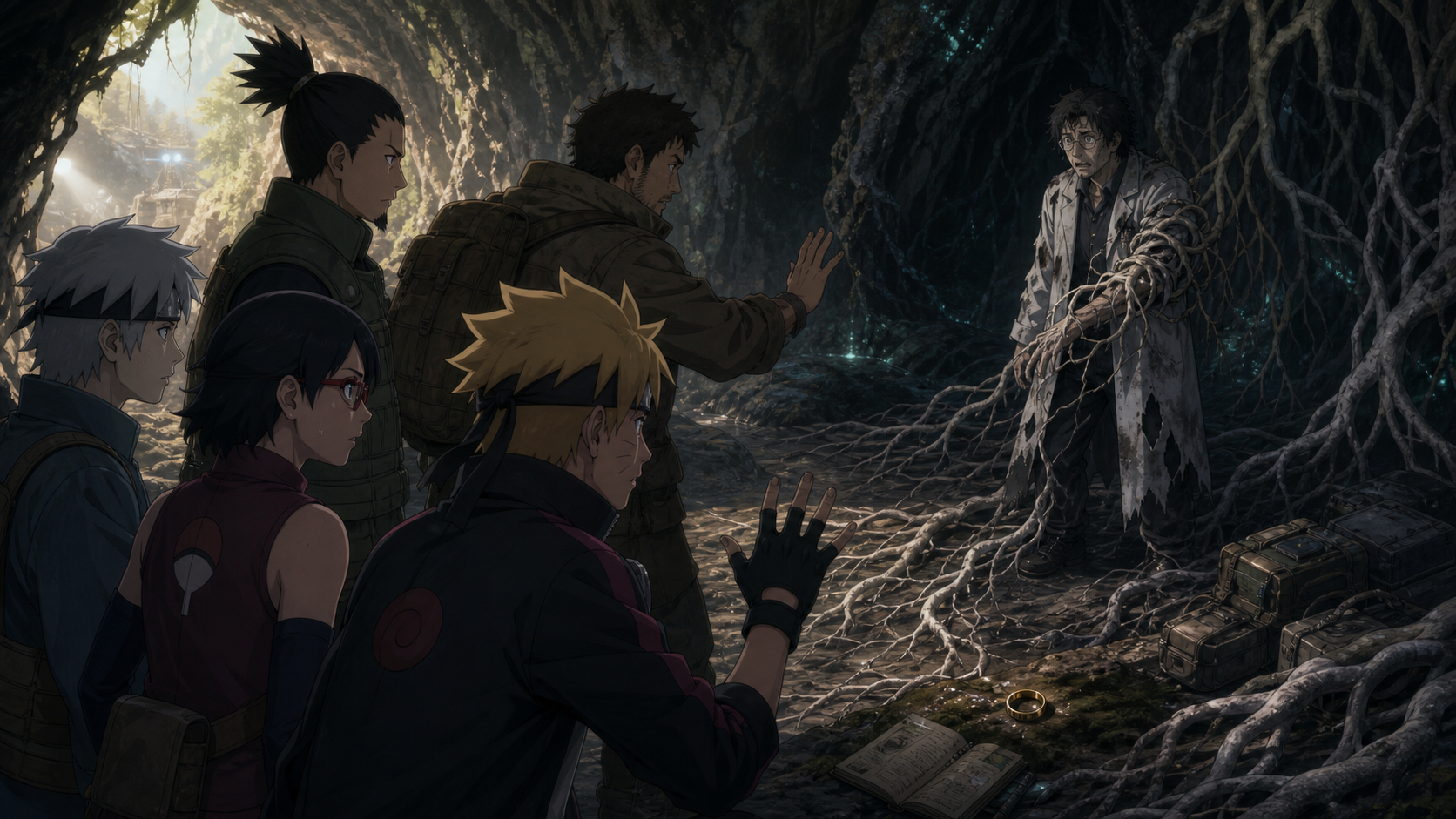
The search leads into a cave filled with unnatural roots and evidence that the expedition encountered something far beyond ordinary plant collection.
The roots make regeneration visible in the wrong form. Growth without control does not heal. Growth invades, distorts, and consumes the structure that was supposed to benefit.
Victor’s promise to restore bodies now stands beside a body being overtaken by the material his company pursued.
Anato is found and the rescue becomes another question
Team 7 locates Anato alive, but he no longer responds like the researcher Mia expects to come home. Roots cover his arm and his behavior has become aggressive.
Finding the missing person does not complete the mission. The team must determine whether he is infected, transformed, controlled, contagious, or reacting to trauma.
The most important question becomes the one Victor does not want asked: what did the company send Anato to find?
Mia’s husband risks becoming corporate evidence instead of a patient
Victor’s people have every incentive to classify Anato as a research incident. Mia sees a spouse, shared future, and person who deserves care.
Those perspectives should not be mutually exclusive, but corporate secrecy can make the worker disappear a second time inside files, containment protocols, and legal language.
Anato’s treatment must prioritize his health and autonomy. Victor should not control the diagnosis, samples, and public explanation alone.
The wedding ring carries the story Victor cannot own
Anato’s ring represents the promise Mia is still waiting to resume. The company can hide routes and research objectives. The ring records a relationship outside Victor’s authority.
Boruto understands the human scale of the mission through that object. Returning Anato is not an abstract success condition.
Somebody at home planned for him to walk back through the door.
The episode teaches Boruto what hunting Kara actually means
Boruto wanted to search for Kara directly. The missing-person mission places him inside a Kara-connected system before he recognizes the connection.
Enemy organizations do not live only in hideouts. They use public companies, medical hope, trade secrecy, hired shinobi, frightened workers, and respectable executives.
Sasuke’s lesson becomes practical. Training prepares Boruto to survive a fight. Attention prepares him to notice which fight has already started.
A missing worker is not a customer-service inconvenience
Victor’s company treats Mia as though she is asking for an optional update. Her husband vanished during assigned work. That makes the company responsible for a timeline, search protocol, emergency contact, and truthful account of known hazards.
The receptionist may have no authority to disclose research details, but somebody with authority must speak to the family. “Trade secret” cannot swallow the basic facts of whether Anato entered the field, when colleagues last saw him, who supervised the expedition, and what rescue steps began afterward.
Mia has to escalate because the ordinary channel is designed to exhaust her. Repeated calls become proof that she is difficult instead of proof that the process failed. Hiring shinobi becomes the only way to force movement, which means information belongs to whoever can pay for an investigation.
That is not privacy. That is institutional control over a person’s disappearance.
Victor’s personal arrival is reputation management disguised as concern
An executive showing up can look compassionate. Victor knows that. His presence reassures Team 7 that the company takes the situation seriously while keeping every conversation close to the person with the most to hide.
He offers a persuasive history, visible injury, medical ambition, and practical cooperation. None of those details proves guilt or innocence. Together, they create a story sturdy enough to delay suspicion.
Victor does not need to lie in every sentence. Effective institutional deception mixes truth with carefully controlled gaps. His war injury may be real. His belief in regeneration may be sincere. His company can still expose workers, conceal a specimen, and manage the search around private interests.
The episode understands that dangerous people do not always arrive wearing danger on their faces. Sometimes the villain brings credentials, funding, and exactly the amount of transparency needed to remain welcome.
The wedding ring should begin an evidence chain
The ring proves identity and connects the transformed body in the cave to the man Mia asked Team 7 to find. Emotional recognition matters, but investigators need more than recognition.
Team 7 should photograph the location before moving Anato, map the roots, collect environmental samples, and document every injury. The ring should remain associated with him rather than disappearing into a pocket. Search-party members should give separate accounts before Victor can coordinate the narrative.
Those steps do not make the rescue cold. Evidence preservation protects Mia’s right to know what happened and helps doctors treat the exposure. Care and investigation serve the same person when both are done correctly.
Victor wants the scene to become a contained emergency: dangerous worker found, executive intervenes, problem removed. The ring refuses that containment. Anato has a name, a home, a spouse, and a life outside company property. Every piece of evidence should keep that life attached to the case.
Mugino understands that “ordinary” missions reveal political systems
Boruto hears missing-person work and feels diverted from Kara. Mugino sees roads, jurisdictions, employers, witnesses, and the habits people develop around power. Those details are how covert organizations stay hidden.
Kara does not exist outside ordinary society. Members need money, laboratories, transport, cover companies, frightened staff, and officials willing to accept clean paperwork. Looking only for robes and secret meetings misses the infrastructure that lets a network survive.
Mugino’s patience is not passivity. He watches which employee answers which question, who controls the search route, and how quickly Victor claims authority over Anato. Field experience has taught him that behavior becomes evidence before a confession arrives.
Boruto wants acceleration because Karma feels like a clock inside his body. Sasuke’s advice and Mugino’s conduct offer the same correction: urgency should sharpen observation, not replace observation.
Medical promise does not erase worker protection
Regenerative medicine could save limbs, repair injuries, and reduce suffering across the shinobi world. That promise makes oversight more necessary because desperate patients and ambitious institutions will tolerate risks they would reject elsewhere.
Workers searching for biological material need informed consent, hazard training, protective gear, exposure monitoring, and a guaranteed right to stop. Families need emergency contacts and compensation rules. Independent reviewers need access to adverse events. None of those protections prevents discovery. They prevent discovery from consuming the people doing the work.
Victor frames secrecy as the price of innovation. Secrecy also protects weak methods, hidden casualties, and ownership claims that would not survive public examination.
The choice is not progress or caution. Responsible science builds caution into progress. A company that cannot explain how workers disappear has not earned trust with anybody’s body.
What does not work: the rescue moves faster than the moral aftermath
Finding Anato delivers the episode’s body-horror turn, but the script rushes from discovery toward combat. Mia’s long wait becomes fuel for Team 7’s urgency rather than a relationship the story follows through the outcome.
Sarada, Mitsuki, Konohamaru, and Mugino recognize warning signs, yet nobody establishes a clear authority boundary when Victor arrives. The executive who controlled the missing expedition is allowed to control the exposed worker almost immediately.
The scene needs conflict about custody. Anato is a patient and possible victim, not company equipment. Victor may have technical knowledge, but technical knowledge does not grant sole decision-making power.
The episode is building a longer arc, so some answers must wait. Basic questions should still be spoken aloud. Who gets to touch Anato? Who tells Mia? Who records Victor’s intervention? Silence around those questions makes Team 7 look less prepared than the careful investigation deserves.
What Episode 158 gets right
Mia’s distress drives the mission instead of becoming background noise. Mugino adds political experience. Sasuke gives Boruto advice rooted in failure rather than authority.
Victor receives a persuasive public purpose, which makes his control more dangerous. The company does not look evil from the lobby.
The episode also lets Team 7 use different skills: Boruto pushes, Sarada evaluates, Mitsuki infiltrates, and Konohamaru manages the operation.
What the mission should demand next
Anato needs independent medical evaluation and containment based on health rather than corporate ownership. Mia deserves a truthful timeline.
Konoha should preserve samples, interview the entire search party separately, compare personnel counts, and secure the original expedition records before Victor edits the narrative.
Team 7 should also report every unexplained root, missing document, conflicting statement, and attempt to restrict access. A rescue without evidence preservation would leave the next worker exposed.
RaeRae’s read
Mia did everything people tell families to do. She called the employer, waited for updates, asked again, and hired help when the official process produced nothing. Victor still controls more information about her husband than she does.
That imbalance is the episode’s real warning. Kara does not need to kidnap every victim in a dark alley. A company can send workers toward dangerous material, label the route proprietary, conduct its own search, and arrive first when somebody finds the evidence.
Boruto wants a villain he can chase. Mugino keeps pointing toward systems that smile while closing doors. By the time Team 7 finds Anato inside the roots, the mission has already proved Sasuke right: understanding the enemy begins with taking ordinary assignments seriously enough to notice who benefits when a man disappears.
Sources and lawful viewing
Official episode reference: Naruto Official episode guide
Licensed episode route: Crunchyroll licensed series page