
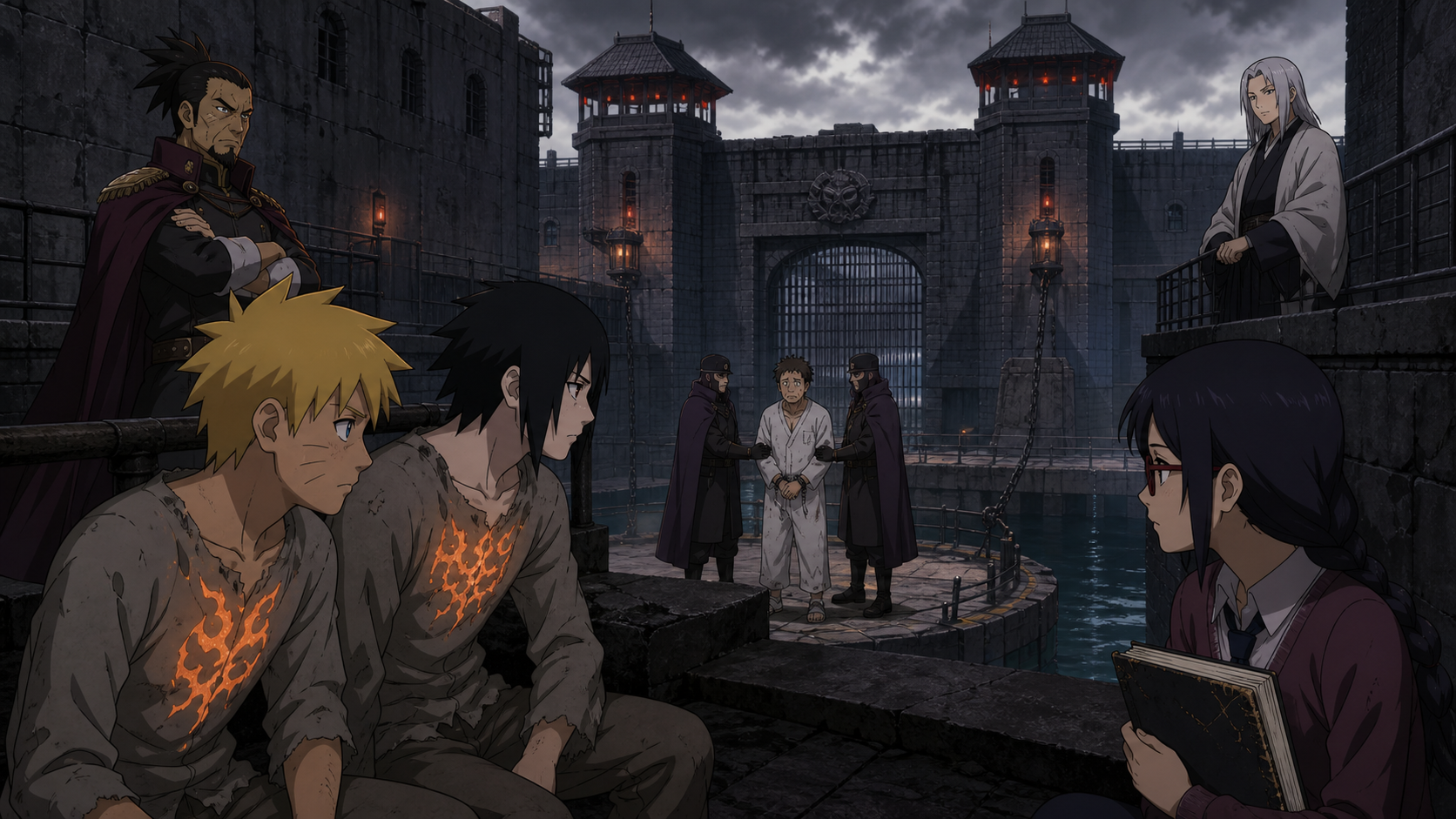
The Shinobi Prison: Hozuki Castle
Team 7 enters a prison where law, protection, and punishment serve different masters, while Kokuri’s assassin already knows how to move through the walls.
Series: Boruto: Naruto Next Generations
Episode: 141 · The Shinobi Prison: Hozuki Castle
Arc: Mujina Gang Arc
Release: 2020-01-26
Previous: Episode 140 · The Mind Transfer Jutsu that Lost to Potato Chips
Directory: All 293 Boruto episodes
Bottom line
Boruto Episode 141 changes the temperature of the series the moment Boruto and Mitsuki step off the prison boat. Hozuki Castle does not care that they are promising Konoha genin. Inside the walls, their names are fake, their chakra is restricted, their bodies belong to the prison schedule, and a mistake can activate a fire seal across their skin.
The mission sounds simple when Naruto explains the objective: protect Kokuri, a former Mujina Gang member who offered information in exchange for safety. The politics make the assignment uglier. Hidden Grass administers the prison and has not suffered from the Mujina Gang’s crimes, so Kokuri’s danger does not receive urgent attention. Konoha therefore sends children undercover because formal cooperation moves slower than an assassin.
This is a strong arc opening because the prison is more than a scary building. Hozuki Castle is an institution with competing ideas about punishment. Warden Mujo speaks about rehabilitation. Chief Officer Benga relies on fear, force, and humiliation. Boruto, Mitsuki, and Sarada have to protect one frightened prisoner while pretending that the system holding him deserves their obedience.
Hozuki Castle arrives before the plot explanation
The episode opens with prisoners transported by boat toward an island fortress. Stone walls, watchtowers, water, guards, and distance establish the basic truth before anyone explains a rule: leaving will be difficult.
Boruto and Mitsuki appear among the inmates without an immediate briefing for the audience. That decision creates useful uncertainty. We know they are not ordinary prisoners, but their bodies still move through intake beside men who may be violent, desperate, or simply trapped inside a system stronger than any individual.
The castle has appeared in the wider Naruto world before, yet Episode 141 treats the location as a functioning jurisdiction rather than a nostalgia prop. Hidden Grass owns the walls. Konoha cannot walk in and take whatever information Konoha wants.
The Heavenly Prison seal turns custody into bodily control
Mujo brands incoming inmates with the Fire Release: Heavenly Prison technique. The seal restricts chakra and punishes attempts to escape with burning pain.
Prisons already control movement, time, food, privacy, and contact. Hozuki Castle adds direct control over the inmate’s chakra network. For a shinobi, that control reaches identity as well as capability. Training, clan techniques, and survival instincts become inaccessible under institutional command.
Boruto and Mitsuki receive fake brands through an arrangement with Mujo, but the performance has to look convincing. Their safety depends on other prisoners and guards believing the prison owns their power.
Haie demonstrates the rules with his body
One prisoner attempts to escape soon after intake. The Heavenly Prison seal activates, and the punishment becomes a public lesson for everyone watching.
Benga does not need a long orientation after that display. The institution teaches through pain. New prisoners learn that walls are only the visible boundary; the true boundary has been placed under their skin.
Boruto reacts because he still expects authority to justify suffering. Benga answers concern with violence and humiliation. The exchange tells Boruto that moral protest can expose him before moral protest helps anyone.
Konoha’s mission exists because cooperation failed
Kokuri contacted Konoha with information about the Mujina Gang. He wants protection from the organization he abandoned. Konoha wants the identity of the gang’s leader and evidence capable of disrupting future crimes.
Hidden Grass does not share the same urgency because the Mujina Gang has not targeted their interests. That position is politically understandable and morally cold. Protection becomes a priority only after danger crosses the correct border.
The delay creates the undercover mission. Boruto and Mitsuki are sent into prison because adults cannot complete an inter-village protection arrangement before the gang reaches Kokuri.
Sending genin into prison deserves scrutiny
Boruto and Mitsuki are capable, but capability does not erase age. The mission asks two teenagers to live among convicted shinobi, conceal their identities, tolerate physical abuse, and protect a target while their chakra use remains constrained.
Sarada infiltrates under a journalist-student cover, giving Team 7 an outside channel. Konohamaru and village leadership have planned the operation, yet the children carry the immediate risk inside the walls.
The Naruto world repeatedly celebrates young shinobi for surviving assignments adults designed. Episode 141 makes the danger entertaining, but the institution sending them should remain part of the analysis.
Boruto and Mitsuki need believable crimes
The pair claims to come from the Land of Water and to be serving eight years for robbery. A cover story in prison has to survive questions from people who understand criminal behavior, sentencing, and regional networks.
Boruto’s personality creates risk because he reacts quickly to injustice. Mitsuki is better at observing before speaking, but his calmness can look unnatural in a frightened new inmate.
Their partnership works because each covers a weakness in the other. Boruto creates human connection. Mitsuki notices systems, routes, and danger without advertising fear.
Their cellmates become an intelligence network
Arai and the other prisoners provide the practical information no official briefing can supply. They explain who controls smuggling, how guards behave, which inmates matter, and what happened between Kokuri and Tsukiyo.
Prison knowledge moves through favors and rumor because official information serves authority first. Boruto and Mitsuki must decide which statements are useful, manipulated, or designed to test them.
Arai’s willingness to talk helps, but immediate friendliness inside a prison should never be treated as free. Every connection can become surveillance in either direction.
Tsukiyo controls violence from solitary confinement
The Mujina Gang’s second-in-command, Tsukiyo, has been placed in solitary after fighting Kokuri. Physical separation does not remove his influence.
He sends notes and directs other people from confinement, proving that the prison’s visible hierarchy is not the only hierarchy that matters. Guards control doors. Criminal organizations control fear, debt, and loyalty between the doors.
Kokuri’s danger therefore cannot be solved by moving Tsukiyo away. The gang operates as a network, and someone inside that network is already willing to act.
Kokuri reaches the medical ward after the attack
Kokuri’s fight with Tsukiyo sends him to the medical ward. The location offers temporary separation from general population, but medical care does not equal protection.
Boruto and Mitsuki need contact with him to confirm the information and establish trust. They cannot simply request a meeting without exposing the mission.
The ward becomes a difficult destination precisely because the prison does not send healthy inmates there on demand. Reaching the target requires Boruto to make himself sick.
Mitsuki’s snake makes the poison plan possible
Arai explains that poisonous plants around the prison can force a transfer to the medical ward. Mitsuki uses a snake during recreation to obtain one without obvious movement.
The technique is clever and deeply unpleasant. Their plan depends on Boruto voluntarily poisoning himself inside a facility where treatment quality and guard response remain uncertain.
Undercover missions often convert the operative’s body into part of the disguise. Boruto cannot carry standard equipment or use open chakra techniques. He uses illness as a credential.
Boruto eats the poison because no safer route exists
Boruto consumes the poisonous fruit and collapses. The decision demonstrates courage, but courage should not make the strategy look clean.
He is trusting the prison doctor to keep him alive, Mitsuki to protect the cover, and the mission planners’ estimate that the toxin will create sickness without permanent damage. Several variables remain outside his control.
The scene works because Boruto does not enjoy the sacrifice. He accepts bodily risk to reach someone whose request for help has been buried under jurisdiction and prison procedure.
Sarada’s journalism cover uses a different kind of access
Sarada enters as a student researching the prison. Her role grants movement, questions, and observation without placing her in a cell.
Benga guides her and explains his view of the institution. He believes Mujo is too lenient because Mujo thinks prisoners can be rehabilitated. Sarada has to listen without openly challenging the man controlling access.
Her cover also fits her ambitions. A future Hokage needs to understand institutions outside Konoha, including institutions whose practices she dislikes. Observation becomes political education as well as mission support.
Mujo and Benga represent competing prison philosophies
Mujo speaks with greater calm and retains belief in rehabilitation. Benga treats harshness as realism. The contrast is familiar because prison systems often frame cruelty as proof that an administrator understands danger.
Mujo still runs a facility built around chakra seals, isolation, armed guards, and bodily punishment. His relative mercy should not be mistaken for freedom.
Benga’s methods are easier to condemn because he enjoys intimidation and resents softness. The more difficult question is how much violence remains normal under the kinder warden.
Kokuri attacks Boruto before believing him
Boruto reaches the medical ward and asks for Kokuri. The frightened prisoner knocks him unconscious and restrains him because he assumes another assassin has arrived.
That response tells us how completely safety has failed. Kokuri cannot distinguish rescue from murder because every new person can belong to the gang.
Boruto has to explain that Konoha received the letter and sent help. Trust begins through information only Kokuri and the responding village should know.
Protection requires Kokuri to risk trust again
Kokuri betrayed the Mujina Gang and entered prison carrying information. Cooperation with Konoha may reduce his sentence or secure protection, but reaching out also paints a target on him.
He has already learned that walls do not block the gang’s reach. Believing Boruto means accepting another plan controlled by strangers.
His fear is not cowardice. Fear is an accurate response to a network capable of placing an assassin inside a prison ward.
The medical ward is breached immediately
After Boruto is escorted back toward general population, someone enters the ward and stabs Kokuri under Tsukiyo’s orders.
The attack proves that Team 7 arrived late to a system already compromised. A medical room, solitary confinement, official guards, and chakra seals have not stopped internal communication.
The cliffhanger works because the mission’s central promise collapses almost as soon as Boruto makes contact. Konoha said help had arrived. Kokuri is attacked before that help can change his conditions.
Hozuki Castle makes law and justice visibly different
Every person inside the prison may have a legal status, but legal status does not explain who deserves protection. Kokuri committed crimes with the Mujina Gang. He also possesses information that could prevent more harm and has become a target for cooperating.
Benga follows prison authority while enabling conditions where gang influence thrives. Mujo believes in rehabilitation but cannot guarantee safety inside his own institution.
Team 7 breaks rules to protect a prisoner because formal channels failed. The episode does not offer a simple lawless-hero fantasy. Their covert intervention exists because multiple legal systems value responsibility differently.
The Blood Prison comparison helps and hurts
Hozuki Castle carries memories of Naruto’s Blood Prison story, but Boruto’s mission avoids the cruelest part of that setup. Boruto receives a briefing and agrees to infiltrate. Naruto was made to believe allies had betrayed and imprisoned him.
That difference matters. Informed risk preserves some agency. Boruto knows the brand is false and his team remains nearby.
The setting still invites comparison because both stories use prison to strip a protagonist of public identity and chakra access. Episode 141 improves the mission logic while preserving the oppressive atmosphere.
The Heavenly Prison seal makes medical consent impossible by design
The seal punishes unauthorized chakra use through the prisoner’s body. Custody therefore reaches beneath movement and into physiology.
Officials may argue that dangerous shinobi require extraordinary restraint. Extraordinary restraint requires independent review, medical monitoring, appeal, and clear limits on activation. Hōzuki Castle presents pain as routine administration.
Haie’s demonstration teaches prisoners that authority can trigger suffering publicly and call the suffering procedure. That spectacle discourages reporting because witnesses understand what happens to bodies labeled uncooperative.
Security needs do not erase bodily rights. A system using implanted control should face more scrutiny than a locked door, not less.
Cross-village delay becomes an excuse for child infiltration
Kokuri faces immediate danger, and formal cooperation is too slow. Urgency explains why Konoha seeks an unconventional route. Urgency does not prove that genin are the safest available operatives.
Experienced infiltration shinobi, sealing specialists, medical personnel, or a joint oversight team should be considered. If Team 7 is chosen because younger inmates attract less suspicion, the adults need to say plainly that children are being selected for vulnerability.
The mission also needs extraction authority. Identifying Kokuri without a guaranteed route out only places three more children inside the compromised institution.
Diplomatic failure should not quietly become the reason minors absorb every risk officials could not resolve.
Fake brands create operational freedom and enormous exposure risk
Boruto and Mitsuki can use chakra because their seals are staged. That advantage keeps the mission possible while making discovery catastrophic.
Any medic, guard, prisoner, or surveillance system noticing inconsistent activation could expose the cover. Team 7 needs defined limits on technique use, a cover explanation for physical anomalies, and a rapid response if Benga orders a public test.
The plan should also protect Mujo. If the fake brands are traced to him, cooperation could become evidence of corruption rather than witness protection.
The episode uses the deception effectively but leaves the consequences implied. A good undercover plan names the consequence before somebody has to improvise under torture.
Boruto’s poison plan treats his body as mission equipment
He ingests poison because reaching the medical ward requires symptoms guards will accept. The choice is brave, specific, and deeply alarming.
Mitsuki’s snake helps control dosage and timing, but Team 7 cannot guarantee Boruto’s reaction, treatment quality, or whether staff will isolate him from Kokuri. A compromised medical ward could let the plan become an actual poisoning.
Child shinobi are trained to accept bodily risk as proof of commitment. Adults overseeing the mission should define a maximum dose, antidote route, medical monitoring, and abort condition.
Sacrifice should not become the default answer whenever institutional access fails.
Sarada’s journalism cover needs ethics as well as access
She poses as a researcher to enter spaces unavailable to inmates. The cover works because prisons attract academic and media interest while officials want control over the resulting story.
A convincing interviewer needs subject knowledge, consent language, source protection, and questions that do not expose vulnerable prisoners. Sarada cannot promise confidentiality she has no mechanism to keep.
Her role also raises a useful contrast. Real journalism can create accountability. Fake journalism can make future prisoners less willing to trust genuine reporters.
The mission may justify deception to save a life. The debrief should still record the damage and avoid using a real outlet or scholar’s identity.
Mujo’s rehabilitation language needs measurable practice
He speaks about prisoners as people capable of change, which separates him from Benga’s punishment-first worldview. Language alone cannot protect Kokuri.
Rehabilitation requires education, medical care, family contact, safe reporting, sentence review, release planning, and protection from gang recruitment. Officials need data showing whether those services reach prisoners rather than existing in speeches.
Benga controls daily conditions, so Mujo’s philosophy remains vulnerable to sabotage. A humane policy with no enforcement becomes cover for abuse performed below the warden’s sightline.
Mujo has the right idea. Leadership means building systems that keep the idea true when he leaves the room.
Solitary confinement does not stop Tsukiyo from exercising power
The prison isolates his body while messages, money, fear, and gang relationships continue moving. Physical separation becomes theater when informal networks remain intact.
More isolation is not automatically the answer. Administrators need to understand communications, staff corruption, prisoner coercion, and the needs that make gang protection valuable.
Tsukiyo can order violence because somebody carries the order and somebody believes compliance will produce benefit or safety. Investigating that chain offers more protection than assuming one locked door neutralizes leadership.
Kokuri’s attack proves that custody has contained the visible man without containing his authority.
The medical ward needs independence from both gang influence and disciplinary command. Clinicians should control patient access according to care and safety, not whichever guard holds the corridor. Visits, medications, injuries, and unusual transfers need records stored beyond Benga’s reach. A protected patient should receive an identity check, confidential interview, and a way to report threats without returning the report through the same officers supervising the attackers. Reaching the ward should reduce danger. In Hōzuki Castle, the ward becomes another room where institutional credentials open the door faster than patient need closes the door.
What worked for me
The episode builds a complete operational problem: cross-village delay, an endangered informant, a compromised prison, criminal influence from solitary, and three distinct covers for Team 7.
Boruto’s poison plan is memorable because the infiltration demands physical cost. Mitsuki’s snake and Sarada’s journalism cover use their specific abilities rather than making everyone perform the same role.
Mujo and Benga give Hozuki Castle internal conflict. The prison feels governed by people, incentives, and competing beliefs rather than existing as a stone obstacle course.
What needed more room
Konoha’s decision to send genin needs a stronger justification than speed. Experienced infiltration shinobi should be considered before children become the solution to diplomatic delay.
The fake Heavenly Prison brands also deserve clearer limits. If Boruto and Mitsuki can secretly use chakra, the consequences of discovery should be explicit.
Sarada’s cover could include more preparation around journalism ethics and prison research. A convincing interviewer needs knowledge beyond a notebook and a plausible introduction.
The verdict
“The Shinobi Prison: Hozuki Castle” is an effective arc opener because every solution exposes another layer of risk. Boruto and Mitsuki enter under false convictions. Sarada enters under false academic purpose. Kokuri survives by trusting identities he cannot verify.
The castle promises order while gang messages cross solitary walls and an assassin reaches the medical ward. Mujo speaks of rehabilitation. Benga teaches obedience through pain. Team 7 has to discover which rules protect people and which rules merely protect the institution.
By the final attack, the mission has already changed. Finding Kokuri was difficult. Keeping him alive inside a prison that cannot control its own shadows will be much harder.
Sources and lawful viewing
Official episode reference: Naruto Official episode guide
Licensed episode route: Crunchyroll licensed series page