
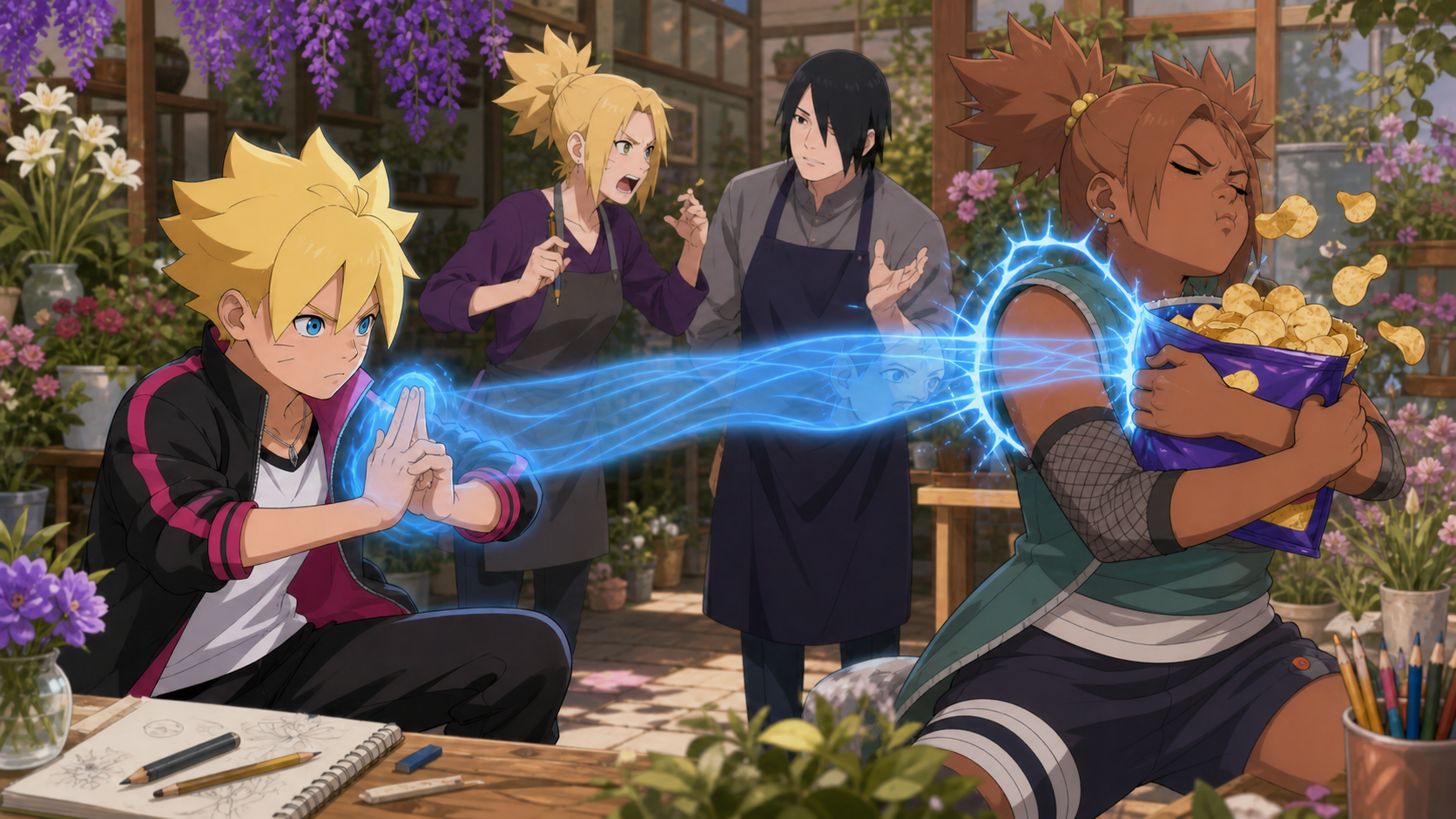
The Mind Transfer Jutsu that Lost to Potato Chips
Inojin wants Ino’s signature technique, but Chocho’s appetite exposes the difference between inherited talent and a decision strong enough to enter another mind.
Series: Boruto: Naruto Next Generations
Episode: 140 · The Mind Transfer Jutsu that Lost to Potato Chips
Arc: Team 10
Release: 2020-01-19
Previous: Episode 139 · The Terror! Enko Onikuma
Directory: All 293 Boruto episodes
Bottom line
Boruto Episode 140 uses potato chips, marital bickering, and an inherited jutsu to ask a useful question: what happens when a talented child cannot decide which parent’s strengths are supposed to become his own? Inojin can draw Sai’s Super Beast Scroll creatures, but his art once lost its emotional force. He carries Yamanaka sensory potential and wants to master Ino’s Mind Transfer Jutsu, but wanting the technique does not give him confidence inside another person’s mind.
Ino approaches training with the intensity of a clan heir who knows how dangerous hesitation can be. Sai sees their son freezing and tries to lower the pressure. Their disagreement turns into a fight because both parents recognize a piece of themselves in Inojin and fear that the other parent’s method will damage him. Chocho, meanwhile, understands the entire household better than anyone gives her credit for.
The chips are funny, but the lesson is not that snacks possess stronger chakra than a Yamanaka. Inojin fails against Chocho because her desire is clear and his is not. He succeeds when he stops performing the version of himself he thinks his parents expect and acts from a decision he actually owns.
Team 10’s hostage mission exposes the gap
The episode opens with Team 10 pursuing a criminal at night. Shikadai predicts the escape route, but the target grabs a hostage. Clouds block the moon, leaving Shikadai without the light needed to extend his shadow.
He calls on Inojin to use Mind Transfer. Inojin hesitates because missing the target could leave his body helpless and the hostage exposed. The fear is reasonable. Mind Transfer is precise, risky, and unforgiving when a moving target knows an attack is coming.
Shikadai eventually creates another solution, and the team completes the mission. Success does not hide the weakness. Inojin knows that a teammate needed him and he could not answer.
Shikadai’s promotion changes the emotional balance
Shikadai is already a chunin, which gives his decisions formal weight. Inojin and Chocho remain genin following a friend who now carries command responsibility.
That shift can sharpen insecurity. Inojin is not jealous of Shikadai’s competence, but he cannot ignore the comparison when a mission stalls around the technique he should have inherited.
The new Ino-Shika-Cho needs all three family traditions to function under pressure. Shadow possession controls movement. Expansion techniques supply force. Yamanaka mind techniques can resolve hostage situations without a direct strike. Inojin’s gap is therefore personal and structural.
Inojin asks for training instead of hiding the failure
Inojin approaches Ino and Sai because he wants to improve. That choice deserves credit before anyone evaluates the result.
He could retreat into drawing, dismiss Mind Transfer as his mother’s specialty, or wait until another mission forces the issue. Instead, he names the weakness to the two people most capable of helping.
The request also reveals trust. Inojin expects his parents to take him seriously. Children do not always ask for help when earlier failure has been punished or mocked. Whatever mistakes Ino and Sai make during training, their son begins from the belief that home can support growth.
Ino hears responsibility inside the request
Ino becomes excited because the Mind Transfer Jutsu is family knowledge with practical and cultural weight. The Yamanaka techniques connect espionage, communication, sensory work, interrogation, and the generations of Ino-Shika-Cho cooperation.
Her intensity comes from experience. Ino used Mind Transfer in combat situations where missing could mean death. During the Fourth Shinobi World War, Yamanaka communication and sensory ability linked entire forces. She knows the technique deserves more than casual practice.
The problem begins when her urgency becomes the atmosphere Inojin has to enter. Confidence cannot be ordered into existence, especially for a jutsu that sends consciousness away from the safety of the body.
Sai watches the student before the technique
Sai notices Inojin tightening under pressure and tries to calm Ino. He is not dismissing the clan art. He sees their son becoming less capable with every irritated correction.
Sai learned human connection later than most people. Root trained obedience, emotional suppression, and mission efficiency. He knows what instruction looks like when the student’s internal state counts only as an obstacle.
His gentler response is therefore connected to history, though gentleness alone can slide into avoidance. Inojin still needs correction, repetition, and standards. Sai is strongest when he helps create room for learning rather than simply protecting his son from discomfort.
Chocho agrees because friendship includes inconvenience
Chocho becomes the practice target after Inojin offers food in exchange for help. The bargain is funny and completely believable. She values snacks, understands her worth, and refuses to donate labor merely because a teammate asks.
Her participation also carries trust. Mind Transfer gives another person access to her body. Even a controlled exercise requires vulnerability.
Chocho does not approach the training as a passive dummy. Her will becomes the central obstacle, which is exactly why she is useful. Inojin needs a target whose sense of self does not disappear to make him feel accomplished.
Mind Transfer requires conviction, not louder hand signs
The Yamanaka technique projects the user’s consciousness into a target. The user’s body becomes vulnerable, and resistance can complicate control. A wavering attempt therefore carries more than technical weakness.
Inojin struggles because he is thinking about failure while trying to impose direction. His attention splits between the target, his mother’s judgment, his father’s reaction, and the fear that he does not belong in the technique.
No amount of shouting “focus” can simplify that mental traffic. He needs a reason to enter, a decision about what he will do after entry, and enough trust in his training to accept temporary vulnerability.
Potato chips become Chocho’s perfect defense
Chocho’s desire for the chips is immediate, specific, and gloriously uncomplicated. Inojin enters the contest carrying doubt. She meets him with appetite.
The joke works because willpower often looks less dignified than people expect. A heroic speech is not automatically stronger than wanting the snack already in your hands. Chocho does not split her attention trying to sound profound.
Her resistance teaches Inojin that another mind is not empty territory. A target has impulses, priorities, and a body with its own momentum. Technique has to meet a living person rather than a training diagram.
Ino’s frustration crosses into the wrong kind of pressure
Ino becomes irritated when Inojin cannot perform. Her frustration is understandable but poorly directed. She sees capacity in him and interprets hesitation as a refusal to claim that capacity.
Parents can become least patient with traits they fear in themselves. Ino fought to be recognized beyond beauty and social confidence. She trained medical ninjutsu, sensory work, and clan techniques while supporting teammates with louder reputations.
Watching Inojin shrink from a Yamanaka technique may feel like watching family knowledge disappear. That fear still does not justify making him responsible for preserving her identity on command.
Sai’s defense turns training into a marriage argument
Sai intervenes when Ino’s irritation rises, and the discussion shifts from Inojin’s technique to the parents’ methods. Their son becomes the ground on which two histories collide.
Ino values directness, effort, and emotional honesty. Sai often relies on observation, restraint, and carefully learned social behavior. She can hear his calmness as judgment. He can hear her intensity as harm.
The argument is funny because they remain recognizably married while disagreeing. The scene also shows how quickly adults can make a child’s struggle about their own relationship. Inojin starts worrying that his request caused the fight.
Inojin assumes responsibility for emotions he did not create
Inojin wants to fix the conflict because training triggered the argument. That logic is common in children, even when the parents’ disagreement grows from years of personality and history.
He did not create Ino’s fear about his confidence. He did not create Sai’s sensitivity to harsh instruction. He asked for help, and the adults lost control of how they offered help.
The episode could have named this boundary more clearly. Inojin can contribute to reconciliation, but his success with Mind Transfer should not become the price of peace between his parents.
Chocho reads the room without pretending to be polite
Chocho sees that Inojin is performing anxiety instead of making a decision. Her advice cuts through the family drama because she has no investment in protecting Ino or Sai’s pride.
She understands appetite, confidence, and public judgment. People constantly assume Chocho should want a smaller body, less food, or quieter confidence. She refuses those borrowed desires.
That experience makes her the right person to tell Inojin that he needs his own reason. She does not give him a generic confidence speech. She demonstrates what undivided wanting looks like every time she reaches for another chip.
Inojin uses Mind Transfer on Ino
Inojin eventually directs the technique toward his mother. The choice changes the training relationship because Ino is no longer only the instructor judging from outside.
Entering her mind or controlling her body requires him to meet the strongest will in the room. He cannot succeed by imitating her confidence. He has to bring his own.
The resulting intervention helps Ino and Sai recognize what their argument is doing. The jutsu becomes communication rather than a combat trick, which reflects the broader Yamanaka tradition.
The family’s reconciliation works because affection was never absent
Ino and Sai are not fighting because they disagree about whether Inojin matters. They are fighting because both care and each distrusts the other’s method in that moment.
Once the pressure breaks, they can see that shared motive. Sai respects Ino’s expertise. Ino recognizes that their son needs a path shaped by more than inherited expectations.
The repair is quick, but the household has enough established affection to support the speed. This is a disagreement inside a functioning marriage, not evidence that the family was secretly collapsing.
Inojin is allowed to inherit from both parents
Inojin does not have to choose between Sai’s art and Ino’s mind techniques. His identity can contain both, and mastery may arrive unevenly.
The combination is unusually useful. Ink creatures provide mobility, scouting, restraint, and distance. Sensory and mind techniques provide intelligence, communication, and control. Art also gives Inojin an emotional language that neither clan technique supplies alone.
Inheritance should expand a child’s options. When family legacy becomes a test of loyalty, every choice feels like rejection. Ino and Sai serve him best when they teach without demanding exclusive resemblance.
The final fry theft is petty and perfect
Inojin treats Chocho to a meal after training, honoring their bargain. Then he uses Mind Transfer to eat some of her fries.
The prank proves improved control while preserving the friendship’s comic rhythm. Chocho helped him, challenged him, and offered the clearest advice. Inojin repays her with food and immediately abuses his new skill for snack theft.
Ethically, entering a friend’s body to steal fries is terrible jutsu etiquette. Comedically, Chocho remains the only target whose food commitment makes the achievement feel earned.
Mind Transfer training needs explicit consent every single time
Chocho agrees to help, which gives the exercise a legitimate starting point. Agreement to practice does not create unlimited permission for every later entry into her body.
The technique removes physical control while leaving the target aware enough to experience the violation. Training should establish a signal, duration limit, emergency exit, prohibited actions, and confirmation before each attempt.
Stealing fries through Chocho’s body is funny because the stakes are small and the friendship survives. The same joke normalizes using another person’s body for the user’s desire.
Good jutsu etiquette cannot depend on whether everybody laughs afterward. A technique built around bodily control requires stricter boundaries than a technique aimed at a training target.
The hostage mission proves why confidence alone is not enough
Inojin freezes because Mind Transfer places him inside the consequence. Missing can expose a teammate or civilian. Succeeding can leave his own body vulnerable.
Training therefore needs scenario planning beyond willing friends and snacks. Team 10 should practice cover for Inojin’s body, target verification, timed release, communication during possession, and response if the target resists or becomes injured.
Shikadai’s command role matters here. A team leader must decide when the technique’s benefit exceeds the risk and make sure Chocho protects the user during the transfer.
Inojin needs conviction, but the team needs a procedure strong enough to hold his conviction under real pressure.
Shikadai’s promotion changes the team whether anybody discusses the change or not
One friend now carries formal authority over the others. That shift can create pride, resentment, dependence, and pressure to prove usefulness.
Inojin’s request for training grows from a real tactical gap, but comparison may intensify the urgency. Shikadai advanced. Inojin failed during a mission. The family technique begins to feel like evidence that he deserves his place.
Team 10 should talk about command expectations, disagreement, debriefs, and how promotion changes responsibility without changing friendship.
Silence leaves Inojin to interpret one failed technique as a verdict on his entire contribution.
Ino’s expertise becomes pressure because she remembers what failure costs
She understands Mind Transfer as clan responsibility, battlefield tool, and family inheritance. When Inojin hesitates, she hears danger for him and the team.
Fear makes her push harder. The student experiences that urgency as disappointment. Both readings can be true.
Ino needs to separate instruction from emotional history: identify the technical error, reduce the exercise, ask what Inojin wants, and explain her concern without turning concern into a test of loyalty.
Parents teaching inherited skills carry two roles. The child needs permission to fail as a student without feeling love become conditional.
Sai’s protection helps Inojin breathe and lets technique disappear
Sai recognizes distress and interrupts Ino’s pressure. That defense matters because a student cannot learn while managing a parental conflict and personal failure at the same time.
He also moves too quickly toward emotional rescue without offering a structured path back to practice. Protection can become another way of treating the child as fragile.
The marriage argument grows because Ino feels her expertise dismissed and Sai feels the student’s emotional safety ignored. Both adults speak around Inojin until he assumes responsibility for restoring peace.
The better move is a pause, a private adult conversation, and a later training plan built with their son rather than performed over him.
Inojin inherits two traditions without owing either parent a copy
Mind Transfer connects him to the Yamanaka clan. Super Beast Scroll connects him to Sai’s art and intelligence work. Each technique responds to his emotional state in a different way.
The episode could connect those histories more directly. Inojin’s difficulty is not a lack of talent. He struggles when inherited ability becomes a performance of somebody else’s identity.
His hybrid skill set may produce new tactics neither parent used: sensory work paired with drawings, remote scouting before possession, or ink creations protecting his vacant body.
Inheritance becomes exciting when the next generation can combine, revise, and sometimes decline what came before.
Chocho reads motivation better than the adults because she asks what matters now
She knows Inojin wants to succeed, knows Ino is frightened, knows Sai is defensive, and knows food can make a ridiculous exercise emotionally concrete.
Her appetite is not random decoration. The chips create a target with genuine competing desire. Inojin has to choose his objective more strongly than Chocho chooses hers.
That framing makes the exercise work while letting Chocho remain herself. She supports a friend without becoming a passive practice dummy or a solemn motivational speaker.
The episode should repay her contribution with clearer consent around the final prank. Understanding everybody does not mean surrendering bodily autonomy to everybody.
Team 10 also needs a post-training agreement before Mind Transfer returns to field use. Inojin should name the situations where he feels ready, Chocho should confirm how she will protect his unoccupied body, and Shikadai should define the command signal and abort point. Ino can evaluate technical control without deciding motivation for him. Sai can support confidence without interrupting every difficult correction. Turning one successful fry theft into a structured practice plan would prove that the family learned something larger than how to end an argument with laughter.
What worked for me
The episode gives Inojin a problem connected to his specific parents and team role. Mind Transfer is not a random power-up. The hostage mission shows why Team 10 needs him to gain confidence.
Ino and Sai remain flawed adults rather than perfect mentors. Their marriage has humor, affection, and friction rooted in distinct histories. Chocho steals the episode by understanding desire better than the people discussing technique.
The chips keep the story light without making the emotional problem fake. Confidence can fail during ridiculous exercises and still matter during the next hostage crisis.
What needed more room
The episode should have explored consent around Mind Transfer more carefully. Chocho agrees to train, but the final fry prank turns control of another body into a punch line.
Inojin’s artistic identity also deserves more attention. His earlier difficulty with Super Beast Scrolls showed that emotion affects his inherited abilities from Sai as well as Ino. Connecting those two confidence problems would have made the family argument deeper.
Shikadai and Team 10 barely participate after creating the need. A closing mission where Inojin uses Mind Transfer under Shikadai’s command would have provided stronger proof than stolen fries.
The verdict
“The Mind Transfer Jutsu that Lost to Potato Chips” is a family-training comedy with enough character truth to justify the absurd title. Inojin wants a technique because his team needs him, but family expectation turns desire into performance anxiety.
Ino learns that expertise can become pressure. Sai learns that protecting a student’s feelings cannot replace instruction. Inojin learns that inherited power works best after he decides why he wants to use the power. Chocho learns nothing because Chocho understood everybody before training began.
The Mind Transfer Jutsu does not truly lose to potato chips. Inojin’s divided attention loses to Chocho’s perfectly concentrated appetite. Once he owns a decision, even the fries are in danger.
Sources and lawful viewing
Official episode reference: Naruto Official episode guide
Licensed episode route: Crunchyroll licensed series page