
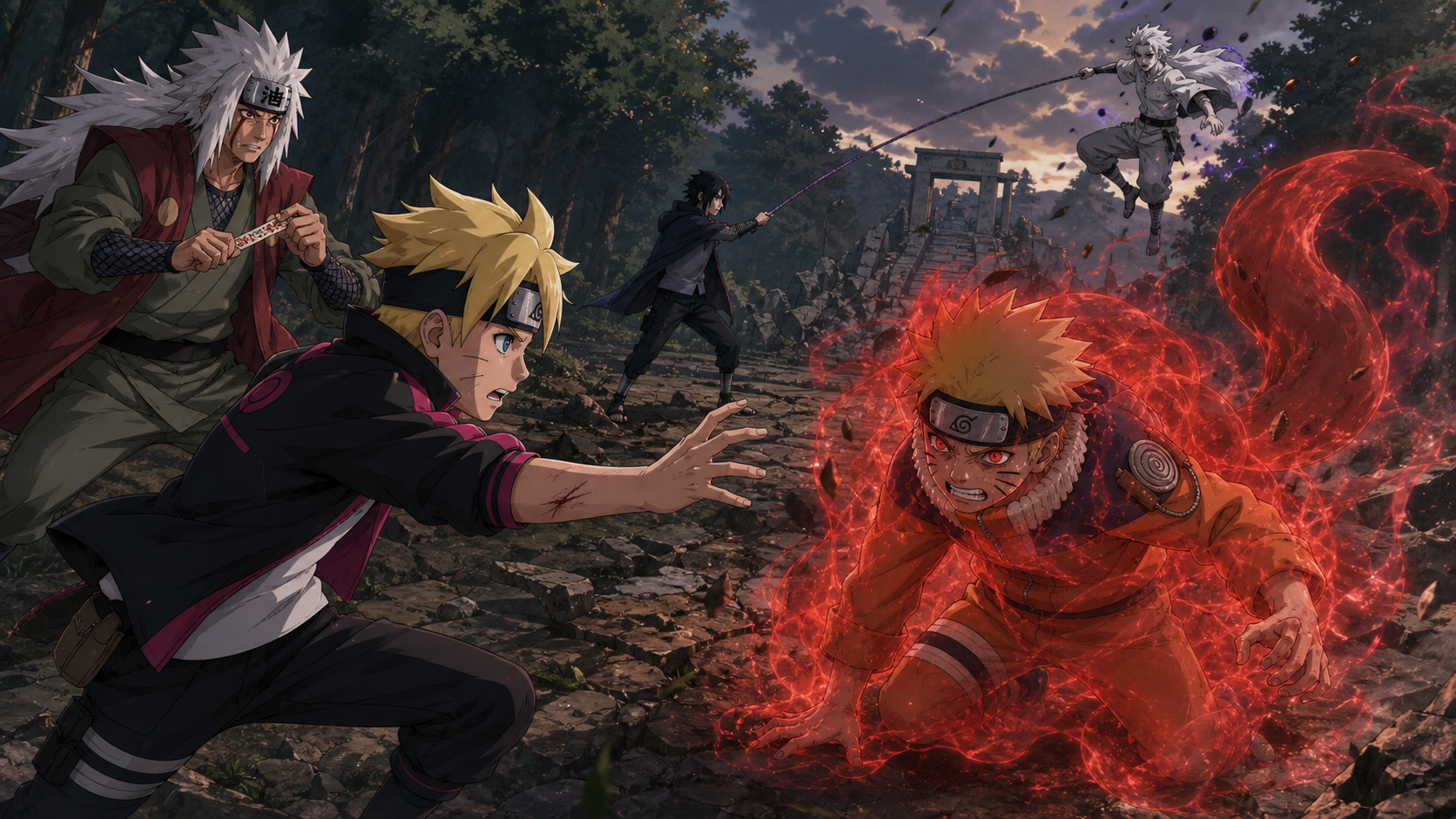
The Power of the Nine Tails
Boruto knows Kurama as Naruto’s partner. Young Naruto shows him the years when the same chakra burned, isolated, and attacked anyone who came close.
Series: Boruto: Naruto Next Generations
Episode: 131 · The Power of the Nine Tails
Arc: Time Slip Arc
Release: 2019-11-03
Previous: Episode 130 · Genin, Assemble!
Directory: All 293 Boruto episodes
Bottom line
Boruto Episode 131 takes the power Boruto knows as his father's greatest advantage and shows him the period when that same chakra behaved like a loaded weapon inside a lonely child. Adult Naruto and Kurama eventually become partners. Young Naruto has no partnership, no permission, and very little understanding of the seal holding the Nine-Tails inside him. Urashiki reaches for that chakra, damages the balance, and leaves Boruto facing a version of his father who cannot recognize him.
The episode also corrects Boruto's romantic view of Naruto's childhood. Old Konoha looked smaller and funnier while everybody cleaned a bathhouse. Jiraiya now tells him that villagers feared and rejected Naruto because he carried the fox that attacked them. Boruto knew his father grew up alone. He had not understood that adults made a child pay for a disaster committed before he could speak.
Urashiki remains the weakest part of the episode for me. His ability set bends around whatever delay the plot needs, and Sasuke's reduced stamina keeps becoming a convenient brake. The emotional material survives because Boruto's attempt to calm Naruto matters more than the villain's fishing hook. Naruto pauses when he hears Boruto, then the chakra surges again. A future family bond reaches him for one second before the seal's violence takes control.
Urashiki learns that Naruto is not an open container
Urashiki begins by complaining about Boruto interfering with his plans. Sasuke attacks while Boruto tries to move Naruto away from the fight. Urashiki's chakra line reaches Naruto, but the hook returns empty. He expected the Nine-Tails chakra to come out like every other stolen supply. Naruto's seal refuses that simple extraction.
The failure matters because Naruto's body is not a storage jar. Minato built the Eight Trigrams Sealing Style to contain Kurama and gradually allow Naruto access to the chakra. The seal is tied to Naruto's life, body, and future development. Urashiki cannot pull the fox out without confronting the system that keeps Naruto alive.
Sasuke recognizes the likely cause immediately. His knowledge comes from years beside Naruto and from later threats targeting tailed beasts. Young Naruto knows far less about the architecture inside him than the adult stranger fighting nearby. That gap summarizes the cruelty of jinchūriki policy. Villages turn children into military assets, hide the truth, and then expect those children to manage consequences nobody explained.
Sasuke fights under a lie that keeps getting thinner
Urashiki dodges Sasuke through his Rinnegan and points out that Sasuke is not at full strength. The story needs that limitation because a healthy adult Sasuke would end the threat too quickly. The repeated reduction can feel obvious, especially when falling rocks restrain fighters who have survived much worse.
Sasuke still has a harder problem than winning. Every technique can expose his identity, era, and connection to Naruto. He cannot fight as the shinobi Boruto knows without giving Jiraiya information that should not exist yet. Urashiki has no reason to protect the timeline, so the villain can use strange powers openly while Sasuke works under rules only one side respects.
Jiraiya arrives in time to see Urashiki avoid Boruto's Rasengan. That moment gives him another receipt. Boruto knows Naruto's signature technique during an era when the technique remains closely connected to Jiraiya, Minato, and Naruto's recent training. Boruto and Sasuke can call themselves traveling performers, but their combat knowledge keeps contradicting the disguise.
Naruto is kidnapped because the seal buys time, not safety
Urashiki restrains Naruto after the first extraction fails. He traps Boruto, Sasuke, and Jiraiya inside an earth corridor and leaves with his target. The capture looks too easy for the talent present, and the staging deserves criticism. Sasuke and Jiraiya should not feel helpless because some rocks moved around them.
The narrative purpose is clearer than the execution. Urashiki needs privacy to examine the seal, and Boruto needs time to learn what forced extraction would mean. The delay turns Naruto from a prize in a chase into a child whose life depends on a damaged containment system.
Jiraiya asks who Urashiki is. Sasuke explains that the stranger wants the Nine-Tails and suggests a connection to the Akatsuki. The partial truth fits the era because Jiraiya already investigates that organization. Sasuke gives him enough believable context to secure cooperation without saying that an Ōtsutsuki traveled backward through time.
Jiraiya hears the cover story and keeps watching
Jiraiya accepts the operational explanation, summons a toad, and breaks them out of the prison. Acceptance does not mean trust. He has seen Boruto use Rasengan, watched Sasuke fight with advanced techniques, and heard strangers arrive with specific knowledge of Naruto's seal and a threat tied to Akatsuki.
Jiraiya is foolish about women and brilliant about intelligence work. The franchise often lets the peeping gag obscure how observant he can be. He gathered information on Orochimaru, tracked Akatsuki, understood sealing, and later uncovered the secret of Pain at the cost of his life. Sasuke's story gives him a direction. The inconsistencies give him a reason to stay close.
His decision to help also shows what Naruto has in Jiraiya that the village failed to provide. Jiraiya may disappear, behave irresponsibly, and cause his own damage, but he knows Naruto is a child rather than a demon in human skin. When the seal becomes dangerous, he responds with knowledge and action rather than disgust.
Breaking the seal would kill Naruto
Boruto explains Urashiki's extraction ability. Jiraiya confirms Sasuke's theory that the seal prevented the first theft. He also states the consequence plainly: if Urashiki forcibly breaks the seal and removes the Nine-Tails, Naruto will die.
Boruto knows that lesson from later battles and from Naruto's abduction by Momoshiki. Hearing the rule while staring at young Naruto changes the scale. This is not the Hokage with Sage Mode, Kurama cooperation, war experience, and allies ready to cross dimensions. This Naruto is a genin who still struggles with the chakra inside him.
The life-and-death connection exposes the ugliness beneath village policy. Konoha tied a tailed beast to an infant because the village needed containment. That infant grew into a child feared for carrying the weapon adults placed inside him. Naruto has to survive both Kurama's rage and the human decision to blame him for housing Kurama.
Urashiki enters the seal and mistakes Kurama for property
Urashiki reaches through Naruto's seal and enters the subconscious space where Kurama waits. He speaks about taking the chakra back as though the Nine-Tails belongs to the Ōtsutsuki. The language reduces Kurama to harvested power, which matches the clan's larger relationship with living worlds. People, tailed beasts, and planets become fuel.
Kurama is still hostile toward Naruto in this era, but hostility does not make Urashiki a liberator. Urashiki wants extraction, control, and consumption. The seal repels him and burns his hand. He manages to steal only a small amount of chakra before deciding that he must weaken the seal further.
The confrontation places two systems of captivity beside each other. Konoha sealed Kurama inside Naruto for military survival. Urashiki treats Kurama as clan property to reclaim. Naruto and Kurama are trapped together by decisions made around them. Their later friendship becomes powerful precisely because neither began with freedom or trust.
Naruto breaks free and the chakra follows him
Urashiki uses the stolen chakra to heal his burned hand and tries again. Naruto repels the fishing hook and escapes the line, but freedom from Urashiki does not restore the seal's balance. Nine-Tails chakra leaks around him as Sasuke, Boruto, and Jiraiya arrive.
Sasuke has placed a sealing measure on himself, so Urashiki's hook cannot steal chakra from him either. That preparation is smart, though the episode moves past the detail quickly. Sasuke fights the villain while Jiraiya and Boruto approach Naruto.
Jiraiya warns Boruto to stay away from the leaking chakra. Boruto ignores the safe distance because the person inside the shroud is his father. The choice is emotionally understandable and physically reckless. Future knowledge makes him believe connection should work because Naruto eventually learned to control Kurama. Young Naruto has not reached that relationship.
The red chakra is not the golden power Boruto remembers
The chakra forms a Version 1 shroud around Naruto. Red energy, altered movement, aggression, and loss of recognition replace the golden cooperation Boruto has seen in adulthood. The visual distinction matters. Kurama's later chakra mode represents consent and shared purpose. This cloak represents a damaged seal and rage forcing a way through Naruto's body.
Boruto approaches with the expectation that Naruto remains reachable. He calls to him and briefly succeeds. Naruto pauses. Their similar chakra and growing emotional bond appear to cut through the rampage for a moment.
Then the Nine-Tails chakra surges again and Naruto attacks. Boruto receives an injury from the father he came to protect. The strike is not a betrayal because Naruto cannot choose clearly inside that state. The pain still changes Boruto. He can no longer treat Kurama's power as a spectacular family inheritance separated from Naruto's fear.
Boruto reaches Naruto for one second
The brief pause carries more weight than a full victory would. Boruto has spent the Time Slip Arc hiding the word “Dad,” denying obvious similarities, and learning his father's history through accidents. When Naruto stops, the episode suggests that Boruto's voice reaches something beneath the chakra.
That connection does not magically fix the seal. I appreciate that limit. A sentimental speech cannot replace years of training, Jiraiya's sealing knowledge, Naruto's later confrontation with hatred, or the partnership he builds with Kurama. Family love matters. Family love is not a shortcut around trauma and power mechanics.
Jiraiya applies a sealing tag and suppresses the leaking chakra. An adult with the correct knowledge ends the crisis. The sequence respects expertise. Boruto supplies connection, Jiraiya supplies the method, and Sasuke keeps Urashiki occupied long enough for both to work.
Jiraiya finally tells Boruto what the village did
After Urashiki retreats through a portal, Jiraiya bandages Boruto's injury. He explains that Naruto faced prejudice from villagers because of the Nine-Tails. Boruto has already seen the empty apartment, cheap meals, quick accusations, and Naruto's hunger for acknowledgment. Jiraiya gives those clues a cause.
The villagers lost family and homes during Kurama's attack. Their grief was real. Directing fear and hatred toward Naruto was still wrong. He was an infant during the attack and became the container that saved the village from further destruction. Adults punished the child who carried their protection because looking at him reminded them of the beast.
Fairness does not require neutral language here. Trauma explains the villagers' behavior without excusing years of isolation. Konoha failed Naruto. Hiruzen's rules hid information but did not provide a family, stable supervision, or protection from social rejection. Naruto had to earn the affection that adults should never have made conditional.
Boruto learns that strength came after abandonment
Boruto knows the public story of Naruto's perseverance. The Hokage never gave up, won people over, saved the village, and built peace. Public stories often make suffering look valuable after the survivor succeeds. Episode 131 restores the cost before the triumph.
Naruto did not need cruelty to become compassionate. He became compassionate despite cruelty, with help from Iruka, Team 7, Jiraiya, Tsunade, and others who eventually treated him as a person. The village benefits from his refusal to repeat their rejection. That benefit does not convert the rejection into good parenting or wise policy.
Boruto's earlier resentment toward an absent Hokage remains valid. Adult Naruto hurt his family when he sent a shadow clone to Himawari's birthday and let work replace presence. Understanding his childhood explains why duty consumes him. The explanation does not erase what Boruto and Himawari needed.
Sasuke's reduced power keeps serving the plot too visibly
Sasuke holds Urashiki off while already drained from the previous encounter. The limitation gives Boruto and Jiraiya room to carry the episode, but the writing leans on that device repeatedly. A time-travel story with adult Sasuke requires constraints. Those constraints should feel consistent rather than appearing whenever Urashiki needs another escape.
Urashiki also retreats once the immediate plan fails. His Rinnegan movement, chakra theft, healing, flight, and portal access make him difficult to pin down, yet his tactics remain oddly improvised. He knows Naruto is a jinchūriki and still seems surprised that a sophisticated seal protects the Nine-Tails.
The villain functions better as pressure than personality. He forces Boruto to confront Naruto's burden and gives Jiraiya reason to investigate the strangers. The emotional consequences are richer than Urashiki himself.
Jiraiya's training offer is protection and interrogation
Jiraiya expects Urashiki to return and offers to train Naruto and Boruto together. The proposal solves several problems at once. The boys need a coordinated defense. Boruto fears the chakra he just encountered. Naruto needs greater control. Jiraiya also wants the suspicious visitors close enough to study.
Training under Jiraiya gives Boruto access to the teacher whose legacy shaped Naruto, Minato, Nagato, and eventually Boruto's own name through *The Tale of the Utterly Gutsy Shinobi*. Boruto began this arc searching for a scandalous book because he wanted to understand Jiraiya. Now he meets the part of Jiraiya that matters more: the shinobi who sees danger around Naruto and responds by teaching.
Jiraiya may already suspect the family connection. Boruto knows Rasengan, resembles Naruto, reacts to Naruto's pain with unusual intimacy, and carries chakra capable of reaching him through a Nine-Tails shroud. The training offer lets Jiraiya test cooperation without demanding an answer that could damage the timeline.
Boruto sees the difference between inherited power and inherited damage
Boruto grew up after Naruto and Kurama had already completed the hard part of their relationship. He knows the fox as a gruff ally who lends chakra when the family faces a disaster. He has seen the golden cloak, the enormous avatar, and the confidence that comes from two minds choosing the same target. That version can make Kurama look like an inherited family advantage, almost another technique waiting in Naruto's toolbox.
Episode 131 destroys that comfortable picture. The red shroud does not protect Naruto's body. The chakra distorts his movement, burns anyone who approaches, and removes his ability to distinguish help from threat. Boruto cannot calm the crisis by claiming family authority because young Naruto does not know him as family. Kurama does not owe trust to a stranger from the future. The seal reacts according to the damaged relationship that exists in this year, not the healed relationship Boruto remembers.
That lesson matters beyond this fight. Children inherit the consequences of family history even when nobody explains the history clearly. Boruto inherited Naruto's name, expectations, enemies, and unusual chakra potential. He also inherited silence around the years when Naruto survived as a jinchūriki. The family celebrates the strength because the wound feels settled. Boruto now learns that a settled wound still has a history, and that history shaped every decision his father later made about protection, duty, and being needed.
Konoha treated secrecy as protection and left Naruto exposed
Hiruzen prohibited villagers from discussing Naruto's status openly. The rule prevented adults from directly telling children that Naruto carried the Nine-Tails, but silence did not remove the disgust from their faces. Children learned avoidance from parents without receiving the facts. Naruto received the punishment without receiving an explanation. Konoha protected classified information more reliably than Konoha protected the child at the center of that information.
The result appears throughout this arc. Naruto expects strangers to judge him. He covers loneliness with noise because negative attention still proves that people can see him. He treats a shared meal, a training invitation, or one adult's confidence as a major event because ordinary care has never felt ordinary. Jiraiya's explanation allows Boruto to connect those behaviors to a system rather than treating every painful detail as one unlucky childhood anecdote.
The village's grief deserves acknowledgment. Kurama killed people and destroyed homes. Survivors had nightmares, funerals, and children who grew up without parents. None of that transferred guilt to Naruto. He did not summon the fox, direct the attack, or volunteer to become a container. Adults chose an infant because Minato needed a living host and believed his son could carry the burden. Konoha then let survivors turn that burden into a social sentence.
Naruto's later service cannot retroactively justify the sentence. A village does not earn moral credit because an abandoned child becomes generous enough to save the adults who abandoned him. Naruto's compassion belongs to Naruto. Konoha benefited from that compassion after failing to nurture such generosity.
Kurama is a prisoner before he becomes a partner
Urashiki speaks about the Nine-Tails as recoverable clan property. Konoha speaks about the Nine-Tails as a weapon that must remain sealed. Both descriptions erase Kurama's personhood. The fox has a name, memory, anger, and a history of being captured, divided from the Ten-Tails, controlled through dōjutsu, and passed between human hosts. Kurama responds with hatred because humans keep proving that power matters more to them than consent.
That context does not excuse Kurama hurting Naruto or Boruto. The red chakra remains dangerous, and Naruto remains the child absorbing the consequences. Understanding captivity explains the hostility without pretending the hostility causes no harm. Naruto and Kurama begin as two prisoners forced into one body. Their later partnership works because both eventually recognize the other as a person rather than a container or a supply.
Urashiki cannot imagine that future. He assumes superior blood grants ownership. His fishing hook reduces chakra to something removable and consumable, which makes him a clean expression of the Ōtsutsuki worldview even when his personality feels thin. Kurama's refusal becomes more than a defensive reflex. A being treated as property rejects another owner.
Boruto stands between those histories. He loves Naruto, respects the Kurama he knows, and still approaches the shroud as though his future relationship should grant immediate access. The attack teaches him that respect must begin with the version of a person standing in front of him. Future trust cannot be borrowed early.
The injury should change how Boruto approaches the next training session
Boruto's wound is physical evidence that reassurance and readiness are different things. He can understand that Naruto lacked control and still flinch when the same chakra appears. The body does not wait for a clean moral conclusion before learning danger. Episode 132 needs that consequence because cooperation training would feel dishonest if Boruto returned cheerful and untouched.
Naruto will carry a different injury. He wakes after losing control and learns that he hurt someone who tried to reach him. Shame can make him withdraw, apologize too much, or decide Boruto would be safer without him. Those reactions protect nobody. They turn one frightening event into distance and leave both boys guessing what the other feels.
Jiraiya's assignment must therefore test more than chakra compatibility. Naruto and Boruto need to say what happened without blaming Naruto for being attacked or asking Boruto to pretend he feels safe. Small, controlled attempts would respect the injury better than demanding one dramatic success. The cooperation ninjutsu can become proof of repaired communication only if the adults allow failure to provide information rather than treating failure as weakness.
That is the emotional bridge between Episodes 131 and 132. The Nine-Tails crisis exposes the wound. Training reveals whether father and son can acknowledge the wound while almost every fact about their relationship remains hidden.
Final reaction
“The Power of the Nine Tails” earns its place in the Time Slip Arc because Boruto finally encounters the difference between knowing Naruto's biography and understanding Naruto's body. The Nine-Tails was not always a golden partner supplying heroic power. Kurama's chakra could burn, overwhelm, isolate, and turn Naruto against someone trying to help him.
Boruto's failed rescue is the right emotional choice. He reaches Naruto for a moment, gets hurt, and learns that love cannot bypass every seal. Jiraiya must intervene with actual knowledge. The scene gives connection value without turning connection into magic that ignores the rules.
Jiraiya's explanation about the village lands harder than another flashback montage would. Boruto has already collected the physical evidence. Naruto lives alone, eats poorly, expects blame, and chases recognition. The Nine-Tails explains why adults chose fear over care.
The episode also deserves criticism where the action strains credibility. Falling rocks should not neutralize Sasuke and Jiraiya so easily, and Urashiki's plan feels underprepared for a villain who specifically traveled through time to steal tailed-beast chakra. Sasuke's exhaustion keeps doing visible plot labor.
None of those weaknesses erase the central discovery. Boruto admired the Hokage's power without understanding the child who first survived that power. Episode 131 makes him see the wound before the victory. Jiraiya's training offer promises the next step: Boruto and Naruto must learn to work together while Boruto is still afraid of what lives inside his father.
Sources and lawful viewing
Official episode reference: Naruto Official episode guide
Licensed episode route: Crunchyroll licensed series page