
Genin, Assemble!
Boruto meets his parents’ generation before adulthood, sees Neji alive, and learns that one casual comment can send the future leaking into old Konoha.
Series: Boruto: Naruto Next Generations
Episode: 130 · Genin, Assemble!
Arc: Time Slip Arc
Release: 2019-10-27
Previous: Episode 129 · The Village Hidden in the Leaves
Directory: All 293 Boruto episodes
Bottom line
Boruto Episode 130 lets Boruto meet the people behind his family stories before adulthood, grief, war, and responsibility changed them. The episode could have settled for a parade of familiar faces. Instead, “Genin, Assemble!” keeps slipping consequences under the comedy. Boruto meets Hinata before she can speak comfortably around Naruto, sees Neji alive without being allowed to explain why that matters, watches Rock Lee behave exactly like the father Metal knows, and hears Sasuke's desertion discussed as a fresh emergency rather than a finished chapter.
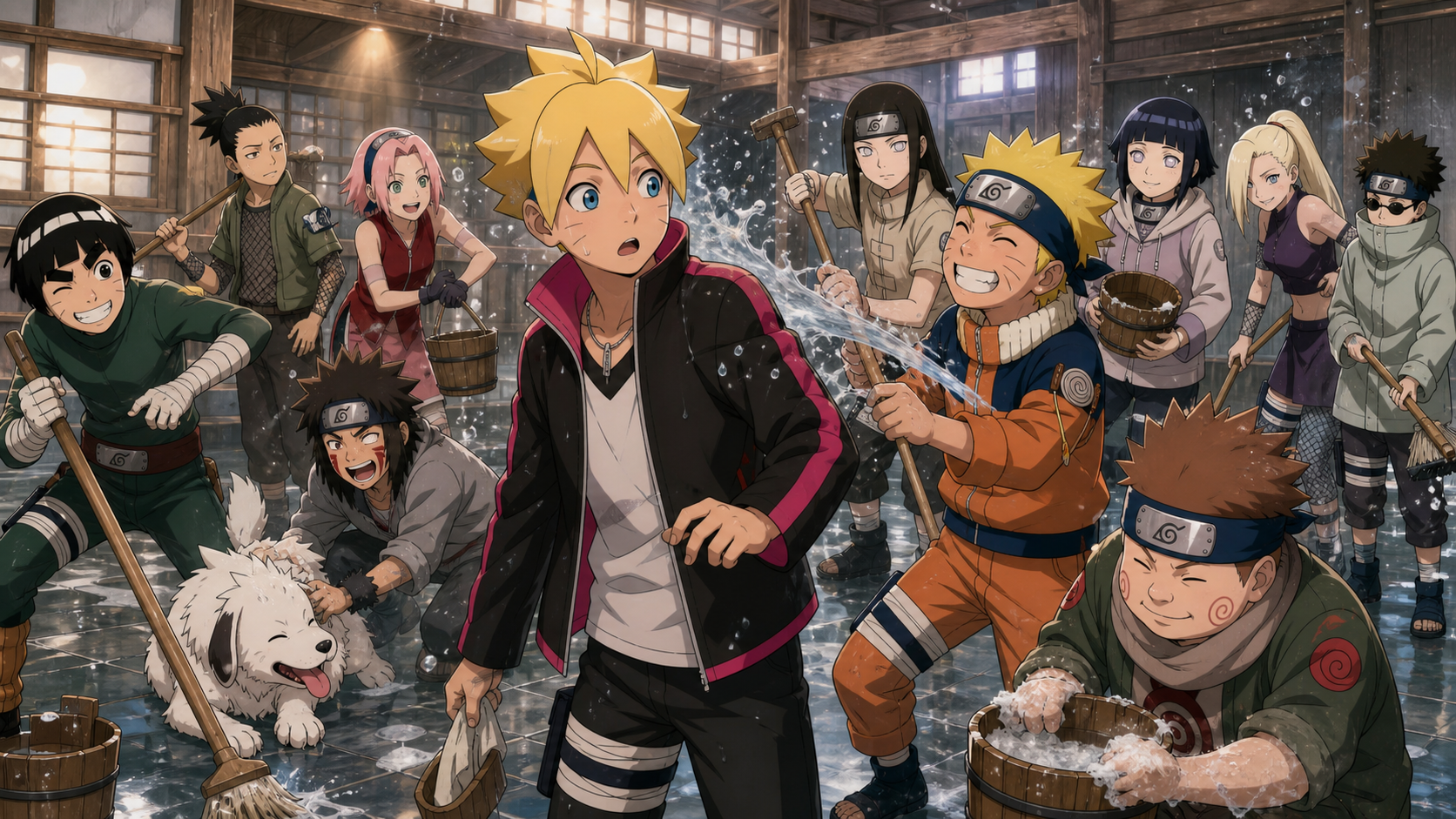
The bathhouse cleanup is ridiculous in the best Part I way. Naruto tries to behave because Jiraiya caused the mess, Kiba turns soap into a weapon, Lee attacks cleaning like a taijutsu exercise, and Chōji sends the whole operation sideways by slipping at the worst possible moment. Boruto laughs, competes, and studies everybody. The mission gives him something no family album could provide: his parents and their friends as children who had no idea which losses, marriages, jobs, and funerals waited for them.
The episode also makes Boruto part of the history he knows. A casual complaint about Konoha lacking Thunder Trains reaches Ereki Kaminarimon, Denki's father, and plants a possible idea for the technology that defines Boruto's village. Karasuki warned him not to change the past. Boruto barely finishes breakfast before the future begins leaking out of his mouth.
Ramen for breakfast tells the whole apartment story
Naruto serves instant ramen again in the morning and insists that a different flavor counts as variety. Boruto complains, checks the refrigerator, and tries to improve breakfast with whatever ingredients he can find. The scene plays as an ordinary food argument between two boys. The refrigerator makes the argument sadder because Naruto has almost nothing available beyond convenience food and condiments.
Boruto grew up in a home where Hinata cooked, Himawari shared the table, and the family could complain about Naruto missing dinner. Young Naruto has no parent setting limits on ramen or noticing when groceries run low. Boruto does not deliver a speech about childhood neglect. He opens the refrigerator and sees the evidence.
Sasuke watches from a distance because closeness would expose too much. His position turns breakfast into a strange family portrait. Naruto eats with the son he has not had. Boruto fusses over food like someone raised inside a functioning household. Sasuke, the future teacher and family friend, stands outside because his younger self has just abandoned Konoha. Nobody at the table knows the full relationship, but every part of Boruto's future is already present around that cheap bowl.
Boruto wants young Sasuke and finds the wound instead
While Naruto shows him around Konoha, Boruto asks to meet Naruto's teammates. The request sounds harmless because Boruto wants to see Sarada's father as a child. Naruto cannot give a normal answer. Sasuke is not away on a mission. Sasuke deserted the village and left Naruto and Sakura carrying the damage.
Naruto talks around the truth because the betrayal is still raw. Boruto knows adult Sasuke as the quiet shinobi who trained him, protected the village from the shadows, and became the person Naruto trusted with impossible threats. Young Naruto knows a friend who chose Orochimaru and power over their bond. Both versions are true. Boruto's admiration does not erase the boy who left, and Naruto's hurt does not erase the man Sasuke eventually became.
Adult Sasuke refuses to explain his past when Boruto asks later. His silence can feel frustrating, but the episode places that silence beside the people who suffered. Sasuke would have to tell Boruto about violence, revenge, manipulation, and choices he cannot repair from inside a borrowed week. A clean explanation would make the history sound neater than the history was.
Konohamaru brings the wrong family tradition
Young Konohamaru arrives eager to show Naruto how much his Sexy Technique has improved. Naruto answers with his own transformation and claims Boruto can perform the technique better than Konohamaru. Boruto almost gets pulled into a competition nobody needed, then Sakura ends the nonsense with one punch.
The gag gives Boruto another uncomfortable connection with his father. He has inherited Naruto's creativity, competitiveness, and willingness to use an embarrassing trick when the trick works. Boruto wants distance from the comparison, but the past keeps producing receipts. Even Konohamaru's relationship with Naruto looks familiar. The future teacher once chased Naruto's approval with the same loud determination Boruto sees in younger shinobi around him.
Sakura's reaction also belongs to this era. She is angry, embarrassed, and carrying concern about Sasuke beneath the surface. Naruto's foolishness gives her a target she can actually reach. Boruto sees the punch as part of his parents' old social circle. Sakura is trying to function after someone central to that circle walked away.
Hinata and Neji stop Boruto cold
Hinata steps in after Sakura hits Naruto. She can barely manage her feelings around him, yet she speaks to Boruto without the same nervousness. Boruto sees his mother as a shy genin rather than the calm parent who runs his home. The difference embarrasses him because children rarely want proof that their parents had crushes, awkward pauses, and unfinished emotional lives.
Then Neji arrives, and Boruto's reaction changes. Neji is alive. Boruto knows the uncle he never got to grow up with through family memory and the sacrifice that protected Naruto and Hinata during the war. Young Neji stands in front of him with no knowledge of that death. Boruto cannot hug him, warn him, thank him, or explain why seeing his face hurts.
Time travel becomes cruelest around people who will not survive. Boruto can return home and speak to Naruto, Hinata, Sakura, Shikamaru, Lee, Ino, Chōji, Kiba, and Shino in their adult lives. Neji exists only here and in stories. The episode wisely lets Boruto stare instead of forcing him to explain the entire grief.
Rock Lee proves that Metal came by everything honestly
Rock Lee joins the group with the same explosive energy Boruto recognizes in Metal Lee. The resemblance shocks him because the habits survived across generations almost untouched. Lee attacks ordinary tasks with physical commitment, earnest pride, and no sense that moderation could ever be useful.
Boruto has spent his life surrounded by children who inherited faces, techniques, family expectations, and personality traits from this group. Meeting their parents at the same age makes those connections visible. Ino-Shika-Chō already carries the rhythm Boruto knows in the next generation. Hinata's kindness, Naruto's noise, Sakura's temper, Shikamaru's tired intelligence, and Lee's intensity all continue inside the village their children inherit.
The episode does not claim children are copies. Boruto remains different from Naruto because comfort, education, technology, family, and peace shaped him differently. The similarities matter because Boruto usually notices the pressure of legacy before the warmth. Here, legacy looks less like a burden and more like a village passing habits down at the dinner table.
One Thunder Train comment may change Konoha
Naruto bumps into a shinobi while walking with Boruto. Boruto starts talking about Thunder Trains as though the technology should already exist. The shinobi, Ereki Kaminarimon, hears the idea and considers the possibility. Boruto walks away without understanding that Denki's father may have just received inspiration from the future.
Karasuki explicitly warned against changing history. Boruto's mistake shows why time travel cannot be controlled through clothing and fake names alone. He carries an entire modern vocabulary. Every complaint about food, transportation, buildings, devices, or village services can reveal an invention before the right person develops the idea.
The scene creates a bootstrap paradox. Boruto knows the Thunder Train because Kaminarimon Company built the system. Ereki may pursue the system because Boruto mentioned the train. The invention begins to circle without a clean starting point. The anime does not pause for a lecture, but the possibility makes Boruto's casual mouth as dangerous as any visible jutsu.
Naruto's Hokage dream sounds different here
Boruto notices that Tsunade's face has not been carved onto the Hokage Rock. Naruto explains that she only recently became Hokage and says his own face will join the monument one day. Boruto has heard the dream as family history. Hearing young Naruto state the promise before almost anyone believes him gives the familiar ambition new weight.
Boruto knows the ending. Naruto becomes Seventh Hokage, helps transform Konoha, and then allows the office to consume too much family time. The dream saved young Naruto by giving his loneliness a direction. The fulfilled dream later damaged his relationship with Boruto because Naruto treated service to the village as a debt he could never stop paying.
That contradiction does not make the dream false. Young Naruto needs the goal. Adult Naruto needs boundaries. Boruto has spent much of his story criticizing the consequences without understanding what the promise once did for his father. Watching Naruto make the promise in the old village closes part of that distance.
Tsunade's urgent mission is bathhouse cleanup
Neji gathers the available genin under Tsunade's orders. The solemn assembly leads to a bathhouse where Shikamaru explains their assignment: clean the destruction left by the previous day's disaster. Naruto knows Jiraiya caused the problem and wants everybody to finish before the truth spreads.
The setup feels exactly like classic Naruto, where a humiliating practical task could turn into a full team crisis. Shikamaru supervises with the exhausted expression of someone already doing management work above his rank. Naruto creates shadow clones. Kiba and Akamaru overcommit, fill the room with foam, and destroy the clones. Lee treats cleaning as training. Boruto joins Naruto in a water fight. Chōji slips and knocks them down.
The chaos matters because Boruto meets legends before legend hardened around them. These are not monuments, clan heads, parents, teachers, war heroes, and senior officials yet. They are children who can ruin a cleaning assignment in minutes. Fans know what each person becomes, so ordinary stupidity feels precious rather than disposable.
The village still expects Naruto to be the problem
A bathhouse employee recognizes Naruto from the peeping disaster and exposes him. Naruto tries to blame Jiraiya, correctly, but his reputation makes the defense sound convenient. Once again, an adult created trouble and Naruto inherited the public consequence.
Young Naruto often survives through attention, even negative attention, because being blamed still means being seen. That pattern makes adulthood complicated. He learns to carry problems, volunteer for impossible promises, and accept responsibility for other people. Those qualities help him save the village. They also make him a Hokage who believes every demand belongs on his shoulders.
Boruto sees the unfairness without receiving a formal explanation. His father did not become compulsively responsible only after taking office. Konoha trained Naruto to prove himself every time somebody expected failure, then rewarded him for carrying more than one person should.
Shino praises the student he will someday teach
After the cleanup, Shino compliments Boruto's movement and immediately points out technical weaknesses. He has no idea that he will become Boruto's Academy teacher. Boruto knows the adult version as a serious instructor whose explanations can wander until students lose the point. Young Shino already has the analytical habit underneath that future career.
The other genin tease Naruto because Boruto might surpass him and suggest Boruto become a shinobi. The joke carries another time-travel risk. Boruto already is a shinobi and uses training developed in the future. His skills can impress this generation only if he stays vague about where he learned them.
When Boruto asks why Konoha needs more personnel, the group mentions the recent desertion. Naruto and Sakura go silent. The conversation finally names the absence shaping every earlier interaction. Their friends change the subject because everybody understands the wound even when nobody knows how to help.
Sasuke will not ask the past to understand him
Boruto meets Sasuke at night and reports that Karasuki has not recovered enough power. Sasuke has not sensed Urashiki. Boruto also confirms what he has pieced together: young Sasuke is the genin who deserted Konoha.
He asks his teacher to explain. Sasuke refuses and returns the focus to protecting Naruto. The refusal keeps emotional distance between them, but Sasuke is standing inside the immediate fallout of his worst early choice. Naruto wants him back. Sakura cannot speak about the departure without shutting down. Tsunade has tightened security. The village needs additional personnel because one gifted child crossed into enemy hands.
Adult Sasuke cannot offer the ending as a defense. He eventually returns, helps save the world, marries Sakura, raises Sarada imperfectly, and protects Konoha. None of those later acts made this week painless. Sasuke's restraint respects that boundary better than a confession designed to make Boruto forgive him quickly.
Urashiki ends the reunion before Boruto is ready
The next day, Naruto brings Boruto to the training ground to meet Jiraiya. Sasuke rejoins them and receives a complaint from Naruto for disappearing. The group barely settles before Urashiki arrives, irritated that his plan has gone wrong.
The entrance ends the nostalgic breathing room. Boruto has spent the episode studying family history, but the mission was never a vacation. Urashiki wants the Nine-Tails chakra inside a Naruto who cannot control Kurama and does not possess his adult defenses. Every friendly encounter increased the number of people who could become collateral damage.
Sasuke's caution now faces the harder test. Protecting Naruto may require techniques nobody in this era should see. Boruto may need to fight beside his father without revealing their bond. Jiraiya is observant enough to notice inconsistencies, even when his behavior invites people to underestimate him.
Boruto meets a family archive made of living people
Family stories flatten people without meaning to. Neji becomes the uncle who died protecting Naruto and Hinata. Young Hinata becomes the shy girl who always loved Naruto. Shino becomes the teacher nobody notices. Lee becomes Metal's loud father. Those summaries are true, but truth loses texture when every life becomes one sentence told after the ending.
Boruto receives the texture here. Hinata's shyness has boundaries rather than controlling every conversation. Neji carries discipline, intelligence, and the weight of the Hyūga system while still finding room to observe a suspicious stranger. Shino can be encouraging and exacting in the same breath. Lee's intensity is ridiculous until the viewer remembers how much work sits underneath every confident movement.
The episode lets Boruto love these people without claiming them. He cannot call Hinata Mom, warn Neji, or tell Shino about the classroom waiting in his future. Recognition belongs entirely to Boruto, which makes every encounter feel lonely. The relatives and teachers stand close enough to touch while the rules of time force him to behave like a visitor.
That restraint saves the reunion from becoming a wish-fulfillment parade. Boruto gains knowledge, not ownership. He leaves each conversation carrying a fuller person than the family shorthand allowed.
The bathhouse cleanup shows why static hero worship never works
The future generation knows these genin through monuments, clan records, war stories, and parents who edit childhood memories before telling them at dinner. Boruto walks into a room full of names that history treats seriously and finds foam, arguments, wet floors, bad decisions, and children avoiding an embarrassing truth about Jiraiya.
That comedy is not filler attached to the meaningful material. The mess is the meaningful material. Hero worship makes courage look like a permanent personality trait possessed by special people. Watching future heroes fail at cleaning shows that competence developed unevenly. Shikamaru already manages. Naruto overcompensates. Kiba escalates. Chōji creates accidental disaster. Everybody contributes something useful and something exhausting.
CVM Sekai's Naruto coverage should preserve that contradiction because the franchise depends on messy people becoming important without becoming flawless. The war hero was once a child slipping across a bathhouse floor. The future Hokage was once desperate to hide his teacher's misconduct. The future Academy instructor was already giving notes nobody requested. Their later achievements matter more when the earlier foolishness remains visible.
Naruto's dream carries both rescue and future danger
Young Naruto's Hokage promise gives him a direction when the village offers almost nothing else. He believes the title will force people to acknowledge him. The dream keeps rejection from becoming surrender, and Boruto finally hears that promise before success turned the words into a slogan.
The same promise contains a future danger. Naruto learns to measure love through usefulness. If protecting everyone earns belonging, then resting can feel selfish and delegating can feel like failure. Adult Naruto does not neglect his family because he stopped loving them. He neglects them because the lonely child inside the Hokage still believes every village need must be answered personally.
Boruto's anger over Himawari's birthday remains justified. A shadow clone carrying a cake could not replace their father, and Naruto chose the office at a moment when the family needed presence. Episode 130 adds context without demanding forgiveness on command. Boruto can understand why the pattern formed and still require change.
That is stronger family writing than a simple reversal where the son discovers the father was right all along. Naruto's dream saved him. Naruto's dream also taught him habits that hurt the people closest to him. Both truths belong in the same profile.
Sasuke's silence protects the past and avoids easy absolution
Boruto wants the adult explanation because adult Sasuke is easier to understand than the missing genin everyone discusses in lowered voices. The teacher he knows protects Konoha, loves Sarada badly but sincerely, and carries remorse without asking for celebration. Young Sasuke has just chosen Orochimaru and left friends wondering whether they ever mattered.
Adult Sasuke could explain the curse mark, Itachi, clan trauma, manipulation, and the long road back. Those facts would give Boruto a coherent narrative. They would also turn Naruto and Sakura's fresh pain into background material for Sasuke's redemption. Refusing the explanation keeps the episode inside the emotional time where the wound remains open.
Silence is not always noble, and Sasuke's family often suffers because he withholds too much. Here the refusal has a boundary worth respecting. Boruto does not need a private confession to decide whether young Naruto deserves protection. The mission comes first, and Sasuke's later choices cannot erase the cost his earlier choices created.
The scene also prepares Boruto for a harder truth about mentors. Sasuke is not wise because he avoided terrible decisions. Sasuke has wisdom because he survived those decisions, faced their consequences, and kept working after apology stopped being enough.
Final reaction
“Genin, Assemble!” works because the episode treats nostalgia as access rather than decoration. Boruto does not merely recognize faces. He learns how those people behaved before adulthood, which wounds were still open, and which relationships had not reached their familiar forms. Hinata can speak to him because he is not Naruto. Neji is alive because the war is years away. Shino critiques the future student he has not taught. Lee makes Metal's entire personality look hereditary.
The bathhouse mission gives the episode its old-school Naruto energy. Everybody uses too much force, Shikamaru gets stuck managing, and Naruto cannot escape a reputation he did not fully earn. The comedy also protects the humanity of characters Boruto knows as respected adults. Parents were once messy children with no idea what history planned to demand from them.
The Thunder Train moment is the episode's smartest warning. Boruto can change the future without throwing a punch. A familiar word spoken to the right engineer may alter Konoha's development. Karasuki's rule sounded abstract in Episode 129. Ereki Kaminarimon makes the danger concrete.
Neji remains the emotional center for me. Boruto cannot explain why seeing him matters, and the silence feels honest. Family grief often reaches children through stories about someone everybody else remembers directly. Boruto finally stands in front of that missing person, but time travel gives him recognition without permission.
Urashiki's arrival closes the door on the reunion. Boruto came to old Konoha wanting to understand Naruto. Episode 130 gives him Naruto's friends, failures, dream, loneliness, and unfinished fight for Sasuke. The next lesson will be worse because Boruto is about to meet the power Naruto feared inside himself.
Sources and lawful viewing
Official episode reference: Naruto Official episode guide
Licensed episode route: Crunchyroll licensed series page