
Urashiki's Target
Urashiki steals Mirai’s genjutsu, listens to Konoha’s radio network, and empties the village around the wrong target before Karasuki opens the road to Naruto’s past.
Series: Boruto: Naruto Next Generations
Episode: 128 · Urashiki's Target
Arc: Time Slip Arc
Release: 2019-10-13
Previous: Episode 127 · Make-Out Tactics
Directory: All 293 Boruto episodes
Bottom line
Boruto Episode 128 begins the Time Slip Arc by letting Urashiki weaponize Konoha's new radio network, Mirai's stolen genjutsu, and everybody's reasonable fear that he wants Naruto. Boruto gets excluded from the village search because Urashiki has already targeted him. He argues with Naruto, accepts a two-person team with Sasuke, and then does the most useful thing anybody does all episode: he stops running toward the obvious target and asks why an Otsutsuki would make the obvious target so obvious.
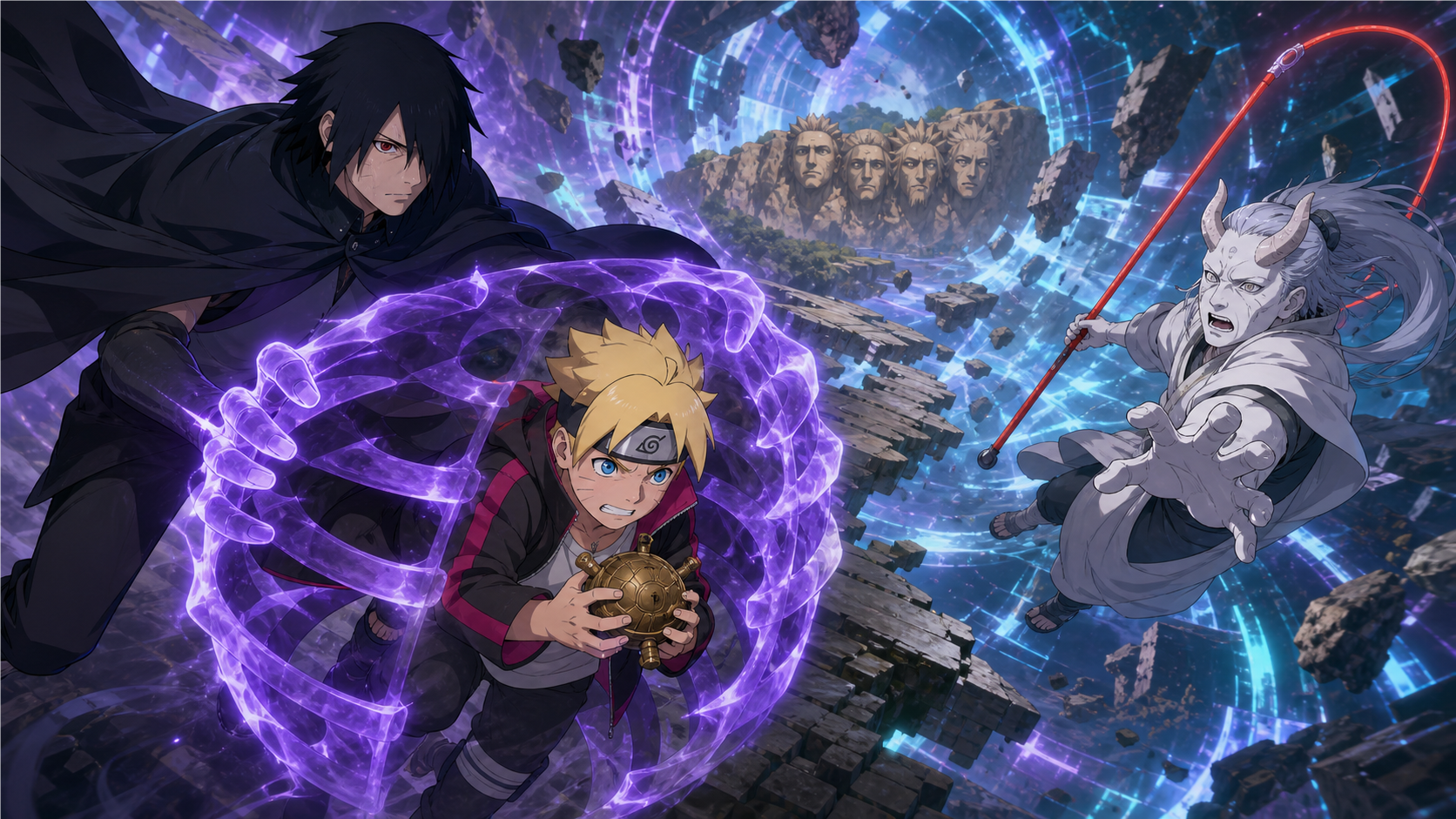
That question leads Boruto and Sasuke to Karasuki, the turtle-shaped archaeological relic introduced in Episode 127. Urashiki has used Mirai's radio to hear Konoha's movements, stolen her chakra to make patrols attack illusions of him, and drawn defenders away from the research facility. He activates the relic before Sasuke and Boruto can stop him. All three fall through a strange dimension, Sasuke uses Amenotejikara and Susanoo to keep Boruto and Karasuki alive, and they land outside Konoha beneath a Hokage Rock with only four faces.
The episode makes time travel feel less like a gift and more like a security breach. Boruto wanted to understand Jiraiya and Naruto's childhood one day earlier. Now an enemy has opened a route to the exact era when Naruto was younger, more isolated, and far easier to reach. Curiosity gets answered, but Urashiki chooses the terms. That is the danger hanging over the final image: Boruto has finally reached his father's past, and the first person who knew where the door went was a chakra thief.
Mirai refuses before anybody rescues her
Urashiki confronts Mirai after defeating several Leaf shinobi. He demands the location of the hidden Tailed Beasts. Mirai says she would not tell him even if she knew, which is the correct answer and not a magic shield. Urashiki drains her chakra anyway. The scene establishes two important facts before Konoha starts moving pieces around a map. Mirai has the discipline to resist him, and resistance cannot compensate for the difference in power.
The radio earpiece becomes the detail that changes Urashiki's plan. Someone tries to contact Mirai, the device answers from the ground, and Urashiki realizes that Konoha has built a communication network he can exploit. He does not need to defeat every patrol if he can hear where every patrol is moving. The technology that should help scattered teams coordinate becomes a live map for the person listening on the wrong end.
Urashiki also recognizes the usefulness of Mirai's genjutsu. Chakra theft keeps becoming more dangerous because he does not only remove energy. He steals access to personal techniques and can deploy them without the relationships, training, or ethics that shaped the original user. Mirai's skill becomes the bait used against her own village while she remains missing.
Konoha looks protected and feels afraid
Shinobi patrol the streets while Naruto and Shikamaru discuss the response. Naruto worries that visible security makes ordinary residents uneasy. Shikamaru insists that the village cannot afford a softer posture because Urashiki teleports, attacks unpredictably, and has already drained several shinobi. Both men are right. A village under threat needs protection. A village filled with armed patrols also reminds civilians that the threat may already be close.
Naruto wishes Urashiki would come directly for him. That impulse combines confidence, frustration, and a father's instinct to pull danger away from other people. Naruto has enough power to make himself the obvious fortress. Urashiki has already shown that he prefers leverage, distraction, and targets whose chakra can be reused. Fighting Naruto on Naruto's terms would be the least interesting choice available to him.
Sasuke remains weakened after losing chakra, which limits the strongest tracker Konoha has. The episode respects that injury instead of pretending one night's rest erased dimensional exile and repeated combat. Naruto cannot send himself everywhere. Sasuke cannot operate at full strength. Shikamaru must build a response around incomplete people and uncertain information.
Protecting Boruto feels like punishment to Boruto
Boruto discovers that the other genin received assignments to help search while he was excluded. Naruto explains that Urashiki holds a specific vendetta against him, so sending Boruto into a wide patrol would hand the enemy an attractive target. The decision is reasonable. Boruto still hears another adult telling him that his experience makes him less useful instead of more prepared.
Naruto jokes that even he behaved more reasonably at Boruto's age, which is a wild statement from the man who painted the Hokage Monument, stole a forbidden scroll, charged stronger enemies, and treated plans as suggestions until consequences arrived. The joke lands because Naruto is now the parent using safety language on a child who inherited his exact refusal to sit still. Boruto knows the hypocrisy. Naruto knows the fear behind the rule.
Sasuke offers a compromise: he and Boruto can operate as a two-person team. Naruto limits them to the village because Sasuke must remain close enough to defend Konoha if Urashiki attacks. The arrangement gives Boruto work, provides protection, and preserves the strongest available response near Naruto. Good leadership rarely gives anybody everything they wanted. The compromise is useful precisely because everybody leaves with a limit.
The radio network changes the speed of the hunt
Boruto sees his friends working with Denki and the Kaminarimon Company's new radio system. The technology lets mission control receive reports and move teams across the village faster than messengers could. Tenten relays orders while shinobi respond to sightings. Konoha's modernization is not decorative background. The network changes how a military village manages a threat that can appear and disappear without using roads.
The same speed creates confidence that the incoming information is useful. Urashiki understands that weakness immediately. Once he has Mirai's radio, he can hear the response and shape the next sighting around the expected movement. A system built for coordination becomes easier to manipulate when every team assumes the voice in the network describes reality.
Denki's involvement also matters because the genin contribute through engineering and operations rather than all joining a physical chase. The village needs people who can test equipment, track reports, and notice failures. Boruto's frustration about being left out comes from defining participation as movement toward the enemy. Episode 128 quietly shows several kinds of useful work before Boruto makes his best contribution through reasoning.
Mirai's genjutsu turns allies against each other
Konoha receives a report that Urashiki is moving away from the village, and teams mobilize to corner him. Sasuke suspects that the Otsutsuki stole Mirai's chakra and used her genjutsu to create the sighting. The theory becomes real when shinobi nearly attack one another, each seeing Urashiki where an ally stands. Kōrogi and Mirai become weapons inside the trap without choosing any part of the attack.
The danger is not only false vision. The radio coordinates real bodies around false information. Patrols move farther from Konoha, defenders focus on the wrong direction, and every correction consumes time. Urashiki combines an old shinobi art with new communication technology. Neither tool causes the failure alone. His strategy works because Konoha trusts both what trained eyes see and what the network reports.
Sasuke identifies the mechanism, but understanding the trick does not immediately reveal the true target. Urashiki has built a convincing answer: Naruto contains Kurama, Naruto is the strongest chakra source nearby, and Urashiki has repeatedly hunted Tailed Beasts. Everybody has a reason to race toward the Hokage's office.
Boruto questions the answer everybody can see
Boruto and Sasuke run toward Naruto, then Boruto stops. He knows capable shinobi remain around his father. More important, he recognizes that Urashiki spent too much effort making Konoha believe Naruto is the target. A villain who can teleport and steal chakra does not need a noisy village-wide decoy just to approach the most guarded person in the country.
Boruto remembers the archaeological relic shown on television and the symbol connected to the Otsutsuki ruin where Team 7 fought White Zetsu. That memory links Episode 127's curiosity to the present attack. Karasuki is not merely old. The relic belongs to a system Urashiki may understand better than Konoha's researchers do. If he wants access before humans decipher the device, drawing security away from the facility makes sense.
This deduction is Boruto's strongest moment because the answer comes from experience adults treated as a reason to sideline him. Urashiki targeted him before. Boruto visited the Otsutsuki ruin. He saw the symbol. Protecting him remains valid, but protection did not make his knowledge irrelevant. Sasuke listens and changes direction. A mentor who trusts a student's pattern recognition can turn frustration into useful judgment.
The research facility was the real battlefield
Boruto and Sasuke reach the facility and find shinobi drained of chakra. Urashiki has already crossed the security perimeter and activated Karasuki. The device resembles a turtle, speaks, and opens a field of light around the travelers. Konoha found an archaeological object and began researching the fūinjutsu without knowing that an Otsutsuki enemy might recognize the operating system.
The failure does not prove the researchers were foolish. Studying dangerous discoveries is part of protecting a village. The problem is compartmentalization. The symbol appeared on an Otsutsuki ruin, Urashiki had returned, and the relic remained valuable enough for television coverage. Those facts should have made the facility a priority before Boruto reconstructed the connection during an emergency.
Urashiki uses Karasuki because direct access to present-day Kurama has become difficult. Time travel offers a younger Naruto before adult power, alliances, and village security developed. The target in the episode title is not only an object or one person. Urashiki wants a more vulnerable moment.
Sasuke spends power to keep the future alive
Boruto and Sasuke attack as Urashiki enters the light. They follow him into a strange transitional dimension filled with unstable paths and open space. Urashiki repels them, Boruto collides with Karasuki, and both begin falling from a ledge. Sasuke uses Amenotejikara to exchange positions with Urashiki, turning the villain's advantage into the place of danger.
The switch is ruthless and efficient. Sasuke then shields Boruto, himself, and the device with Susanoo during the fall. He is already low on chakra, but the immediate choice is clear. Keeping Boruto and Karasuki alive preserves the possibility of returning home and stopping whatever Urashiki planned. Saving power while losing the child and the only known route would protect nothing.
They land in a forest and begin moving toward Konoha. The landscape looks familiar enough to reduce the first panic. Time travel reveals itself through civic architecture rather than a glowing date. The Hokage Rock carries only four faces. Tsunade's face is absent, Naruto's face is absent, and the village Boruto knows has not finished becoming itself.
Four faces change the whole mission
Boruto wanted stories about young Naruto. The missing faces tell him that the past is no longer a story. Depending on the exact date, his father may be a lonely genin who has not learned why villagers hate him, has not brought Sasuke home, and has not survived the losses that will shape his adult life. Jiraiya may still be alive. Tsunade may not yet be Hokage. Every person Boruto knows exists inside a different relationship.
Sasuke understands another danger before Boruto can enjoy the discovery. His younger self lives somewhere in this village, carrying anger that the adult man cannot explain without changing history. Sakura, Naruto, Kakashi, and the Uchiha story all sit near wounds that have not closed. A careless name, technique, photograph, or emotional reaction could expose the travelers.
Urashiki also fell through the device, and his goal remains younger Naruto's chakra. The past has fewer defenses against an Otsutsuki, but the villain may also be weakened or separated. Boruto and Sasuke have to locate him, protect Naruto, preserve history, manage Karasuki, and avoid meeting too much of themselves. That is not a nostalgic vacation. That is an intelligence nightmare with family attached.
Mirai's stolen technique proves chakra theft is identity theft
Urashiki does more than drain a resource bar. He takes access to a technique Mirai developed through training, clan inheritance, and personal judgment, then uses that technique against the village she protected. The violation reaches beyond exhaustion. Her own skill appears in front of colleagues and makes them doubt their senses, their network, and one another.
The Ōtsutsuki approach power as portable property. A person's history does not matter once chakra leaves the body. Urashiki treats genjutsu, dōjutsu, tailed-beast power, and ordinary reserves as items to collect and spend. That worldview clashes with a franchise where technique usually carries relationships. Asuma taught Mirai. Kurenai shaped her genjutsu foundation. Sarutobi responsibility and grief sit behind the adult shinobi standing guard. Urashiki strips away that context and keeps the weapon.
Konoha's recovery plan should therefore include more than rest. Mirai deserves a clear account of how her technique was used, which allies were affected, and what information Urashiki heard through her radio. Treating chakra theft as a temporary medical problem ignores the operational and emotional damage. Someone invaded her body, copied her work, and made her village respond to her power as a threat.
Her refusal still matters. Urashiki obtains access through force, not cooperation. The episode should never frame the resulting trap as Mirai's mistake.
Naruto and Boruto repeat the same argument from opposite chairs
Naruto spent childhood rejecting every instruction to stay behind. Adults saw poor judgment, dangerous power, and a child who needed protection. Naruto saw people deciding his limits without acknowledging what he knew or why the mission mattered to him. Episode 128 places Naruto in the adult chair and gives Boruto almost the same complaint.
The reversal is funny because Naruto's claim about being more reasonable collapses under ten seconds of franchise memory. The reversal also hurts because parental fear changes how the argument feels. Naruto is not trying to humiliate Boruto. Urashiki has targeted his son, and Naruto knows what enemies do when they turn a child into leverage. His own history makes the protective instinct stronger.
Boruto is not wrong either. He recognizes Urashiki's habits, visited the Otsutsuki site, and remembers the relic broadcast. Exclusion would remove information the search needs. Sasuke's compromise respects both sides by pairing knowledge with protection and setting a geographic boundary.
That solution models the family conversation Naruto often misses. Safety does not require pretending Boruto has nothing to contribute. Independence does not require pretending danger disappeared. A workable boundary names both facts and assigns support.
Konoha's new technology needs an adversarial imagination
The radio network gives patrols speed, shared awareness, and centralized direction. Those gains are real. The same network creates a single stream an enemy can monitor and manipulate. Konoha designed communication around trusted devices and trained users. Urashiki proves that stolen equipment and stolen chakra can compromise both.
Denki's generation understands systems in ways older shinobi training did not prioritize. That knowledge should extend from building equipment to imagining how equipment fails under attack. Teams need authentication, fallback signals, independent confirmation, and procedures for a missing operator whose device remains active. More radios do not automatically create better information.
The episode becomes especially sharp when genjutsu and radio reports reinforce the same lie. Shinobi see Urashiki, hear orders responding to Urashiki, and move as though two channels confirmed the threat. In reality, one attacker controls both channels. Technology did not replace old shinobi vulnerabilities. Technology multiplied their reach.
Boruto breaks the trap by questioning the story rather than the signal. Urashiki wants everybody to believe Naruto is the obvious target. Boruto asks why the villain worked so hard to advertise an obvious plan. Critical judgment becomes the security layer no device supplied.
The research facility advertised a relic nobody understood
Karasuki appeared in a television segment before Konoha understood the device's origin, access rules, or capabilities. Public enthusiasm around archaeology turned a dangerous object into a known target. Urashiki did not need to search every archive. Konoha announced that researchers held an Otsutsuki-linked relic and showed enough context for Boruto to remember the symbol.
The mistake does not mean every discovery must remain secret. Scholarship, preservation, and public history matter. The problem comes from publicity arriving before threat modeling. An artifact connected to a hostile extraterrestrial clan should receive security based on possible capability, not current researcher comprehension. Unknown function increases risk rather than reducing risk.
Urashiki recognizes Karasuki as a route through time. Konoha sees a turtle-shaped puzzle. That knowledge gap becomes the battlefield. Strong guards cannot protect a facility when a decoy pulls them away and nobody understands what activation looks like.
The incident should change how the village files future discoveries. Provenance, symbols, known enemies, activation conditions, media exposure, and evacuation plans belong in the same record. Ancient technology can carry a threat model even when nobody has found the power button.
Sasuke protects Boruto because preserving the future is personal
Sasuke's Amenotejikara exchange and Susanoo shield are tactical decisions, but the emotional stakes reach beyond mission protocol. Boruto is Naruto's son, Sakura's neighbor, Sarada's teammate, and Sasuke's student. Losing him would damage every family Sasuke has spent adulthood trying to protect after once helping tear those families apart.
Using scarce chakra also risks leaving Sasuke weaker in the past. He chooses the immediate life because saving strength has no value if Boruto and the only return mechanism disappear into the dimension. The decision shows mentorship through action rather than another speech about shinobi resolve.
Landing beneath four Hokage faces gives that protection a second meaning. Sasuke has carried Boruto into the period where his own younger self is missing from Konoha. The adult protector and the runaway genin now occupy the same timeline. Every responsible choice Sasuke makes will sit beside evidence of the damage he once caused.
Boruto came looking for Naruto's past. Sasuke has fallen into his own, and his past has far less nostalgia waiting.
Final reaction
“Urashiki's Target” earns the time-travel turn because the episode builds the trip out of choices made in the present. Urashiki steals Mirai's chakra, hears the radio, creates a genjutsu diversion, listens to Konoha's response, and empties the research facility. Boruto remembers the Otsutsuki symbol and rejects the obvious target. Sasuke trusts the deduction. Karasuki opens only after all those pieces meet.
Mirai deserves credit even though the episode uses her as stolen-technique evidence. She refuses Urashiki before help arrives and gives him nothing willingly. Her radio and genjutsu become parts of his trap because he overpowers her, not because she fails a loyalty test. Konoha should treat technique theft as a violation with consequences beyond chakra recovery.
Boruto's argument with Naruto also works because neither side is stupid. Naruto sees a child Urashiki wants to punish. Boruto sees a threat he understands better than many patrol members. Sasuke creates a team that respects both facts. Boruto then proves his value through memory and inference rather than winning another fight. That is growth the series can support without breaking the power scale.
The four faces on the mountain provide the final shock without a speech. Boruto spent Episode 127 trying to read an old book because he wanted his father's past. Episode 128 gives him the entire village before Naruto became Hokage. The answer is bigger, crueler, and more dangerous than anything hidden in *Make-Out Tactics*. He wanted context. Now he has to keep that context alive.
Sources and lawful viewing
Official episode reference: Naruto Official episode guide
Licensed episode route: Crunchyroll licensed series page