
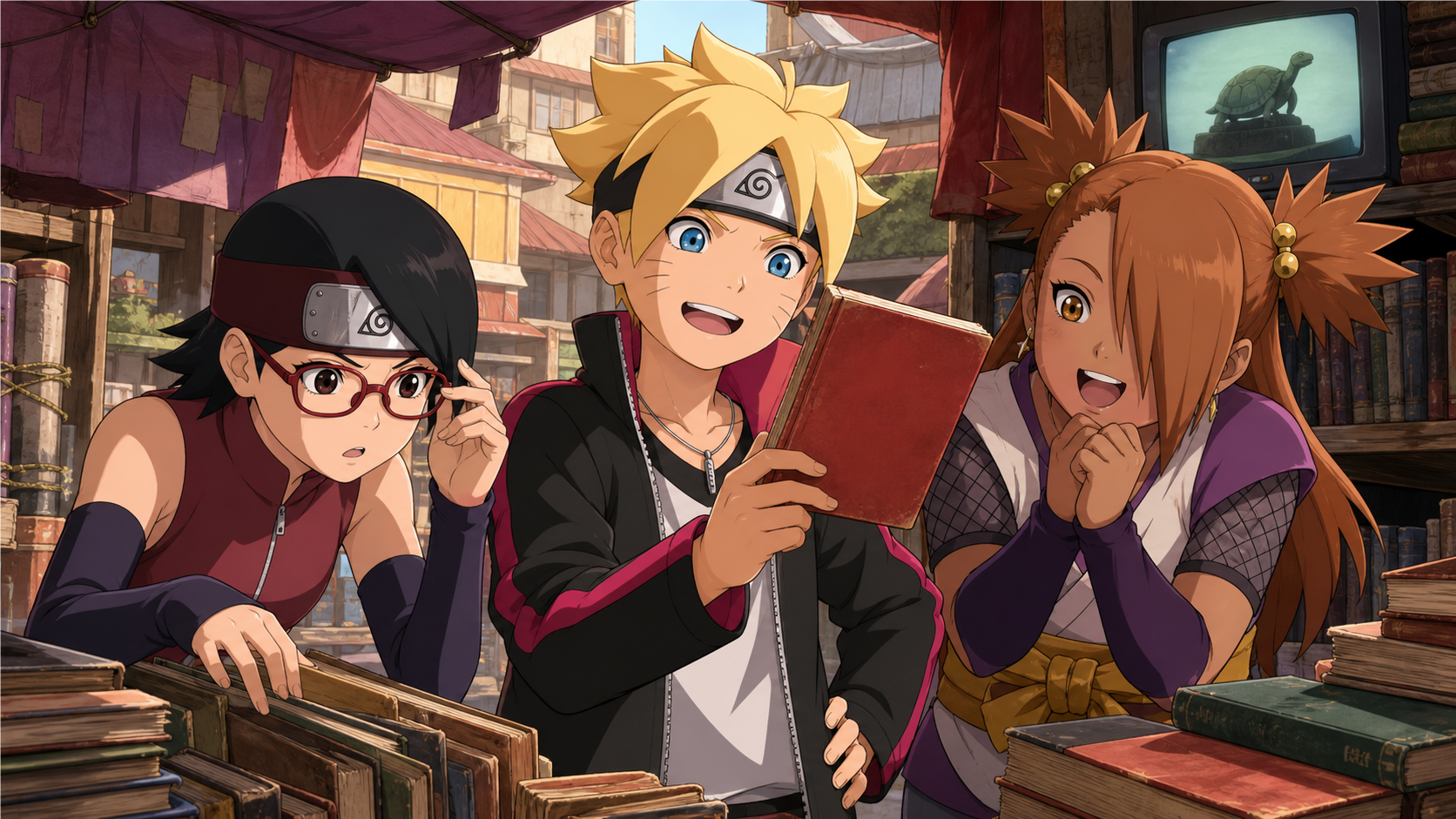
Make-Out Tactics
Boruto and Sarada think Jiraiya’s forbidden romance novel may explain their fathers, while every embarrassed adult makes the wrong book sound like a legendary secret.
Series: Boruto: Naruto Next Generations
Episode: 127 · Make-Out Tactics
Arc: Time Slip Prelude
Release: 2019-10-06
Previous: Episode 126 · Shukaku's Trick
Directory: All 293 Boruto episodes
Bottom line
Boruto Episode 127 is a comedy about two children hunting for an adult romance novel because every grown person in Konoha becomes suspicious the moment they hear the title. The better story sits underneath that joke. Boruto realizes that he knows almost nothing about Jiraiya, the teacher who shaped Naruto's fighting style, courage, grief, humor, and entire idea of what a shinobi could become. Sarada realizes that the adults around her have their own half-told histories too. Their search for *Make-Out Tactics* becomes a search for parents before they were parents.
The episode is funny because Boruto and Sarada assume a famous book written by a legendary shinobi must contain elite training secrets. Kiba, Shino, Chōji, Sasuke, Hinata, and half the flea market react like adults trying to keep children away from a shelf without explaining why the shelf exists. Every warning convinces them that the book must be deeper. That is exactly how forbidden knowledge works on curious children. “You are too young” rarely ends the question. The sentence tells them that an answer is real and everybody older already has access.
The ending quietly turns the joke into the opening move of the Time Slip Arc. Boruto notices an ancient seal pattern on a newly discovered relic. Naruto informs Sasuke that Urashiki has been stealing chakra along the border. A turtle-shaped artifact named Karasuki waits behind the news report while Boruto keeps thinking about Jiraiya and his father's childhood. The episode spends twenty minutes asking how a son can know the people who made his father, then prepares to throw that son directly into the past.
Boruto wants the teacher behind his teacher
Boruto rushes through breakfast because Sasuke may train with him. Hinata compares his excitement to the way Naruto once ran off to train with Jiraiya. That casual comparison opens a gap Boruto did not know existed. Sasuke is not the first complicated teacher in this family story. Naruto also followed an older shinobi, argued with him, learned signature techniques, survived terrible missions, and built a relationship that changed both lives.
Boruto asks whether he can meet Jiraiya, and Hinata has to tell him that Jiraiya died. The answer changes the mood without turning the breakfast table into a memorial speech. Boruto's curiosity arrives too late for a living introduction. Photographs become the available route. Hinata shows Boruto and Himawari images of young Naruto, Jiraiya, and familiar adults before age, office, marriage, and parenthood changed how the children see them.
The pictures matter because family history often survives in fragments chosen by whoever built the album. Boruto recognizes Naruto and some village adults, then notices that Sasuke is missing. Hinata redirects the question because the truthful answer involves defection, attempted murder, war, grief, and a long road back. Her hesitation is understandable. The silence still leaves Boruto trying to understand his mentor through missing photographs and clipped adult answers.
Sarada is asking the same question from another house
At the Uchiha home, Sarada complains that Sasuke remains absent. Sakura explains that he left early for the Hokage's office. Boruto arrives looking for training and finds another child measuring a father through departures, meals, and messages. Their family problems are not identical. Naruto lives in Boruto's house and struggles to be present because Hokage work consumes him. Sasuke spends long periods outside Konoha because his mission keeps him in the shadows. Both children know the sound of adults explaining why a father is somewhere else.
Boruto mentions Jiraiya, and Sarada remembers that Sasuke read one of Jiraiya's novels during Family Day. The connection feels ridiculous enough to become irresistible. If Jiraiya wrote a book and Sasuke read that book, then the pages may reveal the man who taught Naruto and interested Sarada's unreadable father. Neither child knows that *Make-Out Tactics* is erotic comedy. They assume authors place their useful knowledge inside their work. That assumption is naïve, but the instinct is not stupid.
Sarada joins the search for her own reasons. Boruto wants Naruto's teacher. Sarada wants a route into Sasuke's private world. A book offers something adults have not: fixed words that cannot change the subject, leave on a mission, or decide the children are not ready. The episode could have treated her as Boruto's assistant inside a silly errand. Instead, her interest keeps the story connected to both families.
Every adult makes the book sound more important
Boruto and Sarada visit a flea market because an older title may no longer sit in ordinary shops. They encounter Kiba and Shino stopping a thief and ask about Jiraiya. Shino gives them the respectable facts. Jiraiya trained under the Third Hokage, stood alongside Tsunade and Orochimaru as one of the Legendary Sannin, traveled widely, gathered intelligence, and became one of Konoha's most important shinobi.
Then the children ask about the novel, and adult composure collapses. Kiba and Shino insist that they are too young. The warning has the opposite effect because Boruto and Sarada hear a challenge. If a reader needs life experience to understand the book, the pages must contain wisdom so advanced that ordinary training cannot prepare them. The adults could end the chase by saying, “Jiraiya wrote bawdy romance, and Kakashi likes the series.” Embarrassment keeps producing mythology instead.
That running joke works because adults regularly underestimate how quickly children detect avoidance. Kiba grows awkward. Shino becomes formal. Chōji later tries to block the purchase. Sasuke gives a hard refusal. Hinata skims a copy and removes the book from reach. Every reaction confirms that the title has power. Nobody wants to say what kind.
Chōchō understands the sales problem better than anybody
The search crosses Chōji and Chōchō selling old clothes. Chōji becomes flustered when the children ask about *Make-Out Tactics* and admits that the series is romance. Chōchō immediately becomes more interested because romance sounds much better than a dusty shinobi manual. Her reaction shifts the group from Boruto and Sarada's secret-technique theory toward the possibility that Jiraiya's great wisdom concerns love.
Chōchō also handles a separate flea-market problem when two potential buyers feel insulted because Chōji does not remember them. She turns the awkward exchange into a promotion and saves the sale. That small scene is not random filler. Chōchō reads people, desire, presentation, and embarrassment faster than the adults around her. While Boruto and Sarada hunt for hidden wisdom in a book, Chōchō demonstrates practical social tactics in public.
She joins the search because a forbidden romance novel is exactly the kind of mystery she would enjoy. The trio reaches an old book stall and learns that Jiraiya wrote several books in the series. A copy is available, but Chōji intervenes before the children can buy the book. His protection is reasonable. His refusal still fails to answer the question that brought them there.
Jiraiya wrote more than the joke remembers
The episode uses *Make-Out Tactics* because Kakashi's devotion to the series is one of Naruto's longest-running jokes. The choice creates comedy, but the title also exposes how easily one famous habit can swallow a person's larger work. Jiraiya wrote *The Tale of the Utterly Gutsy Shinobi*, the novel that gave Naruto his name and carried a hero's refusal to give up. He also wrote intelligence reports, coded warnings, and the message that helped Konoha understand Pain.
Boruto wants to know the teacher who shaped Naruto. *Make-Out Tactics* cannot answer that question by itself. The romance series can reveal Jiraiya's humor, appetite, observation, bad boundaries, commercial instincts, and willingness to turn travel into fiction. The book cannot explain the years he spent training Naruto, the guilt he carried over Orochimaru and Nagato, or the choice to enter the Hidden Rain knowing he might not return.
The adults make the wrong book sound like the only door because they are embarrassed by sex and slow to offer the better material. A simple conversation about Jiraiya's other writing would preserve the age boundary and honor the man Boruto actually wants to understand. Instead, the children leave the stall with more curiosity and less context.
Sasuke gives Boruto the honest part and hides the rest
Boruto eventually finds Sasuke and asks about Jiraiya. Sasuke explains that Naruto and Jiraiya shared a bond much deeper than the training relationship Boruto currently has with him. The distinction is important. Boruto admires Sasuke, and Sasuke teaches him, but their connection has not carried years of travel, daily care, ideological inheritance, shared grief, and the kind of love that makes a loss reshape a life.
Sasuke does not insult Boruto by pretending the two relationships are already equal. He gives the boy something to grow toward. A mentor is not only a supplier of techniques. Jiraiya taught Naruto the Rasengan and helped him control chakra, but he also gave Naruto time, stories, discipline, protection, and a larger world beyond Konoha's opinion of him. Sasuke understands that depth partly because he watched Naruto survive Jiraiya's death.
When Boruto asks why Sasuke is absent from the old photographs, the answer becomes less useful. Sasuke speaks curtly, and Boruto cannot make sense of the gap. He also orders Boruto not to read *Make-Out Tactics*. Sasuke knows both subjects involve histories the children are not prepared to receive in one street conversation. His boundary is fair. His style makes every boundary sound like another locked room.
The parents keep protecting children from context
Boruto returns home frustrated and finds copies of Jiraiya's books among Naruto's belongings. The discovery proves that the family could have answered part of his question without sending him through a flea market full of embarrassed adults. Hinata skims the material and decides he is too young for the romance series. That decision makes sense. The missed opportunity sits beside the decision. She could hand him *The Tale of the Utterly Gutsy Shinobi*, tell him why Naruto received his name, and explain why Jiraiya's writing mattered beyond Kakashi's favorite paperback.
The adults' silence does not come from cruelty. They remember war, betrayal, sexual material, grief, and mistakes that feel impossible to summarize for children. Parents also want the right moment, and the right moment keeps moving. Boruto and Sarada are shinobi who face violence, political missions, and Otsutsuki threats. The village trusts them with danger before families trust them with history. That imbalance is one of the strangest parts of the shinobi system.
Sarada leaves a meal and a note for Sasuke when he returns late. The small domestic gesture does more emotional work than another complaint. She cannot make him come home earlier, but she can leave proof that somebody expected him. Sasuke sees the plate and the message after the house has gone quiet. The episode never needs him to deliver a speech. The meal records both love and absence.
Karasuki waits inside the news report
Television coverage announces the discovery of an archaeological relic marked with fūinjutsu. Boruto vaguely recognizes the symbol, and researchers begin examining the object. The audience receives the first appearance of Karasuki, the turtle-shaped device that will drive the Time Slip Arc. Episode 127 hides that machinery inside a story about old photographs, old books, and inherited memory. The connection is not subtle once the next arc begins, but the setup is clever.
Boruto wants a route into Naruto's past. The relic can provide a route far more literal than any album or novel. The episode lets him circle the emotional question before the plot supplies the dangerous answer. Meeting a younger Naruto will give Boruto context that adults withheld, but direct access to the past also creates risks no child can understand from a television image.
The seal symbol matters because Boruto notices before he knows why. Recognition can arrive ahead of explanation, especially in a family and village saturated with inherited techniques. The moment keeps the relic from feeling like a random device dropped into Episode 128. Karasuki enters the story while everybody is still laughing about a forbidden paperback.
Urashiki turns nostalgia back into danger
Naruto calls Sasuke with a border report: Urashiki has been stealing chakra indiscriminately. The Otsutsuki complains that humans hid the Tailed Beasts too effectively, so he has widened the search. That development connects the family-comedy episodes to the threat Episode 125 failed to end. Urashiki did not disappear because Sasuke blocked one attack. He adapted.
Sasuke leaves the domestic plate and note behind because the mission continues. The scene quietly places Sarada's personal frustration beside a real security problem. She deserves her father, and the village needs the work he performs. Both facts remain true. The episode does not have to declare one side correct to show the cost carried by the child at home.
Urashiki's return also changes how Boruto's curiosity will be answered. A safe family conversation about Jiraiya is no longer the likely route. The villain, the relic, and Sasuke's pursuit will drag Boruto into history under pressure. Konoha's adults kept postponing the story, and the plot is about to tell him the hard way.
Konoha trusts children with danger before trusting them with history
Boruto and Sarada take missions, fight killers, enter hostile territory, and face enemies whose chakra threatens entire worlds. Adults still freeze when those same children ask why Sasuke vanished from photographs or what kind of books Jiraiya wrote. The contradiction is baked into the shinobi system. Physical danger counts as training. Family context counts as a conversation for later.
Age boundaries still matter. Boruto does not need an erotic comedy handed across the breakfast table, and Sarada does not need every violent detail of Sasuke's history without preparation. The problem is the false choice between complete disclosure and silence. Hinata can explain that Jiraiya wrote adult romance and also wrote the novel that inspired Naruto's name. Sasuke can say that he left Konoha, hurt people, and needed years to repair what he broke. Honest framing does not require graphic detail.
Silence leaves children to build meaning from reactions. Boruto sees adults blush and assumes secret wisdom. Sarada sees a missing photograph and assumes another inaccessible chamber in her father's life. Their conclusions are incomplete because the available evidence is incomplete.
The village repeatedly asks young shinobi to make life-and-death judgments. Giving them careful family history would support that judgment rather than destroy innocence Konoha already compromised through missions.
Jiraiya's legacy needs the brave work and the ugly behavior together
Death often cleans a character's reputation until affection replaces evidence. Jiraiya deserves love for training Naruto, investigating Akatsuki, protecting Konoha, writing the code that exposed Pain's secret, and choosing a final mission he understood might kill him. Jiraiya also peeped on women, stole Naruto's money, neglected boundaries, and turned misconduct into a running joke.
Boruto wants the man who made his father stronger. A useful answer cannot reduce Jiraiya to either a noble martyr or a dirty-book punchline. Naruto inherited Rasengan training, strategic lessons, literary ideals, grief, and several terrible habits from a mentor who contained all those contradictions.
The romance series belongs in that legacy because creative work reveals appetite, humor, commercial instinct, and observation. The series should not swallow every other book or deed. *The Tale of the Utterly Gutsy Shinobi* offers Boruto a direct route to Naruto's name and refusal to surrender. Jiraiya's intelligence record shows the operative beneath the unserious public image. Pain's arc shows the teacher confronting the result of earlier hopes.
Fandom does not protect a beloved character by deleting the parts that deserve criticism. Honest affection can hold gratitude and disgust in the same hand.
Sarada leaves food because love keeps becoming evidence of absence
Sarada's plate and note look small beside Otsutsuki threats and time machines. The domestic scene carries the episode's sharpest receipt. She cannot control Sasuke's mission, make him speak more openly, or force him to sit at the table. She leaves proof that the household prepared a place for him anyway.
Sasuke returns after everybody sleeps. The food confirms love and exposes the missed moment at once. A parent can have an essential mission and still create loneliness at home. Sarada does not become selfish because she wants her father present. Sasuke does not become uncaring because protecting the village pulls him away. The cost remains real even when nobody acts from malice.
Boruto understands that pattern through Naruto. Both children live with fathers whose service protects their families while removing them from family life. Their frustration becomes common ground, but the causes differ. Naruto sits inside a public office and struggles to delegate. Sasuke works outside the village because his abilities and history fit threats few others can track.
The meal refuses a simple verdict. Sarada loves him, waits for him, and resents waiting. Sasuke notices after the opportunity has passed.
The wrong book becomes important because the right conversation never happens
Every adult could end the hunt with a calm sentence. Jiraiya wrote an adult romance series. Kakashi enjoyed the books. Naruto valued different writing and valued Jiraiya himself far more than any one title. The children can read age-appropriate work now and revisit the romance later.
Embarrassment blocks that answer. Each refusal adds mystery until *Make-Out Tactics* appears to contain a hidden curriculum. The comedy works because adults create the forbidden object through avoidance. Boruto and Sarada are not unusually foolish. They follow the social evidence presented to them.
That pattern appears across both families. Adults omit Sasuke's desertion, Jiraiya's flaws, Naruto's childhood, and the emotional cost of long missions. Children respond by searching harder. When trustworthy explanations disappear, rumor, inference, and accidental discovery take over.
Karasuki provides the largest accidental discovery possible. Boruto wants one honest account of the people who shaped Naruto. The relic will place him among those people before anybody can prepare him. A kitchen-table conversation becomes a time-travel emergency because the family keeps choosing later.
Karasuki answers curiosity without providing consent or safety
A book lets a reader pause, close the cover, ask questions, and return after gaining context. Time travel gives Boruto none of those protections. He will meet young Naruto, Jiraiya, Sakura, and others as living people who cannot know why their faces matter to him. Knowledge arrives through direct exposure while the timeline forbids explanation.
Urashiki makes the route worse by turning Karasuki into a weapon. Boruto does not choose the date, prepare emotionally, or establish rules with his family. The villain reaches for a vulnerable version of Naruto, and Boruto follows because protection matters more than curiosity once the door opens.
The relic therefore answers the wrong question first. Boruto wants to know who Jiraiya was and why Naruto loved him. The past will show behavior, relationships, and pain, but observation without context can mislead as easily as silence. Boruto will see a peeping fool before the spy, a loud orphan before the Hokage, and a distant young Sakura before the mother he knows.
The Time Slip Arc must earn its nostalgia by letting those contradictions survive. Meeting the past should complicate the family story, not turn every remembered person into a perfect exhibit.
Final reaction
“Make-Out Tactics” is funnier than the premise has any right to be because the children approach an adult romance novel with the solemnity of a forbidden jutsu scroll. Every adult reaction makes the book sound more powerful. Chōchō treats the romance angle as an upgrade. Chōji blocks the sale. Sasuke issues the least inviting reading recommendation in history. Hinata finally opens a copy and closes the whole operation.
The better material lives in the questions around the chase. Boruto wants Jiraiya because he wants to know Naruto before Naruto became the Seventh Hokage and his tired father. Sarada wants the book because Sasuke read the series and gives her so little access to his inner life. Both children are collecting fragments from photographs, meals, awkward witnesses, and adults who keep choosing later.
Jiraiya deserves more than the dirty-book joke, and the episode knows enough to hint at the difference without fully fixing the imbalance. Sasuke tells Boruto that the mentor bond ran deeper than training. Hinata describes Jiraiya's influence. The family owns his other books. Nobody gives Boruto the work most likely to answer his real question. That omission is funny until one remembers how much of Naruto's identity came from *The Tale of the Utterly Gutsy Shinobi*.
Karasuki and Urashiki turn the final minutes into a promise. Boruto wants the past, a relic can reach the past, and a chakra thief is already moving toward that relic. The adults could have told a careful family history at the kitchen table. The anime chooses time travel instead. Honestly, that is wildly unsafe and exactly the kind of answer this franchise would give.
Sources and lawful viewing
Official episode reference: Naruto Official episode guide
Licensed episode route: Crunchyroll licensed series page