
The Qualities of a Captain
Shikadai can read a battlefield, but his first command asks whether he can trust three unfamiliar genin and one spoiled pig before the flower stops blooming.
Series: Boruto: Naruto Next Generations
Episode: 113 · The Qualities of a Captain
Arc: First Chūnin Mission
Release: 2019-06-30
Previous: Episode 112 · The Chunin Selection Conference
Directory: All 293 Boruto episodes
Bottom line
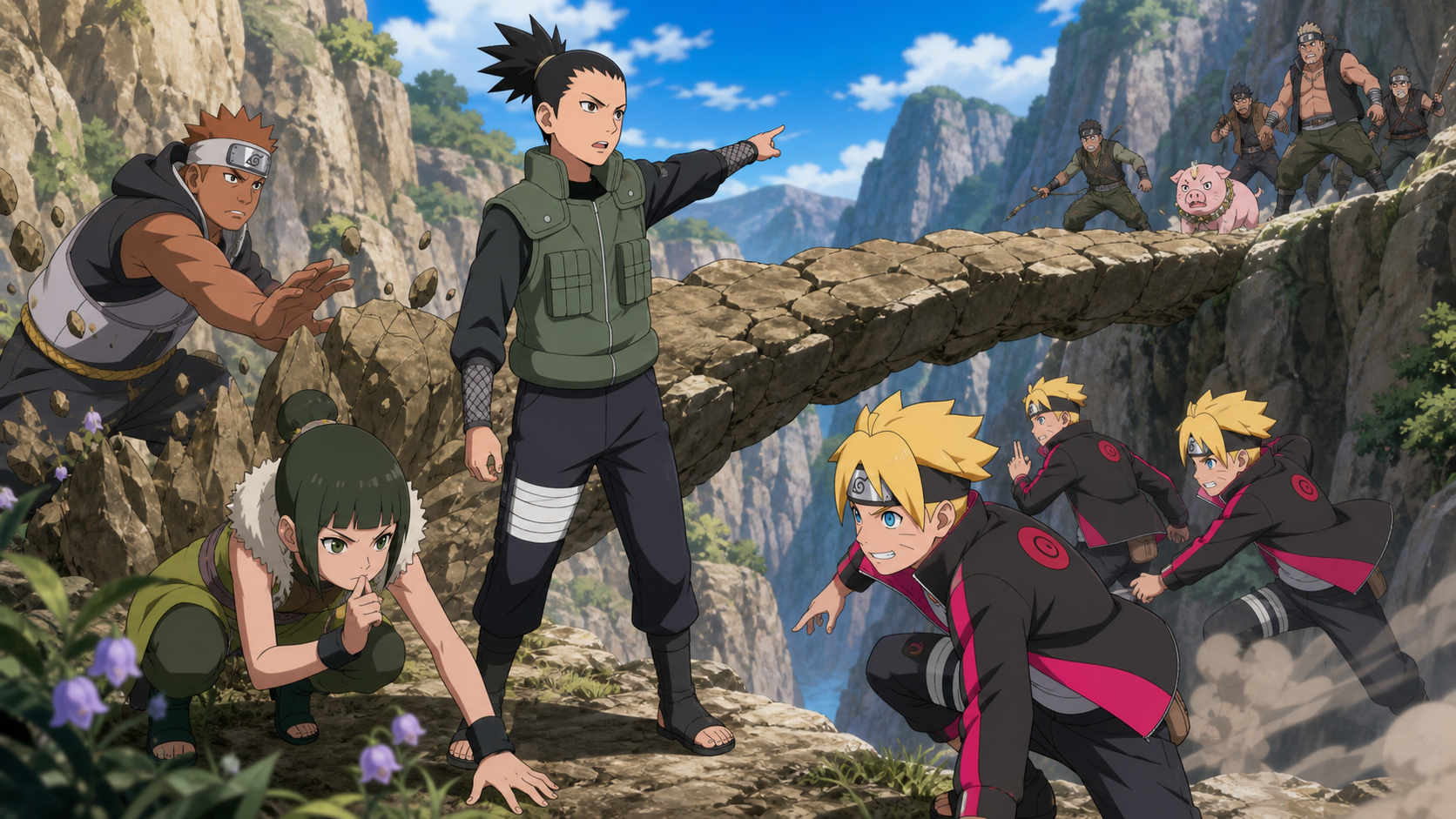
Boruto Episode 113 gives Shikadai the flak jacket, a spoiled tracking pig, three genin who did not ask to work together, and the immediate discovery that intelligence does not make other people behave like pieces on a shōgi board. “The Qualities of a Captain” sends the newly promoted Chūnin to retrieve a rare medicinal flower that blooms once every four years. His emergency squad includes Boruto, Iwabee, and Wasabi, while Tonsuke the pig provides the only nose capable of finding the flower. Iwabee and Wasabi argue. Boruto arrives late. Bandits switch Tonsuke with another pig during an ambush. Shikadai injures his leg, loses the mission's most important asset, and initially makes decisions without giving his team enough room to contribute. The recovery works only after Iwabee builds a bridge, Wasabi uses her hearing to locate Tonsuke, Boruto supplies clones, and Shikadai coordinates the final trap. Moegi later admits the assignment was also a leadership test. Shikadai passes, but not because he looked brilliant from the first step. He passes because his team stops being an inconvenience he must control and becomes a collection of abilities he needs to trust. That is a better lesson than Episode 112's promotion meeting managed to say directly. A captain is not the smartest person walking in front. A captain is responsible for making everybody's different kind of smart usable.
The flak jacket feels better before the mission starts
Shikadai admires the physical proof that he has moved beyond genin rank. The jacket carries authority, family history, and a little of the pride he would rather pretend is troublesome.
Moegi arrives before he can enjoy the moment for long. His promotion becomes a job immediately.
Rank looks clean while hanging in a bedroom. Leadership starts once three other people bring their moods, limits, and bad timing into the same assignment.
Moegi calls the mission easy and therefore suspicious
She comes to his house personally for a supposedly simple flower retrieval. Shikadai correctly notices that the delivery does not match the description.
His instinct is useful. Senior shinobi often hide the real evaluation inside an ordinary task because a candidate behaves differently when told he is being tested.
Shikadai knows a catch exists. He does not yet know the catch is the team.
The squad exists because these genin happened to be free
Team 10 is not available. Moegi assembles Boruto, Iwabee, and Wasabi on short notice.
That matters more than the flower. Shikadai earned promotion partly through his ability to coordinate familiar friends. A Chūnin captain cannot demand the exact personalities he already understands.
Real assignments are staffed by whoever the village can send.
Iwabee and Wasabi arrive arguing
Both are capable, proud, and quick to react when the other pushes. Their conflict creates noise before the team leaves the gate.
Shikadai wants a formation he can explain once and expect everybody to follow. Iwabee and Wasabi require active management, which feels less elegant than strategy and far more like leadership.
The episode does not invent deep hostility between them. Fatigue, ego, and unfamiliar roles are enough.
Boruto arrives late with condolences
He looks at Shikadai's squad and treats the assignment like a sentence the new captain must survive. That joke positions Boruto as the least worried person in the group.
Boruto can be disruptive, but he understands Shikadai well enough to tease without challenging his authority at every step.
His casual confidence becomes useful once the mission stops being simple.
The Gekkōran flower is not decorative cargo
The rare flower blooms only once every four years and carries valuable medicinal properties. Limited supply and high market value make bandits predictable.
The mission asks the team to protect both a natural resource and the treatment the resource can provide.
Retrieval sounds low stakes until somebody remembers that medicine reaches patients only if the flower survives the mountain.
Tonsuke is the mission's irreplaceable nose
The pig can identify the flower's scent and is apparently the only available animal trained for the job. Tonsuke receives special food and enough pampering to develop standards.
The team laughs at the guide because a pig does not fit their picture of serious shinobi equipment.
Specialized ability does not care whether the specialist looks dignified. Tonsuke is more operationally valuable than any single fighter on the mountain.
Protecting the tracker should shape the formation
The pig is a mobile mission-critical asset. Losing Tonsuke could make every other success meaningless.
Shikadai knows the importance intellectually but still allows the animal to become vulnerable during movement and conflict.
A captain has to build the plan around the weakest irreplaceable component, not simply place strong fighters at the front.
Iwabee carrying Tonsuke creates concentrated risk
Iwabee offers strength and Earth Release, so the physical assignment makes sense. He also becomes a single point holding both a valuable animal and major combat capacity.
When bandits strike, the formation gives them a clear target.
Shikadai's mistake is not choosing Iwabee. The mistake is failing to build enough redundancy around that choice.
A wolf scare reveals Tonsuke's identifying mark
During the night, Tonsuke bolts, and Shikadai helps recover him. He notices a distinctive mark near the pig's snout.
The observation later saves the mission. Good leadership includes learning the asset closely enough to recognize substitution.
The episode rewards attention to a tiny detail rather than giving Shikadai a sudden genius speech.
The bridge creates the first real pressure point
Mountain terrain forces the squad through narrow routes and unstable crossings. Movement becomes slower because Iwabee and Wasabi keep fighting instead of coordinating.
Shikadai focuses on getting everybody across, but frustration begins to replace communication.
A leader can give correct orders and still lose the team if every instruction sounds like proof that the others are a problem.
Bandits attack the mission rather than the strongest shinobi
The thieves want the flower and the tracker. They do not need to defeat every genin in a fair contest.
That asymmetry tests Shikadai more effectively than a duel. He has to protect a goal while enemies create distractions and exploit movement.
Captains who chase victory can lose the mission behind them.
Shikadai's injured leg changes the available plan
He takes damage during the ambush and cannot pursue normally. The new captain has to lead while physically limited and while processing that Tonsuke may be gone.
Shikadai wants to keep personal control because the mission feels like his first proof of worth.
The injury makes control impossible and forces him to rely on people he has not learned to trust.
The replacement pig nearly fools everybody
The recovered animal eats wild mushrooms and behaves differently. Shikadai checks the snout and realizes the identifying mark is missing.
The bandits switched Tonsuke with the pig stolen earlier. Their plan works because the team expects one pig to look enough like another under stress.
Shikadai catches the deception by combining behavior and physical evidence rather than trusting relief.
Knowing the pig was switched does not solve the ravine
The team locates the direction of the thieves but reaches a gap too wide for a normal crossing. Boruto tries building a bridge from shadow clones, and the distance defeats the idea.
Shikadai considers jumping despite his leg. That impulse is pride disguised as urgency.
A captain breaking himself at the ravine would leave the team with one more rescue problem.
Iwabee returns with the bridge the mission needs
His Earth Release creates a stable route across. The teammate who spent the early mission arguing becomes the person who changes what is physically possible.
Shikadai could not substitute a smarter individual plan for Iwabee's specific ability.
Leadership begins improving when the captain stops treating difficult personalities as failed copies of himself.
Iwabee and Wasabi apologize without a grand speech
They recognize that the bickering slowed the mission and made coordination harder. Neither becomes a different person.
The apology clears enough space for their skills to work together.
Teams do not need permanent emotional harmony. They need members capable of repairing conflict before the mission pays the price again.
Tonsuke's hunger becomes a tracking signal
The stolen pig misses his special food and starts crying. That undignified sound gives the squad a location.
Wasabi's cat-enhanced hearing turns the cry into usable direction. A detail that looks like comic weakness becomes a rescue beacon because the right teammate can perceive the signal.
Shikadai's job is connecting those facts quickly enough to act.
Wasabi proves speed is not her only value
Her acute hearing locates Tonsuke when eyesight and ordinary tracking fail. The mission needs sensory interpretation as much as combat speed.
Wasabi spent part of the episode framed through conflict with Iwabee. Her contribution reminds Shikadai and the audience that irritation does not cancel competence.
A captain who reduces a teammate to her most annoying moment wastes the rest of her skill set.
Boruto's clones create the numbers for an ambush
Once the bandits' position is known, Boruto supplies confusion and coverage through shadow clones. His technique lets a small squad attack like a larger unit.
Boruto follows the plan without needing to become captain by personality force.
That restraint matters. He helps Shikadai lead instead of treating friendship as permission to take over.
Iwabee separates Tonsuke from the leader
Earth Release changes the terrain and removes the hostage from immediate control. The same skill that built the bridge now structures the battlefield.
Iwabee is not merely the heavy hitter carrying the pig. His jutsu lets the team determine where people and animals can move.
Shikadai finally uses that capacity as part of a coordinated sequence.
Shadow Possession finishes the capture
With the target isolated and the field arranged, Shikadai pins the leader through his clan technique.
The finishing move works because everybody else created the condition. Wasabi found the sound. Boruto supplied numbers. Iwabee separated the hostage.
The captain delivers the last restraint, but the victory belongs to the structure around him.
The flower survives because the squad learns fast enough
They recover Tonsuke, defeat the bandits, and locate the rare bloom before the short window closes.
The mission succeeds despite early dysfunction rather than because the dysfunction was harmless.
Every delay could have cost a four-year opportunity. Repairing teamwork becomes part of protecting the medicine.
Moegi admits the assignment was a test
She deliberately placed Shikadai with unfamiliar genin to see whether the new Chūnin could lead outside Team 10.
The test is fair in purpose and reckless in presentation. A valuable flower and real bandits create consequences beyond a training ground.
Konoha trains leaders through live responsibility because no simulation can reproduce people who genuinely disagree while the clock keeps moving.
Shikadai passes without pretending he mastered command
He recognizes that he still has work to do. That conclusion is the clearest sign the promotion may have been correct.
A weak captain would point to the recovered flower and declare every earlier mistake irrelevant. Shikadai sees that success included avoidable failures and contributions he initially mishandled.
Humility becomes useful only when the next plan changes.
Episode 113 proves rank should remain provisional in practice
The vest grants authority. The mission reveals whether Shikadai can grow into that authority.
Promotion does not certify a finished leader. Konoha is betting that he can learn while carrying responsibility without making teammates pay for the same lesson repeatedly.
Moegi's evaluation continues after the conference door closes.
A promotion should begin a supervised learning period
Shikadai receives a flak jacket and command authority because adults judged his tactical ability and temperament strong enough for chūnin rank. The promotion does not install experience that he has never lived.
Episode 113 works because Moegi treats the first mission as a test with observation and room for correction. A responsible promotion system should pair new captains with debriefs, review early assignments, and distinguish teachable mistakes from reckless misconduct.
Rank grants responsibility before mastery. Pretending otherwise pressures young leaders to hide confusion and perform certainty. Shikadai passes partly because he adapts after the plan breaks rather than insisting the first decision must remain correct.
The village should measure whether a captain learns, communicates, and protects people over time, not whether one badge produces flawless command immediately.
The mixed squad needed a deliberate briefing before departure
Iwabee, Wasabi, and Boruto join because they are available, not because the team trained together. Different habits, communication styles, and personal friction arrive with them. Shikadai cannot assume Team 10 shorthand will transfer.
A proper briefing should name the objective, route, Gekkōran flower requirements, Tonsuke's role, likely threats, medical constraints, communication signals, and who takes temporary command if Shikadai becomes unable to lead.
The episode lets personality conflict emerge on the road because the mission doubles as a test. Real command should reduce avoidable uncertainty before testing adaptability.
Mixed teams can become strong quickly when members know why each skill was selected. Treating genin as spare bodies creates the exact coordination problem the captain later has to solve under attack.
Tonsuke is a specialist and a protected teammate
The pig's nose makes the mission possible because the flower cannot be found reliably without him. That role turns Tonsuke into the critical specialist, not comic baggage.
Carrying him protects speed and safety, but concentrating the tracker with one shinobi creates a single point of failure. The squad should rotate responsibility, maintain visual checks, and establish how to identify Tonsuke if bandits attempt a switch.
The marking discovered during the wolf scare becomes important evidence because someone paid attention before the crisis. Small observations protect a mission when enemies imitate the obvious features.
Tonsuke's hunger and behavior also communicate information. Leadership includes reading nonhuman partners rather than treating them as equipment that either works or fails.
Shikadai's injury should become team information immediately
An injured leg changes pace, formation, retreat options, and who can respond at the ravine. Hiding the injury to preserve authority would make the whole team plan around false capacity.
Shikadai adjusts rather than pretending nothing happened, but the episode could state the disclosure more clearly. Captains model safety when they name limitations and redistribute tasks without treating injury as shame.
The other genin also need enough information to protect him without taking over every decision. Wasabi's speed, Iwabee's construction ability, and Boruto's clones become more valuable once the team understands where mobility has narrowed.
Authority survives honest injury reporting. Authority becomes dangerous when everyone must guess whether the leader can still execute the plan.
Iwabee's bridge proves initiative needs a shared objective
Iwabee disappears from the immediate formation and returns with a structure the squad needs. The decision could look like insubordination because he acts without waiting for detailed instruction.
The bridge works because he understands the objective, terrain, and team's limitation. His Earth Release solves a problem Shikadai cannot solve alone. Initiative becomes useful when members share enough mission context to act toward the same goal.
A captain should not micromanage every technique. A captain should create clarity about priorities, constraints, and rendezvous expectations so specialists can make decisions without fragmenting the team.
Iwabee also apologizes for earlier friction, which helps rebuild trust. The useful action matters more than a dramatic loyalty speech.
Wasabi's speed supports analysis, rescue, and pressure
Wasabi is easy to classify as the fast member. Episode 113 lets her use speed inside a larger decision chain rather than as a complete identity.
She can scout, protect the tracker, interrupt a theft, and respond when the formation changes. Speed becomes valuable because Shikadai and the others supply information about where movement matters.
Her argument with Iwabee also reveals confidence and impatience. Strong teams do not need to erase personality conflict. They need members who can stop feeding the conflict when the objective demands cooperation.
Wasabi proves that specialized movement belongs in leadership planning, not at the edge waiting for someone to yell “go fast.”
The bandits attack mission architecture rather than power rankings
The enemy targets the bridge, tracker, captain's injury, and confusion around a replacement animal. They do not challenge the strongest genin to a fair duel because stealing the flower requires disrupting the process.
That approach makes the episode's tactics more believable. Mission security depends on relationships between people, terrain, cargo, and information. Remove one element and stronger fighters may still fail.
Shikadai's success comes from rebuilding those relationships: verify Tonsuke, use Iwabee's bridge, let Wasabi apply pressure, create numbers with Boruto's clones, and finish with Shadow Possession.
Command is not personally defeating every bandit. Command is making separate abilities arrive in the correct order.
Shikadai passes because he can name what he still lacks
Moegi reveals that the assignment tested his command. Shikadai does not respond as though one successful mission proves complete readiness. He recognizes mistakes, the team's contributions, and the distance between tactical intelligence and experienced leadership.
That humility is a qualification rather than a weakness. Captains who believe promotion ended their learning become dangerous faster than captains who know where to seek help.
The episode should not use modesty to deny Shikadai credit. He reads the switch, adjusts around injury, coordinates unfamiliar teammates, and completes the capture. He earns the result.
The mature conclusion is simple: he can lead, and he still needs practice. Both facts are true on the same day.
Final reaction
“The Qualities of a Captain” gives Shikadai a deliberately awkward first team and lets him struggle in believable ways. He notices the pig's mark, understands the switch, and designs the final ambush. He also concentrates risk, communicates poorly, considers worsening his injury, and initially sees Iwabee and Wasabi's conflict mainly as noise blocking his plan.
The episode works best when every silly element becomes operational. Tonsuke's pampering creates the hunger cry. Wasabi hears that cry. Iwabee's Earth Release turns terrain into access and separation. Boruto's clones create coverage. Shikadai's shadow closes the trap.
None of them solves the mission alone. That fact is the lesson.
Episode 112 selected Shikadai because he looked like the safest person to coordinate other genin. Episode 113 immediately shows how little a title guarantees once the genin are unfamiliar, irritated, and standing on opposite sides of a ravine. Shikadai earns the episode by adapting before the flower's short life ends. The flak jacket fits. The captain inside still needs breaking in.
Sources and lawful viewing
Official episode reference: Naruto Official episode guide
Licensed episode route: Crunchyroll licensed series page