
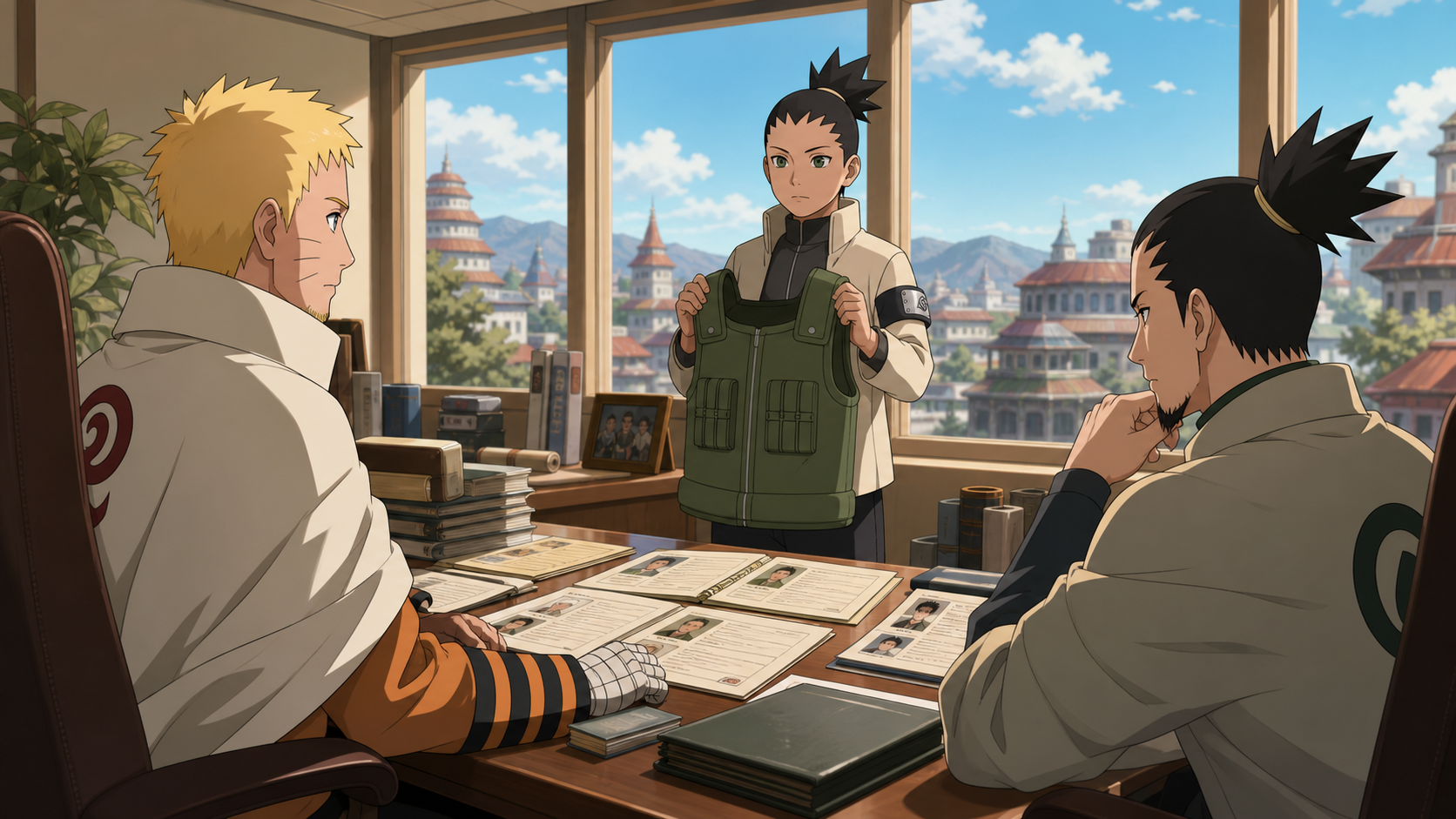
The Chunin Selection Conference
Konoha has one promotion, several qualified genin, and a closed-door argument about strategy, obedience, trust, and whose mistakes leadership can forgive.
Series: Boruto: Naruto Next Generations
Episode: 112 · The Chunin Selection Conference
Arc: Chūnin Selection
Release: 2019-06-23
Previous: Episode 111 · The Steam Ninja Scrolls: Mirai's King!
Directory: All 293 Boruto episodes
Bottom line
Boruto Episode 112 turns a clip show into an argument about whether leadership should reward judgment, obedience, combat strength, or the ability to keep a team moving when every available option is bad. “The Chunin Selection Conference” has Naruto and Shikamaru revisit a Chūnin Exam interrupted by the Ōtsutsuki attack, compare the candidates' later missions, and select one genin for promotion. Sarada, Sumire, and Denki emerge as serious options. Naruto leans toward Sarada because her strategy comes with the strongest combat record. Sasuke complicates that choice by pointing to her decision to leave the village during Mitsuki's disappearance. Naruto eventually promotes Shikadai after reconsidering how he handled the Iwagakure crisis. The result makes sense. The reasoning does not always sit comfortably. Shikadai showed coordination, analysis, and the willingness to adapt after learning his first judgment was incomplete. Sarada showed many of the same qualities and carried more of the fighting burden, but the episode treats her disobedience as a larger stain. Boruto's cheating removes him from the conversation, and Mitsuki's secret departure makes promotion impossible. The conference is not thrilling television, but the quiet format exposes the political part of rank. Chūnin status does not mean “strongest child.” The promotion tells the village which mistakes leadership will forgive and which kind of judgment the institution wants younger shinobi to copy.
The exam never reached a normal conclusion
Momoshiki and Kinshiki attacked before the Chūnin Exam could complete its intended evaluation. The stadium became a battlefield, Naruto was taken, and the candidates moved from tournament logic into an actual crisis.
Konoha cannot pretend the exam produced a clean winner. The administration has to judge performance from incomplete matches and everything the genin did afterward.
That sounds messy because leadership decisions are messy. A tournament bracket can measure victory. Chūnin responsibility requires evidence about people under pressure.
Naruto has to choose as Hokage, not as a father
Boruto's performance sits in the room whether Naruto wants that discomfort or not. His son reached the later rounds by using a prohibited Scientific Ninja Tool and lied about the source of his techniques.
Boruto later helped defeat Momoshiki and demonstrated courage far beyond a normal genin assignment. None of that erases the cheating.
Naruto cannot promote him without telling every candidate that public heroism after exposure cancels dishonesty during evaluation.
Boruto is capable enough and still disqualified
The episode does not need to argue that Boruto lacks Chūnin-level talent. His tactical creativity, combat instincts, and ability to rally people are obvious.
Rank also carries trust. A captain receives information, teammates, and authority under the assumption that the village can rely on his report.
Boruto cheated because he wanted Naruto's attention more than he wanted an honest measure of himself. That motive is sympathetic. The breach remains real.
Mitsuki made secrecy his promotion problem
Mitsuki possesses frightening combat ability and often reads a situation faster than his peers. Raw capacity does not answer whether he can lead a Konoha team.
During his disappearance, he withheld his plan, allowed village guards to believe he attacked them, and made his friends chase him into international danger.
Mitsuki was trying to learn whether his will belonged to him. Konoha still has to judge the operational damage caused by that private search.
Sarada looks like the obvious leadership candidate
She wants to become Hokage, studies seriously, coordinates Team 7, and combines tactical thinking with high-level combat ability. During the exams, she makes decisions rather than waiting for Boruto to become the center of every problem.
Naruto initially favors her after narrowing the field. Compared with Sumire and Denki, Sarada offers similar strategic value with more battle strength.
That logic is straightforward. A Chūnin captain has to keep people alive when the mission stops behaving like the plan.
Sumire brings a different kind of command intelligence
Her record includes technical understanding, observation, and the ability to manage complex threats. Sumire knows how systems connect and often sees emotional conditions other candidates miss.
Her history with Nue also complicates a simple promotion narrative. She moved from carrying her father's destructive plan to choosing her classmates and building a new future.
Leadership does not always look like the loudest fighter at the front. Sumire represents the value of a captain who understands what everybody else overlooks.
Denki deserves to be in the room
The episode's willingness to consider Denki is one of its better choices. He lacks the inherited combat power surrounding many classmates, but he contributes analysis, communications knowledge, planning, and technical problem-solving.
A squad does not need every captain to win a fistfight against an Ōtsutsuki. A squad needs somebody who can read terrain, maintain contact, and convert information into decisions.
Denki's candidacy tells the Academy class that intelligence developed through work can compete with clan techniques.
The shortlist exposes what Konoha says leadership means
Sarada, Sumire, and Denki share strategic awareness. Their inclusion suggests that Chūnin selection values the person who can see beyond an individual duel.
Combat strength becomes the tie-breaker favoring Sarada, which makes sense until the conference introduces obedience as another decisive category.
The criteria are not wrong. The weighting changes whenever a candidate gets close to promotion.
Sasuke challenges the Sarada choice
He enters the conversation after learning about her departure during Mitsuki's disappearance. Sasuke understands unauthorized travel better than almost anybody alive.
His concern is not hypocrisy by default. A person who knows the cost of leaving can recognize the danger clearly.
Still, hearing Sasuke Uchiha become the voice of procedural caution around Sarada is rich enough to deserve a raised eyebrow.
Sarada disobeyed orders for Mitsuki
She left because Konoha's official response could not answer whether her teammate had betrayed the village or needed help. Boruto rushed forward. Sarada chose to join him rather than let one reckless friend pursue another alone.
That decision put her outside direct authority and increased the number of genin exposed to danger.
The same decision also gave the rescue group a levelheaded leader who repeatedly stopped Boruto from turning urgency into chaos.
Punishing disobedience is not the same as judging bad leadership
Konoha has to discourage genin from ignoring orders whenever friendship pulls hard enough. A military village cannot function if every squad invents its own foreign policy.
The conference should also ask what Sarada did after leaving. She evaluated new evidence, changed plans, protected teammates, and accepted responsibility.
Disobedience describes how the mission began. Leadership describes how she handled the consequences.
Shikadai made the same crisis possible to survive
He originally tried to stop Boruto and Sarada. After learning more, Shikadai chose to help and drew Team 10 into the effort.
That shift demonstrates flexibility. He did not cling to his first judgment simply because changing course might look inconsistent.
Shikadai could identify the institutional rule, understand why his friends broke that rule, and create a plan that reduced the damage.
Shikamaru is hardest on his own son
He downplays Shikadai's achievements and refuses to let family pride perform the evaluation. That caution is understandable when the father advising the Hokage could easily look biased.
The result almost becomes reverse favoritism. Shikadai has to clear a higher verbal bar because Shikamaru would rather undersell him than appear indulgent.
Parents in authority still shape outcomes when they try to disappear from the decision.
Shikadai's exam loss is useful evidence
He cornered Boruto through planning and lost only because Boruto used a prohibited tool. Shikadai then conceded with composure before the cheating was exposed.
That response matters more than the bracket result. A captain must recognize when a situation has changed and communicate honestly without turning defeat into a personal crisis.
Shikadai showed the temperament his father displayed during the original Chūnin Exams, which makes the parallel obvious and slightly too convenient.
The episode cannot resist repeating Shikamaru's promotion
Naruto's generation saw Shikamaru become the sole promoted candidate despite losing his match. Episode 112 sends his son through a similar door.
The echo has thematic value. Both win institutional trust through judgment rather than overwhelming power.
The repetition also makes Shikadai's promotion feel preselected by franchise symmetry. The conference has to work harder to prove that the son earned more than his father's old storyline.
One promotion feels manufactured
The episode treats the decision as though Konoha must choose a single candidate. Chūnin Exams have never functioned purely as winner-takes-rank tournaments. Multiple candidates can qualify when their performance supports promotion.
Restricting the outcome to one person creates drama inside a meeting, but the rule feels designed to preserve manga-era ranks and recreate Shikamaru's history.
Sarada and Shikadai could both be ready without either promotion weakening the other.
Clip-show structure does not automatically equal analysis
Much of Episode 112 revisits events viewers already watched. Repetition earns its space only when Naruto and Shikamaru interpret those events differently from the original scenes.
The strongest moments do that. A rescue framed earlier as friendship becomes evidence about command judgment. A lost match becomes evidence about composure. Technical support becomes evidence for Denki's leadership potential.
Other flashbacks simply remind the audience what happened and slow a decision that could fit inside half an episode.
Sasuke's Ōtsutsuki investigation keeps the larger threat nearby
He returns looking for information about the clan that attacked the exams. His presence reminds Naruto that selecting Chūnin is not school administration detached from danger.
These young shinobi will inherit missions shaped by enemies the village still does not fully understand.
The standard should be serious because the world will not wait for every new captain to finish growing.
Naruto changes his decision for a defensible reason
He reconsiders Shikadai after weighing the Iwagakure incident. Shikadai contributed to resolving a crisis that crossed village borders and demanded more than tournament tactics.
That record supports promotion. He coordinated peers, adjusted to evidence, and helped bring people home.
The problem is not that Shikadai lacks merit. The problem is that the conference uses Sarada's role in the same crisis mainly against her.
Sarada receives the harsher reading of shared disobedience
She and Boruto initiated the unauthorized pursuit. Shikadai joined later after trying to stop them. That difference matters.
Sarada also carried leadership responsibility through much of the journey. If Konoha wants captains who can make independent judgments, her performance deserves more than a cautionary footnote.
The institution rewards the boy who changed sides carefully and delays the girl who recognized the teammate's need early. Both choices carried risk.
Promotion gives Shikadai a job, not a trophy
The next episode will test him as a captain. That is the important consequence.
Chūnin rank means accepting responsibility for teammates whose abilities, personalities, and bad decisions cannot be controlled like shōgi pieces.
Shikadai is smart enough to understand formations. Leadership will ask whether he can keep moving when people refuse the neat move.
Naruto's administration values recoverable judgment
Across the discussion, the favored quality is not perfection. Shikadai makes an initial choice, receives new information, and revises the plan without losing the team.
That pattern suits peacetime missions where civilians, politics, and incomplete intelligence create problems no exam can stage.
Naruto became Hokage because he repeatedly changed people and changed his own understanding. His promotion choice favors a genin capable of revision.
The candidates do not hear the argument made about them
Rank decisions happen behind a closed door. Sarada will know she was not selected, but she will not receive every compliment, concern, and contradiction shaping that result.
That gap can make evaluation feel arbitrary to the people being evaluated.
A serious development system should tell candidates what kept them from promotion and what evidence could change the decision next time.
Promotion criteria should exist before the conference begins
Naruto, Shikamaru, Sasuke, and the other adults discuss leadership, judgment, mission conduct, and exam performance as though everyone shares one standard. The episode never presents a clear rubric to the genin or the audience.
Chūnin selection can remain holistic without becoming mysterious. Candidates should know that evaluators consider tactical judgment, communication, rule interpretation, teammate safety, adaptability, emotional control, and conduct after failure.
Clear criteria would not produce automatic answers. Sarada and Shikadai both have strong evidence and real violations. Transparency would let adults explain why one pattern currently outweighs another without making the result feel invented for a callback.
Promotion affects assignments, authority, pay, risk, and future opportunities. A closed conversation needs a documented standard because “we know leadership when we see leadership” usually favors whichever story evaluators already prefer.
Naruto and Shikamaru need explicit conflict-of-interest boundaries
Naruto evaluates Boruto, and Shikamaru evaluates Shikadai. Both men recognize the problem and appear harder on their own children. Extra harshness does not automatically create fairness.
A conflict policy should require independent votes, recorded evidence, and recusal where a parent's participation could change the outcome. Parents can provide factual context without becoming the final authority over promotion.
Being stricter with family may feel ethical while punishing a candidate for the evaluator's discomfort. Shikadai should not need stronger evidence than another genin because his father advises the Hokage. Boruto should not receive softer or harsher treatment because Naruto fears appearances.
Fairness comes from consistent process, not from parents proving impartiality through public severity.
Sarada and Shikadai both disobeyed because the official plan failed
Sarada left the assigned path during the Mitsuki crisis. Shikadai also made choices outside ordinary orders and helped coordinate a situation that Konoha had misunderstood. The adults interpret their actions differently because Shikadai's tactical role looks more recoverable.
That difference may be defensible, but the episode needs sharper evidence. Which decision increased danger? Which candidate communicated, adjusted, protected teammates, or accepted consequences? Which disobedience served a coherent alternative plan rather than personal loyalty alone?
Rules matter because teams need coordination. Blind obedience becomes dangerous when authorities hold bad information. Leadership evaluation should examine why an order was broken and what happened next.
Calling one violation loyalty and another judgment without documenting the distinction turns bias into hindsight.
Sarada's ambition deserves feedback rather than silent rejection
Sarada openly wants to become Hokage and repeatedly demonstrates tactical intelligence, courage, medical awareness, and an ability to direct Team 7 under pressure. The conference identifies those strengths and then denies promotion without telling her why.
If the adults believe her Mitsuki decision showed poor command judgment, she needs that feedback. A future leader cannot improve against a reason hidden in a room she never enters.
The harsher reading also risks treating emotional loyalty as uniquely disqualifying when Naruto's generation built entire victories around refusing to abandon people. Sarada should learn how to connect loyalty with communication and risk assessment, not that caring for Mitsuki made leadership impossible.
Delayed promotion can be fair. Silent delay wastes the lesson.
Shikadai's earlier loss shows more than one kind of evidence
Shikadai lost his exam match because he surrendered after calculating that he lacked the chakra and options to continue. The result disappointed him and echoed Shikamaru's own history. Surrender can show accurate self-assessment or premature disengagement depending on context.
The conference treats that moment as useful evidence because captains must know when persistence becomes waste. The adults also need evidence that Shikadai can inspire, communicate, and carry responsibility after the clean tactical answer disappears.
Episode 113 supplies that field test immediately. Episode 112 would feel stronger if the promotion were framed as provisional and supervised rather than as history repeating because the franchise enjoys symmetry.
Shikadai earns consideration. The callback should support the evidence, not replace the evidence.
Mitsuki's secrecy blocks evaluation because nobody can assess unknown capacity
Mitsuki has exceptional power, composure, and observation. His hidden origins, Sage Transformation, and decisions during the disappearance crisis leave evaluators unable to judge whether he will disclose information a captain must share.
The problem is not that privacy disqualifies leadership. Shinobi work includes classified history. The problem is operational secrecy inside the chain of command.
Mitsuki needs a safe process for explaining limitations, health risks, and abilities without surrendering every personal detail to public scrutiny. Orochimaru's involvement makes that process difficult and more necessary.
Promotion should not demand total exposure. Promotion does require enough verified information for teammates and commanders to plan safely.
Candidates should receive written reasons and a next-step plan
The adults discuss each genin's future, then announce one promotion. Everyone else receives silence, speculation, or the emotional message that they were not good enough.
A responsible system would provide each candidate with strengths observed, concerns preventing promotion, evidence supporting those concerns, and assignments that can demonstrate growth. The feedback should include an appeal or review route when facts are wrong.
That process matters especially for Sumire and Denki, whose leadership skills appear in technical, logistical, or emotional work that combat-centered evaluators may undervalue.
Promotion decisions become less arbitrary when rejection contains a path forward rather than a closed door.
One promotion should not become proof that Konoha found the only leader
Shikadai can deserve the flak jacket while Sarada, Sumire, Denki, and others remain leadership material. A limited promotion count reflects timing and available roles, not a final ranking of human worth.
The conference language sometimes makes the selection sound like one correct answer hidden among weaker candidates. Different missions need different captains. Sarada may fit a combat team, Sumire a scientific or rehabilitation context, Denki a technical operation, and Shikadai a mixed tactical unit.
Leadership is contextual. The village should build several routes toward command rather than forcing every talent through one exam narrative.
Shikadai's promotion starts his work. The others' non-promotion should start targeted development instead of indefinite waiting.
Final reaction
“The Chunin Selection Conference” is not exciting, and the clip-show padding deserves criticism. The episode still asks a worthwhile question: what does Konoha actually promote when strength, strategy, loyalty, and obedience point toward different people?
Shikadai is a defensible answer. He reads situations, coordinates peers, accepts loss, and changes course when new evidence proves his first plan incomplete. Those qualities belong in a captain.
Sarada is also a defensible answer. The conference praises her strategy and combat skill, then lets unauthorized action outweigh the leadership she demonstrated after making that choice. Konoha cannot ignore disobedience, but the episode should not pretend obedience and judgment always point in the same direction.
Denki and Sumire benefit from being treated as genuine candidates rather than background classmates. Boruto and Mitsuki face consequences that make sense. The one-person limit remains the weakest piece because the restriction turns evaluation into artificial scarcity.
Shikadai does not steal a promotion. The writing narrows the door so only one qualified child can walk through, then uses his father's history to make the destination feel inevitable. Episode 113 now has to prove the rank changed more than the label beside his name.
Sources and lawful viewing
Official episode reference: Naruto Official episode guide
Licensed episode route: Crunchyroll licensed series page