
Memory, Sorrow, and Thorn · Canonical Character Profile
Bishop Anodis of Naglimund
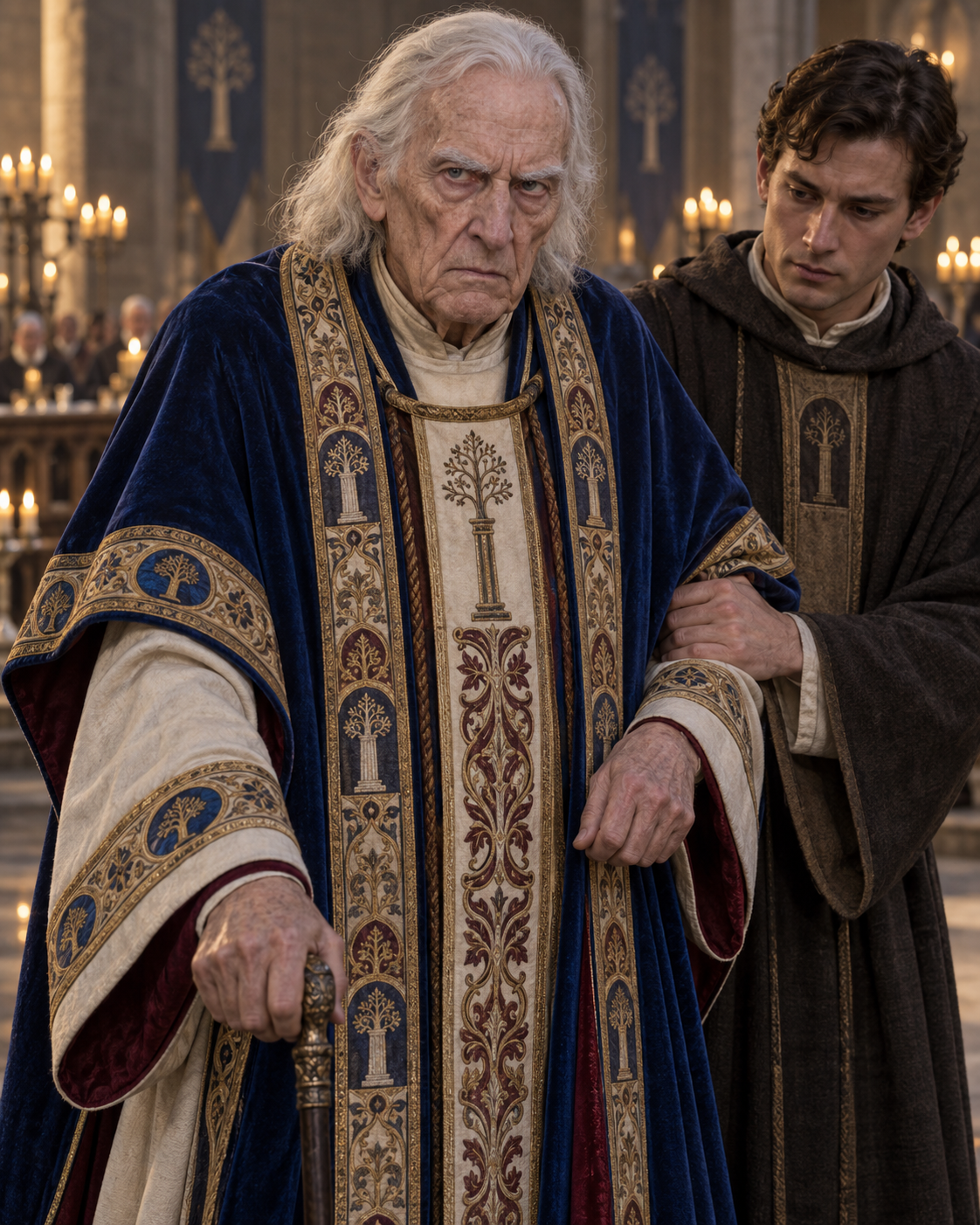
Bishop Anodis is the very old, magnificently robed churchman sent by Lector Ranessin to mediate between Elias’s sons and prevent Aedonite bloodshed. At Josua’s Raed, he offers a sour prayer, resents the gathering’s anti-Elias direction, and treats northern warning as religiously suspect. When the Harrowing begins, Bukken erupt inside Naglimund’s gardens and kill him. Anodis comes to stop Christians killing Christians and never makes room for the possibility that the rightful king has invited something far worse through the gate.
At a Glance
The mediator whose definition of peace cannot survive the king he defends
- Name
- Anodis
- Office
- Bishop of Naglimund
- Age
- Very old
- Appearance
- Sumptuous religious robes; assisted by a husky young priest
- Mandate
- Mediate between Elias and Josua and prevent Aedonite bloodshed
- Political position
- Recognizes Elias as rightful king and resists rebellion
- Death
- Killed by Bukken during the Harrowing of Naglimund
Ranessin’s Mediator
Anodis arrives with a serious mandate even when he performs it badly
Lector Ranessin sends Anodis to mediate between Elias’s sons and prevent Aedonite bloodshed. That mission deserves to be taken seriously.
Erkynland is sliding toward civil war. Josua has been imprisoned, escaped, and gathered supporters at Naglimund. Elias holds the Dragonbone Chair. Regional grievances, succession, personal betrayal, and supernatural fear are converging.
Mother Church has reason to fear Christians killing one another. Anodis’s purpose is not inherently cowardly, corrupt, or absurd. Mediation could save soldiers, servants, farmers, children, and clergy from a war fought under competing claims of legitimacy.
The problem is the boundary Anodis brings to the work. He appears to treat Elias’s crowned status as morally prior to evidence about how the king governs and what forces surround him.
The books do not preserve Ranessin’s detailed instructions, Anodis’s travel, or a private conversation between the two bishops. We know the mandate because Anodis states it. We do not know whether Ranessin would approve the way he interprets it.
This distinction prevents easy villainy. Anodis begins with a defensible goal and narrows it until peace means submission to the person already using violence.
The Sour Prayer
His body and tone announce resistance before the council reaches its hardest evidence
The formal Raed gathers in Naglimund’s dry, candlelit great hall around a vast horseshoe of tables. Roughly fifty lords, soldiers, clergy, emissaries, and witnesses attend.
Anodis arrives in sumptuous religious robes and requires the help of a husky young priest. He offers the opening prayer with definite bad temper and visibly resents the anti-Elias direction of the gathering.
The visual contrast is sharp. Josua wears gray with a simple silver circlet and displays the prison shackle as political evidence. Anodis’s robes embody established church grandeur, yet his manner makes mediation feel pre-decided.
Devasalles presses Josua to say whether he wants accommodation, revenge, or the throne. Gwythinn demands war. Josua says he does not seek kingship and would trade revenge for fair rule, but Elias has become dangerous. He also refuses to begin war on rumor alone.
Anodis’s presence should matter here. This is exactly the kind of claim-testing a mediator ought to welcome. The council is not yet a war declaration; it is gathering testimony and deciding what can be believed.
His sourness does not prove every later conclusion was fixed before arrival. It does show that the resistance’s existence already feels improper to him.
The Rightful King
Legal continuity becomes the answer before moral responsibility has finished asking the question
Anodis insists that Elias remains the rightful king and treats resistance as sin. In ordinary succession terms, Elias did inherit John’s throne.
The Raed’s challenge is whether inherited legitimacy can survive unlawful captivity, violent repression, catastrophic neglect, and alliance with forces the court refuses to name.
Anodis’s position protects continuity. It also risks making continuity self-justifying. If opposing a crowned ruler is always sinful, then evidence of the ruler’s crimes can never authorize meaningful resistance.
Josua’s displayed shackle is especially important. The prince does not merely allege that Elias dislikes him. He presents the material residue of imprisonment.
Anodis’s mandate to prevent bloodshed should require scrutiny of the side already using chains, disappearances, occupation, and coercion. Instead, his emphasis falls on the danger of resisting that side.
The profile cannot prove whether Anodis knows every detail of Josua’s captivity or Pryrates’s acts before the Raed. It can show that testimony is being offered and that his legitimacy framework remains resistant to revision.
Northern Knowledge on Trial
He helps classify evidence as pagan noise until weather enters the room
Jarnauga brings an evidence chain. Summer has been displaced by Yuven-month winter. Hunën move in the Wealdhelm. Bukken attack soldiers in open ground. Stormspike’s forges burn through the night, and Jarnauga has seen their glow and heard the hammers.
Only after presenting observations does he name the larger conclusion: Ineluki, the Storm King, is moving behind the crisis.
Anodis and Devasalles treat northern knowledge as lunacy, superstition, or pagan noise. Binabik is asked to validate Jarnauga while still absorbing insults about trolls and baby-stealing.
The council scene is not asking Anodis to accept every legend untested. It is asking him to distinguish observation, military report, inherited history, and interpretation.
His religious certainty interferes with that work. Evidence associated with non-Aedonite cultures arrives already contaminated in his judgment.
Jarnauga opens the courtyard door and lets impossible winter enter the argument. Weather becomes a witness no faction can easily dismiss. The physical cold does not prove every part of Jarnauga’s conclusion, but it destroys the comfort of treating the entire warning as picturesque northern madness.
Anodis’s error is therefore epistemic as well as political. He filters the source before weighing the receipts.
What Mediation Misses
Preventing one category of war cannot excuse refusing to recognize another
Anodis wants to prevent Aedonite bloodshed between Elias and Josua. The concern is narrow but not false.
The enemy approaching Naglimund does not respect that category. Norns, Hunën, Bukken, and the Red Hand are not participants in a church dispute waiting for clerical compromise.
Elias’s human army eventually withdraws with suspicious completeness. Josua recognizes the retreat as wrong. The black storm moves toward Naglimund.
Anodis’s framework leaves him poorly prepared to interpret what follows. He has treated Elias’s kingship as the anchor of order while Elias clears the battlefield for allies who do not need human siege engines.
This is not a punishment narrative in which skepticism magically summons monsters. Anodis does not deserve to be killed for being wrong. His death reveals the mortal cost of an institution refusing to expand its model of danger.
The Harrowing of Naglimund
Bukken rise inside the gardens and end the argument with teeth
The storm reveals thousands of Norns, armored Hunën, and five riders of the Red Hand. The riders demand Naglimund’s master and announce revenge in Ineluki’s name.
Then Bukken erupt inside the gardens.
Strangyeard witnesses them kill Bishop Anodis. The attack comes from within the defended space while the supernatural force confronts the gate from outside.
The death is brutally fitted to the earlier council without becoming deserved irony. Anodis treated reports of unprecedented Bukken behavior as part of suspect northern testimony. The creatures now enter his immediate reality.
During the collapse, he continues to call Elias the rightful king and resistance sinful. Institutional obedience has become so rigid that the catastrophe does not produce a documented revision before death.
The record does not supply his exact final words, which creature strikes, the physical wound, or burial. The profile should not stage a cinematic last realization the book does not give him.
His death occurs amid mass slaughter. Norns pour through with fire-tubes, Hunën smash defenders, and soldiers, clergy, court women, and civilians die. Anodis is named within collective devastation, not isolated for spectacle.
The Young Priest Beside Him
Even his first appearance records dependence, succession, and the body beneath the office
Anodis is very old and assisted by a husky young priest. The unnamed helper provides physical support and a visual reminder that church office is embodied across generations.
The record does not identify the priest, preserve speech, or confirm the helper’s fate during the Harrowing. The profile cannot promote him into a named successor.
His presence still matters. Anodis’s sumptuous vestments and episcopal authority do not erase age or dependence. Someone younger helps him move through the public ritual of mediation.
When Anodis dies, the institutional question extends beyond one bad-tempered man. What knowledge, habits, and errors pass to the people assisting him? Naglimund’s destruction interrupts any orderly answer.
Connections
The Lector, princes, witnesses, and observer around Anodis’s failed mediation
Lector Ranessin
Sends Anodis to mediate between Elias’s sons and prevent Aedonite bloodshed.
Prince Josua
Hosts the Raed, displays his prison shackle, and becomes the resistance leader Anodis views through sin and legitimacy.
King Elias
The crowned ruler Anodis continues to recognize as rightful even as Elias’s supernatural allies destroy Naglimund.
Jarnauga
Presents the northern evidence chain Anodis resists before the Harrowing confirms its danger.
Binabik
Asked to validate northern knowledge while cultural insult remains active in the same hall.
Father Strangyeard
Witnesses the Bukken kill Anodis inside Naglimund’s gardens.
Why Anodis Matters
He makes institutional failure more complicated than simple corruption
Anodis is not presented taking bribes, serving Pryrates, or plotting murder. He is trying to preserve peace and lawful kingship.
His failure grows from how he defines those goods. Peace becomes nonresistance to crowned violence. Faith becomes a reason to discount evidence from cultures outside his religious authority. Mediation becomes pressure directed mainly at the side already carrying chains as receipts.
That makes him more useful than a cartoon hypocrite. Institutions often fail through principles applied too narrowly, not only through people who possess none.
His death does not validate every opponent or make monstrous violence morally educational. It closes the arc by showing that a framework unable to recognize reality cannot protect the person committed to it.
On the Record
Book 1 only, dead at Naglimund, and no invented conversion at the end
This is Bishop Anodis’s one canonical full-spoiler profile. His Raed presence, mediation mandate, prayer, political and religious objections, treatment of northern warning, continued Elias legitimacy claim, and death during the Harrowing all occur in Book 1. No direct Anodis receipt appears in Books 2–4. Hengfisk’s later fantasy that Anodis would admire him does not make Anodis personally present.
The record confirms that Anodis is very old, bad-tempered, sumptuously robed, assisted by a sturdy young priest, sent by Ranessin to mediate, opposed to rebellion, dismissive of northern knowledge, and killed by Bukken inside Naglimund. It does not confirm exact age, face, hair, birthplace, earlier career, private relationship with Ranessin, comprehensive theology, final words, precise wound, burial, or a last-second change of mind.
The approved living identity presents Anodis as an alert but stooped man around eighty-four with a long lined face, heavy white brows, sharp slate-blue eyes, fine nose, age-spotted skin, shoulder-length white hair, clean-shaven jaw, sumptuous sapphire-and-ivory robes, and the younger priest’s supporting hand. Apart from very old age, sumptuous robes, bad temper, and physical assistance, every visible detail is CVM editorial reconstruction. Any Harrowing scene must preserve the same face, keep the unnamed assistant distinct, and communicate chaos without gory death spectacle.