
Memory, Sorrow, and Thorn · Canonical Character Profile
Bindesekk
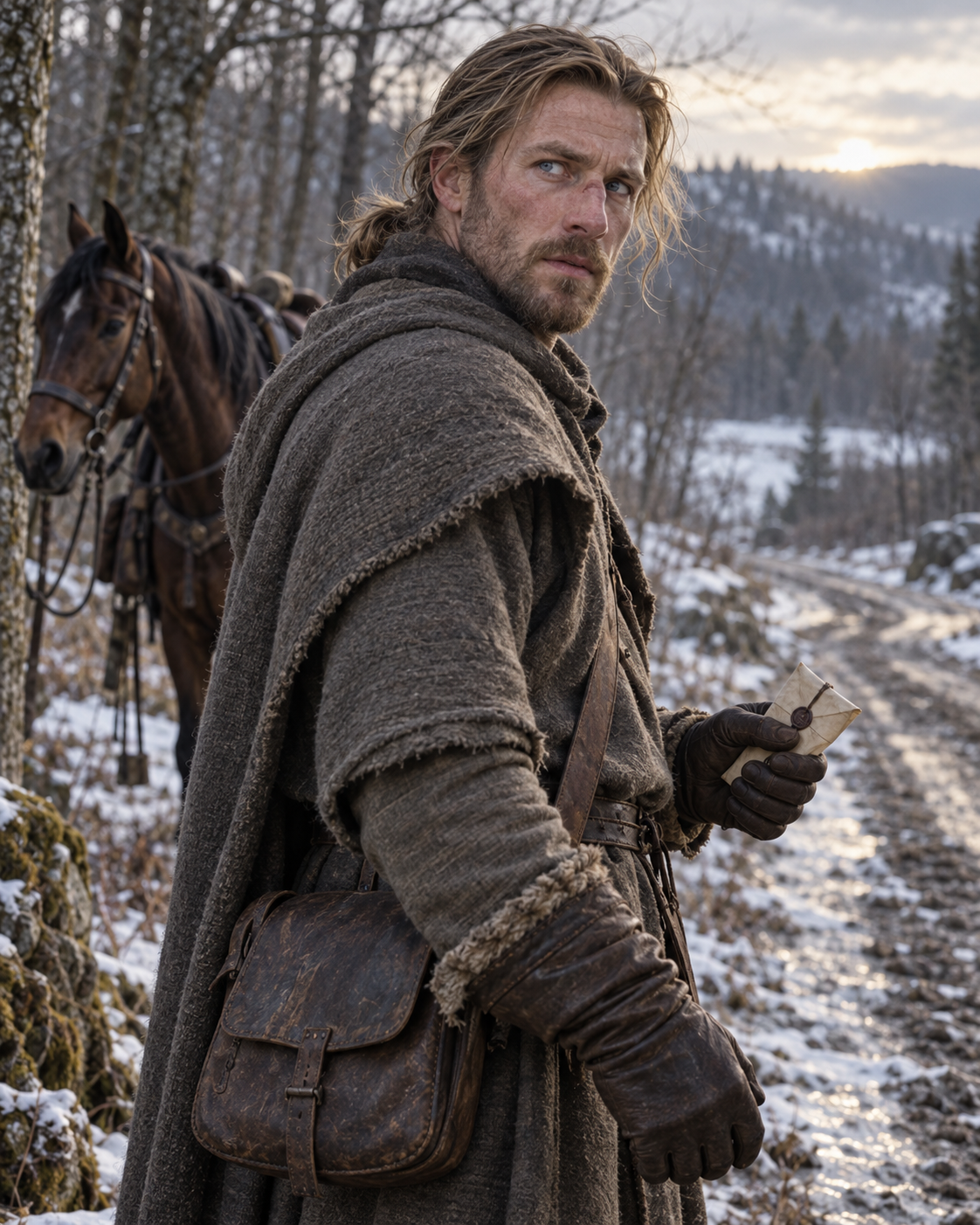
Bindesekk is Isgrimnur’s trusted messenger, sent north to watch Skali Sharp-nose and warn Isorn. Simon’s herb-gathering party finds him weeks later hidden in Kynswood, killed by an arrow whose shaft has been deliberately broken. His old crooked nose gives the anonymous corpse back its name—and turns one murdered rider into evidence that northern intelligence has been intercepted close to the Hayholt.
At a Glance
The warning rider whose undelivered message becomes a warning of its own
- Name
- Bindesekk
- People
- Rimmersman
- Allegiance
- Duke Isgrimnur of Elvritshalla
- Mission
- Follow Skali and carry a warning to Isorn
- Identifying feature
- Old broken nose from earlier service
- Death
- Killed by an arrow and hidden in Kynswood
- Killer
- Unresolved in the completed four-book record
The Northern Message
Isgrimnur trusts him with surveillance, family warning, and a politically dangerous route
After Skali of Kaldskryke leaves with his kinsmen, Isgrimnur sends Bindesekk north. The messenger has two connected duties: watch Skali closely and carry warning to Isgrimnur’s son Isorn.
The assignment is not routine courier work. Skali is Isgrimnur’s liegeman. Suspicion therefore sits inside a feudal relationship where open accusation could trigger conflict and disloyalty can become treason. Bindesekk must observe without announcing that his lord expects betrayal.
His destination also matters. Isorn is a family member and northern heir, not an anonymous military office. The message is simultaneously intelligence, protection, and a father’s attempt to reach a son while weather and politics fracture the roads.
The text does not preserve Bindesekk’s conversation with Isgrimnur, exact route, departure date, or private response to the task. “Trusted” is earned from the mission’s sensitivity, not invented friendship scenes. Isgrimnur chooses him to carry information whose interception could expose both suspicion and resistance.
Kynswood
The children go looking for medicine and find the kingdom’s intercepted nervous system
Simon, Morgenes, Jeremias, and the younger page Isaak enter Kynswood on an herb-gathering expedition. Drought and political crisis already press around Erchester. The forest should provide plants useful to Morgenes’s work.
Instead, they find a weeks-old northern corpse hidden in a thicket. Birds and insects have damaged the face; tendrils of beard remain. Plain traveling clothes, a light wool cloak, and tanned fur-lined boots fit a practical road journey rather than court display.
An arrow is buried in the torso. Its shaft has been snapped roughly a handbreadth above the ribs. The break is deliberate enough to raise the possibility that the remaining arrow would identify a maker, faction, or origin.
The discovery turns rumor into a body. Northern storms, Skali’s movement, missing messages, and the wider royal crisis are no longer distant court subjects. Someone has killed a traveler close enough to the Hayholt that children gathering herbs can stumble over the concealed remains.
The Broken Arrow
Concealment continues after the killing
The arrow kills Bindesekk; breaking it alters how the body can be read. A full shaft might carry fletching, color, mark, construction style, or other recognition available to experienced soldiers.
The profile cannot claim exactly what was hidden because the characters do not recover the answer. The important fact is the act of removal. Someone cared enough about attribution to damage the evidence after the shot.
The body is also concealed rather than left openly on the road. That choice does not fit Isgrimnur’s expectation of Skali’s usual methods. Skali may be brutal, but the duke imagines him killing more directly rather than hiding a messenger near the castle.
Method becomes political information. The murder looks less like opportunistic violence and more like an effort to stop communication while delaying discovery and confusing blame.
The Old Broken Nose
Damage from an earlier life restores the dead man’s name
At first the corpse is simply an unidentified northerner. Later, during Isgrimnur and Eolair’s secret discussion, Isgrimnur recognizes Bindesekk through an old break in the nose.
The feature is modest but devastating. A scar or healed injury from prior service, once part of the living man’s familiar face, survives enough weather and animal damage to identify him.
Naming changes the evidence. The body is no longer generic proof that the roads are dangerous. It is Isgrimnur’s own man, carrying Isgrimnur’s own warning on an assigned route.
The recognition also personalizes compromise. Whoever killed Bindesekk did not only commit roadside murder. They interrupted a relationship of command and trust. The duke’s northern intelligence network has lost a known human being.
The Secret Council
Bindesekk’s name joins drought, plague, winter, piracy, taxation, and Josua’s disappearance
Isgrimnur and Eolair meet while the kingdom appears to fail in opposite weather. Rimmersgard freezes under unprecedented snow; southern wells dry; farms lie fallow; displaced people sleep in fields; Meremund suffers plague; taxes and levies continue while nobles celebrate tournaments.
They discuss strained relations among Elias, Hernystir, Nabban, and the Church. Pryrates’s influence concerns Isgrimnur, although he does not use influence to erase Elias’s responsibility. Prince Josua is missing.
Bindesekk’s murder enters this inventory as connecting evidence. The crises are not necessarily caused by one simple hand, but private warning, northern surveillance, and violence near the Hayholt now occupy the same political map.
The dead messenger helps turn separate unease into shared analysis. Isgrimnur and Eolair can name that something has gone fiercely wrong even before they possess a complete conspiracy.
What Remains Unsolved
Suspicion of Skali is rational; certainty would be dishonest
Bindesekk was following Skali, so Skali is the obvious initial suspect. Killing a liege lord’s messenger would be treason. Yet the location, concealment, and arrow method make Isgrimnur doubt the simple answer.
The body lies near the castle rather than openly along the northern road. The arrow has been altered. The murder appears designed to hide both victim and attribution.
The completed four-book ledger does not supply a confirmed killer or explain exactly when the message was intercepted. The profile therefore keeps the question open.
This unresolved status is not a weakness. It records what the scene does: prove that communication has been compromised while preventing readers from converting the nearest villain into automatic forensic certainty.
A Messenger After Death
The message never arrives, but the corpse still communicates
Bindesekk fails to reach Isorn with Isgrimnur’s intended warning. In the narrow operational sense, the mission ends in defeat.
Yet discovery and identification produce a different warning. Someone is operating near the Hayholt, killing northern travelers, concealing bodies, and removing arrow evidence. Skali’s movement cannot be treated as the only danger.
The transformation is cruelly appropriate to the series’ interest in memory. Bindesekk’s body becomes a document. Clothes suggest route and origin; the wound records method; the snapped shaft records concealment; the old nose supplies a name; Isgrimnur supplies mission context.
Reading that document requires people to resist easy conclusions. The dead man continues serving the warning network because the living examine what remains carefully.
Connections
The lord, intended recipient, suspect, and witnesses around the intercepted mission
Duke Isgrimnur
Trusts Bindesekk with the mission and later recognizes him by the old broken nose.
Isorn
Intended recipient of the warning Bindesekk never delivers.
Skali Sharp-nose
Target of the surveillance and obvious suspect whose expected methods do not fit neatly.
Simon
Member of the herb-gathering party that discovers the hidden body.
Morgenes
Leads the forest expedition and helps convert the discovery into part of the widening evidence.
Count Eolair
Receives Bindesekk’s identity and mission context during the secret political inventory with Isgrimnur.
Why Bindesekk Matters
He makes intelligence failure physical, personal, and readable
Bindesekk has no surviving dialogue and no viewpoint chapter. The text still gives him narrative weight by making identity the hinge between atmosphere and conspiracy.
Before his name, the corpse is ominous. After his name, it proves Isgrimnur’s private network has been penetrated. The old injury converts a dead stranger into a trusted man and a hidden warning into political evidence.
His page also protects a kind of character fandom often erased by encyclopedias: the messenger whose mission matters even though he dies before delivery. Bindesekk is not important because the story secretly reveals he was royal. He is important because systems of resistance depend on ordinary trusted people reaching the next person alive.
On the Record
Book 1 only, killer unresolved, and no corpse-as-clickbait art
This is Bindesekk’s one canonical full-spoiler profile. His mission, murder, discovery, identification, and unresolved killer question occur in Book 1. The existing Book 1 scope is retained.
The record confirms that he is Isgrimnur’s trusted Rimmersman messenger, sent to follow Skali and warn Isorn; an old broken nose identifies him; plain clothes, wool cloak, and fur-lined boots survive on the weeks-old body; an arrow kills him and is deliberately broken; the body is hidden near Kynswood. It does not confirm his exact age, living face beyond the nose, coloring, family, private thoughts, final moments, killer, or what the removed shaft would have revealed.
The approved living identity is a strikingly attractive adult Rimmersman around thirty-five with a rangy rider’s build, long rugged face, ice-blue eyes, tied-back dark-blond hair, short rough beard, and the canonically identifying old crooked nose. Except for the nose and practical travel clothes, every visible bodily, equipment, horse, landscape, weather, and lighting detail is CVM editorial reconstruction. Any later evidence scene must preserve this exact identity while handling the concealed body without facial gore.