
Memory, Sorrow, and Thorn · Canonical Character Profile
Barnabas
Barnabas is the Hayholt chapel sexton Simon plans routes around, fears being caught by, and finally meets at the worst possible moment: barefoot beneath a ruined tapestry after Malachias has escaped. He does not hear the spy story. He sees the damage, drums Simon on both temples with his knuckles, and walks away disgusted. In a castle filling with dynastic catastrophe, Barnabas represents the stubborn authority of doors, cloth, chores, and consequences.
At a Glance
The sexton whose entire job is standing between Simon and places Simon absolutely intends to enter
- Name
- Barnabas
- Position
- Sexton of the Hayholt chapel
- Work sphere
- Chapel, Chancelry, and routes near Green Angel Tower
- Appearance
- Shaven-headed; brow lowers until his eyes become slits
- Connection to Simon
- Known enforcer of restricted chapel and tower space
- Major action
- Finds Simon beneath the tapestry after Malachias escapes
- Discipline
- Silently drums both of Simon’s temples with his knuckles
- Status
- Alive in his direct Book 1 record; later fate unconfirmed
Keeper of Ordinary Sacred Space
Barnabas belongs to the working chapel, not its grand theology
Simon crosses the Inner Bailey through the chapel while trying to shelter nestlings from the cold wind. Morning prayers are finished, and he hopes the route is empty because Father Dreosan may be eating and singing.
Barnabas is the other risk. As sexton, he belongs to the material care and practical order of the chapel rather than the abstract religious argument unfolding elsewhere in Osten Ard.
The choir loft is warm, cluttered, and thoroughly human: nutshells, apple cores, wooden stools, and scraps bearing monks’ private written messages. Simon compares it to a cage for apes or festival bears. The space is sacred in institutional purpose and messy in daily use.
Barnabas’s authority fits that world. A sexton deals in access, upkeep, objects, and the physical consequences of people treating communal space as their private playground.
The record calls him shaven-headed. It does not clarify whether the shaving is a tonsure, a complete practical shave, or another local custom. It does not name him a priest or monk. “Sexton” is the confirmed office; anything more specific would be promotion by fandom guesswork.
Simon thinks Barnabas’s unruliness rivals that of farm boys. The comparison gives him roughness and energy without explaining whether Simon means temper, manners, appearance, or some familiar combination.
He is therefore not a miniature Father Dreosan. Dreosan’s eating, singing, and clerical presence create one kind of chapel authority. Barnabas guards the working edges—the places where a curious boy, a hidden listener, and an expensive wall hanging can collide.
The Route Simon Avoids
Before Barnabas enters a scene, his enforcement already shapes Simon’s map
Simon knows the Hayholt through unofficial routes: lofts, passages, stairs, roofs, corners, and doors whose usefulness depends on adults not noticing him.
When he decides to climb Green Angel Tower with pantry bread and cheese, he avoids the chapel route because Barnabas would chase him away.
That single expectation establishes a history of enforcement without supplying individual prior incidents. Simon does not wonder whether Barnabas might object. He treats objection as certain and changes course.
Barnabas consequently affects the plot before he physically arrives. By making one path risky, he helps push Simon toward the secret upper-floor door and the throne-room route.
That route brings Simon to the Dragonbone Chair, the memory of Erkynland’s six pre-John kings, and the astonishing view from the Sithi tower. It also leaves him with a stiff injured knee that makes the return leap unsafe.
Forced onto the ordinary internal stair, Simon encounters the hidden youth who calls himself Malachias. A practical bodily consequence and an enforced spatial boundary funnel him into one of Book 1’s central identity mysteries.
Barnabas does not cause those discoveries in any intentional sense. The point is architectural: minor authority figures help define what movement is normal, forbidden, hidden, or dangerous inside the Hayholt.
The castle is not merely a fantasy backdrop waiting for protagonists. It is a workplace maintained by people such as Barnabas, and Simon’s adventures repeatedly depend on violating the patterns those workers enforce.
Caught Beneath the Evidence
Barnabas arrives after the mystery leaves and finds only the boy-shaped disaster
Simon hears footsteps below Green Angel Tower, finds no obvious traveler, and notices shoulder-like shapes beneath a stained silver tapestry.
When he pulls the heavy hanging loose, it knocks him down and exposes the small dark-haired youth he recognizes from the chapel. Simon tackles him, learns the name Malachias, receives denials instead of explanation, and loses him when the surprisingly strong youth breaks free.
Then Barnabas arrives from the Chancelry.
The timing is perfect in the cruel way childhood explanations are always perfectly timed. Malachias is gone. Simon is on the floor. The tapestry is torn down. The extraordinary truth has left the room while the ordinary damage remains available for inspection.
Barnabas examines the scene. His brow beetles downward until his eyes narrow to slits. He silently drums Simon on both temples with his knuckles and leaves in disgust.
He does not interrogate Simon, pursue Malachias, or hear the theory about hidden spies. The record does not show Simon attempting a full explanation before the sexton acts.
The gesture is physical discipline, but brief and unspectacular compared with the formal punishment that follows. Rachel suspends Simon from his apprenticeship, confines him, and assigns exhausting repetitive labor.
Barnabas’s response belongs to immediate local accountability: boy, damaged property, forbidden space. He cannot see the dynastic secret inside the incident because the scene offers him no visible evidence of it.
The Name in Rachel’s Elimination
Book 2 remembers Barnabas as someone who could have carved a name—but did not
In Book 2, Rachel hides in the bell-ringer’s closet while following Elias and Hengfisk up the tower. Inside the door, someone educated has carved “Miriamele” deeply and carefully.
Rachel considers who might have made the carving. She rules out Simon and Barnabas.
This is not a direct Barnabas appearance. It does not place him in the closet, connect him privately to Miriamele, or reveal new action. It is a memory-based elimination by a woman who knows the Hayholt and its workers intimately.
The receipt nevertheless confirms Barnabas remains part of Rachel’s mental map of people associated with these spaces. She can judge the likelihood of his authorship and dismiss it.
The ledger therefore scopes him to Books 1 and 2: direct action in Book 1, remembered reference in Book 2. His Book 2 card must not pretend he participates in Rachel’s resistance or knows about the carving.
Connections
The runaway boy, the disguised princess, and the workers who make the Hayholt function
Simon
Plans routes around Barnabas and is caught by him beneath the fallen tapestry.
Malachias / Miriamele
Escapes seconds before Barnabas arrives, leaving the sexton no evidence of the hidden youth.
Rachel
Administers Simon’s larger punishment and later rules Barnabas out as the “Miriamele” carver.
Father Dreosan
The other named chapel authority Simon hopes to avoid while using the loft and tower routes.
The Chancelry clergy
The administrative religious world from which Barnabas approaches the damaged-tapestry scene.
Green Angel Tower
The forbidden vertical territory whose ordinary access Barnabas helps police.
Why Barnabas Matters
He preserves the comedy and truth of consequences inside a world-ending plot
Barnabas does not know he has walked into a royal disguise mystery. From his position, Simon has trespassed and wrecked a tapestry.
The mismatch is funny, but it also protects the story’s scale. Great historical events do not suspend maintenance. A castle still has fabric, doors, rules, and workers who see damage rather than destiny.
Simon experiences himself as accidental spy, future traveler, and investigator of a familiar face. Barnabas sees a boy exactly where the boy should not be.
Both views are true. Simon really has encountered something consequential, and he really has caused the visible mess.
Barnabas gives the Hayholt institutional memory. Simon avoids him because prior familiarity has taught the boy what the sexton will enforce. Rachel can later eliminate him from a list because she too knows his habits.
That is a modest role, not a meaningless one. Barnabas helps turn the Hayholt from castle-shaped scenery into a lived workplace with overlapping responsibilities and reputations.
On the Record
Direct Book 1 action, one Book 2 remembrance, and no invented life beyond either
This is Barnabas’s one canonical full-spoiler profile. His direct chapel, route-enforcement, and tapestry material occurs in Book 1. Rachel’s elimination of him as the closet-door carver supplies a limited Book 2 reference. No further direct receipt appears in the completed Books 3–4 ledger.
The record confirms his name, work as Hayholt chapel sexton, shaven head, rough or unruly impression, expressive lowering brow, authority around chapel and tower routes, discovery of Simon beneath the tapestry, brief knuckle discipline, disgust, and Rachel’s later certainty that he did not carve Miriamele’s name.
It does not confirm exact age, face, height, build, eyes, clothing, clerical status beyond sexton, family, education, origin, political allegiance, private beliefs, relationship to Miriamele, whereabouts during the Hayholt crisis, or final fate.
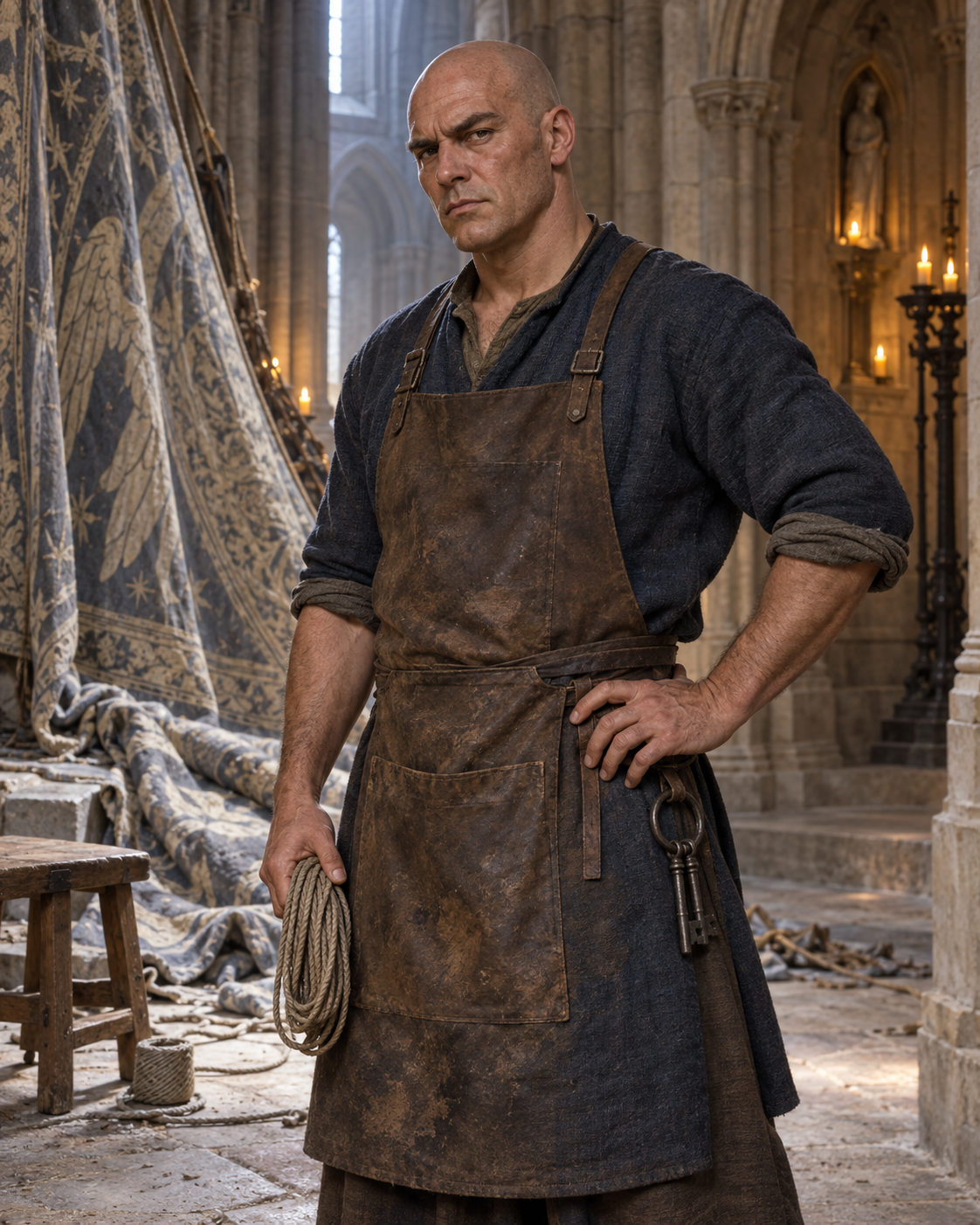
The approved identity presents Barnabas at about thirty-eight: tall, solidly work-built, completely shaven-headed, clean-shaven, with a strong square face, pronounced dark brows, keen hazel eyes, and weathered warm-fair skin. His exact age, face, height, build, eye color, clothes, apron, keys, repair cord, tapestry arrangement, chapel architecture, and light are editorial reconstruction. This exact identity now governs chapel, tower-route, damaged-tapestry, directory, hero, social, and contextual imagery. He must never acquire invented priestly vestments or become a generic monk.