
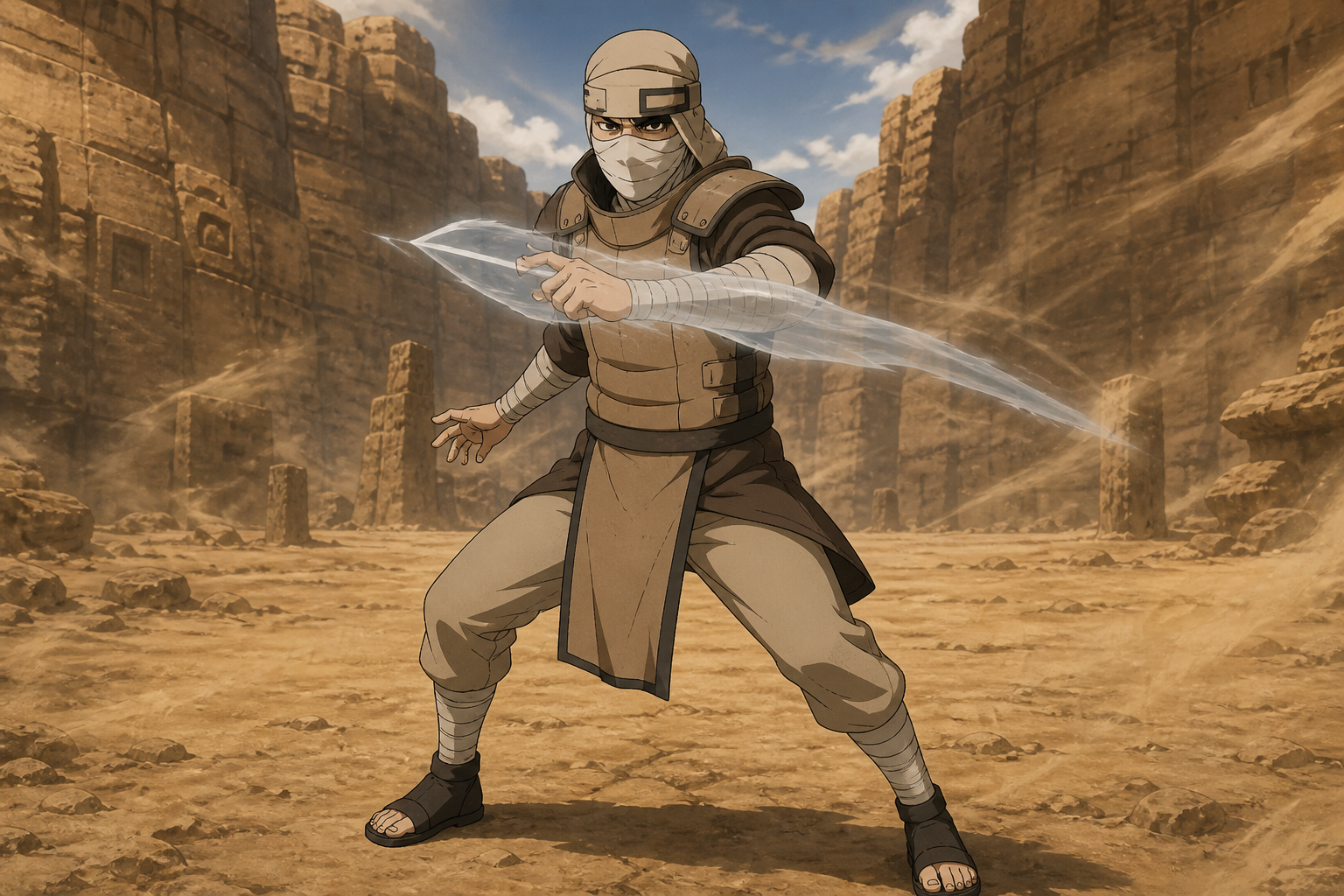
Baki
Baki obeys Sunagakure’s invasion, kills Hayate to protect it, then helps rebuild the alliance after Orochimaru’s deception collapses.
Bottom line: Baki obeys the invasion and inherits the bill
Baki’s arc is the uncomfortable passage from executing an invasion competently to helping repair the alliance it violated,without the story granting him a full public accounting for the people his obedience killed.
He is important because institutions are not carried only by famous leaders. Orders become real through professionals who train children, manage secrecy and decide when mission duty outranks moral doubt.
The essential file
- Japanese name: バキ, Baki
- Birthday: July 4
- Blood type: A
- Age: 30 in Part I; 34 in Part II
- Height: 188.2 cm
- Weight: 80 kg
- Registration number: 38-212
- Village: Sunagakure
- Rank: jōnin; later a member of Suna’s advisory council
- Academy graduation: Age 8
- Chūnin promotion: Age 12
- Students: Temari, Kankurō and Gaara
- Primary discipline: Wind Release and close-range chakra blades
- Major operation: Konoha Crush
- Japanese voice: Jōji Nakata
- Signature technique: Blade of Wind
- Core conflict: professional loyalty after the government’s strategic premise proves fraudulent
Baki receives one published numerical databook sheet rather than the three-stage progression available for larger characters. It totals 29.5 points: ninjutsu 4, taijutsu 3.5, genjutsu 3.5, intelligence 3.5, strength 4, speed 4.5, stamina 2.5, and hand seals 4.
The shape fits his only decisive manga fight. Speed is the high mark because Hayate cannot escape after overhearing the invasion plan. Ninjutsu, strength, and hand seals support a compressed Wind Release blade that kills through precision instead of spectacle. Stamina is the low mark, and the story never supplies a prolonged battle that would justify pretending otherwise.
No official mission-count breakdown is included in Baki’s published character record. That absence matters. It is more honest to leave the count unknown than import an unsourced total from a repost and dress it as a databook receipt.
The jōnin assigned to the Kazekage’s children
Baki leads Temari, Kankurō and Gaara during the Chūnin Exams. This is not an ordinary genin cell. All three are the Fourth Kazekage’s children, and Gaara is Sunagakure’s unstable jinchūriki weapon.
Baki’s teaching role is inseparable from political supervision. He must prepare talented children for combat while monitoring a teammate whose loss of control could compromise both tournament and invasion.
The assignment demonstrates trust from the Kazekage and complicity in the system harming the siblings. A good officer can still be a mechanism inside a destructive policy.
Why Sunagakure agrees to invade
The Wind daimyō has shifted missions toward Konoha, weakening Sunagakure’s economy and military relevance. Orochimaru exploits that grievance while impersonating or replacing the Fourth Kazekage.
Baki operates inside information shaped by leaders above him. The plan promises strategic recovery through betrayal of an ally. Economic pressure does not excuse invasion, but it explains why the promise finds institutional listeners.
The Chūnin Exams become cover for mobilization. Children display power in an allied capital while adults prepare to convert the tournament into war.
Hayate Gekkō: the murder beneath the tournament
Hayate overhears Baki meeting Kabuto and discussing the invasion. Baki intercepts him and uses Blade of Wind to kill him.
The scene establishes Baki as more than a supervising teacher. He is willing and able to eliminate a Konoha jōnin-level operative to preserve the mission.
Hayate’s death has personal consequences for Yūgao Uzuki and strategic consequences for Konoha. Yet Baki never receives a later confrontation with that grief. Diplomatic repair proceeds without the narrative forcing killer and bereaved survivor into the same moral frame.
Blade of Wind and combat method
Compressed edge
Baki shapes Wind Release into a nearly invisible cutting blade extending from hand or forearm.
Close-range surprise
The technique looks like unarmed movement until the air itself cuts, punishing opponents who read only visible weapons.
Wind affinity
Sunagakure’s open desert and fan traditions make wind a culturally coherent element, but Baki condenses it rather than spreading it across Temari’s scale.
Precision
Hayate is killed in a brief exchange, suggesting speed and exact placement rather than prolonged spectacle.
Secrecy
An almost invisible edge suits covert elimination and reinforces Baki’s role as the adult managing what the public tournament must not see.
Limits
The series provides few extended fights, so range, stamina and counters cannot responsibly be inflated beyond demonstrated use.
Konoha Crush and the collapse of the premise
The invasion begins during the finals. Gaara’s transformation becomes a central weapon, Sound and Sand forces attack, and Orochimaru isolates Hiruzen Sarutobi.
Sunagakure later discovers its Kazekage was murdered and the alliance was manipulated. Baki and other Sand leaders must confront that they committed real violence based on a false command structure.
Manipulation distributes responsibility without erasing it. Orochimaru designed the deception; Sunagakure’s insecurity made it usable; officers including Baki turned it into action.
Repairing alliance after participating in betrayal
Sunagakure apologizes and renews its alliance with Konoha. Sand shinobi later rescue the Sasuke retrieval team, and cooperation deepens across subsequent crises.
Baki remains a trusted village figure and supports Gaara’s rise. The continued career suggests institutional rehabilitation, but the story largely skips process: investigation, accountability, reparations and the perspectives of Konoha families harmed by the attack.
Peace may require working with former enemies. It becomes fragile when reconciliation asks victims to disappear for administrative convenience.
Gaara’s Kazekage future
Gaara changes after fighting Naruto and eventually becomes Fifth Kazekage. Baki moves from supervising a feared state weapon to serving under a young leader committed to protecting the village through relationship.
The reversal matters. The student once managed as dangerous infrastructure becomes Baki’s political superior and a principal architect of international alliance.
Baki’s support can be read as adaptability, loyalty to Sunagakure and recognition that Rasa’s methods failed. The story leaves much of his internal reckoning unstated.
Kazekage Rescue and war-era service
When Akatsuki abducts Gaara, Baki participates in Sunagakure’s response and the village’s coordination with Konoha. The crisis tests whether the repaired alliance can function under real cost.
During the Fourth Shinobi World War, Sunagakure joins the Allied Shinobi Forces. Baki’s generation enters a coalition designed to end cycles of village rivalry that once made the Konoha invasion thinkable.
He does not receive a major spotlight battle, but strategic continuity depends on experienced officers carrying new policy into actual formations.
Relationship atlas
Gaara
Student, jinchūriki responsibility and later Kazekage. Their hierarchy reverses as Gaara builds a model of leadership beyond Rasa’s weapon policy.
Temari
Student whose political awareness and Wind Release eventually serve diplomacy rather than invasion.
Kankurō
Student and puppeteer whose practical loyalty becomes essential to Gaara’s government.
Rasa
Kazekage and commander whose policies place Baki in charge of weaponized children and an invasion founded on compromised authority.
Hayate Gekkō
Konoha examiner killed to protect the invasion secret. His absence is the clearest human cost attached directly to Baki’s hand.
Orochimaru
Architect of the deception who exploits Sunagakure’s grievances and uses professional obedience as delivery system.
Design, voice and meaning
Baki’s head covering and extensive face wrapping leave one eye especially prominent, making vigilance part of the silhouette. His layered desert clothing communicates protection from climate as well as combat.
Jōji Nakata performs Baki in the original Japanese anime. The role’s clearest contexts include tournament observation, the private invasion briefing, Hayate’s killing, the Konoha Crush collapse, and later Suna council duty. Those are verified story contexts, not permission to invent vocal texture.
What the hidden world is really saying
Baki reveals the distance between institutional reconciliation and personal accountability. Villages can sign a new alliance faster than individuals can grieve the people professionals killed under the old policy.
Common misunderstandings
“Baki was just tricked, so he is innocent.”
Deception explains the command environment. He still kills Hayate and helps operationalize invasion. Responsibility can be shared without becoming zero.
“He is only the Sand Siblings’ handler.”
He is their jōnin mentor, an invasion operative, a Wind Release specialist and later an experienced figure in Gaara’s allied Sunagakure.
“Peace means the past no longer matters.”
Peace changes what actors do next. It does not restore Hayate or erase the ethical need to remember how policy became violence.
Essential viewing
- Chūnin Exams: Sand team leadership, invasion planning and Hayate’s discovery.
- Konoha Crush: execution of the plan and collapse of Sunagakure’s assumptions.
- Post-invasion alliance material: apology, repair and Gaara’s changing family.
- Kazekage Rescue: Sunagakure and Konoha cooperating under crisis.
- War-era material: the village Baki served as invader joining a multinational alliance.
Sunagakure’s economic pressure is context, not an innocence coupon
The invasion begins inside a real political grievance. The Land of Wind’s daimyō cuts military spending and sends work toward Konoha, weakening Sunagakure’s mission economy. A hidden village that trains shinobi as state labor cannot survive on pride while contracts disappear.
That pressure explains why Rasa’s government becomes vulnerable to a plan promising strategic reversal. Explanation still does not erase choice. Baki participates in an operation that places children inside espionage, releases Gaara as a weapon, and targets civilians and shinobi who did not create Suna’s budget crisis.
Economic desperation can make dangerous policy feel reasonable inside the briefing room. Professionals like Baki are the people who turn that reason into schedules, routes, student instructions, and bodies on the ground.
The arc refuses the comforting idea that war begins because every participant loves evil. War can grow from shrinking contracts, status fear, manipulated intelligence, and officers who decide obedience is safer than doubt.
Hayate Gekkō is not collateral inside Baki’s biography
Hayate overhears Baki and Kabuto discussing the invasion. Baki kills him to protect the operation. The act is direct, deliberate, and professionally competent. No amount of later alliance work should blur the victim into a footnote.
Hayate is a Konoha examiner and shinobi doing exactly what intelligence duty requires: he investigates suspicious activity and tries to carry warning back to the village. Baki treats that discovery as a security breach to close.
The murder reveals the point at which loyalty becomes personal guilt. Baki does not merely stand near a bad policy. He decides that preserving the plan is worth another man’s life.
Naruto gives many killers later usefulness without staging a courtroom for every death. A complete profile can acknowledge Baki’s later service and still keep Hayate’s name attached to the cost. Reconciliation between villages does not privately reconcile the dead.
Blade of Wind: invisible reach, visible discipline, honest limits
Baki’s signature Wind Release technique forms a concentrated blade capable of cutting at close range. The technique suits an officer who values speed, concealment, and decisive force. An opponent can see the motion and still misread the actual cutting edge.
The attack that kills Hayate establishes lethality. That does not make Baki the strongest Wind Release user in the franchise. Temari develops broader battlefield control, Naruto later changes the scale of wind-nature combat, and other specialists bring different methods.
Baki’s ability shelf should remain proportionate: jōnin fundamentals, tactical awareness, infiltration discipline, command experience, and a dangerous close-range wind blade. Anime and games may expand movement or named attacks. Those additions need medium labels.
Power ranking often treats a small number of fights as missing evidence rather than a writing choice. Baki’s narrative function is operational. His strongest skill may be making state violence look like a manageable assignment until the plan collapses.
Mentoring Gaara means supervising a child the state weaponized
Gaara is Rasa’s son and Sunagakure’s jinchūriki. Baki leads a team whose most dangerous member has been isolated, tested, and taught to interpret violence as proof of existence. This is not ordinary classroom management.
Baki monitors Gaara’s stability because the invasion depends on controlled catastrophe. The arrangement exposes a contradiction: adults fear Gaara’s loss of control while relying on the power produced by the abuse that destabilizes him.
Temari and Kankurō learn to watch their brother’s moods as a survival skill. Baki operates above them in the same chain. He can recognize risk and still participate in sending the siblings into the plan.
When Gaara later becomes Kazekage, Baki’s continued loyalty requires a new relationship to the former weapon. The student becomes the leader. That transition is one of Suna’s quiet political revolutions.
Temari and Kankurō are operatives, students, and children at once
Baki respects the Sand Siblings’ competence, but competence does not remove childhood. The Chūnin Exams let villages display young talent, gather intelligence, and conduct policy through bodies small enough for adults to call promising.
Temari reads danger quickly and often becomes the most practical sibling in the room. Kankurō carries puppet expertise and anxiety about Gaara. Baki’s assignment requires him to direct their skills while preserving the invasion’s secrecy.
A teacher’s duty should include protection and moral instruction. A military officer’s duty may demand mission success. Baki embodies the collision because he occupies both roles without the story giving him a clean private monologue about the conflict.
The later alliance allows the siblings to build identities beyond the failed invasion. Baki’s legacy has to include what he taught well and what he normalized by obeying.
Konoha Crush collapses the story Baki was ordered to believe
The attack fails. Hiruzen dies fighting Orochimaru, Gaara is defeated and changed by Naruto, and Suna learns that Rasa was murdered before the operation. The strategic premise falls apart after the costs are already irreversible.
Baki survives into the aftermath. Survival gives him a job the dead cannot perform: helping the village understand what happened and supporting a repaired relationship with Konoha.
The collapse also changes Gaara’s political trajectory. Naruto reaches the child inside the weapon label, and Gaara begins rebuilding his relationship with Temari, Kankurō, and the village. Baki has to serve a future produced partly by the failure of the policy he enforced.
That is more interesting than a sudden saint conversion. Institutions usually change through people who remain after a bad order and decide whether to preserve the excuse or learn from the evidence.
Alliance repair is labor, not amnesia
Sunagakure and Konohagakure rebuild cooperation after exposing Orochimaru’s manipulation. The alliance later becomes essential during the Kazekage Rescue mission and the Fourth Shinobi World War.
Baki’s presence in Suna’s continuing military structure suggests retained trust and competence. The story does not provide a detailed public accountability process for Hayate’s death or the invasion. Silence cannot be converted into proof that every person forgave him.
Political reconciliation often works before emotional reconciliation. Villages exchange intelligence, coordinate missions, and face larger threats because survival requires cooperation. Families of the dead can still carry a different ledger.
Baki’s biography lives in that gap. He helps support the alliance that replaces the invasion, but later usefulness does not refund the earlier cost.
Gaara’s Kazekage era changes what loyalty should mean
Gaara becomes Fifth Kazekage and leads Sunagakure through a different political vision. Authority no longer rests only on weaponizing fear. The former jinchūriki seeks recognition through service and protects the village that once treated him as equipment.
For Baki, loyalty to Gaara cannot mean repeating loyalty to Rasa’s worst decisions. Real service requires responding to the leader’s goals, the village’s people, and the evidence left by failure.
The relationship also reverses the adult-child hierarchy. Baki once supervised Gaara as a dangerous student. Adult Gaara becomes the commander whose moral development exceeds many of the adults who managed him.
A professional officer can experience that reversal as humiliation or as instruction. Baki’s later cooperation supports the second reading, even if canon gives him limited interior narration.
War service and the limits of the available record
The Fourth Shinobi World War brings Suna and Konoha into the same Allied Shinobi Forces. Baki belongs to the generation whose earlier cross-village violence becomes evidence for why coordination matters.
His war-era appearances confirm continued service, but the profile should not invent command titles, decisive battles, or private speeches absent from the licensed record. Limited panel time is not permission to write a résumé through vibes.
The war gives his generation another loyalty test under a shared command. Service matters, but later cooperation does not erase earlier harm.
A Buddhist reading emphasizes causes and consequences. Economic pressure, Rasa’s policy, Orochimaru’s deception, Gaara’s abuse, and Baki’s obedience form a chain. No single cause erases the others.
Later alliance work can create better consequences without cleansing the earlier act. Karma is not a scoreboard where one war contribution cancels one murder. Actions continue through institutions and relationships.
Jōji Nakata, adaptation, and media boundaries
Jōji Nakata is Baki’s original Japanese performer. His credit is verified. I am not inventing vocal weight, pauses, breath, or command-tone analysis without the heard Japanese scenes. A strong casting name is still not a substitute for listening.
The manga controls Baki’s central record: leadership of the Sand Siblings, the invasion conspiracy, Hayate’s death, Konoha Crush, exposure of Orochimaru’s fraud, and later Suna service. The anime expands reactions, connective missions, and the amount of time viewers spend with the village’s senior officers. Each expansion needs a medium label.
Naruto Shippūden the Movie: The Will of Fire uses Baki as part of Sunagakure’s response during the inter-village crisis. His role is supporting roster work, not a new personal arc. The OVA Finally a Clash! Jōnin vs. Genin!! Indiscriminate Grand Melee Tournament Meeting!! also includes him inside its game-like tournament premise.
Gaara Hiden: A Sandstorm Mirage gives Baki more meaningful political labor. He replaces Kankurō on security for Gaara’s meeting with Hakuto, recognizes that the reassignment is suspicious, and helps protect the event when missing-nin attack. That novel material belongs to the Blank Period shelf, not retroactive Chūnin Exam biography.
Baki debuts in games through Naruto: Ultimate Ninja and appears across later franchise rosters. Games preserve Blade of Wind, Suna allegiance, and the invasion setting, but playable techniques and altered matchups belong to game continuity unless manga or anime supplies the same receipt.
Design: a covered face for a man who works through controlled information
Baki’s design is spare and immediately readable as Sunagakure. He wears the village forehead protector, practical shinobi clothing, and a cloth covering across much of the face. One eye and the upper expression carry more of the acting because the lower face remains obscured.
The covering does not prove a secret clan, medical condition, or hidden identity. Naruto uses masks, wraps, hoods, and partial concealment throughout its military designs. A visual cue can communicate environment and profession without becoming an unsolved genealogy puzzle.
His muted palette also separates him from the Sand Siblings. Temari’s fan, Kankurō’s face paint and puppets, and Gaara’s gourd announce specialized identities. Baki looks like the officer assigned to manage the operation around them.
The design fits his narrative position. He holds information, protects a plan, and reveals little interior life. The face covering becomes a visual rhyme with institutional secrecy without requiring the cloth itself to carry magical symbolism.
Personality: restraint becomes dangerous when the plan is wrong
Baki is observant, controlled, and loyal to Sunagakure. Those qualities make him useful as a mentor and field officer. They also make him effective inside a disastrous invasion.
Naruto often assigns obvious instability to villains and visible passion to heroes. Baki complicates that split. He can kill calmly, follow procedure, and assess students without performing cruelty as entertainment.
Professional restraint is morally neutral until attached to a purpose. The same calm that helps protect a team can prevent doubt from interrupting an unlawful mission.
His later service suggests adaptability. He does not disappear when the operation is exposed. He remains inside the village as Gaara changes its direction. That persistence can be read as loyalty becoming more mature, but canon does not provide a confession detailed enough to manufacture complete repentance.
Kabuto and Orochimaru use Baki’s loyalty as operational cover
Baki’s conspiracy contact with Kabuto places him close to Orochimaru’s network without making him one of Orochimaru’s disciples. He believes he is coordinating an alliance operation. Kabuto carries another agenda inside the same conversation.
The encounter shows how layered deception works. Baki protects Suna’s plan from Konoha. Kabuto serves Orochimaru while wearing Konoha affiliation. Orochimaru directs the whole operation while wearing Rasa’s face.
Every participant controls a different secret, and no subordinate possesses the whole map. That structure allows intelligent professionals to make locally rational decisions inside a globally fraudulent operation.
Baki remains responsible for what he knows: the invasion and the need to silence Hayate. He is not responsible for facts Orochimaru deliberately withholds, including Rasa’s murder. Accountability improves when the profile separates knowledge levels instead of declaring everyone equally guilty or magically innocent.
Hayate’s relationships remain outside Baki’s redemption arc
Hayate’s death does not exist only to demonstrate Blade of Wind. He belongs to Konoha, works with other exam personnel, and leaves grief behind. The wider story connects his loss most visibly to Yūgao Uzuki, especially through anime-expanded war material.
Baki does not receive the right to define how those people interpret his later alliance work. Political peace may require cooperation without demanding that victims’ loved ones narrate the killer as redeemed.
The anime’s use of Hayate in the war emphasizes unfinished attachment and duty. That material belongs to Hayate and Yūgao’s record. It should not be distorted into an invented confrontation or forgiveness scene with Baki.
Keeping relationship boundaries honest prevents a common fandom shortcut: if two villages become allies, every private injury must have resolved off screen. Diplomacy can end official hostility while grief keeps its own calendar.
Fandom misreadings Baki does not need
“Baki was only following orders.” Orders explain the chain. They do not remove the decision to kill Hayate.
“Orochimaru tricked Suna, so Baki did nothing wrong.” He lacked the full truth and still knew he was protecting an invasion.
“He trained Gaara, so he caused every part of Gaara’s trauma.” Rasa’s policy, Yashamaru’s coerced role, village fear, and jinchūriki exploitation carry distinct responsibility. Baki participates in the military system without owning every cause.
“Blade of Wind makes him secretly Kage level.” Lethality in one encounter does not create an invisible tournament résumé.
“The alliance proves Konoha forgave him.” State cooperation is not evidence for every individual’s private judgment.
“Limited screen time means there is nothing to analyze.” Baki connects mission economics, manipulated command, child soldiers, assassination, and reconciliation. The page count is small. The institutional footprint is not.
The mission economy turns reputation into food, weapons, and political leverage
Hidden villages sell organized violence as contracted service. Mission assignments fund personnel, training, intelligence, equipment, and the status that attracts future work. When the Land of Wind’s daimyō redirects contracts, Sunagakure does not experience an abstract insult. The village loses revenue and strategic relevance.
That system rewards reputation and creates a dangerous feedback loop. Fewer missions weaken the village. Weakness makes clients send even more work elsewhere. Leadership can respond by reforming institutions, reducing military dependence, negotiating with the daimyō, or trying to damage the competitor.
The Konoha Crush chooses the last route under fraudulent leadership. Baki becomes the professional layer that translates economic anxiety into covert coordination. His biography proves why mission economics belongs in character analysis. A budget decision eventually reaches Hayate’s body.
The later alliance offers a different answer. Shared threats and coordinated missions can turn competition into interdependence, though the villages remain military institutions. Gaara’s diplomacy matters because he tries to build security without treating Konoha’s destruction as Suna’s business plan.
Baki lives across both models. He serves the village that attacks a competitor and the village that later fights beside it. That continuity makes him a useful witness to how policy changes while institutions keep many of the same people.
Source shelf and canon boundary
This profile synthesizes the Naruto manga and television adaptations across the Chūnin Exams, Konoha Crush, Kazekage Rescue and Fourth Shinobi World War. Anime-expanded political and mission scenes are treated as anime continuity where they extend beyond the manga. Official franchise reference routes include the Naruto anime archive, the Shippuden archive and the Boruto archive.