
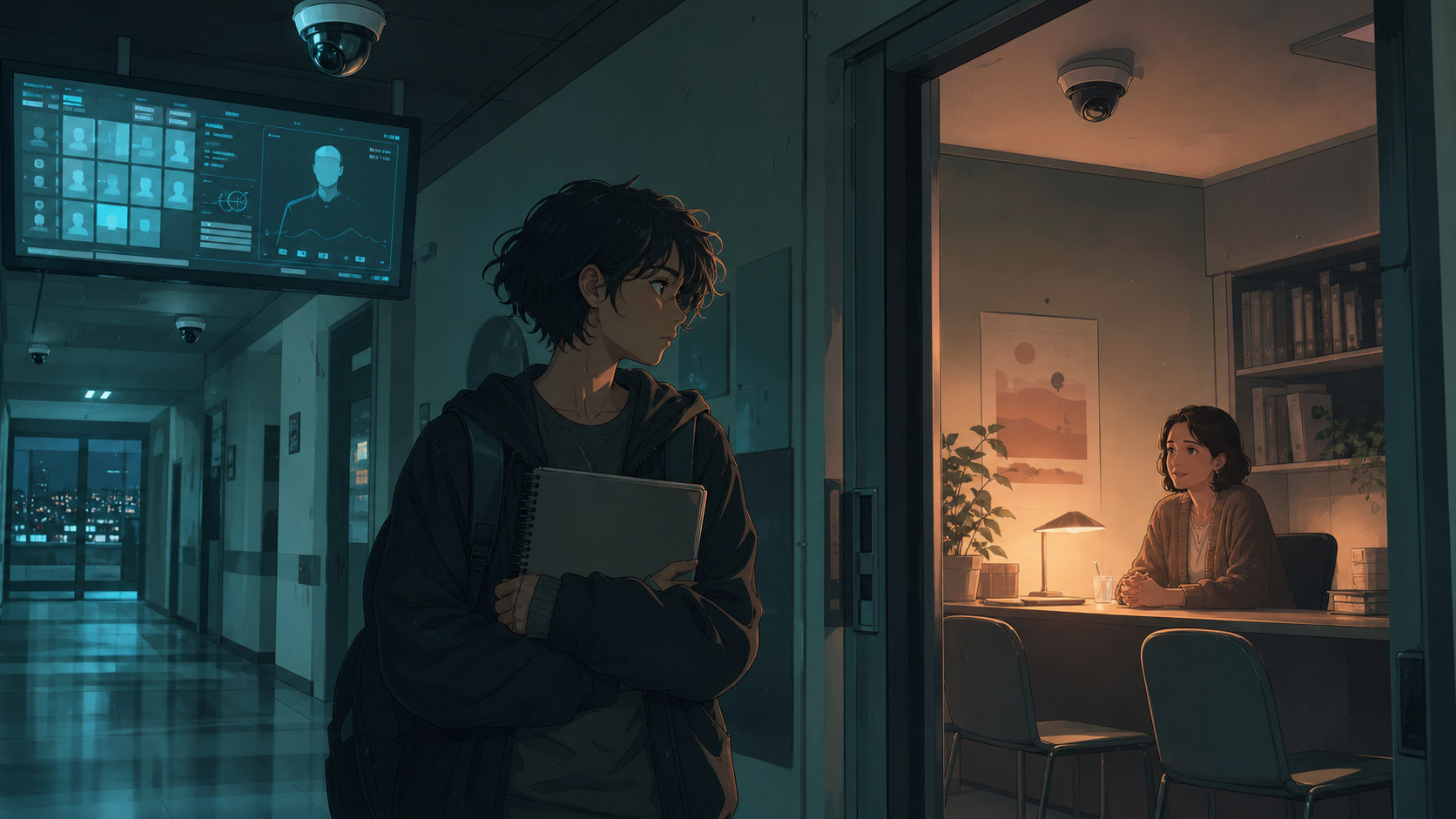
RaeRae Rants · Anime Surveillance and Institutional Trust File
Surveillance Is Not Care Just Because an Adult Says “For Your Safety”
Anime institutions monitor children, predict crimes, track bodies, and record private lives. Then those institutions call constant observation protection while refusing the harder work of earning trust.
The camera that calls itself a guardian
An anime school places sensors in every hallway. A military command tracks every pilot. A police system reads faces, voices, stress, and movement. An anxious parent installs a device without telling the child. Each authority gives the same explanation: danger exists, therefore observation equals care. Danger does exist. Students face violence. pilots carry weapons, heroes attract villains, and police investigate people who can destroy cities. A serious argument should not pretend that every camera represents tyranny or that privacy requires leaders to ignore credible threats.
The problem begins when observation becomes the whole safety plan. Institutions collect information without providing enough adults to respond. Algorithms produce warnings without creating treatment. Teachers receive dashboards while students receive suspicion. Commanders measure stress while continuing the mission that caused the stress. Surveillance feels active. A glowing screen shows movement, alerts, and colored risk scores. Care often looks slower and less cinematic. Care means hiring counselors, reducing class sizes, answering questions, arranging transportation, protecting sleep, investigating abuse, and accepting that trust takes time.
When the system fails, stored footage can clarify events. The same archive can also become evidence against the person who needed help. A panic response becomes misconduct. A private conversation becomes disloyalty. A visit to a clinic becomes a risk marker. Information gathered under the language of protection can quietly migrate toward discipline.
What care actually requires
Care begins with a duty toward another person rather than a desire to manage uncertainty. A caring institution explains what information gets collected, why collection remains necessary, who can see the record, how long storage lasts, and how a person can challenge an error. Care also changes conditions. If monitoring reveals exhaustion, hunger, harassment, or fear, somebody must respond with resources. Observation without remedy converts suffering into data. Consent needs a real alternative. A student cannot freely agree when refusal means expulsion. A hero trainee cannot meaningfully decline when refusal ends a career. A child living under adult authority may say yes because disagreement feels unsafe.
Institutions should therefore limit collection even after obtaining formal consent. A signed form cannot transform unnecessary intrusion into ethical practice. Privacy supports honesty. People disclose fear when disclosure does not automatically trigger punishment. Confidential counseling, protected medical care, and private communication allow early help. Total monitoring can produce cleaner behavior in public and deeper concealment in private. Students learn which words trigger alerts. Workers perform calmness. Families move difficult conversations beyond official spaces. The institution receives less truth while collecting more information. Human review must carry responsibility. An algorithm can identify a pattern. A responsible adult must examine context, explain the decision, and accept accountability. Leaders should not hide behind a score when consequences affect freedom, education, medical treatment, or family relationships.
Anime case files
Psycho-Pass turns emotional distress into a policing category. The Sibyl System measures mental states and predicts criminal potential through the Crime Coefficient. Public safety becomes inseparable from continuous assessment. Citizens learn that a worsening psychological state may bring treatment, detention, or lethal force depending on the number and the officer holding a Dominator. The series understands a central danger of predictive governance: measurement does not merely describe society. Measurement organizes society around the metric. People fear becoming legible as dangerous. Stress about the score can worsen the score. A system presented as neutral creates the emotional environment that confirms official suspicion.
Sibyl also hides political judgment behind technical authority. The scanner appears objective, yet somebody designed categories, thresholds, exceptions, and enforcement. When leaders call a value scientific, public debate becomes harder even though moral choices remain inside the machinery. Death Note shows how surveillance can be both justified and corrosive. L faces a mass murderer with supernatural means. Surveillance of Light Yagami has a credible investigative purpose. The case gives viewers an uncomfortable reason to tolerate intrusion because the suspected conduct remains catastrophic.
Credible suspicion does not erase ethical questions. Cameras enter private family space. Relatives become collateral subjects. Investigators operate through secrecy with limited external review. Light then exploits the same surveillance logic, performing innocence for observers and turning observation into part of his strategy. The contest becomes a warning about institutional certainty. L may be right about Light while remaining unable to prove every step lawfully. Being correct about a suspect does not make every method harmless.
My Hero Academia treats visibility as both rescue and branding. Hero society depends on public observation. Rankings, broadcasts, school festivals, sports events, and news coverage help citizens understand who provides protection. Visibility can build accountability and hope. The same system trains young people to perform identity under constant judgment. Students develop marketable names, costumes, and public personas before they fully understand adulthood. A mistake can become national entertainment. Private trauma becomes part of a hero narrative that agencies, schools, and media can use.
U.A. increases security after attacks for understandable reasons. Physical protection remains necessary. The harder question concerns whether guarded dormitories and tracking measures arrive alongside emotional support, family transparency, and meaningful student participation. Naruto gives villages intelligence networks without enough social care. Hidden villages monitor borders, bloodlines, missions, sealed powers, and political threats. Sensory units and intelligence divisions respond to genuine military danger. Children also grow inside systems that know enormous amounts about their abilities while ignoring obvious loneliness, grief, and family instability.
Konoha can track a dangerous chakra signature more reliably than Konoha can ensure that an orphan eats with somebody. That imbalance captures the entire rant. Technical awareness becomes highly developed because technical awareness protects state capacity. Ordinary care remains fragmented because no department receives glory for showing up every Tuesday. Attack on Titan makes information control part of the wall. The government protects social order by restricting history, policing inquiry, and managing public knowledge. Physical walls and informational walls serve the same political function. Citizens cannot evaluate danger because leaders control the facts required for judgment. Surveillance and secrecy reinforce one another. Authorities watch people who seek truth, then cite the investigation as evidence that questioning threatens stability. The public receives safety as a command rather than a relationship.
Prediction changes the person being predicted
Risk models often use previous behavior to forecast future harm. Previous behavior already reflects unequal policing, unequal access to care, and unequal chances to recover from mistakes. Feeding those records back into prediction can make past bias look like future certainty. Anime makes that loop visible by giving forecasts dramatic power. A child labeled dangerous receives isolation and harsher control. Isolation produces fear, anger, or desperation. Authorities then treat the reaction as proof that the label was accurate.
A prediction may support additional care without justifying punishment for conduct that never occurred. The distinction matters. Offering voluntary counseling after a warning differs from removing freedom because a system expects future wrongdoing. Authorities should measure false positives as seriously as missed threats. A safety program that catches one danger while wrongly marking thousands of people can create broad harm hidden behind a successful headline.
Data collected for rescue rarely stays inside the rescue box
Institutions often introduce monitoring after a frightening event. A villain enters a campus. A pilot disappears. A weapon gets stolen. Leaders promise that new cameras, biometric checks, or location records will prevent another crisis. The proposal gains support because every critic must speak while the recent loss remains vivid. The original purpose may be narrow and sincere. Expansion usually arrives through ordinary administrative requests rather than a dramatic coup. A discipline office wants access to attendance patterns. A sponsor wants performance statistics. A police unit wants location history. A researcher wants emotional data. Each request sounds efficient because the information already exists.
Purpose limitation matters because people make choices based on the reason given at collection. A student may share a panic episode with a counselor to receive help. The same student might remain silent if the record could reach an instructor deciding mission eligibility. Changing the use after collection changes the original agreement. Anime frequently skips that quiet migration. A database appears as one giant state machine, already connected to every camera and record. Real systems often become giant through smaller decisions made by committees, contractors, and departments. That slower path deserves narrative attention because nobody feels personally responsible for the final network.
Retention turns a difficult afternoon into a permanent identity. A teenager can have a terrible month. Grief, conflict, illness, or fear can produce behavior that says little about the adult who later emerges. Permanent records freeze temporary struggle and invite future decision-makers to interpret old data without context. Deletion schedules should reflect the original purpose. Emergency location data may need days, not decades. Counseling records need strict protection. Security footage should not become an informal biography available to every future employer or commander.
Anime worlds with inherited powers make retention especially tempting. Authorities may claim that bloodline data or ability measurements protect future generations. Long-term value does not justify unlimited access. Genetic and family information can expose relatives who never agreed to collection. Contractors create another layer of distance. Schools and agencies may buy systems from private companies. The institution sees a dashboard rather than the full collection pipeline. Vendors may process images, voices, or behavior through proprietary models that teachers cannot explain.
Accountability becomes slippery. The school blames the vendor. The vendor cites the contract. The algorithm becomes a sealed witness whose testimony shapes a life while nobody can cross-examine the reasoning. Public institutions should retain enough technical knowledge to evaluate systems independently. A purchase agreement cannot transfer the moral duty owed to students and citizens.
Different anime genres keep reaching the same control room
Cyberpunk makes surveillance obvious. Cameras cover the city, identity scans open doors, and police receive risk scores before meeting a suspect. The machinery becomes part of the skyline. School anime can hide similar power beneath softer design. Attendance apps, dorm rules, ranking boards, televised competitions, and instructor observation create a detailed record of young people. Bright uniforms and friendly mascots do not remove the power imbalance. Mecha stories place children inside machines that measure pulse, synchronization, fear, pain, and obedience. Command staff may know a pilot’s body more intimately than the pilot understands the mission. The cockpit becomes a medical device, workplace, weapon, and interrogation room at once.
Magical-girl stories sometimes turn transformation into a monitored contract. A mascot or organization tracks battles, emotional energy, and compliance while withholding the full cost. The heroine receives extraordinary responsibility without an adult institution willing to share honest information. Sports anime uses data in less sinister ways. Video review, biometric training, and performance analysis can help athletes improve. Ethical tension appears when optimization treats the body as team property or when an injured player cannot refuse because the data says participation remains possible. Across genres, the question stays consistent: who controls the record, and can the person represented by the record say no?
Public visibility is not the same as public accountability
A society can watch heroes work and still know very little about the institutions behind them. Broadcasts show rescues, battles, rankings, and ceremonies. Cameras rarely show contract negotiations, disciplinary meetings, medical decisions, or the quiet removal of someone who no longer fits the public story. Visibility can create the illusion that a system remains accountable because citizens see so much. Public relations teams choose angles, timing, and language. A livestream may offer more images while providing fewer explanations.
Accountability requires records that answer questions rather than footage that generates attention. How many complaints were filed? Who investigated them? Which standards applied? What remedies followed? Did leaders disclose conflicts of interest? A dramatic camera feed cannot substitute for those answers. Hero rankings illustrate the difference. A rank compresses many judgments into one number. Popularity, rescue results, combat strength, public approval, and institutional preference may all contribute. Viewers can see the number while remaining unable to examine the weighting. Numbers feel transparent because comparison becomes easy. True transparency reveals how the number was produced and allows correction when the number misleads.
Why characters sabotage the system watching them
Anime characters cover cameras, falsify readings, trade uniforms, hide injuries, and communicate through unofficial channels. Authorities read every act as proof that subjects cannot be trusted. Some concealment supports genuine wrongdoing. A fair system must investigate credible evidence. Other concealment protects dignity or creates the only available path to honest conversation. A student may hide distress because disclosure triggers punishment. A worker may leave a tracker behind because every private movement becomes subject to review.
Resistance should prompt a design question. What benefit does evasion provide? If people lose access to friends, treatment, rest, or political speech when fully visible, surveillance creates incentives for deception. Trustworthy programs make cooperation safer than evasion. They limit consequences, separate support from discipline, correct errors, and protect people who report institutional abuse. Authorities often demand transparency downward while preserving secrecy upward. Students must reveal location and emotion. Leaders keep strategy, mistakes, and disciplinary records classified. That unequal exchange teaches young people that transparency functions as rank, not principle. A system asking for honest data should model honest governance.
Family tracking can become coercive control with a cute app icon
Parents have legitimate reasons to know where young children are. Development should bring greater independence. Tracking that never decreases can prevent adolescents from learning judgment, managing risk, and seeking confidential help. Anime families often carry unusual danger. A child may belong to a targeted clan, inherit a power, or attract enemies. Those facts can justify stronger safety measures without granting adults unlimited access to every conversation and movement. Healthy family monitoring includes discussion, boundaries, and review. Everyone should know which situations trigger location sharing and when the requirement will change. Secret surveillance damages trust even when adults discover no wrongdoing.
Coercive relatives can use safety language to isolate a child from friends, inspect messages, restrict travel, or punish disagreement. Institutions should not automatically provide family access when evidence suggests abuse or control. Confidential medical and counseling services become essential during adolescence. A young person who cannot ask a question without generating a family alert may avoid care entirely. Protection should help children practice freedom safely. Protection that makes freedom impossible produces dependence rather than readiness.
Hero work turns bodily data into workplace power
Professional heroes, pilots, soldiers, and magical fighters occupy workplaces built around physical risk. Employers need information about injury, readiness, and equipment. Workers still retain privacy and bodily autonomy. Continuous biometric monitoring can reveal fatigue before disaster. The same data can pressure workers to perform through pain, deny benefits, or label natural stress as weakness. A number designed for safety becomes a productivity target. Young trainees face greater pressure because careers depend on approval. They may accept invasive testing, public evaluation, or experimental equipment without understanding long-term consequences.
Independent medical staff should prioritize the patient rather than team performance. Workers need access to records and the ability to seek another opinion. Refusing a mission for medical reasons should not automatically become evidence of disloyalty. Anime frequently celebrates the character who hides an injury and keeps fighting. That choice can express courage in an emergency. A workplace that regularly depends on concealed pain has failed to create safe staffing and honest incentives.
Anime inherited a long argument about watching modern life
Japanese animation did not invent public anxiety about surveillance. Modern states have long counted populations, documented households, monitored borders, and gathered intelligence. Industrial workplaces added clocks, supervisors, productivity measures, and medical examinations. Digital systems made collection faster, cheaper, and easier to connect. Postwar science fiction gave artists a flexible language for examining those changes. A fictional scanner could combine police power, medical authority, and corporate technology inside one machine. A networked city could turn ordinary movement into evidence. Cyborg bodies could make bodily privacy a political question rather than a private feeling.
Western viewers sometimes describe anime surveillance stories as prophetic because a fictional interface resembles a later product. The stronger achievement lies in political diagnosis. Many works understood that convenience and control can share infrastructure. A system can help someone navigate a city while making every journey searchable. A medical device can preserve life while giving employers intimate information. The cultural setting matters without reducing every Japanese work to one national explanation. Dense cities, disaster planning, school discipline, corporate hierarchy, policing, and family expectations can inform stories. Creators also draw from global cyberpunk, Cold War intelligence, Western philosophy, religious imagery, and imported technology debates.
No single Eastern attitude explains why fictional citizens tolerate monitoring. Characters accept systems for reasons familiar everywhere: fear, convenience, social pressure, career ambition, and the reasonable hope that somebody competent is paying attention. The most durable anime refuses the easy fantasy that removal of one villain solves the problem. Networks survive because ordinary people depend on services those networks provide. Reform therefore requires governance, alternatives, and public imagination, not merely one heroic act of sabotage.
Being watched changes behavior before anybody issues an order
People do not need direct punishment to respond to surveillance. The possibility of observation encourages self-monitoring. A student chooses safer words. A worker hides uncertainty. A citizen avoids a controversial meeting. The official may never open the record because anticipated scrutiny already shaped conduct. That effect can reduce harmful behavior in limited settings. Visible cameras may discourage theft. Presence records can help during an evacuation. Problems grow when people cannot identify where observation begins or ends. Uncertainty expands the zone of caution.
Anime visualizes that psychological pressure through lenses, red lights, scanner sounds, command-room displays, and characters glancing toward unseen observers. The audience often occupies the same position as the surveillance system. We see private rooms, memories, and bodies from angles no person inside the story controls. Good direction makes viewers uncomfortable with their own access. The image asks whether curiosity has become entitlement. Fan culture can repeat the tension when audiences demand private information from performers, voice actors, creators, or fictional characters treated as public property.
Young characters face a special burden because identity requires experimentation. Adolescents try opinions, styles, friendships, and ambitions that may not last. Constant recording can turn harmless experimentation into a permanent public statement. A society that records every mistake may produce adults skilled at appearing acceptable rather than adults capable of reflection and change.
Safety language can make disagreement sound irresponsible
“For your safety” closes debate by placing the speaker on the side of care and the critic on the side of danger. The phrase can describe sincere concern. The phrase can also avoid specifics. Responsible leaders should name the threat, evidence, scope, duration, and safeguards. Vague danger allows measures to expand without a measurable goal. Success becomes impossible to evaluate because leaders can always claim an unseen disaster was prevented. Anime councils love abstract nouns: order, peace, stability, destiny, unity. Those words turn individual harm into a small price paid for something grand. A monitored child appears selfish for wanting privacy when the village claims every intrusion protects civilization.
Language also sanitizes coercion. Detention becomes observation. Interrogation becomes assessment. A tracking implant becomes support equipment. A blacklist becomes a risk register. Clear description returns moral weight to administrative choices. Characters should ask direct questions. Can I remove the device? Who reads the data? What happens after an alert? Can I see the record? Does refusal change my grade, rank, or housing? What independent person hears an appeal? An institution that cannot answer those questions should stop calling the system voluntary.
More data can create confidence without creating safety
A large dashboard can make leaders feel informed. Thousands of measurements may still miss context. A system can record that a student entered a building without knowing whether the student felt safe. A scanner can measure heart rate without distinguishing fear, illness, excitement, or exercise. False confidence becomes dangerous when monitoring replaces professional judgment. Staff may ignore a person’s account because the dashboard shows normal values. Officers may escalate because a risk score appears objective. Leaders may underfund human services because technology promises scale.
Bad actors also adapt. Villains learn blind spots, steal credentials, spoof signals, or manipulate thresholds. Broad surveillance often catches ordinary people who follow predictable routines while sophisticated targets design behavior around detection. Security programs need red-team testing, independent audits, and clear measures of failure. Leaders should examine missed events and false alarms. Every false alarm consumes attention and can normalize unnecessary intervention. A program that produces constant alerts may train staff to dismiss warnings. A quieter system with clearer thresholds can protect people better than a dramatic wall of flashing red boxes.
The honest criticism: sometimes the camera really does save someone
A rant against institutional overreach can become lazy when every security measure appears evil. Missing children have been found through location data. Recorded evidence can support victims whose testimony powerful people dismiss. Body cameras and public footage can expose abuse. Medical monitoring can warn patients before a crisis. The ethical answer cannot be automatic rejection. The ethical answer requires design around rights, effectiveness, and remedy. Evidence should remain available to the person harmed, not only the institution controlling the device. Recording policies should prevent selective release that protects officials while exposing civilians. Medical alerts should connect to care rather than punishment. Location tools should include emergency limits and meaningful deletion.
Anime stories gain depth when surveillance produces mixed outcomes. A camera may save one character and endanger another. A database may reveal corruption while preserving records created through abuse. Characters must decide how to retain useful capacity without preserving unjust control. That conflict feels more honest than destroying the central computer and watching every social problem disappear before the ending theme.
How writers can make a surveillance plot smarter
First, show the policy rather than only the machine. Who approved deployment? Which crisis created support? What groups raised objections? Who profits? Which office receives complaints? Second, show ordinary use before spectacular abuse. A student changes a route. A parent checks a location too often. A teacher assumes a score reveals character. Small scenes explain how power becomes normal. Third, give the system genuine benefits. Readers should understand why reasonable people defend the program. Moral tension becomes stronger when reform risks losing something valuable.
Fourth, let errors have administrative consequences. A false match should require correction. A leaked record should lead to investigation, compensation, and changed access rules. Stories often treat exposure as embarrassing rather than materially harmful. Fifth, distinguish secrecy from privacy. Officials may need confidentiality during an investigation. Citizens need privacy from unnecessary official intrusion. Using one concept to cancel the other creates muddled politics. Finally, show life after reform. New oversight will frustrate some officers. Deletion rules will remove data somebody wants. Independent review will slow decisions. Democratic restraint has costs, and accepting those costs proves that rights matter beyond slogans.
Privacy is not a luxury reserved for innocent people
Surveillance debates often drift toward a familiar challenge: if someone has done nothing wrong, why fear observation? The question assumes privacy exists mainly to conceal wrongdoing. Privacy also protects development, intimacy, political thought, medical care, worship, grief, and the ordinary freedom to make a poor joke without creating a permanent state record. People can behave lawfully and still face harm from exposure. A medical condition can affect employment. A family connection can invite harassment. A political opinion can attract retaliation. A location pattern can reveal a shelter, clinic, religious community, or private relationship.
Anime protagonists often become suspects because of identity rather than conduct. A bloodline, power, birthplace, family name, or unusual body marks the character as risky. Monitoring then begins before any wrongdoing. The institution claims neutrality while treating existence as probable cause. Due process matters most when authorities feel certain. People need notice, reasons, access to relevant records, a chance to respond, and review by someone independent. Secret evidence should face strict limits because nobody can correct a claim nobody is allowed to see.
Children deserve additional safeguards. Adults may make temporary protective decisions, but those decisions should preserve future autonomy. Records should not follow a child forever merely because an agency once considered the family complicated. Privacy and safety can support one another. Confidential treatment encourages early care. Anonymous reporting reveals abuse. Protected organizing helps workers identify dangerous patterns. Secure communication allows families and advocates to challenge powerful institutions.
Five scenes that reveal the politics without giving a lecture
The silent glance toward a ceiling camera. A character begins an honest sentence, notices the lens, and changes the subject. Nobody threatens the speaker. The scene shows power through interruption. The camera has entered the conversation before any official listens. Directors can deepen the moment by keeping the lens ordinary rather than sinister. A familiar device makes self-censorship feel routine. The character may even smile before choosing safer words. The counselor who must choose between confidence and reporting. A student reveals fear of losing control. The counselor knows that an automatic report could remove the student from school or training. Silence could leave others at risk. The strongest version gives both choices real consequences.
The scene should clarify rules. Mandatory reporting can protect vulnerable people, but vague policies encourage overreporting and discourage help-seeking. A trained counselor should explain limits before disclosure rather than surprise the student afterward. The parent refreshing a location screen. The child remains safe. The parent cannot stop checking. Tracking promised relief but turned uncertainty into a repeated ritual. Every delay becomes suspicious because the app offers a stream of details without the emotional skill to interpret them.
A humane scene avoids turning the parent into a cartoon villain. Fear may come from loss, violence, or institutional failure. Sympathy does not erase the child’s need for boundaries. The officer who trusts the score over the person standing nearby. A scanner marks danger. The person gives a plausible explanation. Training tells the officer to follow the system. Experience suggests that context matters. The decision reveals whether technology supports judgment or replaces judgment.
Later review should examine more than whether the predicted threat was real. Officials should ask whether the process allowed correction and whether escalation remained proportionate to available evidence. The archive after the regime changes. Reformers inherit files created through coercion. Destroying every record could protect privacy and erase evidence of abuse. Preserving everything could continue the original violation. The choice requires archivists, survivors, legal advocates, and affected communities. Some records may need sealing, some controlled access, some public release, and some deletion. A thoughtful ending treats information governance as part of justice rather than cleanup after the real plot.
A reform checklist for every fictional academy, village, and agency
Start with a public inventory. Institutions should identify every monitoring system, the purpose, the data collected, the operator, the retention period, and the people with access. Secret programs require narrow justification and independent review. Remove systems that cannot demonstrate effectiveness. Leaders should not preserve intrusive tools merely because money has already been spent. Sunk cost is not a safety standard. Create separate pathways for care and discipline. Counselors, doctors, and support staff need confidentiality rules strong enough to build trust. Exceptions should address specific and serious danger.
Give people access to records about themselves. Correction procedures should remain understandable, timely, and free. A person should not need political influence to fix a false identity match. Require warrants, documented authorization, or comparable oversight for highly intrusive searches. Emergency access should create an automatic review after the emergency. Protect whistleblowers who expose misuse. A program cannot remain accountable when every knowledgeable critic risks dismissal, exile, or prosecution. Include young people in policy design. Students understand how monitoring changes hallways, friendships, and help-seeking. Consultation should influence rules rather than decorate a decision already made.
Invest in alternatives. More counselors, safer transport, accessible clinics, conflict mediation, secure housing, and reliable staffing can reduce danger without expanding observation. Publish outcomes. Report false alarms, confirmed interventions, complaints, breaches, disciplinary uses, deletion performance, and demographic disparities. A security claim should face evidence. Finally, allow expiration. Every extraordinary measure should end unless leaders publicly justify renewal under current conditions.
The visual details worth watching for
Surveillance stories often place characters behind frames within the frame: windows, monitors, doorways, mirrors, helmet glass, and targeting displays. The composition turns the character into an image already captured by someone else. Reflections can split identity between the living person and the recorded profile. Repeated identification numbers reduce names to database entries. Scanner sounds may arrive before an authority figure appears, teaching the audience that the system remains present even when human supervisors leave.
Watch who controls playback. Powerful characters pause, enlarge, rewind, and compare. Monitored characters experience time only once. Control over the archive becomes control over interpretation. Color also matters. Green or blue interfaces suggest calm technical neutrality. Red alerts convert uncertainty into emergency. A change in interface color can shift the audience toward fear before any evidence changes. Background signs may promise safety, efficiency, or harmony. Those slogans often sit beside gates and cameras, joining comfort language with restriction in one image.
After surveillance causes harm, an apology needs a remedy
Institutions frequently respond to a breach or false accusation with a statement about concern. Concern does not repair lost employment, damaged reputation, interrupted education, or medical care avoided because confidentiality failed. Repair begins with notice. People should learn what information was exposed, who received access, what decisions relied on the record, and what risks remain. Vague language protects the institution from embarrassment while leaving affected people unable to protect themselves. Correction must travel as far as the error. Fixing one internal field means little when copies remain in school files, police databases, agency records, or public reports. Officials should identify downstream recipients and distribute verified corrections.
Material compensation may be necessary. Legal support, identity protection, counseling, restored benefits, tuition relief, lost wages, and relocation can address consequences that an apology cannot reach. Discipline should focus on responsibility rather than finding one disposable employee. A worker may have violated policy, but leaders also chose staffing, permissions, training, vendors, and oversight. Systemic failure needs systemic consequences. People harmed by monitoring should participate in redesign without becoming unpaid consultants. Institutions should fund participation, provide accessible records, and respect decisions not to revisit trauma. Public acknowledgment matters when false accusations became public. Quiet correction cannot repair a loud injury. Leaders should state clearly what was wrong and restore the person’s name.
The uncomfortable reason audiences enjoy the control room
Surveillance gives viewers narrative pleasure. Screens connect scattered clues. Analysts reveal hidden patterns. A commander sees the whole battlefield while ordinary characters understand only fragments. The control room promises relief from uncertainty. That fantasy becomes especially appealing during crisis. If enough data reaches one brilliant observer, perhaps danger can be found before harm occurs. The fantasy ignores limits of interpretation, bias, missing context, and the political question of who gets the chair.
Anime can let audiences enjoy competence while still examining power. A good analyst may save lives and remain subject to oversight. A useful database may help solve a case and require deletion afterward. Suspense does not depend on pretending rights are obstacles designed for foolish people. The audience should notice whose privacy the story treats as expendable. Main characters often receive emotional interiority while minor suspects become faces on a screen. Ethical storytelling can restore personhood through names, families, consequences, and the possibility that official suspicion was wrong. The smartest surveillance stories leave viewers wanting safety and fearing the machinery built to deliver safety. That tension belongs at the center rather than serving as decoration around a cool interface.
Children cannot consent like employees
Children depend on adults for housing, education, medical care, and permission. That dependence changes every agreement involving privacy. A teenager may accept tracking because refusal risks conflict, exclusion, or loss of opportunity. Age-appropriate participation still matters. Adults can explain what data gets collected and invite questions. Older children should receive increasing control. Systems should remove records that no longer serve a legitimate purpose. Schools and training programs should separate support records from discipline whenever possible. A counseling note should not become routine evidence in a performance review. Medical information should remain limited to people who genuinely need access. Guardians deserve information about serious risk, but blanket access can endanger children whose homes are unsafe. Confidential channels must account for abuse, rejection, and coercive control.
What accountable safety looks like
Accountable safety starts with narrow collection. Gather the minimum information required for a defined purpose. Publish clear rules. Set deletion dates. Record every access. Give affected people a way to correct false information. Independent review should examine both effectiveness and harm. Leaders should report how often alerts proved wrong, which groups received disproportionate scrutiny, what consequences followed, and whether less intrusive methods could work. Human relationships need equal investment. A school that buys facial recognition while leaving the counselor position vacant has announced a priority. A hero agency that tracks location but ignores exhaustion has confused operational control with care.
Emergency monitoring should expire automatically unless leaders justify renewal. Permanent surveillance should never grow from a temporary crisis through administrative inertia. People also need protected spaces where observation stops. Rest, therapy, family communication, worship, creative work, and ordinary friendship cannot flourish when every expression becomes part of an official risk profile.
A more believable anime institution would show the argument before the cameras go live. Students, parents, teachers, counselors, security staff, and privacy advocates would disagree about the actual threat, the least intrusive response, and the evidence required for renewal. That conflict would give writers more than a villainous administrator and one rebellious teenager. A responsible security director could defend limited monitoring while rejecting unlimited access. A frightened parent could support tracking and later recognize the damage caused by constant suspicion. A student could accept a temporary safety measure while demanding deletion, appeal rights, and private spaces. Those choices would make the story harder because every side would carry a reasonable fear and a real obligation.
The better destination is not a magical school with no cameras, no records, and no danger. The destination is a system that knows the difference between seeing a risk and caring for a person. Technology can warn an adult that someone may need help, but policy must decide what happens next, and human judgment must remain open to correction. When an alert leads to a conversation, support, and a fair review, monitoring serves a limited purpose. When an alert leads automatically to punishment, public shame, or permanent suspicion, the system has turned uncertainty into a sentence. Anime already knows how to make control rooms look powerful. The next step is showing whether the people inside those rooms deserve the power.
Final take
A trustworthy system accepts limits even when broader access would be convenient. Leaders delete useful information because the promised retention period ended. Teachers protect confidential conversations even when curiosity feels justified. Officers document mistakes and allow review. Parents loosen control as children demonstrate readiness. Those choices rarely look heroic, but restraint remains one of the clearest signs that care has not become ownership. Institutions also need enough humility to admit that no network can remove every danger. Promising perfect safety encourages endless collection because every tragedy becomes proof that authorities needed more access. Honest leadership names the remaining risk, explains tradeoffs, and asks the public to judge whether a measure remains proportionate.
Trust grows when people can predict how power will behave. Clear boundaries make disclosure safer because students, workers, and families know which information stays private and which serious dangers require action. Surveillance becomes less necessary when relationships produce reliable communication before a crisis. Anime loves the control room because screens make power visible. The deeper story begins outside the control room, where somebody lives under the gaze. Surveillance can support a safety plan. Surveillance cannot become the moral center of that plan. Information does not hug a grieving child, reduce a workload, correct an abusive supervisor, or create a fair appeal.
Adults who say “for your safety” should be able to explain whose safety, from which danger, for how long, under whose review, and with what remedy when the system causes harm. Otherwise the camera serves the institution first. The person merely supplies the footage and bears the consequences.
Sources and further reading
- UNICEF: policy guidance on artificial intelligence for children
- United Nations Human Rights Office: privacy in the digital age
- National Institute of Standards and Technology: Privacy Framework
- Federal Trade Commission: children’s privacy guidance
- American Civil Liberties Union: surveillance technologies