
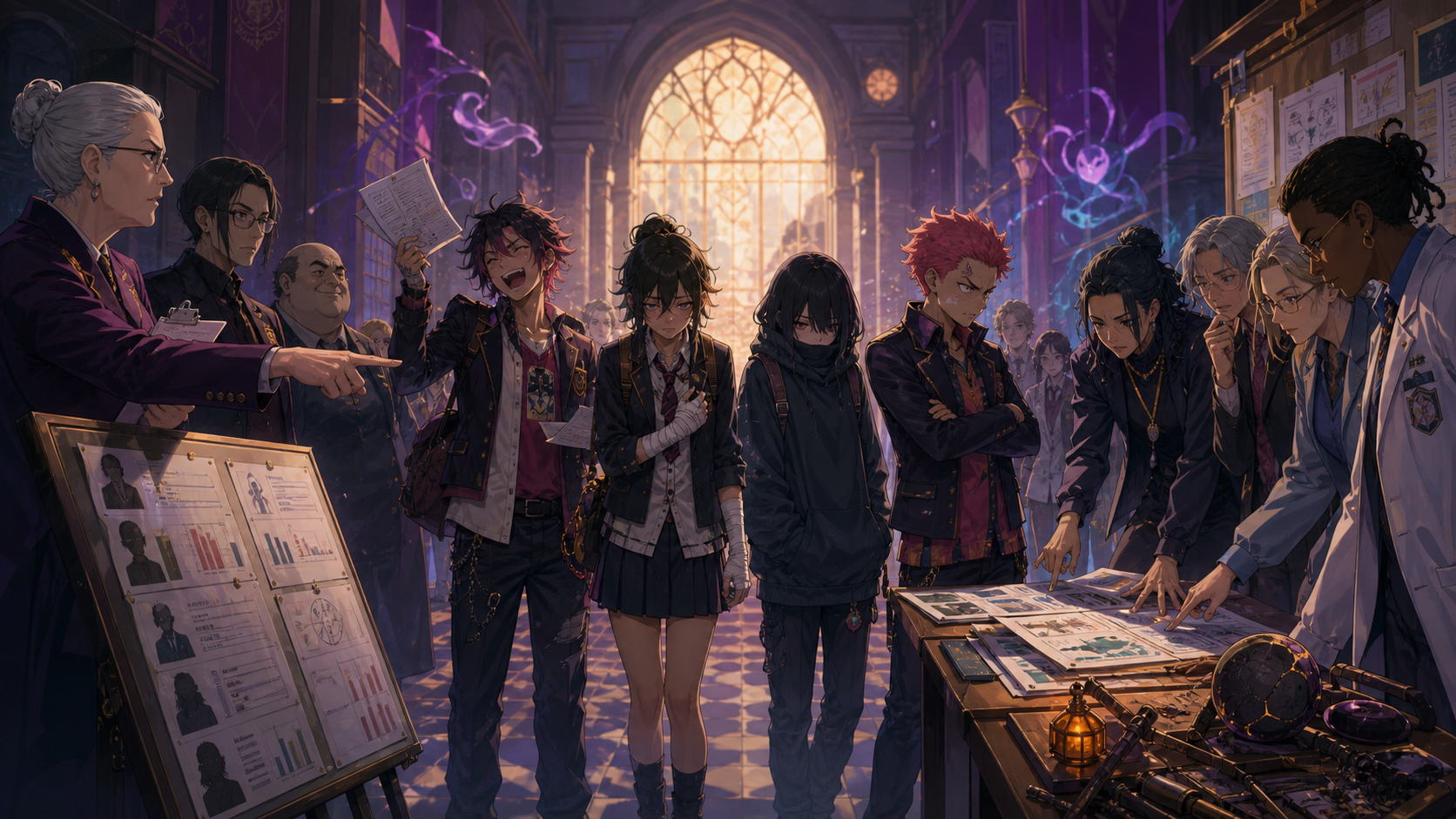
Anime Schools Keep Calling Institutional Failure a Student Personality Problem
Naruto, My Hero Academia, Assassination Classroom, and Jujutsu Kaisen keep handing adults the same report: the difficult child may be the clearest evidence in the building. Anime schools love a problem student. He talks too loudly, sleeps through class, breaks rules, refuses help, starts fights, or stares through the lesson as if somebody turned the sound off. Adults describe attitude because attitude is visible. Housing, grief, violence, disability, family pressure, hunger, discrimination, and institutional neglect require more investigation.
The label solves an administrative problem. Once a child becomes difficult, the school can organize every failure around his personality. Staff meetings discuss compliance. Records document incidents. Nobody must ask why the institution noticed pain only after pain interrupted somebody else’s day.
Contents
- The behavior is communication
- Naruto and punishment before care
- U.A. High and danger marketed as opportunity
- Class 3-E and segregation as pedagogy
- Jujutsu High and lethal staffing
- Why exceptional teachers cannot replace systems
- Discipline, disability, grief, and class
- What supportive schools actually require
- Final take
The behavior is communication, not a complete explanation
Education research on trauma-sensitive schools asks adults to understand challenging behavior and poor academic outcomes as possible communication. That shift does not erase responsibility. Students still need boundaries, classmates still deserve safety, and teachers cannot absorb unlimited harm. The shift changes the first question from “What is wrong with this child?” to “What happened, what need is present, and what response protects everyone?” CDC research links adverse childhood experiences with health conditions, distress, violence risk, substance use, and educational consequences. Safe, stable, nurturing relationships and access to caring adults function as protective factors. Anime exaggerates those findings through children carrying demons, inherited powers, assassination targets, and curses. The emotional mechanism remains recognizable.
Naruto gets punished for making neglect visible
Naruto Uzumaki vandalizes the Hokage monument because ordinary good behavior has not produced belonging. Adults read disruption as evidence of immaturity. The village rarely reads disruption as a request from an orphan who cannot understand why neighbors avoid him. Iruka changes Naruto’s path because he sees the behavior and the child at once. He does not pretend the vandalism was acceptable. He understands punishment without attachment will only confirm Naruto’s belief that recognition arrives through trouble. That humane intervention depends on one teacher’s empathy. Konoha has no visible coordinated plan for guardianship, mental health, anti-discrimination enforcement, or jinchuriki support. Iruka becomes the institution’s conscience without receiving the resources of an institution.
U.A. High turns uncontrolled danger into a selective opportunity
My Hero Academia presents U.A. as an elite school with extraordinary teachers and facilities. Students also enter combat exercises, villain attacks, internships, media scrutiny, and licensing systems while still developing identities. The institution praises composure under conditions adults repeatedly fail to control. Bakugo’s aggression, Todoroki’s withdrawal, Midoriya’s self-destruction, and Shinsou’s resentment emerge through different histories. Treating every pattern as personality misses family abuse, social praise for power, discriminatory assumptions about quirks, and a culture that rewards bodily sacrifice. Aizawa often recognizes structural problems better than administrators, yet one exhausted teacher cannot provide therapy, safeguarding, career regulation, and public-policy reform. Competent teachers become shock absorbers for systems unwilling to reduce impact.
Class 3-E turns segregation into a motivational program
Assassination Classroom makes Kunugigaoka’s hierarchy explicit. Class 3-E occupies a remote building and functions as a warning to other students. Institutional humiliation is not an accidental side effect. Administrators use stigma as academic policy. Koro-sensei succeeds partly because he rejects the premise that low rank describes low human value. He studies individual strengths, provides tailored instruction, notices emotional conditions, and treats failure as information. His methods demonstrate what the main school could fund and chooses not to provide. The series wraps care inside an assassination premise, which keeps contradiction visible. Children learn confidence while adults assign lethal responsibility. Supportive teaching can help students inside an unethical arrangement without making the arrangement ethical.
Jujutsu High calls a staffing crisis education
Jujutsu Kaisen recruits adolescents capable of seeing and fighting curses because adult institutions lack enough personnel and accept young deaths as normal. Students receive mentorship, but instruction frequently arrives through live danger. Yuji’s execution status, Megumi’s family history, Nobara’s rural alienation, and Maki’s clan exclusion shape behavior before teachers record performance. The school cannot separate education from a political order that ranks bodies, clans, techniques, and usefulness. Gojo wants students strong enough to change the system. His strategy depends heavily on exceptional individuals surviving long enough to become a new leadership class. Schools should expand collective capacity, not gamble reform on gifted teenagers.
Exceptional teachers cannot replace a functioning system. Iruka, Aizawa, Koro-sensei, and Gojo matter because relationships matter. CDC guidance identifies caring adults, mentoring, supportive climates, and community connections as protective. The danger begins when stories and institutions use one caring adult as proof that broader support is unnecessary. A teacher cannot provide housing, health care, legal protection, family intervention, disability services, and safe staffing alone. Asking teachers to improvise every missing service converts care into unpaid structural repair. Hero-teacher stories can also hide turnover. What happens when the exceptional adult leaves, dies, burns out, or receives another assignment? Rights must survive personnel changes.
Discipline records the response while deleting the cause. A student yells. The file records yelling. The file may not record the eviction, funeral, panic response, untreated injury, harassment, or weeks of asking quietly for help. Documentation looks neutral because the form contains boxes. The choice of boxes already defines reality. Fair discipline needs clear expectations, proportional consequences, investigation, restorative options, disability accommodation, and support that keeps students connected to education. Safety and compassion belong together. Compassion without boundaries abandons classmates. Boundaries without context abandon the struggling child.
My Hero Academia confuses self-harm with admirable work ethic. Midoriya enters U.A. after years of quirkless exclusion and gains One For All shortly before the entrance examination. His body cannot safely carry the power. He breaks bones to produce results because hero culture has taught him that saving people justifies bodily destruction. Teachers recognize the danger. Recovery Girl warns him. Aizawa demands greater control. All Might gradually understands the cost of asking a child to inherit both power and a public symbol. The institution still allows repeated situations where catastrophic injury becomes a plausible route to success.
Calling Midoriya reckless describes conduct without explaining training history. He learned heroism through a society that broadcasts spectacular rescue, celebrates sacrifice, and ties moral worth to intervention. Adults later ask him to moderate the lesson adults taught most loudly. A trauma-aware response would preserve his desire to help while separating care from self-erasure. The goal would not be a timid hero. The goal would be a student who understands that his future body belongs among the lives worth saving.
Bakugo shows what happens when adults reward the warning signs. Bakugo’s early power receives praise. Adults interpret confidence, aggression, and combat talent as evidence of future success. Peers learn that challenging him carries social cost. His bullying of Midoriya grows inside an environment that repeatedly tells him superiority is real. U.A. confronts parts of his behavior, but the school also values the same intensity during combat. Bakugo has to distinguish excellence from domination while adults continue rewarding both under different names.
His kidnapping exposes the danger of public labeling. Villains assume anger and pride make him recruitable. Bakugo rejects them because his commitment to heroism is genuine. The villains misread behavior as complete identity just as teachers and classmates often do. Support does not require excusing bullying. Accountability should protect Midoriya, name harm, and demand change. Support should also examine the praise economy that helped Bakugo build a self around winning.
Todoroki carries family violence into a public curriculum. Endeavor designs a family around producing a successor. Todoroki arrives at U.A. with extraordinary ability and a refusal to use half his power because fire represents paternal control. A performance choice contains years of family history. The Sports Festival makes that conflict public. Midoriya urges Todoroki to claim power as his own. The scene offers liberation and creates spectacle from trauma. Millions of viewers can watch a child negotiate abuse through combat.
U.A. teachers cannot repair the Todoroki family through tournament insight. Safeguarding would require private assessment, support for siblings and the abused parent, boundaries around Endeavor, and services independent of hero rankings. Todoroki’s later relationship with his father remains his choice. A school’s duty would be safety and options, not steering a survivor toward reconciliation because family unity looks hopeful.
Shinsou reveals how admissions tests manufacture the talent they claim to discover. U.A.’s practical entrance test privileges powers suited to destroying robots. Shinsou’s Brainwashing has enormous tactical potential and receives cultural suspicion, yet the test offers little room to demonstrate control, ethics, interrogation resistance, or team leadership. He enters General Studies, watches Hero Course students receive better access, and must prove his value during a public tournament. The school can describe the transfer path as opportunity. The path asks a student disadvantaged by test design to outperform students already receiving specialized resources.
Standardized assessments often reward familiarity with the assessment itself. A narrow measure becomes a gate, then later performance differences appear to validate the gate. Shinsou improves quickly once Aizawa provides relevant instruction. The lesson is not that every student belongs in every program. Selection should test the work, accommodate difference, publish criteria, and create supported routes for reconsideration. Fairness requires more than one dramatic exception.
Class 3-E makes the hidden curriculum visible. Kunugigaoka students learn two curricula. The official curriculum includes academic subjects. The hidden curriculum teaches that fear of humiliation should motivate performance, status justifies distance, and institutional belonging can be revoked. Main-campus students preserve rank by looking downward. Teachers demonstrate contempt. Physical separation turns stigma into geography. The mountain classroom tells Class 3-E that exclusion is natural rather than administratively produced. Koro-sensei changes outcomes through high expectations joined to tailored support. He notices Nagisa’s observation, Karma’s intelligence, Kayano’s performance, Terasaka’s influence, and each student’s learning pattern. He does not confuse one hierarchy’s ranking with a final description of ability. His success indicts the main school. The students were never empty containers waiting for magical motivation. They needed instruction designed around actual learners.
Nagisa is quiet enough for adults to miss the danger. Nagisa does not match the usual image of a problem student. He is observant, compliant, physically unobtrusive, and academically capable. His mother controls appearance and future plans while directing unresolved ambition through him. Schools often identify externalizing behavior faster than internalized distress. A loud student interrupts class. A quiet student can disappear while meeting every visible expectation. Nagisa’s assassination talent grows through attention, emotional suppression, and the ability to lower another person’s guard. Traits formed under pressure become professionally useful. Usefulness does not mean the pressure was healthy. A supportive teacher must notice perfection, compliance, and detachment alongside disruption. Risk does not always raise a hand.
Karma gets the “too smart to need help” treatment. Karma’s intelligence and combat confidence encourage adults to treat him as self-sufficient. His conflict with a teacher contributes to suspension and distrust. The institution reads defiance while underestimating how betrayal shaped the defiance. Gifted students can be denied support because competence hides need. Adults assume strong performance proves emotional stability, then express surprise when anger, boredom, or disengagement breaks through. Koro-sensei challenges Karma without humiliating him. The teacher creates consequences, exposes overconfidence, and preserves relationship. Correction works because losing does not threaten membership. Discipline becomes developmental when a student can make a mistake, repair harm, and remain part of the community.
Yuji enters school under a death sentence. Yuji Itadori consumes Sukuna’s finger to save others and becomes both student and condemned vessel. Jujutsu leadership postpones execution while he collects more fingers. Education and capital punishment occupy the same enrollment plan. Teachers can mentor him sincerely inside that arrangement. Gojo’s protection matters. The institution still treats Yuji’s continued life as conditional usefulness. After traumatic events, adults repeatedly ask him to continue missions. His guilt makes service feel necessary. The system benefits from a teenager who interprets self-sacrifice as moral repayment. A humane school would separate crisis stabilization from deployment, give him independent representation, and reject execution as an administrative solution to institutional fear.
Maki Zenin proves achievement cannot cure discrimination. Maki leaves a powerful clan that devalues her limited cursed energy and her gender. She pursues elite skill partly to overturn the judgment. Achievement becomes resistance and an exhausting demand. Institutions celebrate barrier-breaking individuals because their success can imply the barrier is gone. Maki’s excellence does not erase clan rules, resource control, inherited status, or abuse toward people unable to match her performance. Representation matters. Structural change requires altered governance, access, inheritance, safety, and consequences. One exceptional graduate cannot carry every person left behind. Students from marginalized groups deserve support without becoming permanent diversity evidence for the school.
Megumi’s talent comes with an ownership dispute. Megumi Fushiguro’s inherited technique gives the Zenin clan an interest in his body and future. Gojo intervenes, but protection again depends on one powerful adult’s choices. A child should not need a stronger patron to escape family ownership. Rights should exist independently of which adult wins the negotiation. Megumi’s reserved behavior and tendency toward self-sacrifice make sense inside a life where adults assessed his value through utility. He saves selectively because he doubts abstract fairness, yet he often excludes himself from the people deserving rescue. Teaching combat without challenging that self-concept leaves the most dangerous lesson intact.
Nobara shows why rural alienation belongs in school support. Nobara rejects the constriction of her hometown and arrives in Tokyo with confidence, taste, anger, and clear ambition. Her behavior resists a culture that policed difference. Rural and urban students may carry distinct access, stigma, family expectation, and cultural displacement. Treating adjustment as attitude ignores the social distance a student has crossed. Nobara values herself fiercely, which protects her from some institutional judgments. Confidence should not become another reason to assume she needs no care. Schools need room for students to criticize where they came from without turning communities into stereotypes or demanding gratitude for escape.
Assassination Classroom understands that belonging changes performance. Class 3-E improves academically after students experience respect, relevant instruction, peer identity, and confidence. The improvement does not prove shame was useful. The improvement begins when shame loses control. Belonging changes willingness to attempt difficult work. Students can reveal confusion without confirming a degrading label. Teachers can correct errors without threatening membership. Competition remains present, and Koro-sensei uses ambitious goals. Supportive education does not eliminate rigor. Rigor becomes more honest when students receive the tools needed to meet expectations. The main campus wants fear to create effort. Class 3-E shows relationship can create deeper effort without requiring contempt.
A supportive school changes adult work before demanding child resilience
Whole-school approaches require trained staff, welcoming climate, screening, family partnership, mental-health professionals, community referrals, and evaluation. Such infrastructure costs money. Motivational speeches remain popular because speeches fit inside existing budgets. Schools should measure belonging, access, safety, staffing, response time, exclusion patterns, and whether students can seek help without punishment. Academic outcomes matter. Academic outcomes do not explain themselves. Children need multiple trusted adults so one relationship does not carry every risk. Teachers need manageable workloads and consultation. Families need navigation help rather than blame. Students need confidential channels and genuine participation in rules affecting them.
“Resilience” becomes suspicious when adults control every stressor. Resilience describes adaptation under difficulty. Schools can strengthen protective relationships, emotional skills, and access to help. Institutions misuse the word when avoidable harm becomes a training method. U.A. students survive villain attacks and receive praise for maturity. Jujutsu students survive missions and receive higher rank. Naruto survives neglect and becomes proof of the village’s values. Class 3-E survives humiliation and improves scores. In each case, adults can mistake endurance for endorsement.
A resilient student may still oppose the conditions she survived. Gratitude is not a clinical outcome. Anger may reflect accurate moral judgment rather than failed recovery. Schools should ask which stressors can be removed, which risks can be reduced, and which supports belong before crisis. Coping skills should expand freedom rather than make institutional failure cheaper.
Suspension moves the student and leaves the cause seated. Exclusionary discipline can protect immediate safety in serious cases. Routine removal also shifts a visible problem outside the classroom without resolving the underlying need. Karma’s suspension confirms his distrust. Class 3-E’s physical segregation turns exclusion into architecture. Yuji’s secret death status separates him from ordinary student rights. Naruto’s social isolation begins before any formal disciplinary record. Removal interrupts instruction, relationships, meals, activities, and access to caring adults. A returning student may face the same triggers with less academic footing and more stigma. Alternatives require staffing: restorative conferences, counseling, behavior support, family liaison, supervised regulation spaces, and plans for reentry. Administrators cannot replace services with slogans about grace.
Safety plans should protect every student, including the one who caused harm. Trauma-informed practice sometimes receives criticism as permission for dangerous behavior. That criticism points toward a real obligation. Classmates and staff deserve safety. A student’s history cannot erase another person’s injury. Good response separates explanation from excuse. Adults stop immediate harm, assess risk, support the affected person, investigate context, set consequences, and build a plan reducing recurrence. The student who caused harm remains a child with rights. Humiliation, abandonment, or violent retaliation may increase risk while satisfying adult anger. Anime often jumps from conflict to inspirational combat resolution. Schools need slower work: repair agreements, supervision, skill teaching, environmental change, and follow-up after attention moves elsewhere.
Disability cannot become a motivational obstacle for the audience. Rock Lee, Midoriya’s injured body, Mechamaru, and students with powers that affect communication or social perception invite disability readings. Their fictional conditions differ, and no single metaphor covers every experience. Institutions often celebrate a disabled student who exceeds an inaccessible standard. The celebration can imply that effort removes the need for accommodation. Anyone unable to produce exceptional performance becomes less inspirational and less visible. Accommodation changes the environment so a relevant skill can be assessed fairly. Shinsou needs an entrance route measuring more than robot destruction. A student with physical limitations may need modified training and medical protection. Communication difference may require time and alternate methods. Access is not lowered expectation. Access asks whether the obstacle belongs to the work or to a tradition nobody has questioned.
Family prestige makes safeguarding harder. Todoroki, Maki, Megumi, Neji, Hinata, and Sasuke belong to families or clans with political and symbolic power. Schools may hesitate to intervene when a family controls resources, reputation, or future employment. Prestige can make abuse look like private tradition. A child’s talent may also benefit the institution, creating pressure to preserve the relationship with family leadership. Safeguarding needs authority independent of donors, rankings, clan councils, and hero agencies. Staff must document concerns, consult specialists, protect confidentiality, and act without requiring the child to defeat the family publicly. Family culture deserves respect until respect becomes an excuse for coercion. Children hold rights inside traditions, not only after leaving them.
Poverty and mission economics shape who can afford to be a “good student”. Anime schools rarely spend enough time on tuition, housing, meals, transportation, equipment, and unpaid training. Those details determine whether attendance and preparation are possible. Naruto’s village supplies basic housing but leaves him without stable family support. U.A. later moves students into dorms partly for safety, showing how housing changes oversight and belonging. Jujutsu students receive institutional accommodation while accepting lethal labor. Class 3-E students travel to a remote building as part of punishment.
A student arriving late may be caring for siblings, working, crossing long distances, or navigating unstable housing. A discipline code that records lateness without material context converts poverty into character evidence. Support requires meals, transport, devices, safe housing referrals, emergency funds, and schedules designed around real lives. Opportunity without logistics remains decorative.
Teachers need support before “build relationships” becomes another impossible demand. Relationship-centered education asks teachers to know students, communicate with families, notice distress, adapt instruction, prevent escalation, and maintain trust. Those tasks take time. Large classes, staff shortages, paperwork, unsafe conditions, and constant coverage reduce capacity. Telling an exhausted teacher to care harder turns systemic scarcity into personal guilt. Iruka can reach Naruto because the story gives their relationship focus. A real educator may serve dozens or hundreds of students. Aizawa sleeps in class partly as a joke and partly as an image of normalized exhaustion. Schools need counselors, nurses, social workers, psychologists, paraprofessionals, substitutes, planning time, professional learning, and leadership that responds when staff report danger. Supporting adults protects children without centering adult comfort over student rights.
Confidentiality should not become secrecy that protects abuse. Students need private spaces to disclose grief, family conflict, identity concerns, and mental health needs. Trust collapses when every disclosure becomes gossip or automatic punishment. Confidentiality has limits where safety requires reporting. Those limits should be explained before disclosure when possible. Students deserve to know who will receive information and what happens next. Ninja and jujutsu schools operate through classification, clan secrets, and restricted knowledge. Secrecy frequently protects leaders from accountability while children carry information alone. A humane system distinguishes privacy for the vulnerable from secrecy for the powerful. The first protects dignity. The second can prevent oversight.
Data can reveal inequality and can also become another weapon. Schools need information about discipline, attendance, achievement, access, referrals, and school climate. Disaggregated patterns can reveal groups punished more often or excluded from advanced opportunities. Data becomes harmful when labels follow students indefinitely, predictive systems treat past struggle as future guilt, or private health information reaches people without need. Anime turns records into dramatic identity: villainous quirk, cursed technique, clan rank, exam score, mission level. Characters keep exceeding the administrative description. Good data policy limits collection, secures access, corrects errors, expires outdated flags, and gives students meaningful explanation and appeal. Measurement should guide support rather than automate suspicion.
Student voice means influence before the crisis episode. Adults often listen after a student proves danger through collapse, violence, escape, or public victory. Earlier concerns sounded emotional, disrespectful, or unrealistic. Student councils and surveys matter only when leadership explains how input changed decisions. Young people need representation in discipline policy, safety planning, accessibility, scheduling, and climate review. Participation does not make children responsible for fixing adult systems. Adults retain duties, budgets, and legal power. Student voice supplies knowledge about how policy functions on the ground. Naruto spends years demanding acknowledgment. A responsive village would not require a national emergency before hearing him.
School belonging should not require gratitude. Students can value teachers, friends, and opportunities while criticizing the institution. Loyalty becomes coercive when critique is framed as betrayal. U.A. students may love heroism and oppose unsafe norms. Jujutsu students may protect people and reject the elders. Class 3-E students may treasure their teacher and condemn the system that segregated them. Naruto may love Konoha and demand truth about Konoha. Mature belonging contains disagreement. A school confident in its mission can hear where the mission fails. Gratitude belongs to relationships freely appreciated. Institutions should earn trust through conduct rather than require gratitude as tuition.
What each fictional school should have done first
Konoha Academy. Assign Naruto stable guardianship, enforce anti-discrimination rules, provide truthful support around jinchuriki status, and separate childhood education from lethal labor. U.A. High. Strengthen independent safeguarding, redesign admissions for varied abilities, reduce public exploitation of student trauma, and regulate work placements around developmental safety. Kunugigaoka. End Class 3-E segregation, investigate abusive staff, distribute tailored instruction across the school, and stop using humiliation as motivation. Tokyo Jujutsu High. Reject student execution orders, expand adult staffing, provide independent mental health and legal support, and place clan authority under enforceable review. None of these steps would remove conflict from the stories. Better institutions create different conflicts: resource decisions, accountability, rights, public fear, and the hard work of changing professional culture.
Schools love individual interventions because buildings cannot be sent to therapy. A student can receive a behavior plan, counseling referral, medication evaluation, detention, mentor, or transfer. Each intervention may help under the right conditions. The list focuses attention on the child because the child has a name and appointment time. Institutional conditions feel harder to hold. Overcrowding belongs to budgeting. Discriminatory placement belongs to policy. Unsafe curriculum belongs to leadership. Staff turnover belongs to labor conditions. Family exclusion belongs to communication design. Responsibility spreads, so action slows.
Anime gives buildings personalities through principals and elders. Removing one corrupt leader feels like reform. Real change requires examining routines that ordinary employees continue after leadership changes. The question should never be individual support or structural reform. A child needs help today, and the institution must stop creating the same injury tomorrow.
“Potential” can become a polite word for usefulness. Adults in these series identify potential quickly when a student holds a rare power. Naruto’s chakra, Midoriya’s inheritance, Todoroki’s elements, Megumi’s technique, and Nagisa’s assassination ability attract attention because institutions can use them. Students whose strengths do not match institutional demand receive less investment. Care begins to look like talent acquisition. Education should develop a whole person rather than extract the most valuable trait. A student may choose a profession built around talent, but choice requires other options and knowledge of cost. Praise also needs caution. Telling a child she was born for a role can erase the right to change direction. Destiny sounds flattering while closing doors.
Peer support keeps saving children after adults clock out. Team 7, Class 1-A, Class 3-E, and jujutsu students repeatedly provide emotional first aid, physical rescue, advocacy, tutoring, and belonging. Friendship becomes the most reliable safety net. Peer connection is genuinely protective. Schools should create spaces where friendship can grow. Schools should not shift adult duties onto children because peers happen to care. A teenager supporting a suicidal, injured, abused, or violently targeted friend needs an adult response pathway. Loyalty should not require secrecy or amateur crisis management. Stories celebrate friends who never give up. A responsible institution gives those friends somebody qualified to call.
Parents are not automatically partners and are not automatically the problem. School-family partnership language can assume every caregiver is safe, available, literate in institutional rules, and able to attend during work hours. Todoroki and Nagisa show why automatic parental involvement can increase danger. Other families may want to help but face language barriers, poverty, transportation, disability, immigration concerns, or prior mistreatment by schools. Nonparticipation does not prove indifference. Staff need flexible contact methods, interpretation, family advocates, and safeguarding judgment. Students should identify trusted adults beyond biological parents where appropriate. Family engagement works when schools share power and information. Summoning a caregiver only after discipline is not partnership.
School reputation competes with student safety. Elite schools depend on public confidence. U.A. faces intense scrutiny after villain attacks. Kunugigaoka protects a high-achievement image through a visible underclass. Jujutsu leadership protects secrecy. Konoha protects military credibility. Reputation can motivate genuine improvement. Reputation can also encourage concealment, retaliation against reporters, rushed reopening, or cosmetic policy. Transparent institutions publish failures and corrective plans before outsiders force disclosure. Leaders distinguish embarrassment from danger. Embarrassment harms adults in charge. Concealment can harm children again. A school worthy of trust does not demand trust as protection from scrutiny.
The school nurse cannot be the whole health system. Anime medical rooms restore characters quickly enough for the plot to continue. Recovery Girl’s quirk accelerates healing while consuming stamina. Shoko treats extraordinary injuries inside a lethal profession. Sakura later develops medical expertise in a military system. Physical repair does not address fear, grief, coercion, sleep, family conflict, or the meaning attached to injury. Returning a student to combat readiness differs from restoring well-being. School health requires nursing, mental health, disability services, external referral networks, consent, privacy, and follow-up. Clinicians need authority to say no when institutional schedules push premature return. A bandage should not become permission to repeat the event that caused the wound.
Teachers should not diagnose characters from vibes, and neither should fans. Viewers use clinical language to understand fictional behavior. Such language can create empathy and can become casual certainty. A scene does not provide a full assessment. Trauma, depression, anxiety, neurodivergence, grief, moral injury, and ordinary personality may overlap in outward behavior. Cultural context and translation further complicate interpretation. This editorial discusses patterns without assigning diagnoses. The useful question concerns what support and safety a behavior may call for, not which label wins an online argument. Real students deserve assessment by qualified professionals and participation in decisions affecting them. They also deserve identities larger than any diagnosis.
Rigor without care measures access to suffering. Institutions defend harsh conditions by saying the future profession is harsh. Shinobi face combat. Heroes face villains. Sorcerers face curses. Students therefore need exposure to pressure. Preparation can include challenge, simulation, feedback, gradual responsibility, and realistic risk. Preventable trauma does not become educational because later work may be dangerous. When programs select only people who can absorb neglect, graduates may reproduce neglect as tradition. “I survived” becomes the curriculum for the next cohort. True rigor measures relevant skill while protecting enough health for learning to continue.
The institution should be graded too. Students receive scores, ranks, licenses, mission grades, and disciplinary files. Schools need equally visible evaluation. Metrics should include preventable injury, staff turnover, access gaps, complaint resolution, mental-health wait time, discriminatory discipline, student belonging, family trust, and successful transition after crisis. Independent reviewers should speak with students privately and publish findings. Leadership should respond with deadlines, budgets, and named responsibility. A school that fails should receive intervention rather than asking students to become more resilient inside the failure.
What trauma-sensitive practice does not mean. Trauma-sensitive practice does not mean lowering every standard, tolerating violence, forcing disclosure, treating teachers as therapists, assuming trauma explains all behavior, or turning private histories into classroom discussion. Trauma-sensitive practice means predictable routines, emotional and physical safety, choice where possible, respectful consequences, access to qualified help, staff awareness, and refusal to humiliate students for adaptations to harm. Universal supports reduce the need to identify one child publicly before offering basic dignity. More intensive services can respond when universal support is not enough. The approach remains accountable because preventing recurrence matters to everyone affected.
An eighth-grade sentence can carry an adult truth. Schools sometimes hide weak reasoning inside professional language. “The student demonstrates oppositional behavior in response to instructional directives” may mean “She said no after nobody answered her question.” Clear language protects students and staff. Reports should identify who did what, when, under which conditions, how adults responded, what harm occurred, and what support follows. Vague nouns such as incident, issue, situation, and defiance can erase agency. Clear pronouns and names matter because readers need to know who made each decision. Good writing will not fix a bad institution. Bad writing can make responsibility harder to find.
A better anime school would still make excellent television
Writers do not need to remove every adult failure. Accountability creates story. A transparent investigation threatens reputations. A student advocate clashes with clan leadership. Budget negotiations expose priorities. Teachers organize around unsafe staffing. Families disagree about repair. Students can face demanding training without becoming disposable. The drama shifts from whether adults notice harm toward what adults do after noticing. Characters can fail, hurt others, apologize poorly, resist help, and change slowly. Care does not flatten personality. Care gives personality room beyond survival response. The most interesting question is not whether a broken system produces one hero. The question is whether that hero can change the system without becoming another exhausted exception.
The repair plan belongs in the file beside the incident. Schools document what went wrong more consistently than what adults promised afterward. A useful record would pair every serious incident with an assigned response: safety measures, academic recovery, health support, relationship repair, environmental change, responsible staff, review date, and the student’s own account. Follow-up matters because early improvement can hide unresolved need. A student may comply to escape scrutiny. Staff may interpret quiet as recovery. Families may stop returning calls after prior contact produced blame.
Plans should expire or change when evidence changes. Permanent flags can trap a student inside one difficult month. Records should preserve accountability without turning childhood into an unappealable sentence. Repair also includes the class. Witnesses may feel frightened, guilty, angry, or confused. Teachers may need debriefing and relief. Community recovery prevents one child from becoming the container for everyone’s distress.
Prevention rarely receives the dramatic scene. A prevented crisis produces no battle, rescue, suspension hearing, or tearful reunion. Staff notice early distress, adjust a schedule, connect a family with help, repair a peer conflict, or change an unsafe routine. The school day continues. Quiet success is difficult to market because nobody can photograph the disaster that did not happen. Leaders therefore need measures and stories that value prevention without exposing private students. Anime depends on crisis for narrative movement. Viewers can enjoy the crisis while noticing which ordinary supports would have changed the path. Prevention does not eliminate every emergency. Prevention reduces avoidable emergencies and preserves capacity for dangers nobody could reasonably predict.
The adult question comes before the student label. Before writing defiant, lazy, aggressive, attention-seeking, unmotivated, or unstable, adults should describe the environment and their own actions. What instruction was given? Was the request understood? What happened immediately before the response? Which supports were available? Who felt unsafe? Such questions do not guarantee a comforting answer. A child may have made a harmful choice with full understanding. Accurate context still improves consequence and prevention. Labels compress history into personality. Description preserves enough detail for another adult to act wisely.
The tunnel has to lead past the diagnosis. A believable school reform arc would begin by reviewing what happened before the student’s worst day. Staff would examine attendance, housing, family safety, disability access, bullying, workload, teacher turnover, discipline history, and the moments when the child asked for help in a form adults did not recognize. The student would still face consequences for harm. Other students would still deserve protection. The difference would be that the school could no longer describe a predictable failure as a mysterious personality problem. A multidisciplinary team would assign real responsibilities to adults, set deadlines, protect confidential information, and revisit the plan after the immediate crisis. Progress would mean fewer emergencies and more belonging, not simply quieter hallways.
The strongest version would follow the student through an ordinary month after the dramatic intervention. A teacher changes one classroom practice. A counselor keeps an appointment. Transportation arrives. A guardian receives support instead of blame. The student apologizes where an apology belongs, makes another mistake, and discovers that the plan survives imperfection. Classmates see that safety does not require exile, while staff learn that compassion without structure leaves everyone exhausted. Anime could keep the tournament, the cursed mission, the rival, and the ridiculous school festival. The school would simply become part of the moral world rather than a painted hallway where adults wait for children to fix themselves.
Final take
Anime problem students keep telling the truth with terrible manners. Their behavior disrupts classrooms because their lives have already been disrupted. Institutions notice the noise and miss the chronology. Naruto did not become worthy after Iruka recognized him. Iruka recognized worth the village had failed to protect. Class 3-E did not acquire humanity through improved scores. Koro-sensei treated humanity as the starting point. U.A. and Jujutsu High cannot solve political violence by producing tougher graduates. The next time a school calls a child difficult, ask who had the easier job before the child became impossible to ignore.