
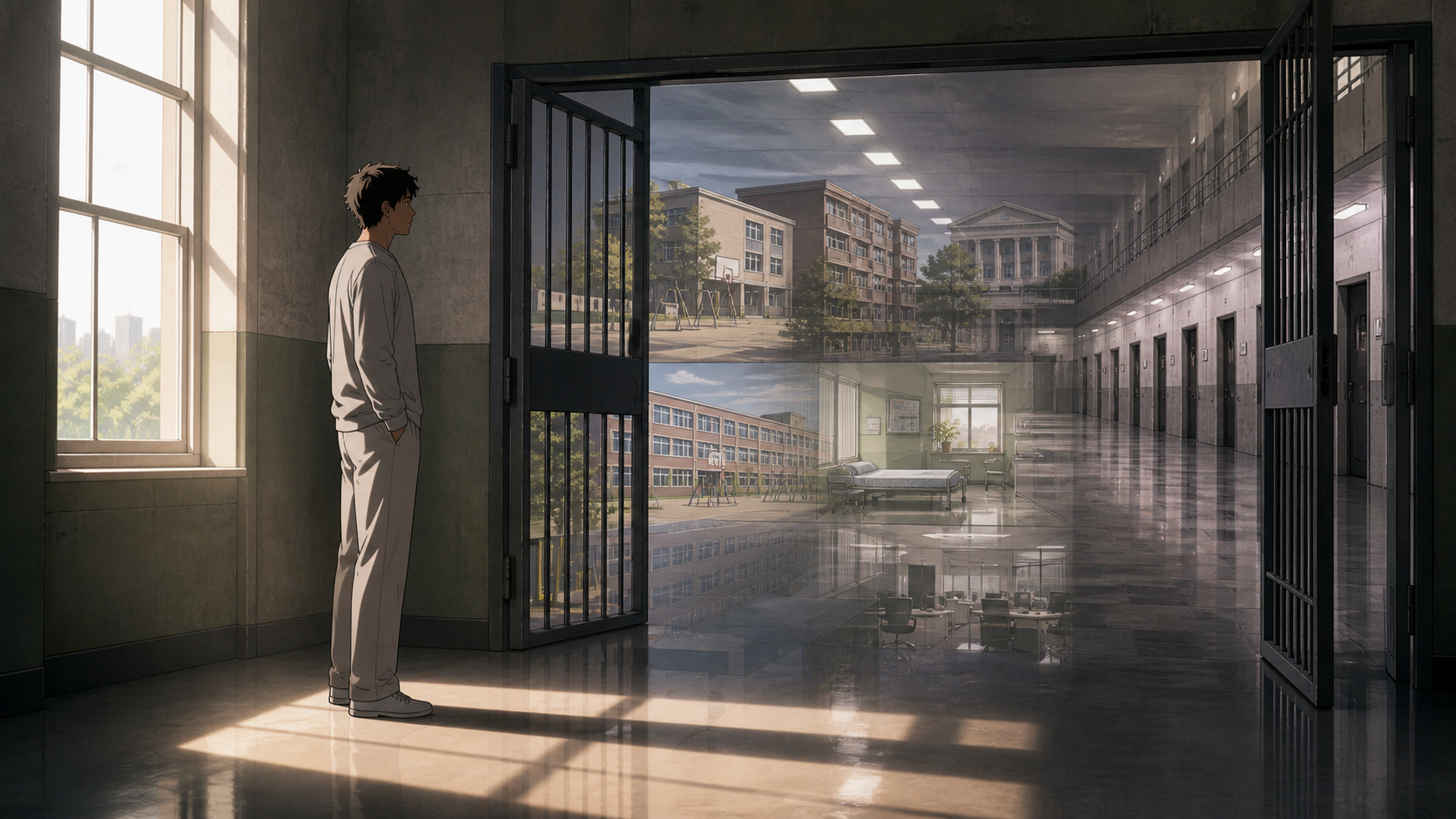
RaeRae Rants · Anime Justice and Incarceration File
Anime Prisons Keep Hiding the Society That Built the Villain
A locked cell can stop immediate harm. A locked cell cannot explain why every warning sign became somebody else’s problem.
The empty visitation chair
A former villain sits under fluorescent light while an empty chair waits across the table. Nobody arrives. Officials pass with files recording crimes, powers, risk scores, and sentence length. The file contains everything the state needs to manage a body and almost nothing needed to understand a life. Above the prison, citizens celebrate because the immediate danger has been removed. News coverage moves toward rebuilding, memorials, and the hero who delivered the final blow, while the public institutions that ignored years of warning signs quietly return to business as usual.
Containment may be necessary. Somebody who has killed, terrorized, assaulted, or threatened others cannot receive freedom merely because society contributed to the path. Explanation does not erase choice, and compassion does not require public exposure to continuing danger. My problem begins where anime justice usually ends. A sentence can respond to an offender, and sometimes confinement is necessary for public safety. The sentence still cannot repair every victim, reform the institutions that helped create the danger, or prevent another neglected child from reaching the same locked door.
When a series shows repeated villains emerging from neglect, exploitation, discrimination, abusive families, secret programs, and corrupt agencies, another prison wing is not a complete public policy. The state has documented a pattern and chosen storage.
Bright colors can carry a very dark social mirror
Part of the prison trope works because animation gives creators distance from the real systems being criticized. A fortress full of superpowered villains looks like fantasy, but the questions underneath are painfully ordinary: who receives help before a crisis, whose pain becomes a police problem, which government crimes remain classified, and why punishment receives funding after care was called too expensive. The powers, uniforms, jokes, and impossible architecture make the story easier to enter without making the social argument less serious. Animation can place a national trauma inside a monster, a discriminatory law inside a magic system, or state violence inside a hero agency and let viewers feel the structure before anybody names the politics.
American mainstream culture has often marketed animation as children’s or family entertainment, although Western adult animation, graphic novels, and experimental film have always challenged that boundary. East Asian animation should not be reduced to one opposite tradition either. Japan, China, and Korea have different industries, histories, censorship systems, audience habits, and storytelling markets. Still, all three provide visible examples of animation serving teenagers and adults alongside children. The Japan Foundation describes anime’s ability to combine sophisticated visual art with complex storylines, Chinese cultural research has documented adult audiences for animated films, and Korea’s content agency tracks animation use across adult age groups rather than treating the form as a children’s category.
That wider audience changes what animation can do. A story can move from slapstick to genocide, school comedy to child recruitment, tournament spectacle to government conspiracy, and viewers accept the tonal range because the world was built to hold several realities at once. Honestly, the best anime and donghua can feel like The Lord of the Rings on steroids: mythology, politics, family trauma, theology, war, bureaucracy, comedy, romance, and one emotionally damaged teenager carrying a power nobody explained. The exaggeration creates room for ideas that live-action studios might flatten into a crime procedural or a safe superhero sequel.
The danger comes when viewers mistake visual brightness for moral simplicity. Cute mascots, colorful powers, and jokes do not cancel the detention center behind the school festival. Sometimes humor gives the audience enough breathing room to stay with material that would otherwise become unbearable. Sometimes humor also helps a series dodge consequences by restoring the familiar tone before anyone investigates what happened. I want to enjoy the absurd prison breakout and still ask why the facility existed, who authorized the conditions, and whether the society above ground learned anything beyond the need for thicker walls.
Containment mistaken for justice
Containment answers an urgent question: how do we stop further harm right now? Justice asks more questions. What happened? Who was harmed? What does repair require? Which rights remain? What accountability fits? Which conditions increased the likelihood? How can recurrence be reduced? Anime compresses those questions because final arcs need resolution. A villain dies, escapes, receives indefinite detention, or enters a mysterious high-security facility. The plot assures viewers that danger has ended.
High-security architecture communicates competence. Thick walls, suppression technology, isolated cells, masked guards, and endless surveillance make the state appear prepared after catastrophe. The same state may have ignored the person for years before arrest. Late competence deserves suspicion. Systems often invest more readily in control after harm than support before harm. A neglected child cannot access care, but the adult offender receives an entire fortified institution. Punishment produces visible certainty. A sentence gives anger a number. Years, levels, restrictions, and classifications create measurable response. Grief remains immeasurable. Community repair remains slow. Prevention produces no dramatic verdict. Certainty can comfort victims and citizens. False completeness becomes dangerous when the number replaces the broader work.
The superpowered offender creates real complications. Some anime villains possess abilities capable of mass destruction, mind control, escape, or bodily transformation. Secure containment may require extraordinary measures. Security needs do not remove human rights, medical care, review, or rehabilitation. Extraordinary capacity increases the need for transparent safeguards because officials receive extraordinary power over the detained person.
The social origins nobody prosecutes
Villains rarely emerge from one cause. Personal choice intersects with family, community, institutions, ideology, opportunity, and chance. A serious story can hold several levels of responsibility without turning the offender into a puppet. Abuse becomes backstory instead of evidence. A villain reveals childhood abuse during the final confrontation. The revelation adds tragedy, explains rage, and sometimes gives the hero a reason to hesitate. After defeat, the abusive household often vanishes from legal attention. Adults who created danger face no inquiry. Child protection failures receive no reform. Abuse becomes character texture rather than public evidence.
Poverty becomes motive instead of policy. Characters steal, join gangs, accept dangerous work, or become vulnerable to recruitment because ordinary survival failed. The justice system prosecutes the resulting act without examining housing, work, healthcare, or social exclusion. Poverty does not excuse violence. Reducing poverty can reduce conditions recruiters exploit. Accountability and prevention belong together. Discrimination becomes personal resentment. A marginalized character experiences fear, exclusion, or legal restriction. The story condemns the violent response and leaves the discriminatory structure mostly intact. That ending reassures the majority. Hatred belonged to one unstable person. The society that supplied daily evidence receives no sentence.
Government programs classify their own victims. Secret experiments, covert assassinations, child recruitment, and weapon programs create damaged operatives. When those operatives resist or collapse, the state calls them criminals, traitors, or failed assets. A government cannot erase institutional responsibility by changing a file label from employee to inmate.
What anime prisons actually do
Most fictional prisons incapacitate. They separate dangerous people from potential victims. For immediate public safety, that function can matter. Rehabilitation receives less attention. Education, treatment, skill development, accountability processes, family contact, and reentry planning rarely shape the setting. The prison stores threats until a breakout returns them to the plot. The neglect becomes self-fulfilling. A facility designed only for containment produces people prepared only for containment. Release then appears impossible, justifying permanent isolation.
Isolation becomes default spectacle. Solitary cells look secure and dramatic. Long isolation can damage mental and physical health. Fiction often uses visible deterioration as proof that the prisoner remains monstrous. Some people may require temporary separation during acute danger. Indefinite deprivation should demand rigorous review, humane conditions, and treatment rather than theatrical cruelty. Suppression can erase bodily autonomy. Power-suppressing restraints, drugs, collars, seals, or surgery may protect staff and other prisoners. Those tools also create enormous potential for abuse. Use should be necessary, proportionate, medically monitored, and independently reviewed. A detainee does not lose ownership of the body because the body carries danger. Prisons become villain networking events. Concentrating people without rehabilitation allows recruitment, coercion, and shared grievance. Breakout arcs recognize the operational risk while rarely questioning the design. Classification, safe programming, education, and transition planning reduce the likelihood that confinement strengthens criminal organization.
Victims deserve more than a villain’s sentence
Punishment may validate that harm occurred and protect others. Victims often need additional forms of support: medical care, counseling, housing, income replacement, privacy, truthful records, memorials, and participation in relevant processes. A long sentence does not rebuild a destroyed home or restore a career. Justice systems that spend heavily on confinement while leaving victims to fund recovery create a strange moral imbalance. Victims also differ. Some want severe punishment. Others want answers, apology, restitution, prevention, or no further contact. No single response should become a purity test.
Explanation should never be forced on victims. A villain’s tragic history may matter for sentencing and prevention. Victims do not owe emotional engagement with that history. Understanding belongs as an option, not another demand. Restorative processes require consent and safety. Restorative approaches can center harm, responsibility, and repair. They are not automatic meetings between victim and offender. Participation must be voluntary, prepared, and supported. Serious violence may require secure settings and long timelines. Restorative work can complement rather than replace legal accountability.
What the villain-prison trope gets right and where the trope cheats
The good part comes first: anime often refuses to pretend danger is imaginary. Some antagonists have killed people, organized mass violence, abused vulnerable characters, or developed powers that make ordinary supervision impossible. A credible story cannot protect the public with one speech about empathy. Secure custody gives victims distance, prevents immediate harm, and acknowledges that understanding a person does not require trusting that person with unrestricted access. I appreciate stories that keep compassion and danger in the same frame because moral seriousness needs both.
The trope also creates a useful physical symbol. Prisons gather a society’s discarded people, secret experiments, failed operatives, political enemies, and unresolved scandals in one place. A breakout then becomes more than an action set piece because every contradiction hidden underground returns to the city at once. The image tells us that containment delayed the argument rather than winning the argument, even when the script never develops that idea as far as the production design already did.
The bad part arrives when prison becomes narrative housekeeping. Writers need the villain gone, the heroes need a ceremony, and the next arc needs a clean starting point, so the cell door closes on every connected question. Victims disappear into montage, government officials keep their jobs, abusive families escape investigation, and rehabilitation never receives enough detail to become plausible. The story uses punishment to create emotional certainty because systemic repair is slower, messier, and harder to draw as one triumphant image.
A more believable version would let the prison remain while expanding the consequences around the prison. Show a lawful review of dangerous powers. Show victims receiving material support. Show investigators following evidence into hero agencies, clans, corporations, schools, and ministries. Show treatment succeeding for one person and failing for another. Show release planning as a contested public decision instead of a sentimental reward. The point is not to turn anime into a criminal-justice textbook. The point is to make the world respond to what the plot already proved.
Anime case files
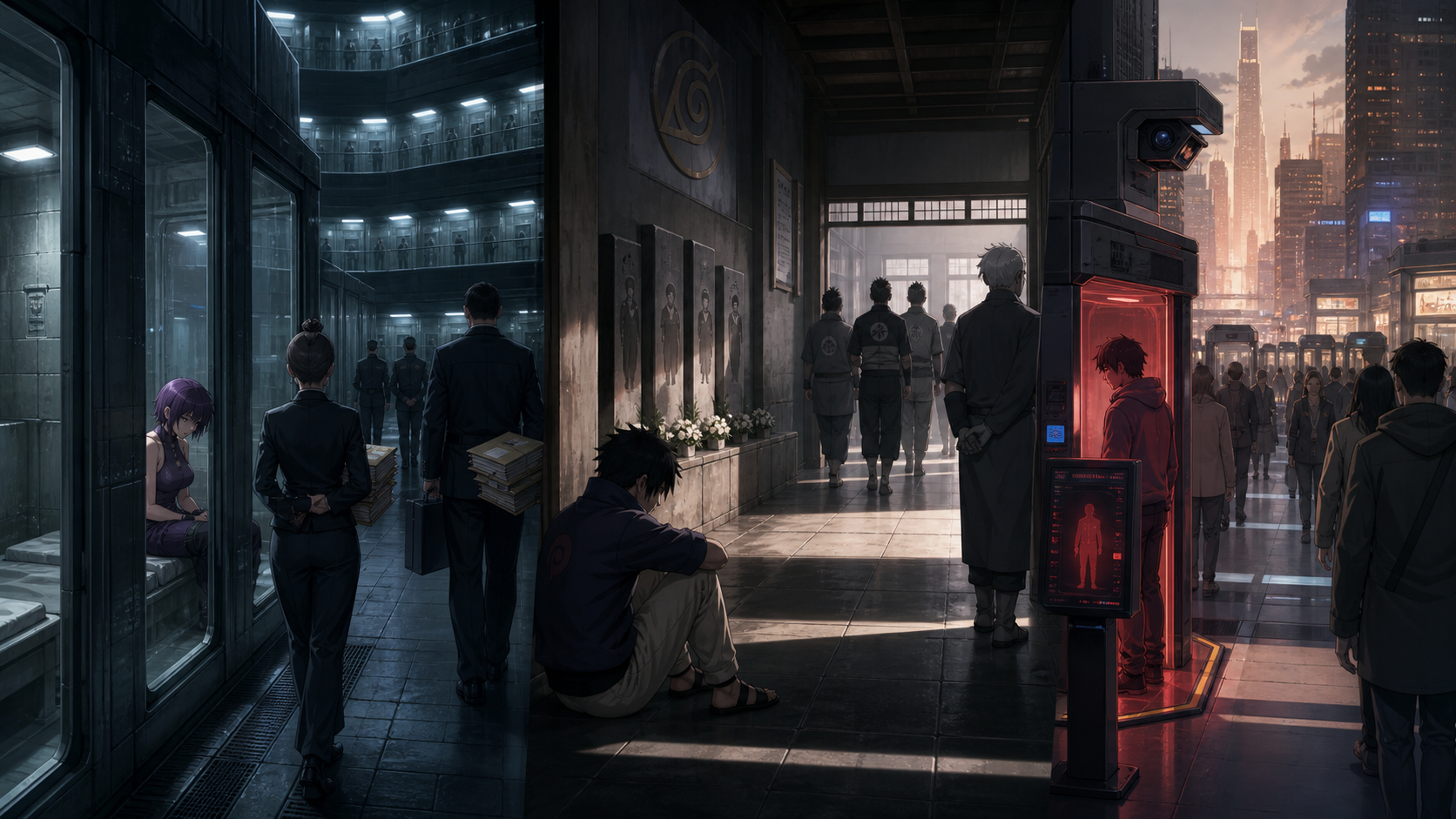
Tartarus and the fantasy of perfect containment. My Hero Academia presents Tartarus as a fortress for exceptionally dangerous prisoners. The facility reflects genuine security problems in a superpowered society. Tartarus also embodies a political decision to hide threats below the national image. Prisoners become sealed evidence of hero society’s failures. When the fortress falls, stored contradictions return at once. The lesson should exceed “build stronger walls.” A system that produces villains and stores them without meaningful reform remains fragile even behind perfect technology.
Lady Nagant and the state-created criminal. Lady Nagant performs covert killings for the Hero Public Safety Commission, breaks under the moral burden, kills a Commission official, and becomes a prisoner. Her crime is real. So is the state program that trained and used her. Imprisoning Nagant allows the Commission to preserve public innocence. The operative carries personal guilt and institutional guilt inside one cell. Naruto’s missing accountability after political violence. The shinobi world repeatedly imprisons, hunts, or kills people shaped by war, clan persecution, experimentation, and state secrecy. Individual villains face consequences while villages negotiate around their own histories. Postwar peace needs truth about institutions, not only forgiveness among exceptional individuals. Otherwise children inherit polished versions of the same system.
Psycho-Pass and risk classified before crime. Psycho-Pass pushes preventive logic into overt dystopia. A numerical system decides whose mental state presents danger, making treatment, policing, and confinement part of one automated judgment. The premise exposes what happens when public safety treats probability as identity. A person becomes punishable for the state’s prediction, and the system hides political choices behind technical objectivity.
What accountability could require
Immediate safety comes first. Secure custody may be necessary. Humane custody still includes healthcare, communication, legal review, and protection from abuse. Sentencing should consider harm, intent, capacity, coercion, risk, and possibility of change. Explanation informs proportion without erasing responsibility. Victim services need direct funding and long-term access. Support should not depend on the offender’s conviction or celebrity. Rehabilitation requires education, treatment, accountability, skill development, and realistic reentry. Release decisions need evidence and independent review.
Institutional investigations must follow patterns revealed by the case. Abusive families, discriminatory laws, corrupt agencies, unsafe schools, and secret programs cannot remain background scenery. Public reporting should track recidivism, conditions, deaths, use of force, isolation, healthcare, complaints, and reentry outcomes. A prison hidden from scrutiny becomes a place where society stores both people and responsibility. Accountability needs a theory of change. A sentence should identify what society expects to become different. Incapacitation may prevent immediate offenses. Deterrence aims to influence future choices. Rehabilitation builds capacity for lawful life. Restitution addresses material harm. Public condemnation affirms a norm. Those goals can conflict. Extreme isolation may increase security today and reduce functioning needed for release. Public humiliation may affirm anger and make future employment harder. A coherent system should acknowledge tradeoffs rather than using punishment as a general emotional answer.
Release planning begins at admission. Most detained people eventually return to communities. Preparation should begin early through identification documents, education, treatment, housing planning, family contact where safe, and work skills. Superpowered settings add technical needs: safe power management, equipment, medical monitoring, and legal rules that do not make lawful survival impossible.
Prison architecture tells viewers what the state believes
Anime prisons descend underground, float offshore, disappear behind dimensional barriers, or rise beyond ordinary geography. Distance communicates that prisoners no longer belong to social space. Cells often remove clocks, windows, names, and human scale. Architecture produces disorientation while officials describe the design as neutral security. Some security features may be necessary for extraordinary powers. Humane design can still include daylight, exercise, communication, healthcare, privacy, and spaces for education and legal contact. A prison designed only around the worst possible act treats every day as the moment of arrest. Rehabilitation requires architecture for the person expected to change.
The city above benefits from not seeing. Remote prisons protect citizens physically and emotionally. Daily life continues without confronting who is confined, under which conditions, or after which failures. Distance reduces democratic scrutiny. Families struggle to visit. Journalists and lawyers face barriers. Staff culture becomes inward and self-protective. Transparency should not compromise safety. Independent access and public data can preserve both.
Guards become part of the hidden system too
Correctional staff work around threat, manipulation, distress, and institutional pressure. Poor staffing, inadequate training, mandatory overtime, and weak mental-health support can increase danger for workers and prisoners. Anime often depicts guards as faceless obstacles, sadists, or immediate victims during escape. The institution remains abstract. Better analysis asks what rules, leadership, and resources shape staff behavior. Accountability for abuse remains necessary. Working conditions can explain risk without excusing cruelty. Independent investigation protects ethical staff as well as prisoners. A militarized culture narrows available responses. When every interaction is framed as dominance or threat, staff may rely on force before communication, de-escalation, or care. Prisoners learn that vulnerability invites control. Specialized mental-health teams, medical authority, de-escalation training, and clear use-of-force review expand options.
Prison is not a mental-health system
Villains may display trauma, psychosis, depression, dissociation, substance use, developmental disability, or other needs. Stories often bundle every condition into dangerous instability. Mental illness does not automatically create violence. Most people with mental-health conditions are not violent. Risk depends on many factors, including environment, access to care, victimization, substance use, and specific behavior. Secure treatment may be necessary for some people. Treatment should remain clinically led, rights-respecting, and distinct from punishment. A cell with medication is not automatically healthcare. Diagnostic labels can also become tools of political control. A state may classify dissent as instability or define understandable reactions to abuse as personal disorder.
Competence and responsibility need careful evaluation. Legal systems distinguish whether a person can understand proceedings and, in some contexts, how mental condition affected responsibility. Anime trials rarely show that complexity. Evaluation should be independent and focused on relevant capacities. A diagnosis alone neither proves innocence nor justifies harsher confinement.
Juvenile offenders need a different frame
Children and adolescents possess developing judgment, impulse control, identity, and susceptibility to pressure. Those developmental realities affect culpability and capacity for change. Young offenders may have extensive histories of victimization, school exclusion, family instability, or recruitment. Accountability should address harm while preserving education, family connection where safe, and realistic reintegration. Adult prisons can expose young people to violence and deepen criminal identity. Separate juvenile systems are not automatically humane, but developmental design matters. Anime frequently sends children into adult conflict and later treats criminal choices as proof they were always villains. The same society that called heroes “children with potential” calls young offenders “irredeemable threats.” Capacity for change is not sentimental optimism. Adolescence involves substantial development. Programs can build education, emotional regulation, relationships, and practical opportunity. Believing in change does not require ignoring victims or risk. Review and graduated responsibility can respond to both.
Political prisoners reveal the system’s true boundary
Fantasy states often imprison whistleblowers, dissidents, clan survivors, forbidden researchers, and operatives who know too much. Their presence among violent offenders blurs public safety with regime protection. Secrecy lets officials call every detained person dangerous. Citizens cannot evaluate evidence. Courts may exist only as administrative decoration. Rule of law requires clear charges, counsel, independent courts, evidence, appeal, and limits on detention. Emergency powers need expiration and review. A society that imprisons criticism beside violence tells viewers that order, not justice, remains the primary goal.
Families serve a sentence nobody announced
Children, parents, partners, and siblings lose income, care, housing stability, and connection when somebody is imprisoned. Some family members are also victims of the offender and need distance. Safe contact can support rehabilitation and family well-being. Distance, expensive travel, restrictive calls, and public stigma make contact difficult. Children should receive age-appropriate truth without being treated as responsible for adult crimes. Schools and services can reduce stigma and practical disruption. Visitation should not become another punishment. Security screening and supervision may be needed. Visits should remain accessible, respectful, and safe. A system that humiliates families discourages one of the strongest supports for successful reentry. When contact would endanger a victim, protective orders and survivor choice remain central. Family connection is a resource, not an automatic right over another person.
Prison labor complicates every rehabilitation claim
Work can provide routine, skill, income, and purpose. Coercive labor with minimal pay and no meaningful choice can become exploitation. Superpowered prisons may use abilities for hazardous work, energy, research, or institutional maintenance. The risk of treating people as assets returns inside custody. Programs should prioritize voluntary participation, fair conditions, safety, transferable skills, and meaningful compensation. Earnings can support restitution, family needs, savings, and reentry without erasing worker rights. Production quotas should never determine release, medical care, or basic living conditions.
Technology does not remove political judgment
Anime justice systems love biometric scanners, power analysis, predictive scores, automated gates, and artificial intelligence. Technical systems promise consistency and speed. Every system contains choices about data, thresholds, error, and acceptable risk. Those choices reflect values even when an algorithm produces the final number. Biased data can reproduce biased enforcement. If authorities historically watched one community more closely, records will show more detected violations there. Prediction then sends more surveillance back to the same community. People need notice, explanation, human review, correction, and appeal. Secret risk models create punishment without meaningful challenge.
Power detection can become permanent suspicion. A dangerous ability may justify training and specific safety plans. Classifying a person as dangerous solely because of ability confuses capacity with conduct. Regulation should focus on demonstrated risk and proportionate safeguards. Otherwise children learn that biology decides legal status before choice.
The gate opens, and society continues the sentence
Release does not guarantee freedom. Criminal records can restrict housing, work, education, travel, voting, licenses, and family reunification. Stigma follows where formal custody ends. Anime often avoids reentry because villains either die, escape, or remain imprisoned. A former offender attempting ordinary life could reveal whether society truly believes rehabilitation. Reentry needs identification, housing, healthcare, income, community support, and realistic legal conditions. Supervision should manage risk without creating impossible rules that make violation inevitable. Victim safety remains essential. Release planning can include geographic restrictions, no-contact orders, notification choices, and support without forcing survivors into ongoing involvement. Employment can become the decisive door. Stable lawful work supports reintegration, but employers may refuse anybody with a record. Programs should connect training to genuine opportunities rather than certificates nobody honors. Public agencies and regulated employers can model fair review based on relevance, time, conduct, and rehabilitation.
News turns defendants into permanent characters
Media simplify cases into villain names, dramatic powers, body counts, and courtroom images. Public fear grows around a recognizable figure. Accurate reporting matters. Sensational repetition can prejudice proceedings, expose victims, and make rehabilitation politically impossible. Children require special privacy. Naming a young offender can create a permanent identity before development has finished. Corrections and context rarely receive the attention of arrest. A person cleared, released, or reformed may remain publicly frozen at the worst allegation. Heroes gain narrative control. Official briefings often center the hero who captured the villain. The defendant’s history appears only as explanation for threat. Victims become supporting figures in a victory story. Ethical reporting separates accountability from entertainment and gives survivors control over participation.
Restorative justice is not forced forgiveness
Restorative processes ask who was harmed, what needs arose, and who holds obligations. They can include dialogue, community participation, restitution, and agreements. Participation must be voluntary. A victim should never face pressure to meet an offender for the offender’s growth or public closure. Preparation matters. Facilitators assess safety, power imbalance, readiness, and desired outcomes. Indirect communication may fit better than a meeting. Serious cases can still involve restorative elements while secure custody and legal consequences continue. The approach concerns repair rather than automatic leniency. Communities may owe repair too. If discrimination, neglect, or institutional abuse contributed to harm, public agencies may hold obligations alongside the offender. A process focused only on individual apology leaves structural responsibility untouched.
The harder question: what should prison be asked to solve?
Debates about incarceration range from reform to abolition. Reform seeks safer, fairer, more rehabilitative institutions. Abolitionist thought questions reliance on cages and emphasizes building systems that prevent harm and support accountability outside conventional prisons. Anime worlds offer exaggerated cases where some people present catastrophic danger. Those cases can make permanent confinement feel obvious and obscure how ordinary systems use the exceptional case to justify broad power. A serious discussion can begin without pretending every answer is simple. Which people require secure separation? For how long? Under what review? Which behaviors could receive community-based responses? Which investments would reduce harm before arrest? The key is refusing to treat current prison design as the only imaginable form of safety.
How writers can build a justice arc beyond the cell door
Show a hearing where evidence and rights matter. Let victims have needs beyond punishment. Let the offender face consequences and participate in repair. Investigate the institution that shaped the case. A corrupt agency, abusive school, discriminatory law, or failed family system should not vanish after the villain loses. Show prison conditions with enough detail for viewers to evaluate them. Security does not need theatrical degradation. Follow reentry. A former offender trying to work, apologize, obey restrictions, and rebuild relationships creates conflict without another world-ending plot. Keep risk real. Rehabilitation becomes more meaningful when trust develops through evidence rather than one emotional speech.
Policing decides who reaches the prison gate
Prison populations begin with surveillance, stops, searches, arrests, charging, bail, and plea decisions. Focusing only on sentencing misses earlier choices that sort people into the system. Anime police often respond after visible villainy. Marginalized neighborhoods may receive heavy enforcement and weak protection. Residents encounter authorities mainly through suspicion. Discretion matters. Two people can commit similar acts and receive different responses based on status, reputation, power type, family, or political usefulness. Data should track who gets stopped, searched, injured, charged, diverted, and released. Patterns need independent review. Heroes and police occupy different moral brands. Hero societies may let glamorous licensed figures perform enforcement while ordinary officers handle paperwork, detention, and unpopular control. The division protects the heroic image. Clear legal authority, training, evidence rules, and accountability should apply regardless of costume or popularity.
A courtroom should do more than confirm the hero was right
Many anime stories skip trial because viewers witnessed the crime. The audience knows guilt, so procedure looks redundant. Courts also decide evidence reliability, legal responsibility, appropriate consequence, victims’ rights, and limits on state power. Procedure protects everyone from a system that might classify political enemies beside dangerous offenders. Defense counsel does not endorse harm. Counsel tests the state’s case and protects lawful process. A society confident in justice should withstand challenge. Superpowered evidence creates special problems. Memory alteration, illusion, clones, possession, coercion, and predictive technology can undermine ordinary assumptions. Stronger powers require stronger verification.
Pretrial detention can become punishment before judgment. Some defendants may require detention due to concrete flight or safety risks. Automatic detention based on poverty or feared identity undermines presumed innocence. Courts should consider tailored conditions, timely hearings, and regular review. Delay can destroy housing, work, education, and family stability before guilt receives final determination.
Some people are both victims and offenders
Anime prefers clean roles. Heroes protect. Villains harm. Complex characters disrupt the categories because they endured violence and later caused violence. Victimization does not erase responsibility. Offending does not erase earlier victimization. Services and accountability can address both histories. Denying victim status because somebody later offended discourages early disclosure and hides institutional failure. Denying offender responsibility because somebody suffered abandons later victims. Integrated responses need trauma-informed care without assuming trauma explains every choice. The person remains more than either label.
Execution gives the cleanest ending and the least information
Some fictional states execute dangerous offenders through law, covert action, or deliberate neglect. Death guarantees incapacitation and prevents future testimony, change, and review. Irreversibility becomes especially troubling in worlds with unreliable memory, hidden conspiracies, mistaken identity, and political manipulation. No correction can reach an executed person. Execution can also protect institutions. A dead operative cannot describe secret orders. A dead experiment cannot demand records. A dead villain allows society to separate evil from the conditions that helped create violence. Victims hold varied views. Some experience execution as justice. Others oppose another death or need answers only the offender can provide. Public policy should not assume one emotional response.
Mercy without accountability becomes favoritism
Popular villains sometimes receive leniency because charisma, beauty, tragic history, or connection to the protagonist encourages empathy. Less appealing offenders remain disposable. Individualized justice should consider context and change. Similar principles must apply beyond beloved characters. Mercy based on audience attachment reproduces inequality. Likewise, heroic offenders may avoid consequences because service outweighs harm. Status cannot become immunity. Transparent criteria protect compassion from becoming favoritism: responsibility accepted, harm addressed, risk evaluated, behavior changed, and victim safety preserved.
Safety is more than absence of the offender
A neighborhood may feel safer after arrest and still lack lighting, housing, youth programs, healthcare, conflict mediation, and trustworthy public services. Fear can return through another person because the conditions remain. Investment should follow the case into the community rather than flowing only toward detention. Community members possess knowledge about local risks and supports. Planning should include them without demanding unpaid labor from the people most affected. Prevention can honor victims. Preventing similar harm does not shift blame away from the offender. Prevention treats victims’ experiences as evidence worth learning from. Memorials and anniversaries can include progress reports: which policies changed, which services opened, and which commitments remain unfinished.
Prison conditions are part of the sentence whether courts admit that fact
A judge announces years, but overcrowding, violence, temperature, healthcare, food, sanitation, isolation, and staff conduct determine daily punishment. When conditions vary unpredictably, equal sentences become unequal experiences. Courts and lawmakers should know the environments they authorize. Independent inspection, complaint systems, legal access, and public reporting create basic oversight. Retaliation against complainants destroys credibility. Human dignity remains relevant because state power is relevant. A government proves commitment to law through treatment of people with little public sympathy.
Every prison has a history before the first prisoner arrives
Facilities grow from political fear, war, moral panic, discrimination, and institutional habit. Design reflects whom society imagines as dangerous. Anime worlds may build prisons after a legendary catastrophe. Emergency features become permanent. Future prisoners live under rules designed for the worst remembered enemy. Regular review should ask whether old powers remain necessary, whether categories became too broad, and whether emergency restrictions acquired ordinary targets. Historical transparency helps citizens recognize when safety language repeats earlier injustice.
The honest objection: some villains remain extremely dangerous
Yes. A person may reject treatment, retain intent to harm, possess catastrophic capability, or repeatedly violate every less restrictive condition. Long-term secure custody may protect lives. Humane treatment does not require naïveté. Review does not require release. Rehabilitation opportunity does not guarantee rehabilitation. The state still owes evidence, lawful process, healthcare, safety, and periodic evaluation. Permanent risk should be demonstrated rather than assumed from a dramatic reputation. Hard cases should not define conditions for everybody. The most dangerous prisoner can justify specialized security without turning every facility into the same fortress.
Questions the final arrest should trigger
Which warning signs were documented? Which agency had authority to intervene? Did discrimination, abuse, poverty, or state action contribute? What do victims need beyond conviction? Which security restrictions are necessary and reviewable? What rehabilitation exists? Who profits from confinement or prison labor? What happens to family members? How will release work if release remains possible? What changes before another person follows the same path?
The ending scene justice stories keep skipping
After the cell door closes, investigators carry copies of the file upstairs. One team reviews the offender’s choices. Another examines the school, agency, family reports, discriminatory policies, and missed interventions. Victims receive direct support without becoming exhibits in the offender’s rehabilitation. The prison receives independent oversight. The community receives resources aimed at prevention. Years later, a review asks whether risk changed, whether repair progressed, and whether institutions kept their promises. The answer may support continued custody. The answer may support a carefully managed return. Justice remains work rather than architecture. The building can hold danger. People must still confront the society reflected in the glass.
Gender changes which villains receive sympathy and which receive control
Women who offend may be framed through madness, seduction, failed motherhood, or romantic obsession. Their pain becomes spectacle while structural conditions receive little attention. Men may receive narratives of rage, lost status, and wounded pride. Violence becomes an extension of masculinity the story both condemns and admires. Gender stereotypes affect punishment too. A woman viewed as vulnerable may receive paternalism instead of autonomy. A woman viewed as manipulative may face disbelief about victimization. Men may face pressure to remain invulnerable and receive less mental-health recognition. Justice should respond to conduct, context, risk, and rights rather than familiar gender scripts.
Queer and gender-nonconforming characters can become coded threats. Anime and wider media have sometimes marked villainy through gender variance or predatory stereotypes. Such coding can make difference itself feel dangerous. Writers can create complex queer villains without treating identity as cause. Institutions should protect detained people from harassment, violence, and inappropriate placement while respecting self-identification and safety.
Disability and difference should not become evidence of criminal nature
Visible scars, unusual bodies, disfigurement, prosthetics, and mental differences often signal villainy before a character acts. The visual shorthand tells viewers that danger can be recognized on sight. Such coding reinforces stigma against people whose bodies already attract public attention. Harmful behavior should be established through behavior. Prisons must provide accessibility, communication support, medication, mobility equipment, and accommodations. Dependence on staff can increase vulnerability to neglect and abuse. Competence should be assessed specifically. A person may need decision support in one area and retain autonomy elsewhere.
Healthcare behind bars remains healthcare
Detained people experience illness, pregnancy, disability, aging, addiction, injury, and chronic conditions. Security rules should support clinical care rather than replace clinical judgment. Medical staff need independence from punishment and interrogation. Treatment information should not become intelligence unless a narrow safety exception applies. Continuity matters at release. Medication, appointments, insurance, and records should transfer without gaps that increase crisis and reoffending risk. Superpowered bodies may require specialized medicine. Rare physiology cannot justify experimentation without consent. Hunger strikes and refusal expose the conflict. A prisoner may refuse food or treatment to protest conditions, assert control, or express despair. Officials face duties toward life and autonomy. Responses need legal and clinical safeguards, capacity assessment, negotiation, and independent oversight rather than automatic force.
People age while sentences remain frozen
A person sentenced as a dangerous young adult may become elderly, ill, or physically incapable of the original harm. Risk can change. Periodic review should consider current evidence rather than only the dramatic facts of conviction. Compassionate release and medical release can address cases where continued confinement serves little safety purpose. Victims deserve notice choices and support during review. Changed risk does not erase original harm. Anime prisons often hold characters unchanged for decades until a plot needs escape. Showing aging would force the system to explain the purpose of continued custody.
Truth commissions may matter more than another secret trial
When violence connects to war, clan persecution, state programs, or systematic abuse, individual trials reveal only fragments. A broader truth process can document patterns, name institutions, preserve testimony, and recommend reform. Truth does not automatically replace prosecution. Different mechanisms can address different responsibilities. Survivors need control over participation and protection from retaliation. Public memory should not require reliving harm for audiences. Naruto’s shinobi villages, hero society’s covert programs, and many dystopian governments would benefit from official records that outlive personal reconciliation.
Education in prison should not be treated as a reward for obedience
Literacy, vocational education, higher learning, art, and civic knowledge can support agency and reentry. Access should not depend entirely on perfect compliance within a stressful institution. Education also creates space for critical reflection. Programs should include history, ethics, communication, and conflict resolution rather than only labor preparation. Teachers need security support without becoming extensions of discipline. Students need materials, time, and recognition that learning can continue across a sentence. Art is not proof of rehabilitation, but art can support change. A painting, poem, or performance should not become a simple test of remorse. Creative work can help people examine identity, harm, and future while retaining privacy and complexity. Audiences should resist consuming prisoner pain as entertainment without consent and compensation.
Confinement creates budgets and institutions that defend themselves
Prisons employ staff, purchase technology, contract services, and anchor political promises. Once capacity exists, organizations gain incentives to preserve use. Private profit can intensify conflict, but public institutions also protect budgets, authority, and reputation. Oversight must examine incentives regardless of ownership. Money spent on extreme containment may compete with prevention, victim services, healthcare, education, and reentry. Budget documents reveal priorities more clearly than speeches. Supervillain prisons with enormous technology budgets should prompt a question: which earlier services could have been built for the same cost?
The villain’s defeat can become the hero society’s public-relations strategy
Officials present capture as proof that institutions work. The hero receives honors, the facility receives funding, and citizens regain confidence. That narrative can suppress inquiry into why leaders ignored risk, concealed abuse, or created the offender. Anyone raising structural questions appears to diminish heroic sacrifice. Honoring responders and investigating failure are compatible. In fact, investigation honors responders by reducing the chance that another team faces the same preventable danger. A villain confession should not close the case. Offenders may accept total blame for pride, despair, ideology, or a desire to protect others. Their confession addresses personal responsibility and cannot absolve institutions that also made choices. Investigators should follow evidence beyond the person willing to carry everything.
The tunnel has to lead somewhere better
Complaining about the prison door only gets me halfway through the argument. The better version does not pretend every dangerous person can go home after one sincere apology, and nobody should ask victims to gamble their safety on a redemption arc. The first step remains honest containment when a person presents a serious risk. The difference begins with what happens after the door closes. Humane custody protects staff, prisoners, victims, and the public while preserving healthcare, legal review, family contact, education, and the possibility that new evidence or real change may matter. Security can be firm without using humiliation as proof that the government finally became competent.
The next step follows the offender’s history backward without confusing cause with innocence. Investigators should examine the family reports nobody answered, the school expulsions that replaced support, the discriminatory rules that narrowed ordinary life, the recruiter who found a desperate teenager, the agency that ordered illegal work, and the officials who buried complaints. A court can still hold the offender responsible for chosen harm while a separate inquiry names institutional decisions that increased the danger. I want the public record to show both sets of choices because blaming one person for every cause guarantees that the same machinery will keep producing replacements.
Victims need more than the satisfaction of knowing a villain sits underground. A serious recovery plan pays for medical treatment, trauma care, housing, disability support, lost income, relocation, privacy protection, and long-term legal help. Some victims may want answers or restitution, while others may want permanent distance. Nobody should have to perform forgiveness to qualify for assistance. Anime often spends its emotional budget on the final fight and gives survivors a memorial scene, but rebuilding a life takes years of ordinary resources. Justice becomes believable when the story shows who handles those bills after the hero leaves the hospital and the cameras move on.
Rehabilitation also needs an honest purpose. Education, mental healthcare, addiction treatment, skill development, restorative accountability, and supervised reentry are not soft alternatives to responsibility. Those programs ask whether the person can understand the harm, change dangerous patterns, build a lawful life, and return without creating another victim. Some prisoners may never reach a safe release point, especially when extraordinary powers create continuing risk. Regular review still matters because permanent decisions made during public panic can become cruelty disguised as caution. A system confident in its evidence should not fear having qualified outsiders examine that evidence again.
Then comes the part anime skips because prevention has no dramatic finishing move. The government has to change the conditions revealed by the case. That may mean funding child protection, rebuilding schools, ending a discriminatory law, closing a covert program, regulating dangerous employers, protecting whistleblowers, improving housing, or creating mental-health care before crisis becomes violence. Prevention will never remove every harmful choice, and promising perfect safety would be another lie. The goal is to stop treating predictable patterns as shocking exceptions. When five villains arrive through the same institutional crack, repairing the crack is public safety, not an excuse for the people who already caused harm.
The community also needs truthful information without turning pain into entertainment. Public reporting can explain prison conditions, deaths, healthcare, isolation, complaints, use of force, rehabilitation outcomes, and reentry results while protecting individual privacy and operational security. Citizens should know whether expensive containment actually reduces danger or merely hides people until the next breakout arc. Oversight sounds less exciting than a fortified island, but secrecy has never made abuse disappear. Secrecy only makes the eventual scandal more expensive and gives every official enough distance to claim personal innocence.
A better anime ending could make this journey visible without becoming a policy lecture. Show the cell, then follow the file upstairs. Let a victim receive keys to repaired housing. Let a teacher testify about the warning signs the school ignored. Let an agency director lose authority after an independent inquiry. Let a prisoner enter a treatment room where accountability requires more than feeling sorry. Months later, show a city budget shifting toward the neighborhood that supplied the villain’s recruits. Those scenes would not erase the final battle. They would finally explain what victory was supposed to protect.
That is the vision at the end of my rant: not a world without prisons by the next episode, and not a sentimental promise that every antagonist was secretly harmless. I want a justice system capable of holding several truths at once. The offender made choices. Victims deserve protection and material repair. Some confinement may remain necessary. Families, schools, corporations, agencies, and governments may also carry responsibility. A society becomes safer when punishment no longer functions as a curtain dropped over everybody else’s part in the story.
A justice-system checklist for the next anime finale
Before I accept the prison door as a complete ending, I want the story to answer the questions that punishment usually pushes out of frame:
- Did victims receive support beyond witnessing punishment?
- Did the offender receive lawful process and humane conditions?
- Did the story distinguish explanation from excuse?
- Did officials investigate abuse, discrimination, corruption, poverty, war, or failed services connected to the case?
- Does custody include treatment, education, accountability, and review?
- Can families visit safely, and does realistic release planning exist?
- Can citizens inspect the institution without compromising security?
- Did anybody change the conditions that may produce the next offender?
A locked door answers only one question. A justice story should remain curious after the lock turns.
Spectacular villains can hide ordinary violence
A supervillain destroys a district and commands national attention. Everyday abuse, wage theft, harassment, unsafe housing, and discriminatory enforcement harm people less cinematically. Justice budgets can follow spectacle. Governments purchase stronger restraints while underfunding inspectors, counselors, legal aid, and community services. A healthy system responds to catastrophic danger and ordinary harm. The existence of one extreme threat should not make every quieter victim wait. Anime can reveal this imbalance through background cases. Citizens seek help before the main villain arrives and encounter indifference. The final disaster then exposes a culture already accustomed to ignoring harm without dramatic costumes.
The last word cannot belong to the prison
Prison architecture says society has finished deciding. Concrete, steel, distance, and silence create an impression of finality. Justice remains provisional because people, evidence, risk, institutions, and communities change. Review does not insult victims. Review protects lawful authority from becoming permanent habit. Some doors may remain closed for safety. The files should remain open to truth, oversight, healthcare, repair, and prevention. A society proves strength not only by containing danger, but by refusing to hide responsibility in the same cell.
That refusal requires political courage because prevention lacks the emotional simplicity of punishment. Citizens must accept that several truths can coexist. An offender can be responsible. A victim can deserve protection and repair. A prison can be necessary for current safety. The state can still owe answers for conditions that made harm more likely. Mature justice does not fear complexity. Mature justice fears repeating preventable harm because complexity felt inconvenient.
Final take
A cell may protect people from immediate danger, and sometimes society genuinely needs that protection. I am not arguing that a tragic childhood erases murder, abuse, terrorism, or the continuing risk an offender may present. I am arguing that the locked door should begin another investigation instead of ending every uncomfortable question. Victims may still need medical care, housing, income, privacy, truthful records, and years of support. The offender may owe accountability, while families, agencies, schools, corporations, villages, and governments may owe answers for choices they made long before the arrest.
Anime builds magnificent prisons and fills those prisons with evidence that respectable society does not want upstairs. Calling every damaged person an isolated monster keeps the public story clean, but the next villain usually grows inside the same neglected conditions. Justice does not become weaker when the investigation follows responsibility beyond the person in the cell. Justice becomes useful enough to prevent somebody else from arriving there.
Sources and further reading
- United Nations Office on Drugs and Crime: Nelson Mandela Rules
- United Nations: Basic Principles for the Treatment of Prisoners
- National Institute of Justice: recidivism
- Office for Victims of Crime
- UNODC: Handbook on Restorative Justice Programmes
- Japan Foundation: The Soul of Anime and complex visual storytelling
- National Office for Philosophy and Social Sciences: Chinese animated film, adult audiences, and social reality
- Korea Creative Content Agency: 2024 animation audience trends