
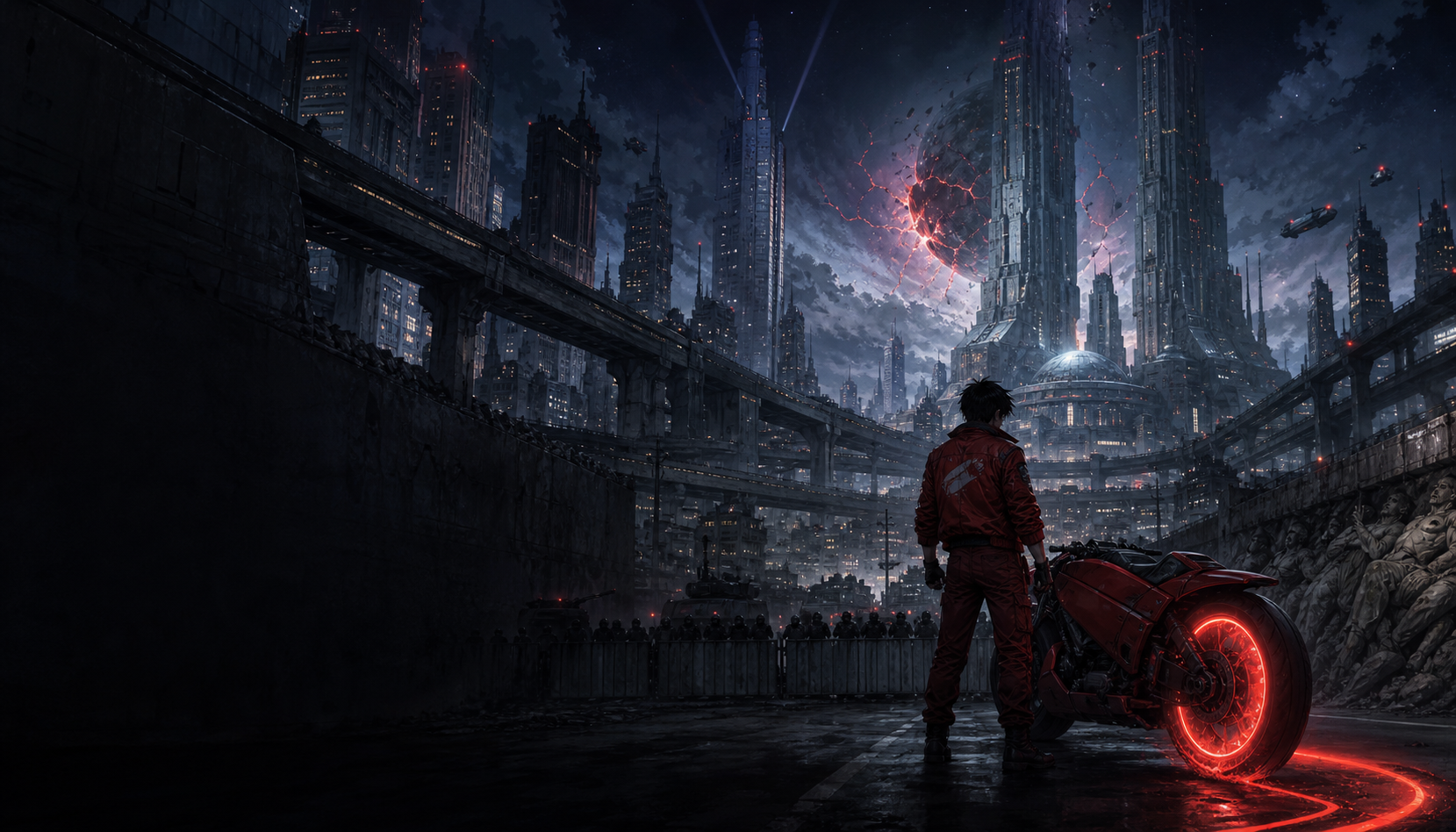
Akira
A city rebuilds after catastrophe, gives teenagers motorcycles instead of futures, and acts shocked when one frightened boy gains enough power to answer back.
Akira gets introduced as a technical miracle so often that the human mess underneath can disappear. Yes, the red motorcycle matters. The light trails matter. The impossible crowd animation matters. The soundtrack can make a living room feel like a ritual chamber. None of those achievements explain why the film still feels dangerous. Katsuhiro Otomo built a story about a society that knows how to rebuild concrete faster than trust. Neo-Tokyo can raise towers, highways, stadiums, laboratories, and military checkpoints. The city cannot give Tetsuo one stable reason to believe that weakness will not make him disposable.
That failure turns a teenage inferiority complex into an urban apocalypse. Kaneda and Tetsuo are not clean symbols. They are loud, cruel, loyal, insecure boys who have learned to perform toughness because nobody around them treats tenderness as useful. The government sees bodies as containers. The school sees students as discipline problems. The army sees psychic children as strategic assets. The biker gang at least sees one another, although even that affection comes wrapped in insults, hierarchy, and fists. The film’s tragedy grows from that miserable menu of choices.
Contents
- My actual reaction
- Before Neo-Tokyo
- How the film was built
- The city as a machine
- Kaneda, Tetsuo, and boyhood
- Body horror and adolescence
- Children as state property
- The sound of a warning
- Manga versus film
- What the ending means
- Easter eggs and visual echoes
- Cultural and industry impact
- What aged well and what did not
- Final take
My actual reaction: the motorcycle is the bait
The famous opening bike chase works because Otomo refuses to make motion feel weightless. Tires grip and slide. Brake lights smear across wet pavement. Riders lean with reckless confidence, then crash with ugly force. Kaneda’s machine looks like fantasy, but every skid reminds us that flesh remains fragile. The movie announces a central argument before anybody explains the plot: technology can expand what a body does without fixing what a person needs.
My favorite trick arrives in the contrast between speed and waiting. The gang tears through the city, yet nearly every institution keeps young people suspended. School offers punishment without direction. Police process bodies. Doctors stare at readings. Politicians debate control. Protesters wait for revelation. Tetsuo spends much of the story strapped down, examined, guarded, or told that somebody else understands him better than he understands himself. His eventual refusal feels satisfying for about five seconds. Then liberation becomes domination, because Tetsuo learned power from the same adults who used power against him.
That emotional contradiction separates Akira from a basic rebellion fantasy. A weaker movie would let Tetsuo become righteous once the state loses control. Otomo gives him every reason to rage and no wisdom for using rage. Sympathy and fear can share the same scene. The audience can understand why Tetsuo hates being rescued by Kaneda while also recognizing that Tetsuo’s answer will crush people who never hurt him. The film never asks us to choose between “victim” and “monster.” The tragedy comes from watching one person become both.
Before Neo-Tokyo: postwar memory, protest, and bored children
Otomo has described the manga’s starting point in unusually direct terms. He wanted a future Japan shaped by the atmosphere after World War II: rebuilding, political factions, foreign influence, uncertainty, and reckless teenagers racing motorcycles because the adult world offered little worth joining. That explanation matters more than a hunt for one perfect historical allegory. Neo-Tokyo is not Tokyo with a science-fiction filter. The city is a compressed memory of destruction followed by development, with prosperity sitting on top of unresolved fear.
The opening blast resembles an atomic detonation, but the film dates the catastrophe to 1988 and rewrites history around a new World War III. That choice gives the image distance without making the reference vague. Japanese viewers do not need a lecture on cities destroyed in white light. Otomo uses the visual grammar of nuclear memory, then connects that memory to a modern security state. The danger no longer arrives only from an enemy bomber. Scientists, generals, and officials inside the nation have built the conditions for another catastrophe.
Neo-Tokyo also carries the political noise of the 1960s and 1970s. Student protest, police violence, factional struggle, and public distrust fill the streets. The demonstrators never become a single noble movement. Some march, some riot, some follow apocalyptic religious claims, and some simply get caught between police lines. That confusion feels intentional. Mass politics appears as lived pressure rather than a neat civics lesson. People know the city has lied. They do not agree on what truth should replace the lie.
The biker gangs complete the historical mixture. Japanese bosozoku culture gave alienated youth a loud uniform, a machine, a crew, and a way to occupy public space. Kaneda’s gang lacks a developed political program, but their speed becomes a claim to the city. Adults built Neo-Tokyo. Teenagers carve temporary ownership into the roads. The motorcycles turn social exclusion into noise that nobody can ignore.
That background keeps the film from becoming a prophecy produced by magic. Akira’s power may be supernatural, yet every disaster around that power comes from ordinary choices: secrecy, competition, military thinking, scientific ambition, and adults who believe control counts as care. The explosion is spectacular. The institutional habits behind the explosion are familiar.
How Akira was built, and why the money shows
The scale of production has become part of the legend. Contemporary accounts describe a budget around ¥1.1 billion, extraordinary for Japanese animation at the time. The Akira Committee brought together major companies to spread the risk. That consortium model mattered because Otomo’s demands were not compatible with a cheap television pipeline. Neo-Tokyo needed crowds, traffic, reflections, moving machinery, changing light, and characters whose faces could carry dialogue rather than merely wait for mouths to flap.
Reports commonly cite 327 colors, including 50 created for the production. Those numbers sound like trivia until the night scenes make their purpose clear. Most of the movie lives after dark. Standard palettes could not give every tunnel, dashboard, alley, hospital corridor, and neon sign a distinct temperature. Otomo wanted darkness with information inside. Blue-black concrete, bruised skin, red warning lights, green monitors, amber streetlamps, and white medical rooms create emotional geography. Kaneda’s red bike becomes iconic partly because the city gives that red something to fight.
Large portions were animated “on ones,” meaning a new drawing could appear for each of cinema’s 24 frames per second. Anime production often holds drawings across two or three frames, a practical method that can still produce brilliant work. Akira uses fuller motion where physical precision strengthens the scene. A sliding motorcycle, a moving crowd, a mechanical door, or a face forming a word can feel unusually continuous. The technique does not make every second uniformly fluid. The achievement comes from placing labor where motion carries weight.
Dialogue was also recorded before key animation, a workflow closer to much American feature animation than standard Japanese post-synchronization. Animators could shape mouths and gestures around performances. That process helps the gang sound like boys interrupting one another instead of voice tracks laid over completed poses. Small expressions carry status. Kaneda’s grin can become a challenge. Tetsuo’s downward glance can show resentment before the screenplay names anything.
The production employed an enormous pool of animation talent, and later artists often point to the film as a school in motion, effects, and layout. Vehicles bank through perspective. Buildings remain stable while cameras seem to move. Glass breaks, smoke curls, cables tighten, liquids spill, and flesh changes volume. None of that craft exists only to show off. Material behavior makes the impossible power feel present. When Tetsuo loses control, the audience believes the room has rules that his body is violating.
The famous bike slide is more than a cool pose
Kaneda’s sideways stop has been copied and quoted for decades. The move works because the entire film has taught us to respect momentum. The bike does not freeze for a poster. Kaneda fights the machine’s speed, plants a foot, shifts his weight, and lets the vehicle rotate around him. The shot delivers swagger through physics. Later imitations often preserve the silhouette but lose the tension. Otomo’s version feels iconic because the stunt looks barely controlled, which also describes Kaneda.
Neo-Tokyo is a machine that eats explanations
The city contains more information than any character can process. News screens compete with street signs. Political meetings run beside military operations. Construction surrounds ruins. A stadium promises a national future while secret tunnels protect a buried past. Otomo avoids the clean establishing shots that usually make fictional worlds comfortable. Neo-Tokyo feels legible at the level of infrastructure and confusing at the level of authority. We can see how traffic moves. We cannot see who truly answers for anything.
That difference matters. The Colonel seems powerful because armed men follow his orders. He still spends much of the story arguing with politicians, scientists, and systems that limit him. The council members appear powerful because they govern, yet they treat catastrophe as a contest over blame. Dr. Onishi appears to possess technical knowledge, although every new measurement makes him more fascinated and less capable of protecting Tetsuo. Nobody owns the whole machine. Each adult controls one lever and assumes another person understands the consequences.
The Olympic construction site sharpens the joke. A huge stadium rises over the chamber holding Akira’s remains. Public spectacle depends on buried violence staying buried. Signs promise the games while protesters crowd outside. When real Tokyo prepared for the postponed 2020 Olympics decades later, those images gained an eerie second life. The coincidence made the film look prophetic, but prophecy may be the wrong word. Otomo understood a recurring political habit: governments use construction and ceremony to project recovery, even when unresolved damage remains under the foundation.
Neo-Tokyo’s scale also changes how loneliness appears. Tetsuo is rarely physically alone. Soldiers, doctors, bikers, classmates, and protesters surround him. Emotional isolation grows inside crowds. The city offers constant contact without intimacy. That pattern feels more contemporary now than the computers do. A person can be watched, measured, discussed, and still remain unseen.
Kaneda and Tetsuo: friendship poisoned by hierarchy
Kaneda loves Tetsuo. Kaneda also enjoys being the person who saves Tetsuo. Both statements can be true. Their friendship formed inside a hierarchy that neither boy knows how to discuss. Kaneda leads. Tetsuo follows. Kaneda owns the better bike, wins fights, flirts confidently, and turns danger into performance. Tetsuo receives protection as proof that he needs protection. Each rescue keeps him alive and confirms the identity he hates.
The flashbacks to childhood reveal why the bond matters. Kaneda approached a frightened new boy when institutions had reduced both children to files. That memory gives Kaneda’s loyalty real tenderness. The same memory traps Tetsuo in the role of the smaller child. He does not merely want strength. He wants history revised. Psychic power seems capable of making every old humiliation false.
Masculinity gives them almost no language for that wound. Kaneda teases, boasts, fights, and keeps moving. Tetsuo sulks, lashes out, and insists that he never needed help. Neither can say, “I love you, and sometimes your love makes me feel small.” The film lets their conflict become absurdly destructive because the emotional sentence remains unavailable. A city dies around two boys who cannot negotiate care without turning care into rank.
Kaori exposes the cost of that masculine contest. She sees Tetsuo’s fear and stays near him, but the story gives her too little power to change his path. His treatment of her shifts between need, affection, control, and neglect. During the final mutation, her death becomes the most terrible proof that Tetsuo’s power cannot distinguish protection from possession. The body that wanted to become invulnerable crushes the person who offered closeness.
Kaneda’s heroism remains messy too. He charges after Tetsuo partly from loyalty, partly from anger, and partly because action is his only reliable emotional skill. He cannot repair Tetsuo. He can refuse to abandon him. That refusal gives the climax its human center. Kaneda enters a disaster created by governments and gods because his friend is somewhere inside.
Body horror: puberty with the safety rails removed
Tetsuo’s transformation gets discussed as body horror because the images are revolting, but disgust alone undersells the design. His body becomes an argument about adolescence, disability, illness, sexual anxiety, and technological power. Teenagers already experience bodies as unreliable machines. Growth changes strength, appetite, desire, skin, voice, and social status. Tetsuo receives that ordinary instability at a cosmic scale. He becomes stronger than every adult while losing the basic authority to decide where his own arm ends.
The replacement arm makes the conflict visible before the final mutation. Tetsuo assembles a mechanical limb from wreckage through psychic force. The result looks impressive and fragile. Metal becomes an extension of will, but the new arm also marks injury. Power has not restored the original body. Power has built armor around loss.
When flesh overwhelms the stadium, Tetsuo’s fantasy collapses. He wanted a body nobody could dominate. He receives a body that dominates him. Skin expands beyond identity. Organs, cables, machinery, and debris merge. The sequence rejects the superhero promise that greater power produces a more complete self. Tetsuo becomes physically enormous while his voice returns to the panic of a child asking for help.
The mutation also makes private pain public. Shame often tells people to hide weakness until control returns. Tetsuo’s weakness grows large enough to cover a national monument. Soldiers, friends, and spectators cannot look away. The city must finally witness what its laboratory created, although the witness comes too late to count as care.
Otomo avoids a simple medical metaphor. Tetsuo is not a lesson about one diagnosis, and reading the body as a coded disability alone can flatten the film. The broader pattern concerns institutions that treat bodies as projects. Doctors value data. The military values force. Tetsuo begins valuing his body only as evidence that he has surpassed Kaneda. Nobody teaches him that a vulnerable body can still deserve dignity.
The state keeps calling child sacrifice research
Takashi, Masaru, and Kiyoko look elderly and young at once. Their faces carry the cost of experiments performed during childhood. The numbers on their palms replace names with inventory marks. The state has converted people into a program and then hidden the program underground. Every adult euphemism makes the violence cleaner on paper. “Subjects,” “potential,” “levels,” and “control” allow officials to discuss frightened children without sounding frightened by themselves.
The Colonel complicates an easy anti-military reading. He recognizes danger earlier than the politicians and treats the espers with more respect than many scientists do. He also continues the system that confines them. Competence does not erase complicity. His tragedy comes from understanding enough to fear the project but not enough to imagine a world without the project.
Dr. Onishi represents another familiar failure: curiosity without an ethical brake. Tetsuo’s readings become beautiful to him. Scientific wonder crowds out responsibility. The doctor can recognize a universe forming in the data while ignoring the teenager suffering in front of the machine. Knowledge becomes another appetite.
Akira himself survives as refrigerated pieces, labeled and stored beneath the stadium. The arrangement may be the film’s sharpest image of bureaucratic confidence. Human remains capable of ending a city have been divided into containers, as though proper cataloging could make catastrophe obedient. Adults trust labels because labels create the feeling of control. The film answers with rupture.
The protest movement and religious cult sense the lie but cannot reach the truth. They turn Akira into salvation because power hidden by the state invites mythology. Secrecy does not prevent public interpretation. Secrecy removes evidence from interpretation. The resulting vacuum fills with rumor, worship, anger, and conspiracy. Neo-Tokyo’s leaders create the exact instability they claim secrecy will prevent.
The soundtrack makes machinery feel ancient
Shoji Yamashiro and Geinoh Yamashirogumi refuse the obvious cyberpunk score. Instead of filling Neo-Tokyo with sleek synthesizers, the music uses voices, breath, percussion, gamelan sonorities, and ritual repetition. The result makes the futuristic city feel older than the buildings. Technology becomes one layer in a much longer human cycle of fear, violence, ceremony, and rebirth.
“Kaneda” gives the motorcycle gang a chant rather than a conventional action theme. Percussion makes speed feel communal. Voices turn the boys into a legend before they have earned one. The music understands Kaneda’s self-image and quietly enlarges the joke. A teenager with a jacket and a bike enters like a folk hero.
Silence carries equal weight. Medical rooms hum. Empty corridors hold distant mechanical sound. Psychic pressure can reduce a crowded scene to breath and vibration. Those choices make explosions feel earned. Loudness has shape because the film allows quiet to establish space first.
The score also resists the division between “modern” and “traditional” sound. Neo-Tokyo does not replace the past. The city samples, buries, and repeats the past. The soundtrack turns that argument into something the body understands before the mind catches up. Low percussion lands in the chest. Layered voices suggest a community larger than any person onscreen. Tetsuo’s private crisis gains the scale of myth without losing the terror of a boy in pain.
The manga and film are related arguments, not matching files
Otomo began the manga in 1982, and the enormous story continued beyond the film’s production. The completed six-volume edition runs thousands of pages. A two-hour adaptation could never preserve the same political factions, character arcs, destruction, and reconstruction. More importantly, the film arrived before the manga’s ending. Otomo had to create cinematic closure while the printed story remained unfinished.
The largest difference concerns Akira. In the film, Akira exists mainly as remains and as a force summoned near the end. In the manga, Akira returns as a living child and becomes central to a much larger struggle after Neo-Tokyo’s destruction. Lady Miyako, reduced in the film, holds major spiritual and political importance on the page. Kei’s role expands. The Colonel’s choices receive more room. Kaneda and Tetsuo move through a broader war over the ruins.
Calling the film a summary would therefore be misleading. Otomo extracts one emotional spine: Tetsuo’s humiliation, expanding power, conflict with Kaneda, and final transformation. Political complexity becomes atmosphere around that spine. The result sacrifices explanation for velocity. Viewers often finish the film with questions because the movie wants disorientation. Neo-Tokyo contains systems bigger than any available point of view.
The manga gives consequences time. Communities form after destruction. Power rearranges politics rather than ending politics. The film gives sensation priority. A two-hour catastrophe becomes a closed circuit, beginning with a city-forming blast and ending with another creation event. Reading the manga after watching does not simply fill holes. The books change the scale of the moral question from “Can friendship reach one boy?” to “What kind of society grows after every institution collapses?”
Both versions share Otomo’s distrust of tidy recovery. Ruins do not guarantee wisdom. Young people inherit adult violence and can reproduce that violence. Spiritual power does not purify politics. Survival creates another set of choices. The manga has room to keep asking. The film ends at the moment a new universe begins.
What Akira’s ending means
The ending refuses to explain psychic evolution in scientific language, which frustrates viewers trained to expect a final rulebook. The espers call Akira to contain Tetsuo’s uncontrolled expansion. Kaneda gets pulled into a field of memory and witnesses pieces of Tetsuo’s childhood. Akira’s scattered remains gather. A white sphere consumes the stadium and much of Neo-Tokyo. Kiyoko suggests that Tetsuo may one day control his power. Then a voice declares, “I am Tetsuo,” as light and matter form somewhere beyond ordinary space.
One reading treats the event as death. Tetsuo’s physical body disappears, and Neo-Tokyo pays for the experiment. Another treats the event as birth. Tetsuo crosses into a new state and possibly creates a universe. The film supports both because creation and destruction share visual language. The opening explosion gives birth to Neo-Tokyo. The final explosion destroys Neo-Tokyo while suggesting another beginning.
The key emotional event happens before metaphysics. Kaneda finally sees Tetsuo’s memories without the old hierarchy. He encounters the frightened child rather than the rival demanding recognition. Tetsuo reaches Kaneda through memory when ordinary conversation has become impossible. Their friendship cannot save the city or restore Kaori. The connection still matters because Tetsuo’s final identity is not spoken into an empty universe. Kaneda hears him.
The line “I am Tetsuo” sounds simple after two hours of cosmic confusion. Simplicity gives the line force. Tetsuo spent the film defining himself against Kaneda, doctors, soldiers, and Akira. His last statement removes comparison. The new self may be terrifying, liberated, lonely, divine, or all four. For once, nobody else supplies the label.
The survivors emerge into ruins, and the film offers no comforting plan. Kaneda calls for Kei. The Colonel watches the city fall. Water and debris replace monuments. Survival remains small beside destruction. That scale keeps the ending from turning into triumph. Kaneda survives his attempt to reach Tetsuo. He does not win.
Easter eggs, visual echoes, and details worth tracking
The 2020 Olympic site
The stadium signs point toward a 2020 Neo-Tokyo Olympics and display the number of days remaining. Real Tokyo later won the 2020 Games, which were postponed to 2021 during the COVID-19 pandemic. The overlap became famous because reality seemed to walk into Otomo’s background art. The stronger detail remains thematic: spectacle rises directly above a buried national secret.
Numbers instead of names
The espers’ palm numbers make bureaucratic ownership visible. Numbers 25, 26, and 27 identify Kiyoko, Takashi, and Masaru. Tetsuo becomes Number 41 in the program’s logic. The sequence implies many absent children without giving the audience a memorial list. Erasure becomes part of the design.
Kaneda’s jacket
The pill emblem on Kaneda’s jacket links youth identity, pharmaceuticals, and rebellion. Drugs circulate through the gang’s world, while the state uses medication to regulate psychic bodies. A stylish symbol therefore sits inside a larger argument about chemical control. The English slogan often associated with the design adds another layer of borrowed cool, but translations and reproductions vary, so the pill itself remains the safest visual anchor.
The nursery toys
Tetsuo’s hallucination turns toys into attackers. Childhood objects become grotesque because childhood never functioned as a protected category in this world. The scene previews the final mutation: soft, rounded forms expand, leak, and absorb space. The teddy bear is frightening not because toys are secretly evil, but because comfort has lost a stable meaning.
The moon
Tetsuo’s attack damages the moon, giving personal rage a planetary mark. Later science-fiction images of a fractured moon can resemble Akira, although resemblance alone does not prove direct influence. Within the film, the damage announces that no military border can contain his power. Neo-Tokyo’s secret has become visible from space.
The repeated rebuilding
Construction appears everywhere before destruction returns. Cranes, unfinished roads, scaffolding, and stadium work make recovery feel permanent rather than complete. Neo-Tokyo is always becoming and never healed. The background artists turn a political argument into architecture.
Cultural and industry impact: the gateway label is true but incomplete
Akira became a major international gateway for adult Japanese animation. The Academy notes that the film failed to recoup its enormous budget during the initial Japanese run but developed a strong American cult audience through home video. BFI describes the movie as a work that challenged assumptions about what hand-drawn animation could contain. Those claims explain part of the Western story: viewers encountered sexual anxiety, political violence, urban decay, and graphic transformation in a form many distributors still marketed primarily to children.
The gateway narrative can become self-centered when Western histories act as though anime began when English-speaking viewers noticed. Japanese animation already had long histories, industries, genres, stars, and audiences. Akira did not invent mature anime. The film helped foreign distributors prove that a market existed for Japanese animation presented as something other than children’s television. That distinction respects both the film’s international role and the culture that produced the film.
The visual influence spreads across animation, comics, games, fashion, music videos, and live action. Creators repeatedly borrow the bike slide, the red vehicle, the expanding flesh, the neon road, and the city-scale psychic blast. Some references operate as affectionate quotation. Others use Akira as shorthand for “serious cyberpunk.” The danger of shorthand is that surface style can detach from political content. Red light trails are easy to copy. A story about institutional abandonment and power is harder.
The film also changed expectations for urban animation. Neo-Tokyo behaves like a production challenge thrown at every future artist: can a drawn city possess traffic, crowds, changing weather, interiors, advertisements, and social class without becoming visual noise? The answer required layout discipline as much as budget. Background detail always serves movement or mood. The city feels dense because information follows spatial logic.
Cyberpunk outside Japan often centers corporations and hackers. Akira centers militarized government, medical experimentation, urban youth, and psychic evolution. That combination widened the global image of cyberpunk. The future could be biological as well as digital. The rebellious body could threaten the network without plugging into a computer.
Home-video circulation matters just as much as theatrical reputation. Fans copied tapes, rented releases, argued about dubs, and introduced friends. The movie became an object people handed to one another with a warning: animation can do this. That informal circulation built cultural weight that box-office totals could not measure.
The 4K restoration brought another question. Restoration can reveal paint, grain, linework, and color separation that older releases blurred. Restoration can also change how audiences remember a film first encountered on soft VHS. Akira now exists across subtitled prints, multiple English dubs, home-video masters, and restored editions. No single viewing history belongs to everyone. The shared object remains the production’s overwhelming visual intention.
Why audiences keep wanting Tetsuo to win
Tetsuo’s appeal creates an uncomfortable test. Long before his choices become indefensible, the movie gives him a grievance that almost anybody can recognize. He hates being treated as the weak friend. He hates needing help from somebody who enjoys looking capable. He hates adults touching, sedating, testing, and discussing him without consent. When psychic force finally makes soldiers step backward, the reversal offers a sharp little burst of satisfaction. A frightened teenager has found the one language every authority understands.
That satisfaction does not mean viewers secretly approve of mass murder. Identification often begins with the emotional problem rather than the chosen answer. Tetsuo wants the humiliation to stop. The audience can share that wish while rejecting the violence. Otomo keeps those positions close enough to create tension. Every cruel act pressures sympathy without erasing the experiences that produced sympathy.
The pattern resembles what psychologists call compensatory control, although the film should not be reduced to a diagnosis. People who feel powerless may seek systems, identities, or acts that restore a sense of order. Tetsuo finds a brutally direct version. Objects move because he wants them to move. People fly backward because he wants them gone. The ordinary uncertainty of social life disappears. Force supplies immediate feedback.
Power then becomes addictive because every success creates a larger threat. Soldiers attack, so Tetsuo must become stronger. Akira’s reputation challenges him, so he must reach Akira. Kaneda’s presence recalls weakness, so Kaneda must be defeated. The goal keeps moving because the wound was never a shortage of force. Tetsuo wants proof that his former self no longer counts. No amount of power can produce that proof while memory remains.
Kaneda attracts a different fantasy. He moves through danger without admitting fear. He keeps friends, gets the bike, flirts with Kei, challenges the army, and jokes while the city collapses. Confidence seems natural on him. The film gradually reveals confidence as another coping strategy. Kaneda turns feeling into motion before feeling can trap him. His approach looks healthier because he does not mutate into a mountain of flesh, but his emotional range remains narrow. Friendship finally forces him to stop performing and listen.
Those two fantasies help explain the film’s longevity. Some viewers recognize the desire to become untouchable. Others recognize the desire to act unbothered. Tetsuo and Kaneda turn common defenses into science fiction. One expands until nobody can contain him. The other keeps moving until love makes forward motion impossible.
Reading the film through rooms, roads, and circles
Akira organizes meaning through spaces as carefully as dialogue. Roads belong to the gang because roads reward speed. Classrooms belong to adults because desks fix bodies in rows. Laboratories belong to the state because straps, screens, and observation windows turn bodies into objects. The stadium belongs to public fantasy, while the chamber underneath belongs to hidden history. Tetsuo crosses those spaces in an order that tracks his changing status.
At first, he rides behind Kaneda through open streets. After the collision, soldiers place him inside vehicles and rooms he cannot leave. Psychic power then lets him break walls and move vertically. He rises above traffic, floats over soldiers, and approaches the stadium as though ordinary routes no longer apply. Freedom from architecture looks like freedom from society. The final transformation reverses that promise. His body becomes another room, trapping Kaori and swallowing machinery. The person who escaped every container becomes a container nobody can escape.
Circles repeat throughout the film. Wheels, pills, eyes, stadium architecture, monitoring screens, craters, and psychic spheres connect movement with return. The gang races in loops through a rebuilt city. Scientists repeat an old experiment. Politicians repeat old denials. The final sphere resembles the opening blast, making history appear circular. Yet the closing declaration offers a possible break. Tetsuo may have entered another cycle, or he may have created a different starting point.
Red carries similar double meaning. Kaneda’s bike and clothes make red a color of identity, youth, and speed. Warning lights and blood make red a color of danger. The glow of Neo-Tokyo makes red commercial. The psychic catastrophe makes red cosmic. One color travels from fashion to injury to creation, refusing a single symbolic definition.
Hands deserve attention too. Kaneda grips handlebars, weapons, and friends. Tetsuo uses a hand to command matter, then loses an arm and builds another. The espers carry numbers on their palms. Kaori reaches for Tetsuo and gets trapped by a body that no longer recognizes touch. Hands usually connect intention to the world. In Akira, hands expose who has control, who has been labeled, and whose attempt to hold another person becomes harmful.
The camera frequently places small bodies against giant structures. Scale turns politics into feeling. Teenagers appear tiny beneath highways and towers built by adults. Tetsuo’s growth answers that imbalance literally. He becomes larger than the institutions that dwarfed him, but size gives no stable self. The film’s visual argument remains consistent: a person can overpower a structure without learning how to live beyond the structure.
What aged well, and what deserves an argument
The film’s distrust of institutions aged painfully well. Politicians protect position, experts hide behind specialization, and public works promise renewal while vulnerable people absorb the cost. Tetsuo’s resentment also remains recognizable. Social media did not invent the ache of comparison. The internet simply built larger scoreboards.
The treatment of women feels thinner. Kei receives agency, political commitment, and psychic importance, but the film still uses her mainly to move Kaneda toward the central conflict. Kaori carries even less narrative protection. Her death is emotionally devastating and thematically purposeful, yet her inner life remains underwritten. The manga gives women more room, especially Lady Miyako and Kei. A modern review should not excuse the film’s imbalance merely because the men are psychologically rich.
The gang’s casual cruelty can also be difficult. Their behavior belongs to the world Otomo depicts, not a handbook for lovable friendship. Kaneda’s charisma encourages audiences to forgive him quickly. Looking harder improves the movie. His loyalty becomes meaningful because loyalty grows beside arrogance, not because arrogance was secretly harmless.
The political plot can feel compressed to the edge of confusion. Names, factions, and motives arrive quickly. That compression gives the film urgency but sometimes asks atmosphere to perform the work of development. Viewers who prefer the manga are not missing the point. They may simply want political consequences that extend beyond the sprint toward the stadium.
The spectacle remains astonishing, although spectacle should not end the conversation. The final mutation can overwhelm the smaller human tragedy. The best way to watch the sequence is to keep listening for Tetsuo’s voice. Beneath every technical achievement, a boy still wants somebody to understand what is happening to him.
Final take
Akira is not timeless because the movie predicted every gadget, protest, or Olympic sign. The film survives because Neo-Tokyo understands a durable social lie: rebuilding structures can look like rebuilding a society. Towers rise, budgets grow, ceremonies return, and officials congratulate one another. Meanwhile, children inherit fear that no adult has named.
Tetsuo does not become dangerous simply because he gains power. He becomes dangerous because power enters a person trained to confuse respect with dominance and care with humiliation. Kaneda loves him but cannot speak without ranking him. The state studies him but cannot recognize him. The city fears him only after his pain becomes large enough to damage property.
That reading makes the movie sadder and smarter than a parade of iconic shots. The animation gives private shame public scale. The soundtrack gives modern violence an ancient pulse. The ending gives one discarded boy a universe, then refuses to pretend that a universe can return everyone he crushed along the way.
Rating: Essential. Not because every subplot lands cleanly, and not because influence excuses weakness. Akira remains essential because the movie understands that technological power never arrives alone. Power carries every social wound already present in the person, the laboratory, and the city holding the switch.
Sources and further reading
- Kodansha: AKIRA manga series, publisher overview and edition history.
- Kodansha interview with Katsuhiro Otomo, including his postwar inspiration and production memories.
- Academy of Motion Picture Arts and Sciences: Akira, production credits, reception, and animation legacy.
- BFI: 10 great anime films, critical context for the film’s political and visual importance.
- BFI Sight and Sound: 50 key anime films, production scale, palette, and animation context.
- The Japan Times: Collecting Akira, one scene at a time, production budget and full-animation technique.
- Miraikan: The sound of AKIRA, Shoji Yamashiro, Geinoh Yamashirogumi, and the score’s musical materials.
- Bandai Namco: AKIRA 4K remaster release, official restoration information.
- JustWatch U.S.: Akira and Apple TV: Akira, current U.S. rental and purchase availability checked August 13, 2026.