
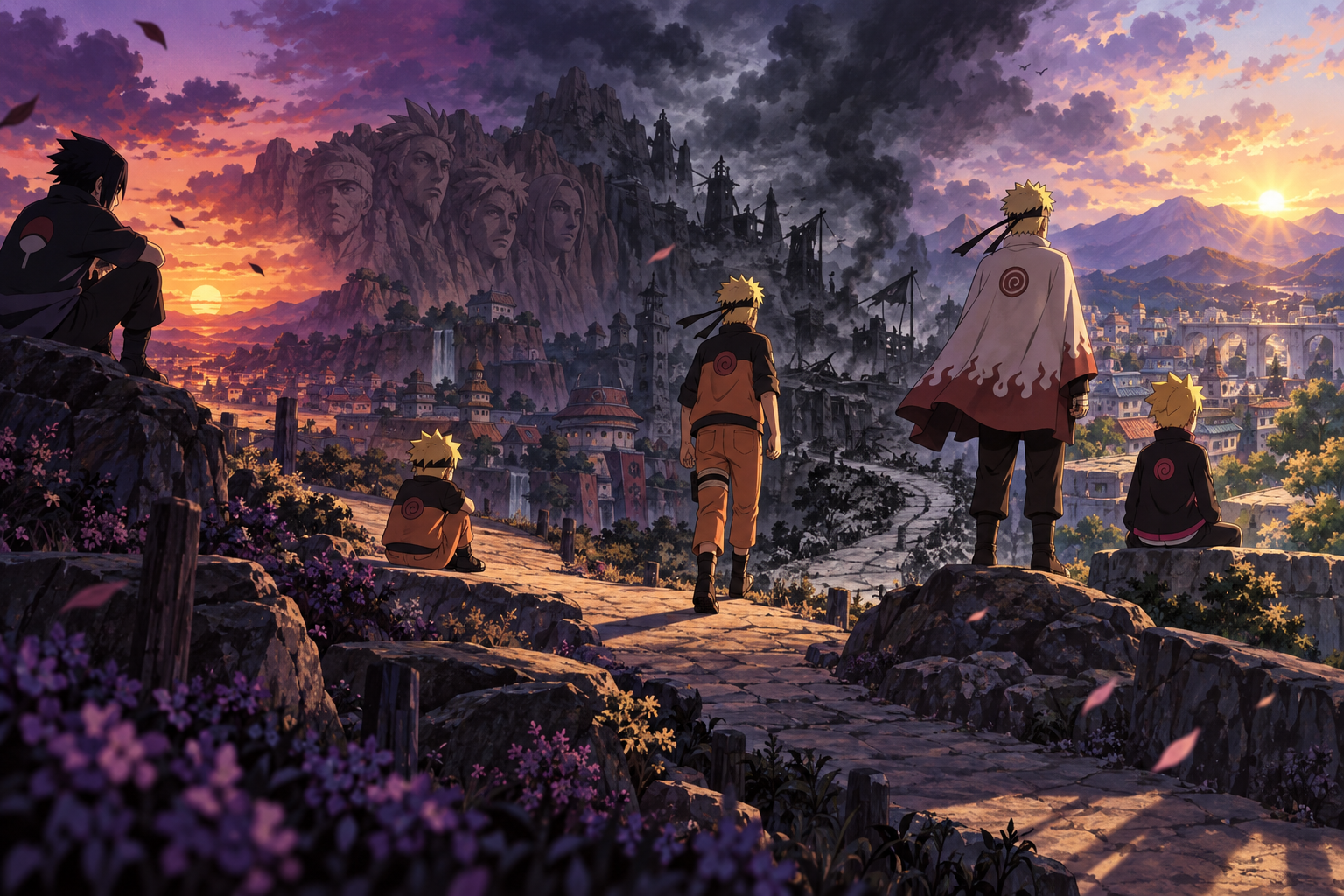
RaeRae Reviews · Animated Franchise
Naruto Animated Franchise Review
Naruto starts with one lonely child making himself impossible to ignore. More than a thousand television episodes later, the franchise has become a sprawling argument about recognition, inherited violence, chosen family, political memory, and what happens when the child who wanted everyone to see him becomes the adult too busy to see his own son.
The bottom line
A messy masterpiece about children carrying adult failures
Across Naruto, Naruto Shippuden, and Boruto: Naruto Next Generations, I land at an 8 out of 10 for the animated franchise as a whole. That number holds enormous peaks, exhausting filler, unforgettable character work, avoidable repetition, thrilling choreography, and a political imagination that can name a cycle of violence more clearly than it can imagine dismantling the institutions that keep producing it.
The franchise’s emotional thesis is simple enough for a child and durable enough to survive adulthood: being seen can save a life. Naruto’s loudness is not empty comedy. It is survival behavior. Sasuke’s silence is not maturity. It is grief hardened into a private justice system. Sakura’s early crush is not her final definition, even when the writing keeps trying to drag her back toward it. Kakashi’s coolness is accumulated bereavement with one eye still pointed toward tomorrow.
What makes Naruto last is not flawless lore. It lasts because its best confrontations are arguments between wounded people who built different philosophies from the same kind of abandonment. A fight becomes memorable when the fists are carrying beliefs.
Part one
Original Naruto understands loneliness before it understands power
The first 220 episodes have the franchise’s clearest scale. The Land of Waves arc teaches Team 7 that the shinobi system can turn children into tools and call the result professionalism. Haku and Zabuza are not disposable villains; they are the first warning that affection survives even where the system forbids people from naming it.
The Chūnin Exams then widen the map without losing the kids. Rock Lee’s work, Neji’s fatalism, Gaara’s violence, Hinata’s quiet refusal to stay down, and Shikamaru’s tactical boredom all reveal different responses to expectation. Naruto beating Neji matters less as a destiny speech than as a lonely child rejecting the idea that pain gets the last word.
The Sasuke Retrieval arc is where friendship becomes obsession and the story’s central promise becomes dangerous. Naruto refuses to let Sasuke disappear because nobody came after Naruto when he was spiraling. It is beautiful. It is also the beginning of a pattern in which saving one boy can eclipse the inner lives of everyone standing nearby.
Then the filler wall arrives. Some anime-original stories give the village texture and let supporting characters breathe. Too many reset before they can matter. A complete watch becomes endurance instead of discovery, and that is the first time the television production machine visibly overrules the story’s emotional rhythm.
Part two
Shippuden reaches higher—and makes every weakness louder
Shippuden is the franchise at its most ambitious. The Akatsuki turn the casualties of the shinobi world into a gallery of competing conclusions. Pain is the essential opponent because he forces Naruto to answer the question beneath every revenge plot: what do you do with justified rage when using it will manufacture the next grieving child?
Jiraiya’s death, Naruto’s return to Konoha, and the conversation with Nagato form the emotional summit. Naruto does not win because he possesses a cleaner ideology. He wins because he admits he does not yet know how to deliver peace and chooses not to pretend murder is an answer simply because it is available.
Sasuke’s story exposes the village’s moral compromise. The Uchiha massacre is not merely a tragic family secret; it is state violence processed through a child soldier and hidden behind respectable leadership. The series recognizes this horror, then repeatedly rushes toward reconciliation without giving institutional accountability equal dramatic weight.
The Fourth Shinobi World War offers scale, resurrection, lore, spectacle, and too many escalations fighting for the final word. Madara’s presence has mythic force. Kaguya’s arrival changes the genre temperature at exactly the moment the human conflict needs room to land. Naruto and Sasuke’s final fight works because it returns the franchise to two boys, one bond, and the exhausted question of whether love can survive the damage done in its name.
The inheritance era
Boruto asks the right sequel question, then stretches the answer thin
Boruto inherits peace from children who had to fight for it. Its best idea is the discomfort hiding inside that victory. What does the heroic generation look like to children who experience those heroes as parents, officials, brands, and history-book certainty?
Boruto’s resentment is not proof that he is spoiled beyond sympathy. He is a loved child watching public responsibility consume private presence. Naruto loves his family and still sends a shadow clone to a birthday. The clone disappearing makes emotional absence literal.
Sarada wants to become Hokage while carrying the clan history Konoha never honestly processed. Mitsuki must decide whether devotion programmed at his creation can become a freely chosen self. Kawaki enters as the wound the sequel needs: a child whose body was treated as property and who turns safety into a single person worth protecting at any cost.
The trouble is volume. Across 293 episodes, sharp domestic conflicts and excellent priority arcs sit among stories that occupy time without changing the characters. The anime-canon label cannot substitute for consequence. Material can count in continuity and still fail to earn its hours.
Narrative allocation
The women keep proving they can carry more than the franchise gives them
Naruto’s women are not empty characters. They are under-allocated characters. Sakura grows from an insecure student into a medical specialist whose strength saves lives on a scale few peers can match. Her training with Tsunade is earned. Her emotional orbit around Sasuke, however, is repeatedly allowed to override the sharper story about who she chose to become.
Tsunade carries grief, addiction, medical innovation, political leadership, and the burden of governing during catastrophe. Hinata turns fear into action long before romance becomes her primary framing. Konan understands the cost of Rain’s exploitation. Temari is politically literate, strategically capable, and wonderfully unwilling to flatter anybody. Each woman suggests a larger story the franchise too rarely follows.
Boruto should have corrected that imbalance. Sarada has the ambition, history, judgment, and combat ability to anchor a major branch of the sequel. Too often the expanding Karma mythology sidelines her. Peace changes the setting, but it does not consistently change whose interior life receives the most space.
The television reality
More than a thousand episodes make greatness compete with scheduling
Studio Pierrot’s animation history across Naruto is wildly uneven because the franchise is also a record of long-running weekly production. Routine episodes reuse framing, hold on faces, and dilute motion. Priority episodes explode with personality. Naruto versus Sasuke, Sakura and Chiyo versus Sasori, Kakashi versus Obito, and Naruto and Sasuke versus Momoshiki do not merely look expensive; their movement reveals character.
The music carries equal weight. Sadness and Sorrow can reopen a scene in a few notes. Shippuden’s percussion and choral textures turn arrivals into mythology. Openings and endings became cultural timestamps, the songs fans use to remember not only arcs but where they were when they watched them.
Filler is not automatically worthless. It becomes a problem when the audience can feel the production protecting distance from the source instead of telling the best possible story. A curated path through the franchise is not cheating. It is often the difference between appreciating its design and resenting its size.
Why it stays
Naruto became a global language for surviving rejection
The franchise traveled because Naruto’s premise does not require specialized knowledge: a child treated as a problem decides he will become impossible to discard. Fans recognized themselves in that hunger even when their lives looked nothing like Konoha.
Its hand signs, headbands, running pose, eye techniques, rivalries, and speeches became shared visual vocabulary. More importantly, its characters gave viewers ways to discuss loneliness, depression, found family, revenge, discipline, and the exhausting work of breaking an inherited pattern.
The fandom also keeps the critique alive. Loving Naruto does not require defending every pacing decision, every woman left waiting, every institutional shortcut, or every late-stage power escalation. Fandom is more interesting when affection and standards occupy the same room.
Final verdict
The franchise is strongest when recognition becomes responsibility
Original Naruto is the most focused character drama. Shippuden contains the highest emotional and visual peaks. Boruto has the smartest inheritance premise and the least disciplined overall delivery. Together they form a generational story about children inheriting systems adults insist are necessary.
Naruto’s victory is not simply becoming Hokage. It is learning to see people before they become enemies large enough for the village to notice. The tragedy is that the institutions around him remain more comfortable celebrating exceptional saviors than preventing exceptional suffering.
Watch the canon spine, keep the character-rich side stories that speak to you, and refuse the idea that completion must feel like punishment. This world deserves attention, not obedience. At its best, Naruto still does what it promised in episode one: it looks directly at a lonely child and says your pain is not the only future available to you.