
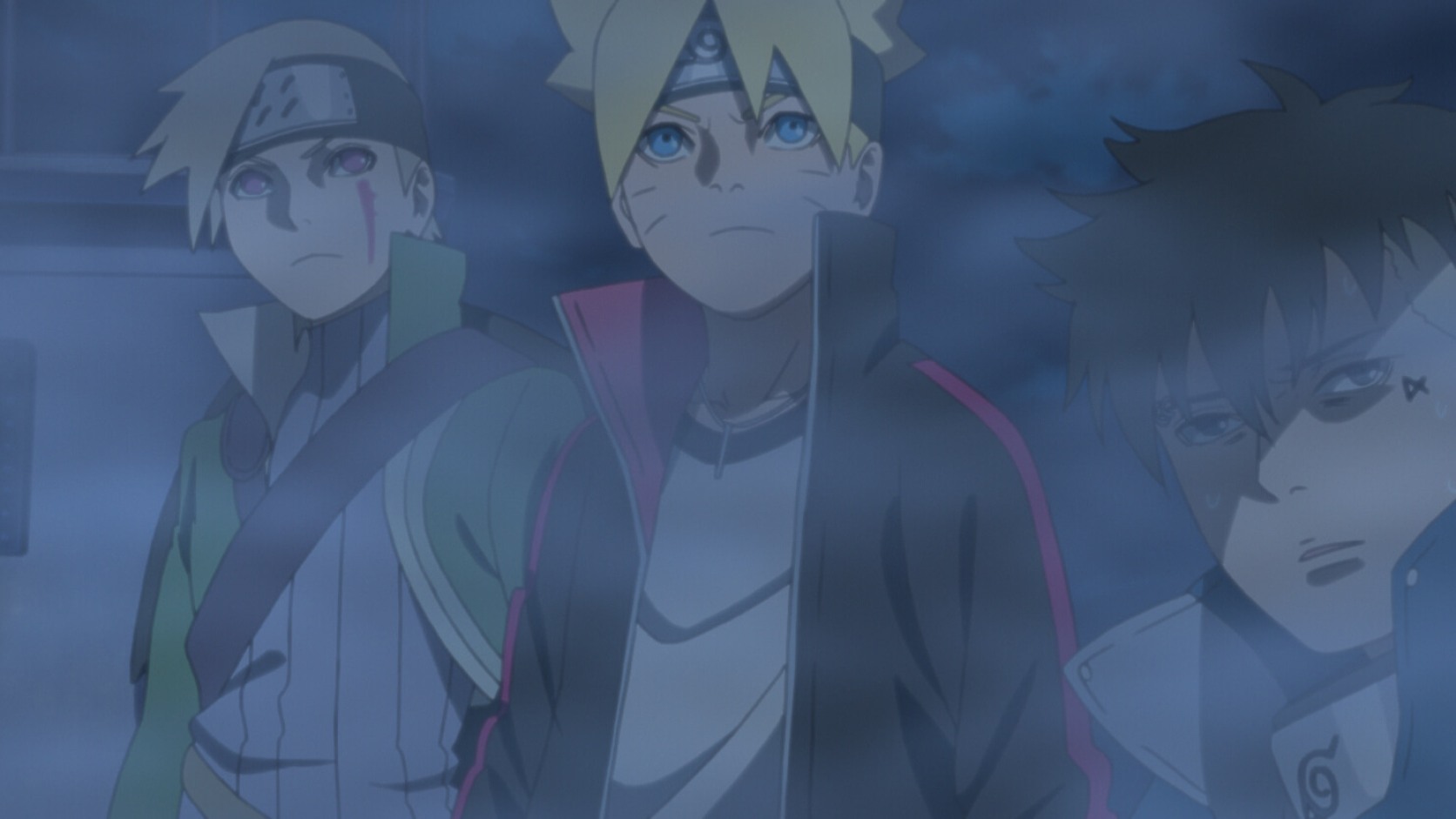
Cut and Run
A Funato mobile fortress splits Kagura’s small force while Dotou Island residents still need rescue; intelligence, evacuation, and rehabilitation all demand accountability.
Series: Boruto: Naruto Next Generations
Episode: 236 · Cut and Run
Arc: Great Sea Battle of the Hidden Mist Village
Release: February 13, 2022
Previous: Episode 235 · Infiltrating Dotou Island
Directory: All 293 Boruto episodes
Bottom line
Boruto Episode 236 begins with a rescue mission and immediately makes the rescue bigger. Dotou Island is still occupied. Civilians are still being used as labor. Team 5 has finally reconnected with Sarada and Mitsuki. Then a Funato mobile fortress appears offshore, so Kagura has to split a small force across two emergencies that should never have existed in the first place.
That title, “Cut and Run,” sounds quick. Nothing here is quick. Every route is crowded with people whose safety has been treated as optional by men chasing territory, gold, and revenge. The episode asks young shinobi to improvise inside a disaster created by adults with fleets, prisons, weapons, and public authority. I enjoyed the stealth, the teamwork, and Sarada refusing to abandon islanders. I am also keeping my eye on every institution that sent teenagers into this mess.
RaeRae’s one-minute verdict
This episode works because both halves of the mission understand that intelligence is not the same as compassion. Boruto, Kawaki, and Buntan board the fortress to learn what the Funato are planning. Sarada, Mitsuki, and Team 5 move the prisoners because knowing where civilians are held means nothing unless somebody accepts responsibility for getting them out.
The heroes are capable. The situation remains unacceptable. That tension is exactly where a strong Boruto React should live.
The enormous fortress changes the math
The Funato do not send another patrol boat. They bring a mobile fortress large enough to alter every decision on the water. Scale matters because spectacle can hide logistics. A giant weapon needs fuel, operators, maintenance, supply routes, intelligence, and a command structure. Somebody funded this. Somebody built this. Somebody watched the Funato turn naval power into a threat against communities and did not stop the expansion early enough.
Boruto sees a dangerous object. RaeRae sees a public failure with engines.
Kagura has two emergencies and one thin team
Kagura cannot concentrate everyone in one place. The fortress may be preparing an attack, yet the people on Dotou Island cannot wait. He sends Boruto, Kawaki, and Buntan to investigate while Sarada and Mitsuki remain connected to Team 5’s rescue.
That division makes tactical sense. The scarcity behind the choice does not become morally neutral. The Hidden Mist is facing an organized naval threat with a unit that includes visiting children and former prisoners wearing lethal curse marks. Kagura is doing the best he can with the people available. Leadership above him still owes an explanation for why “available” looks like this.
Buntan belongs on the scouting team
Buntan knows the sea, the Mist, and the kind of fighter who believes fear creates authority. Her presence is not decorative redemption. Kagura trusts her with a role that could shape the whole operation. That trust carries weight because her freedom remains conditional and her body remains under state control.
She is asked to prove herself while the curse mark guarantees obedience. Those two facts cannot be blended into a comforting rehabilitation story. Consent under a death threat is not consent.
Boruto and Kawaki carry different instincts
Boruto pushes toward people. Kawaki scans for danger and expects betrayal because betrayal has structured so much of his life. Both instincts matter on the fortress. Boruto’s openness keeps a mission human. Kawaki’s suspicion keeps the group from mistaking an opening for safety.
Their partnership is strongest when neither boy has to become the other. Trust does not require identical reactions. Trust means letting another person’s experience sharpen the shared plan.
Infiltration is not a video game level
Sneaking onto the fortress gives the episode movement, but the mission is not about collecting a glowing clue and leaving. Every corridor belongs to a weapon aimed at communities. Every guard participates in a system that has already occupied an island. Every discovery can affect civilians who will never know the names of the shinobi deciding their route.
The episode keeps the stakes attached to people, and that saves the action from becoming empty machinery worship.
A fortress is also a workplace
The Funato fighters operating this machine are not an abstract swarm. They have shifts, orders, ranks, and reasons for being there. Some may believe the clan is reclaiming dignity after the Mist’s modernization. Some may want power. Some may fear refusing orders. None of those possibilities erase responsibility, but serious accountability has to understand how an armed organization recruits and keeps people.
Destroy one fortress without addressing the structure and another weapon can take its place.
The Funato grievance cannot excuse occupation
The Land of Water’s modernization has harmed people and disrupted older ways of living. That deserves a real political response. Occupying Dotou Island, forcing residents to carry mined gold, and threatening civilian movement is not that response.
A grievance can be legitimate while the chosen method is abusive. Fandom conversations lose their footing when they demand one clean label for every faction. The Funato can have history worth hearing and still be responsible for what they do to islanders.
Sarada’s mission centers the civilians
Sarada does not treat the trapped residents as background figures who will disappear once a villain falls. She understands that a rescue needs timing, routes, communication, and somebody prepared to change the plan when frightened people cannot move like trained shinobi.
That is leadership. Sarada’s strength is not only seeing the correct tactical answer. She keeps asking who bears the consequences of that answer.
Mitsuki makes coordination look quiet
Mitsuki rarely needs a speech to prove his value. He observes, communicates, and moves where the plan needs support. Quiet competence can be easy to overlook beside louder hero moments. A rescue collapses without that competence.
The important question is whether the team treats his steadiness as a gift or an unlimited resource. Reliable people are often handed every loose end until reliability becomes exploitation.
Team 5 deserves credit and recovery
Denki, Iwabee, and Metal survived isolation on an occupied island and stayed engaged with the people around them. Reuniting with Sarada and Mitsuki does not magically clear the stress from their bodies. They need rest, medical assessment, and a real debrief after the rescue.
Anime loves to reward endurance with another assignment. I want institutions to reward endurance with care.
Denki’s intelligence has public value
Denki is useful because he reads systems. Technology, routes, timing, and infrastructure all become part of his battlefield awareness. His intelligence shows why a shinobi force cannot define talent only through physical dominance.
Still, Denki should not have to enter an occupied mine before adults recognize that value. Education is supposed to develop a child’s gifts, not prove their worth through exposure to armed coercion.
Iwabee understands physical risk
Iwabee’s strength matters when doors, debris, terrain, and hostile fighters stand between civilians and safety. He can read a structure through his body. That kind of knowledge is not lesser than technical analysis.
The best Team 5 scenes let Denki and Iwabee solve different parts of the same problem. Nobody has to be diminished so somebody else can look brilliant.
Metal Lee is working through fear in public
Metal’s anxiety does not make him unreliable. Anxiety means his nervous system registers danger loudly. Courage is what he does with that information. On Dotou Island, he stays part of the team and keeps moving through a situation that would frighten most adults.
Mocking that fear would be cruel and strategically foolish. A team that punishes honesty teaches members to hide warning signs.
Forced mining is not scenery
The islanders have been made to move the wealth taken from their own land. That is forced labor. The gold does not become clean because the Funato can carry the sacks onto a ship. Every piece remains tied to coercion, stolen time, physical danger, and fear.
After liberation, returning control of the resource to the community should be the beginning. Compensation, medical care, lost wages, environmental repair, and prosecution of organizers belong in the conversation too.
Rescue plans must include disabled and injured people
A crowd cannot simply run because a shinobi says now. Some residents may be injured. Some may be elderly. Some may have mobility, sensory, or cognitive disabilities. Some may be caring for children. Some may freeze after prolonged threat.
A humane evacuation plan builds around the slowest person instead of blaming that person for slowing the escape.
Information belongs to the rescued people
People leaving captivity deserve truthful instructions. Where are they going? Who controls the route? What happens if the group separates? Where can families reunite? Who will document the missing?
Shinobi secrecy may protect an operation, but civilians still require enough information to make meaningful decisions about their own bodies and families.
The islanders are not mission cargo
Language matters. “Move the civilians” can turn people into objects inside a plan. Sarada’s approach feels stronger when she listens and adjusts rather than treating the residents like crates that need transport.
A rescue succeeds when people reach safety with dignity, not merely when a commander can report that a location was cleared.
Kagura’s faith in rehabilitation is personal
Kagura believes Buntan, Hebiichigo, and Kyoho can build lives beyond their previous violence. Boruto helped him imagine that possibility. That faith is emotionally meaningful. Good intentions cannot carry an entire rehabilitation system.
People need legal clarity, treatment, education, housing, work, community repair, and a genuine path out of supervision. Kagura’s kindness cannot substitute for public policy.
Curse marks destroy the moral claim
The former New Seven Swordsmen have marks that can kill them if they disobey. No amount of hopeful language changes the material fact. The Mist has placed death inside their bodies and calls the arrangement a chance.
That is coercion. A state cannot demand moral growth while reserving the right to execute somebody remotely for noncompliance.
Buntan’s good choice still belongs to Buntan
Rejecting the curse-mark system does not require denying Buntan agency. She takes risks, contributes knowledge, and forms judgments. Her choices matter precisely because they emerge inside an unjust structure.
We can honor the person without praising the cage. Fandom can hold both truths at once.
Hebiichigo’s hesitation makes sense
Hebiichigo has every reason to distrust promises about freedom. Institutions often ask supervised people for exceptional loyalty while offering vague rewards later. Suspicion is not proof that she cannot change. Suspicion may be evidence that she understands the terms clearly.
If the Mist wants trust, the Mist needs enforceable commitments, not another lecture about gratitude.
Kyoho cannot be reduced to intimidation
Kyoho’s size makes him easy for others to read as danger before he speaks. That visual assumption follows him even when he contributes to protecting people. Rehabilitation cannot work if society freezes someone forever inside the image of their worst period.
Accountability requires memory. Reintegration requires room for new evidence.
Former prisoners are not disposable specialists
Sending people with criminal records into the most dangerous assignments can look like an opportunity while functioning as disposal. If success earns possible freedom and refusal triggers death, the institution has transferred risk onto people whose rights are already weak.
The Mist should be able to defend its communities without treating supervised bodies as expendable equipment.
Boruto’s compassion keeps widening
Boruto began this trip focused on Kagura and a diplomatic visit. Each new crisis expands his concern: Chojuro, prison guards, airship passengers, Team 5, islanders, and now even people whose past makes trust complicated.
That widening circle is one of Boruto’s best qualities. Compassion becomes political when he notices that harm is connected rather than isolated.
Kawaki recognizes controlled bodies
Kawaki knows what powerful adults can do when they claim ownership of another person’s body. Karma, laboratory modification, surveillance, and threats shaped his childhood. He may not deliver a policy speech about the curse marks, but his history changes how viewers should read that system.
No village earns moral credit for opposing Kara while using a smaller version of bodily control.
The mission needs an exit plan
Getting aboard the fortress is only half a plan. The team also needs a route out, a signal, a response if discovered, and a rule for when intelligence gathering becomes too dangerous. “Cut and run” is not cowardice when the mission objective is information.
Hero culture often confuses staying longer with caring more. Sometimes responsibility means leaving before pride creates casualties.
Intelligence should protect people, not prestige
The value of the fortress information depends on what leaders do next. Intelligence that sits in a report while civilians remain exposed is bureaucracy performing competence. Intelligence used only to plan a dramatic counterattack can also miss immediate needs.
The first question should be: what does this knowledge allow us to protect right now?
Communications failure remains part of the crisis
Team 5 became isolated because communications across the region were disrupted. That earlier failure continues to shape every choice. A resilient public system needs backup channels, local authority, emergency signals, and clear procedures when the central network disappears.
Sending a rescue after silence is necessary. Building a system that does not leave communities invisible is better.
The Land of Water needs civilian emergency leadership
Shinobi can fight, scout, and escort. Civilian emergencies also need medical coordinators, transportation planners, shelter managers, disability access, family reunification, and public information.
When every crisis becomes a ninja mission, essential civic work vanishes behind combat. The Land of Water needs both capacities.
The mobile fortress is a procurement scandal
Weapons do not appear from mist. Materials were acquired. Labor was organized. Plans were developed. Parts moved through ports. Money changed hands. If the Funato built an enormous mobile fortress without officials noticing, oversight failed. If officials noticed and ignored the warning, accountability becomes even more urgent.
Follow the money. Follow the suppliers. Follow every signature that helped the weapon reach the water.
Environmental harm belongs in the aftermath
Naval warfare damages more than combatants. Fuel, wreckage, explosions, mining, and disrupted fishing can harm water and coastal livelihoods long after an episode ends. Islanders may survive the occupation and still lose the ecosystem that supports them.
Reconstruction has to include environmental testing and repair. Peace without safe water is only a pause in harm.
The gold needs a chain of custody
Recovered gold should be documented before powerful institutions decide where the resource goes. Islanders need representation in that process. Evidence of forced extraction must be preserved. Victims should not watch the state seize the same wealth under a different flag.
Liberation does not transfer ownership automatically to the nearest government office.
Medical care cannot wait for victory
People who endured forced labor may have dehydration, injuries, untreated illness, trauma, or exhaustion. Medical screening should begin as soon as a safe route exists. Care should not depend on whether someone can provide intelligence about the Funato.
Victims do not owe useful testimony before receiving help.
Trauma will not end at the dock
Leaving Dotou Island does not mean everyone feels safe. Survivors may fear boats, uniforms, shouting, mines, or separation. Children may struggle to sleep. Adults may carry guilt about choices made under threat.
Long-term mental health support belongs beside food and shelter. A rescued body still deserves a supported mind.
Family reunification needs names, not assumptions
Every evacuated person should be registered in a privacy-respecting system that helps families locate one another. Missing residents need dedicated follow-up. Authorities should not assume that whoever boards the same vessel belongs together.
Documentation can become care when designed around people rather than administrative convenience.
Public updates prevent rumor from becoming another weapon
The Funato benefit when communities do not know which islands are occupied, which routes are safe, or whether rescue is coming. The Mist needs timely public updates that do not expose tactical details.
Silence protects operations only up to a point. Beyond that point, silence creates panic and makes manipulation easier.
Chojuro owes the public more than battlefield courage
Chojuro fighting personally may be brave. Leadership also means explaining preparedness failures, casualty response, prisoner policy, and reconstruction plans. A Kage cannot sword-fight his way out of administrative accountability.
The public deserves records after the emergency, including what leaders knew and the moment each leader learned the facts.
Children should not be the emergency reserve
Boruto, Sarada, Mitsuki, Kawaki, Denki, Iwabee, and Metal are carrying enormous responsibility. Their skill does not age them into adults. Their willingness does not erase the power adults hold over assignments and praise.
A society that survives by repeatedly placing children between civilians and organized violence has not solved its security problem.
Debriefing must include the former prisoners
Buntan, Hebiichigo, and Kyoho should be heard as participants, not merely evaluated as risks. They may identify failures that regular Mist shinobi have normalized. Their testimony about the curse-mark program also deserves independent review.
Nobody should have to praise the terms of confinement to prove rehabilitation.
Sarada’s future Hokage dream is being tested here
Sarada’s leadership dream cannot be measured only by combat victories. Dotou Island tests whether she sees civilians, whether she shares information, whether she adapts, and whether she understands that authority creates duties beyond command.
Her instinct to protect people rather than chase spectacle is the strongest evidence for that future.
The episode’s split structure is the point
The fortress plot and island rescue are not competing for attention. They show two kinds of danger created by the same campaign. One is visible, mechanical, and enormous. The other lives in cramped rooms, forced labor, frightened families, and narrow escape routes.
Public safety fails when leaders notice only the giant weapon.
Action lands better when consequences stay visible
Boruto can deliver thrilling movement without pretending combat is consequence-free. The best action here remains tied to a goal: gather information, open a route, protect residents, leave alive.
That clarity gives every technique emotional weight. Nobody needs a meaningless fight inserted just to prove an episode counts as exciting.
What the next episode must answer
The fortress is not finished with this group. Episode 237 needs to show what the scouts learned, how the team gets out, and whether the Mist can respond without abandoning islanders elsewhere. The former prisoners’ status also cannot fade behind the machinery.
A bigger battle should expand accountability, not shrink the story to who throws the strongest attack.
What RaeRae is keeping
I am keeping Sarada’s civilian-centered leadership, Team 5’s complementary skills, Buntan receiving meaningful trust, and the decision to treat intelligence gathering as a mission with limits. I am keeping Boruto and Kawaki learning how their instincts can work together.
I am also keeping every uncomfortable question the episode raises about child deployment, forced labor, curse-mark coercion, emergency planning, and a government that reached this crisis with too few protected options.
RaeRae’s final ruling
“Cut and Run” understands that rescue work is not lesser than attacking a giant fortress. Sarada, Mitsuki, and Team 5 protect the people whose lives have been pushed behind the Funato’s political story. Boruto, Kawaki, and Buntan take on the weapon that could endanger even more communities. Both missions matter because people matter.
The episode earns its tension. The Mist has not earned absolution. Former prisoners deserve rehabilitation without a death switch. Islanders deserve their resources, wages, health, families, and future. Young shinobi deserve adults capable of building systems that do not require children to become the last emergency plan.
Sources and lawful viewing
Naruto Official lists “Cut and Run” as Boruto Episode 236 in the Great Sea Battle of the Hidden Mist Village arc and provides the synopsis and gallery. Crunchyroll carries “Cut and Run” where regional availability permits. Release and streaming details can vary by country.
Official episode reference: Naruto Official episode guide
Licensed episode route: Crunchyroll licensed series page
After watching, ask which half of this rescue receives public praise and which half receives public funding. Then ask whether anybody can call a curse-mark mission rehabilitation while disobedience still carries a death sentence.