
Infiltrating Dotou Island
Dotou Island’s occupation turns miners into forced labor while Kagura’s former prisoners enter a rescue under lethal control; nobody gets to call coercion rehabilitation.
Series: Boruto: Naruto Next Generations
Episode: 235 · Infiltrating Dotou Island
Arc: Great Sea Battle of the Hidden Mist Village
Release: February 6, 2022
Previous: Episode 234 · The Unleashed Villain
Directory: All 293 Boruto episodes
Bottom line
Boruto Episode 235 sends Team 7, Kagura, and three former members of the New Seven Ninja Swordsmen toward an occupied Dotou Island. Team 5 and Konoha researchers have gone silent. Funato forces are making islanders carry gold from the mine. Sarada and Mitsuki enter quietly to find the missing teams while Boruto, Kawaki, Kagura, Buntan, Hebiichigo, and Kyoho remain offshore.
The episode gets one thing very right: rescue begins with information. Sarada does not charge into an occupied mine because Boruto feels urgency. She scouts, observes, and looks for Team 5 before exposing hostages to a fight. The episode also reveals a serious problem. Buntan, Hebiichigo, and Kyoho wear curse marks that can kill them if they disobey. That is not rehabilitation. That is state control with a lethal switch.
The episode at a glance
- Series: Boruto: Naruto Next Generations
- Episode: 235
- Title: Infiltrating Dotou Island
- Arc: Great Sea Battle of the Hidden Mist Village
- Original release: February 6, 2022
- RaeRae rating: Four bowls of ramen out of five
- Core question: Can the Mist claim rehabilitation while forcing former prisoners into danger under threat of death?
Dotou Island is occupied, not merely captured
The Funato do more than plant a flag. They control movement, extract resources, hold workers, and use fear to maintain power. Residents experience occupation through lost freedom, disrupted food and medicine, forced labor, separation, and uncertainty about who will punish them next.
Rescue planning needs a civilian picture before a military picture. Who remains on the island? Who is injured? Which homes, clinics, docks, and shelters are accessible? A map of enemy positions alone cannot answer what protection requires.
The miners are being forced to extract gold
Sarada and Mitsuki see islanders carrying heavy sacks from the mine while Funato personnel supervise. Forced labor creates immediate physical danger and long-term harm. Workers may face collapse, exhaustion, dehydration, injury, violence, and punishment if production slows.
The gold should be treated as evidence of exploitation. Later recovery must identify what was removed, who benefited, and how workers were harmed. Returning control of the mine without repairing injuries, lost wages, and stolen resources would leave occupation consequences unpaid.
Gold explains strategy without excusing violence
Dotou Island's mine gives the Funato money, material leverage, and a reason to control transport. Resource capture can fund ships, weapons, supplies, and recruitment. That makes the island strategically important.
Economic motive does not make hostage-taking or forced labor inevitable. Leaders choose how to pursue goals. Understanding those choices helps stop the network behind the occupation rather than treating every fighter as an isolated villain.
Team 5 has already been abandoned by communication failure
Denki, Iwabee, and Metal Lee lose contact while Konoha researchers and residents remain trapped. Silence should trigger a planned response long before another youth team arrives. Officials need last-known locations, check-in times, supplies, injuries, and enemy estimates.
Team 5 should not be presumed dead or safe. Both assumptions distort rescue. A careful plan names uncertainty and creates branches for what scouts may find.
Denki continues leading under occupation
Team 5 shelters in a cave and plans to rescue miners and researchers. Denki has moved from a first B-rank delivery to survival and resistance under hostile control. His captaincy now requires conserving supplies, managing fear, and deciding when action helps civilians.
The village should not romanticize that burden later. Denki's competence does not prove the original deployment was appropriate. Young leaders can perform well inside failures adults should have prevented.
Metal Lee's traps show disciplined preparation
Metal sets defensive measures before rejoining Denki and Iwabee. That work protects the group's hiding place and creates warning time. His anxiety does not prevent useful action.
Traps need mapping and communication so allies or civilians do not trigger them. Team 5 should record placement and remove or mark devices before leaving. Defensive necessity does not erase responsibility for what remains after the battle.
Iwabee gives the group physical resilience
Iwabee's earth skills and strength can support shelter, escape, and protection. He may also feel pressure to solve every danger by fighting. Denki needs to use his ability without treating him as expendable muscle.
Iwabee should know when holding position matters more than attacking. In occupation, one loud victory can bring retaliation against residents. Restraint may require more discipline than confrontation.
The Konoha researchers are civilians in a war zone
Researchers who arrived to support automated puppets now face occupation and possible capture for technical knowledge. They need protection, medical checks, and a clear extraction plan. Their equipment or expertise may make them high-value hostages.
Officials should instruct them about destroying or securing sensitive access without demanding heroic sabotage. Civilian employees should not be expected to fight because their project became militarily useful.
Sarada chooses the right scouts
Sarada and Mitsuki can gather information quietly through Sharingan observation and snake reconnaissance. The choice matches skills to mission requirements. Boruto's desire to move quickly does not make him the best person for every role.
Leadership sometimes means assigning a friend to wait. Sarada should explain the reason and expected duration so the decision does not feel arbitrary. Clear roles reduce impulsive interference.
Scouting protects hostages from guesswork
An occupied island contains civilians, captives, collaborators, coerced workers, and enemy personnel in close proximity. A frontal attack could cause executions, collapse the mine, or scatter people into dangerous terrain.
Sarada and Mitsuki need to identify guard routines, exits, hostage locations, communication methods, and reinforcement routes. Every observation should support a specific rescue decision. Information collection without a plan to use the information can become delay.
The full moon deadline creates useful discipline
The teams agree to regroup before the full moon. A visible time marker supports coordination when communication is limited. Everyone knows when absence becomes a warning.
The plan still needs contingencies. What happens if scouts cannot return, the boat moves, or clouds hide the moon? Teams should establish alternate signals, locations, and escalation steps. One shared marker is better than none and weaker than redundant communication.
Boruto must accept a waiting role
He wants to help Team 5 immediately. Waiting offshore may feel passive while friends and residents remain in danger. His task still matters. The boat group needs security, transport, observation, and a route for extraction.
Boruto's growth appears when urgency does not automatically become disobedience. A leader can respect his courage and still require patience. Rescue teams fail when every member chases the most visible action.
Kawaki notices what Boruto ignores
Boruto calls the Funato scum. Kawaki points out that even people doing terrible things have reasons. He does not excuse occupation. He recognizes that behavior has context because his own violence and mistrust grew inside abuse.
That perspective can improve intelligence. Motives reveal loyalties, pressure points, exit routes, and possible divisions. Dehumanizing labels feel satisfying and make strategy less accurate.
Explanation does not erase accountability
Kawaki's point should not become a demand that victims sympathize with occupiers. Residents being forced into the mine do not owe emotional labor to people controlling them.
Investigators and policymakers need context to prevent repetition. Victims need safety, restitution, and choice. Both can exist without pretending understanding equals forgiveness.
Taiki's cautious sailing makes sense
Boruto pushes for greater speed, while Taiki explains that slower movement reduces the chance of attracting pirates. The person operating the boat understands visibility, currents, engine limits, and local routes. Boruto should listen.
A passenger's urgency cannot overrule the captain without evidence. Moving faster may save time and expose everyone. Good operational decisions compare those risks instead of worshiping speed.
Civilian boat operators need protection
Taiki participates in a dangerous mission around armed pirates. Officials should provide informed consent, fair compensation, equipment, insurance, and an extraction plan for him and any crew. Local knowledge should not become free military labor.
If he cannot safely refuse, consent is weak. The Mist must not treat civilian transport workers as replaceable simply because shinobi need boats.
The former swordsmen join under lethal control
Buntan reveals curse marks placed on her, Hebiichigo, and Kyoho. The state can punish disobedience by killing them. That transforms every order into coercion.
Officials may argue the marks protect the public from dangerous offenders. A system that reserves instant execution to administrators without hearing, evidence, or appeal is not public safety. The marks also discourage honest reporting when an order is unsafe or unlawful.
Rehabilitation cannot begin with a death switch
Kagura hopes his former teammates can change through responsibility and trust. Lethal control contradicts that goal. Trust cannot grow when one side can kill the other remotely.
The Mist should use proportionate supervision, clear conditions, independent review, and nonlethal safeguards. If authorities believe no such arrangement can protect the public, they should not deploy the group into civilians' communities.
Consent under custody needs protection
The three former swordsmen may want to participate. They may also believe refusal will worsen confinement or trigger the marks. Independent counsel should explain options and promised benefits.
Terms must be recorded before departure. Sentence changes, pay, medical care, injury support, and the right to report mistreatment cannot depend on Kagura's private goodwill. A fair process protects him too.
Buntan deserves more than permanent suspicion
Her past conduct justifies caution and accountability. Present cooperation deserves accurate recognition. Neither history nor one useful mission should define her entire future.
Sarada can set boundaries without treating every movement as betrayal. Buntan should know what behavior builds trust and how progress will be reviewed. Vague promises allow officials to move the goalposts forever.
Hebiichigo's reluctance matters
She may not share Kagura's enthusiasm for redemption through dangerous service. Reluctance can reflect fear, realism, resentment, or a different view of what she owes the state.
Leaders should not label hesitation as proof of unchanged evil. People may comply and still disagree. Rehabilitation includes the right to develop goals beyond pleasing the authority controlling release.
Kyoho should not be reduced to size
His body and weapon make him visually intimidating. Assessment should focus on conduct, communication, judgment, and specific risk. Appearance cannot replace evidence.
The mission also needs equipment and transport suited to him. Accommodation serves safety. A cramped vessel or poorly fitted restraint can create danger officials later blame on the person.
Sarada asks the right hard question
Seeing the curse marks forces her to confront what cooperation actually means. She should not accept official language about reform without examining the conditions underneath.
Her concern is not insubordination. Shinobi leaders need ethical judgment when orders affect people in custody. A captain who notices coercion may prevent abuse and operational failure.
Kagura links his growth to Boruto
Kagura tells Boruto that earlier support helped him escape Shizuma's influence, which inspires his belief in others. That emotional connection is genuine. Boruto offered a relationship where Kagura could choose differently.
The lesson should support conditions for choice, not lethal enforcement. Kagura cannot reproduce the freedom he received while allowing the state to control his former teammates through death.
Personal redemption does not create a universal program
What helped Kagura may not work for Buntan, Hebiichigo, or Kyoho. People have different histories, needs, risks, and goals. Rehabilitation plans should be individual and evidence-based.
Kagura can offer mentorship without expecting gratitude or emotional similarity. His story provides hope, not a deadline for everyone else's change.
The team handshake is a promise
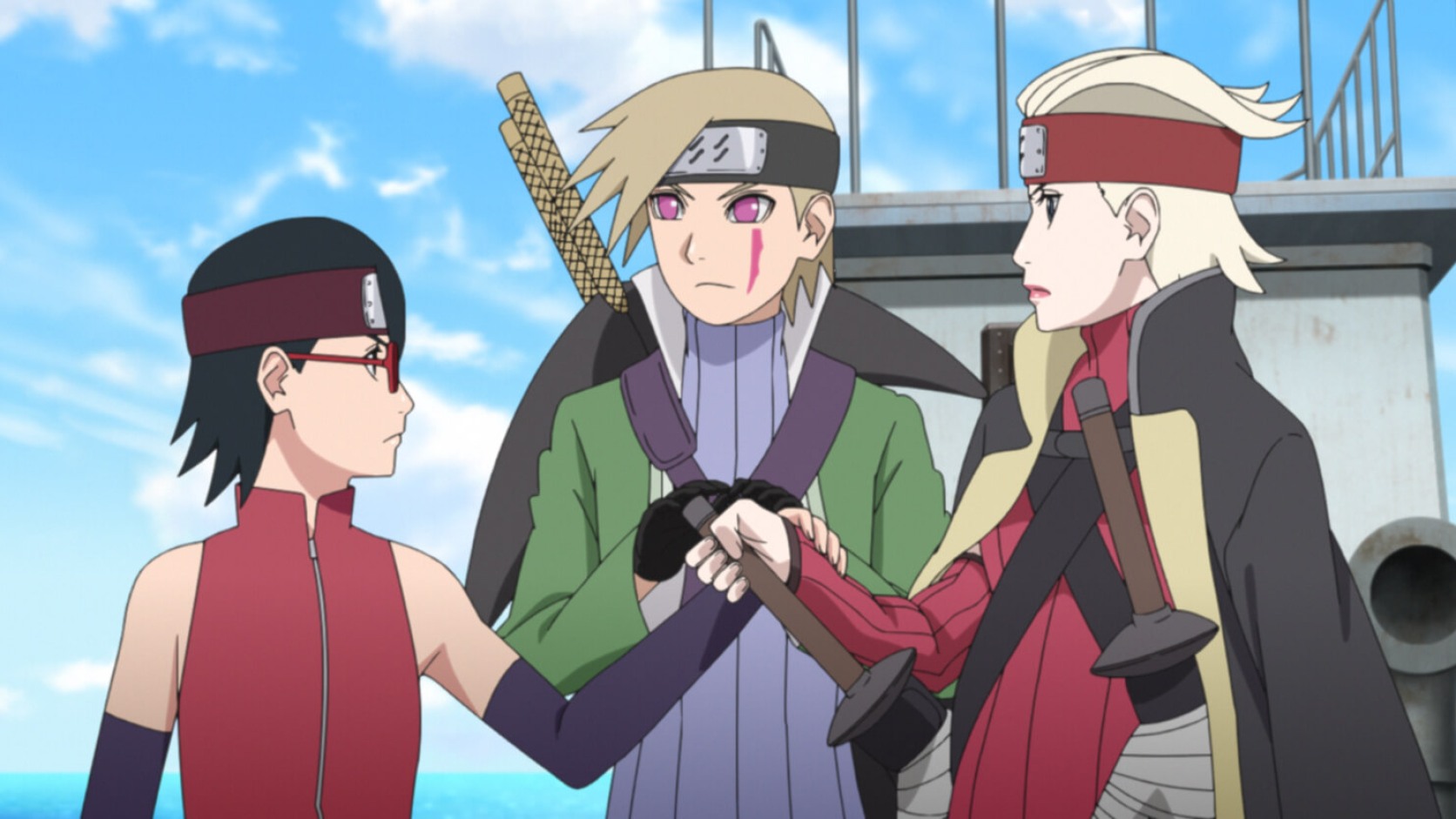
Sarada, Kagura, and Buntan join hands over the mission. The gesture signals cooperation across village, custody, and history. The promise becomes meaningful only if all three retain voice.
Sarada should be able to challenge Mist policy. Buntan should be able to report an unsafe order. Kagura should be accountable for his decisions. Unity without those rights becomes performance.
The automated puppet becomes a trail
Sarada and Mitsuki recover one of Denki's machines from Funato control and use that connection to find Team 5. The same technology introduced for mining now supports rescue and intelligence.
Researchers should later review how enemies accessed, moved, or operated the unit. Authentication and shutdown controls matter. A machine designed to reduce labor harm can become an occupation tool if control transfers easily.
Denki's engineering creates continuity
The puppet links Episode 232 to the occupation instead of becoming forgotten gadgetry. Denki's technical work remains part of Team 5's survival. Equipment can carry traces of its operator even when communication fails.
That continuity respects his character. The rescue does not require a sudden new power. Existing preparation becomes useful under changed conditions.
Sarada and Mitsuki should verify identity
Finding Team 5 through a familiar puppet does not prove every person nearby is safe. Occupiers may use captured equipment as bait. Scouts need challenge phrases, behavior checks, and observation before exposing themselves.
Trust between teams helps, while verification protects everyone. Security procedures should never be framed as personal insult during an active occupation.
Reuniting teams changes the options
Team 7 now gains local information from Denki, Iwabee, Metal, and the researchers. Team 5 gains additional scouts, combat support, and connection to Kagura's larger group.
They need one shared command structure. Sarada and Denki both hold leadership roles. Clarifying objectives and authority before action prevents duplicated orders or rivalry.
Rescue priorities should be explicit
The teams face miners under forced labor, Konoha researchers, occupied residents, valuable gold, automated puppets, and Funato positions. Human safety comes first. Property recovery should never delay evacuation.
Leaders need criteria for who moves first, where injured people go, and how to protect those unable or unwilling to leave. Some residents may fear retaliation against family members. Rescue should not become compulsory displacement without explanation.
Hostages may be watched
Workers carrying sacks could face hidden surveillance, guard patrols, or threats against relatives. Approaching them openly may expose the rescue plan. Scouts should seek safe communication methods and ask what residents know.
Local people are partners, not passive packages. They understand routines and consequences outsiders may miss. Their consent can shape timing and routes.
The mine could become a weapon
Occupiers may collapse tunnels, flood passages, trap workers, or sabotage machinery. Rescue planning needs geological and technical expertise. Iwabee's earth skills help, but local miners know the site.
Emergency teams should preserve ventilation, avoid sparks or unstable loads, and prepare medical support. Combat inside a mine can kill people who never see the fight.
Gold recovery needs chain of custody
The Funato are transporting extracted gold. After liberation, authorities should document volume, ownership, location, and handling. Confusion creates space for officials or rescuers to steal while blaming occupiers.
Independent observers and worker representatives should participate. Resource recovery belongs to the community and lawful owners, not automatically to the military force that retakes the island.
Occupation collaborators require careful review
Some residents may cooperate to survive, protect family, obtain food, or reduce punishment. Others may join willingly. Treating every act under occupation as equal betrayal would be unjust.
Investigators should examine coercion, power, specific harm, and available choices. Community reconciliation will need truth and boundaries, not a purge based on rumor.
Children and elders need tailored evacuation
Not every resident can move quickly or board a small vessel. Plans need mobility support, medication, caregivers, identification, and family reunification. Evacuation routes should avoid separating children from trusted adults.
Officials must also prepare shelter, food, sanitation, and privacy at the destination. Removing people from immediate danger without supporting them afterward creates another crisis.
The offshore team needs another boat
Kawaki correctly notes that researchers and rescued residents will require more transport. One vessel cannot safely carry everyone. That logistical observation is as important as spotting an enemy.
Procurement must verify seaworthiness, fuel, crew, capacity, and route. Taking a civilian boat without consent may solve one problem by creating another. Emergency requisition should include records and compensation.
Kawaki contributes through practical thinking
He sees the transport gap while others focus on finding Team 5. That shows growing mission awareness beyond direct combat. Team integration works when Kawaki's perspective influences the plan.
Sarada should acknowledge the contribution specifically. Clear feedback helps him learn which behaviors support the group without making praise another manipulation tool.
The approaching shape changes the risk
A huge object or creature emerges through the mist near the boat. Limited visibility and uncertain scale make immediate identification difficult. The team should avoid attacking before confirming the threat.
Kagura needs to protect the vessel, position lookouts, reduce noise where useful, and prepare escape. Panic can reveal their location. Curiosity can move them too close.
Mist conditions reward local knowledge
Weather and sea conditions affect sound, visibility, navigation, and distance judgment. Taiki and Kagura may understand those conditions better than visiting Konoha shinobi.
Sarada's overall mission leadership should still respect local operational expertise. Authority and knowledge are not identical. Strong command creates a way for both to shape decisions.
Infiltration must have an exit
Getting onto Dotou Island is only half the task. Scouts and rescue teams need routes out, transport capacity, medical support, and fallback locations. An operation that succeeds until extraction is not successful.
The full-moon rendezvous provides timing, while the uncertain boat situation remains a major gap. Leaders should not begin mass movement until enough transport is secured.
Public officials owe residents information
Islanders may not know whether the Mist government is coming, whether fighting is near, or where help exists. Secure communication should offer practical guidance without exposing the operation.
After liberation, officials need regular updates about services, missing people, compensation, and investigations. Silence allows occupiers and rumor to control the narrative.
Team 5 will need recovery after rescue
Living under occupation and planning civilian rescue can produce exhaustion, guilt, hypervigilance, and delayed fear. Denki, Iwabee, and Metal should receive medical care, rest, and confidential support.
They should not be immediately praised into another mission. Competence under crisis does not remove the need for recovery. Konoha must review why the team remained isolated.
The former swordsmen need post-mission protection
If they help liberate the island, Funato supporters may target them. Prison authorities may also minimize their service or retaliate for complaints. Written agreements and independent oversight matter before deployment.
They need medical care and a clear return or release plan. No official should threaten activation of the curse marks to secure silence about misconduct.
The episode gets scouting right
Sarada and Mitsuki observe before acting, match abilities to roles, and prioritize finding allies. The episode lets patience feel active. That is rare and welcome.
Their success also depends on Team 5's earlier preparation and Denki's equipment. Rescue becomes a chain of competent choices rather than one hero arriving to solve everything.
The episode exposes the Mist's contradiction
Kagura believes in change, but the state keeps former offenders obedient through lethal marks. The policy tells viewers that officials value usefulness more than rehabilitation.
If the Mist wants a different future from the Bloody Mist, authorities must abandon execution-as-control. Reform requires due process, rights, and the possibility of disagreement without death.
RaeRae verdict
Boruto Episode 235 earns four bowls of ramen out of five. Sarada leads with patience, Mitsuki scouts effectively, Team 5 keeps working under occupation, and Kawaki notices logistics and human motive that others overlook. The episode understands that information saves lives.
The curse marks poison the rehabilitation claim. Buntan, Hebiichigo, and Kyoho may choose to help, but choice under a lethal switch is not free. The Mist cannot celebrate their service while reserving instant execution. Liberating Dotou Island should include liberating the state's own thinking about control.
Before the next episode
Episode 236, “Cut and Run,” splits the operation between hostage rescue on Dotou Island and infiltration of the Funato mobile fortress. Watch whether the young teams preserve one command structure and whether civilians remain the priority when a massive new target appears.
Also watch how Tenma uses status and violence. A powerful family can call brutality loyalty while ordinary people carry the cost.
Sources and lawful viewing
The official Naruto site provides the Episode 235 synopsis and gallery. Crunchyroll carries “Infiltrating Dotou Island” where regional availability permits. Release and streaming details can vary by country.
Official episode reference: Naruto Official episode guide
Licensed episode route: Crunchyroll licensed series page
After watching, ask whether the Mist offered former prisoners a future or merely a dangerous assignment under threat of death. Then ask who owns the gold after islanders were forced to carry every sack.