
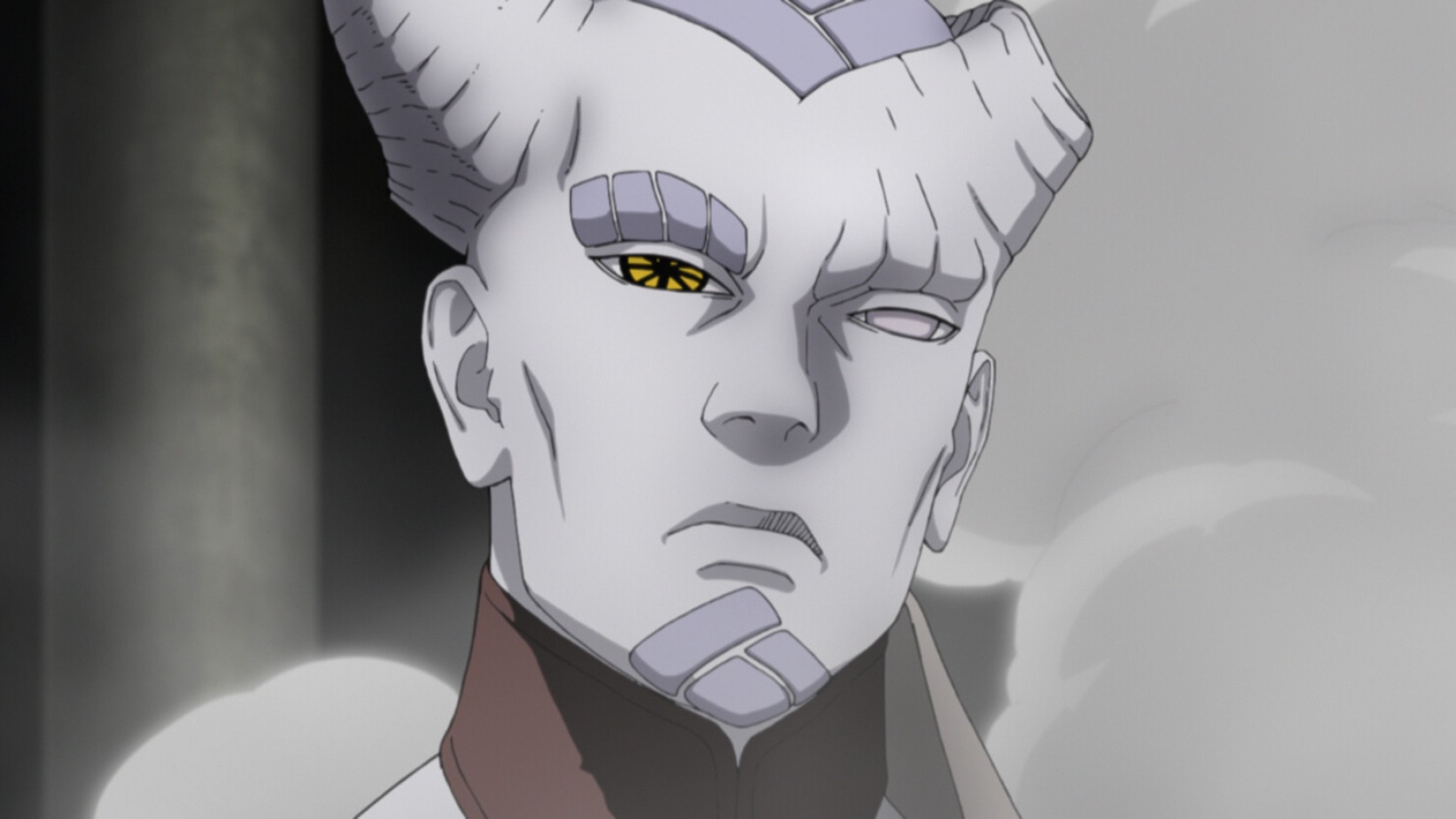
Predestined Fate
Koji’s natural flames force Isshiki into the wrong vessel at the right time, freeing Kawaki from Karma while making the newly freed child Isshiki’s only path to survival.
Series: Boruto: Naruto Next Generations
Episode: 214 · Predestined Fate
Arc: Kawaki: Otsutsuki Awakening
Release: September 5, 2021
Previous: Episode 213 · True Identity
Directory: All 293 Boruto episodes
Bottom line
Boruto Episode 214 lets Koji Kashin win the plan and lose the meaning of victory almost immediately. His natural flames burn Jigen beyond recovery, forcing Isshiki Otsutsuki to resurrect through a defective vessel. Kawaki’s Karma disappears exactly as Amado predicted. Isshiki now has only a few days to live, which sounds like success until he turns toward the one person who can give him another body. The countdown does not end the threat. The countdown points the threat directly at Kawaki.
Koji’s part hurts for a different reason. Amado created him with Jiraiya’s genes, sent him against an enemy whose full power he could not defeat, and built the larger strategy around Koji forcing resurrection. Jigen calls him a tool. Koji answers with the shinobi language of duty, but accepting a mission is not the same as receiving every truth about why someone made you. The episode calls fate predestined while showing scientists, leaders, and fighters making deliberate choices, then hiding those choices behind destiny.
The title protects somebody
“Predestined Fate” makes the outcome sound written before anyone entered the room. That wording can give grandeur to sacrifice and remove responsibility from the people who planned the sacrifice.
Koji’s path was designed by Amado. Isshiki’s resurrection follows Karma rules. Kawaki’s danger follows choices made by Kara. None of those routes are weather.
Koji attacks the body, not the legend
Jigen’s reputation says overwhelming force will absorb, shrink, or counter ordinary ninjutsu. Koji studies the failing vessel beneath that reputation.
He aims at biological limits, depleted power, and the difference between chakra-generated attacks and physical fire. Strategy begins where worship of strength ends.
Natural flames bypass Karma
Koji summons existing fire rather than producing chakra flames for Jigen to absorb. The attack uses the rule Jigen depends on and steps outside that rule.
The move feels satisfying because preparation earns the opening. Koji does not discover a larger energy blast. He finds the category the defense cannot process.
The fire is still a brutal death
Tactical elegance can make viewers forget what happens to the body. Jigen burns while Isshiki decides whether to resurrect.
That body belonged to a human monk before Isshiki occupied him. Koji’s necessary attack ends the vessel and whatever remained of the original victim.
Amado watches from safety
Konoha sees the battle through his glasses while Koji stands inside the danger. Amado narrates the mechanics and controls the larger explanation.
The distance matters. One conspirator receives asylum negotiations while the other absorbs the physical cost of their plan.
Koji agreed to fight
He understands that killing Jigen is his mission and that survival is uncertain. His determination belongs to him.
Respecting that choice does not erase questions about what Amado disclosed. Consent weakens when one person designed the fighter, the mission, and the information available to him.
Creation does not create ownership
Amado may have made Koji through cloning technology. That act gives him responsibility, not property rights.
Koji is a thinking person with memory, judgment, fear, pride, and a future he may want. A creator cannot spend that future as equipment.
Jigen calls him a tool because Kara needs tools
Kara classifies bodies by function: vessel, Inner, Outer, experiment, replacement, weapon. The language makes exploitation feel organized.
Calling Koji a tool also tries to deny the personal meaning of his rebellion. Tools do not choose when to turn against the hand holding them.
Koji answers with shinobi ideology
He accepts that shinobi can be tools serving a purpose. Naruto’s history has challenged that belief since the Land of Waves.
Haku’s death already showed what happens when devotion lets another person define a life as useful only through sacrifice. Koji inherits the same wound in a more scientific form.
Jiraiya’s legacy complicates every word
Jiraiya chose a dangerous mission against Pain and died while preserving information for Konoha. Koji’s mission echoes that death closely enough to feel engineered.
Amado appears to have selected not only useful genetics but a story about a man who would confront impossible power. That makes legacy another material he can manipulate.
Similar courage does not make one person replaceable
Koji can resemble Jiraiya in technique, instinct, or willingness to fight and still remain his own person. A clone is not a returned relationship.
Naruto’s recognition should not force Koji to perform someone else’s memories. Biology can create continuity without erasing individuality.
Naruto watches another familiar sacrifice
He sees techniques tied to Jiraiya while sitting too far away to intervene. The live feed turns an intimate wound into intelligence evidence.
Naruto needs room for that recognition, but the emergency does not pause. Leadership demands attention at the same moment grief tries to take the whole screen.
The live feed confirms Amado’s prediction
Jigen burns, Isshiki resurrects, and Kawaki’s Karma disappears. Those events support Amado’s model of duplicate Karma and forced resurrection.
Successful prediction raises his technical credibility. The prediction does not prove every motive, future promise, or hidden part of his plan.
Evidence should narrow trust
Konoha can trust the confirmed mechanism more than before. Officials can trust that Amado anticipated this stage accurately.
They should not convert narrow confirmation into complete faith. Good intelligence work lets confidence grow claim by claim.
Isshiki emerges from a stolen body
The new form appears powerful, composed, and alien. The transformation can look like a villain finally becoming himself.
That visual arrival depends on Jigen’s erasure. Isshiki’s true body is built through the death of the person he occupied.
Resurrection is not birth
Birth creates a new life through relationships, care, dependency, and time. Isshiki’s return restores an existing ruler by consuming a host.
Calling the process rebirth can soften the theft. Resurrection here is replacement with a body count.
The defective vessel creates a short clock
Jigen cannot sustain Isshiki’s full existence. Amado estimates only a few days remain.
The limit gives Konoha a path to permanent victory if Kawaki remains protected and unmarked. The same limit makes Isshiki desperate enough to attack immediately.
A deadline changes power
Isshiki is stronger than the people preparing to face him, but time now works against him. Every minute without Kawaki reduces his future.
Defenders do not need to dominate every exchange. Survival and denial can become winning strategies when the attacker cannot wait.
Kawaki’s Karma disappears
The mark vanishes as Isshiki resurrects through Jigen, confirming that one Otsutsuki cannot retain duplicate resurrection backups after returning.
Kawaki receives proof through his own body. Relief arrives with collapse because the disappearance also announces Isshiki’s next move.
Freedom becomes immediate danger
For one moment, Kawaki is no longer carrying Isshiki’s resurrection file. The freedom should matter.
Isshiki now needs to place another Karma before his defective body dies. Kawaki becomes most endangered at the exact moment the old mark releases him.
The village must protect Kawaki as a person
Strategists may describe him as the only compatible vessel or the key to Isshiki’s survival. Those descriptions center the attacker’s needs.
Kawaki is a child under threat because someone wants his body. Protection should preserve his agency, relationships, and future rather than hide valuable property.
Hiding him is not enough
Physical secrecy can delay Isshiki, but Kara already knows Konoha’s people, methods, and connections. Chakra, technology, surveillance, or coercion may expose the location.
The plan needs layered deception, limited knowledge, communication controls, evacuation routes, and a response if Isshiki reaches the village.
Kawaki should help plan his safety
He knows Jigen’s habits, Kara’s training, Amado’s methods, and the experience of being hunted. Treating him as passive cargo wastes knowledge and repeats abuse.
Participation does not mean burdening him with sole responsibility. Adults still owe him protection and honest limits.
Naruto’s prosthetic creates a connection
Kawaki’s arm responds to Naruto’s chakra. The device symbolizes care because Naruto gave him a working replacement.
Any chakra link can also become a route an enemy studies. Support technology needs threat review without turning the gift into blame against Kawaki.
Amado knew the next danger
He planned to remove Kawaki’s Karma by forcing Isshiki into Jigen. He also knew Isshiki would need Kawaki again.
Konoha should ask which protections he prepared before arriving. A planner who created the emergency clock should bring more than an explanation of the clock.
Asylum now carries operational duties
Amado’s intelligence has proven useful, and Kara will likely target him. Protection remains justified.
His agreement should require continuing disclosure, technical assistance, evidence preservation, and cooperation that does not end when the first prediction succeeds.
Shikadai’s collar still matters
The battle can pull attention away from the hostage tactic that secured Amado’s hearing. Success against Isshiki does not retroactively cleanse that act.
Konoha should document the device, threat, communications, and psychological harm separately from the asylum bargain.
Urgency does not cancel accountability
Isshiki may arrive within minutes, which means the village cannot complete every investigation now. Delayed review is different from abandoned review.
Officials should preserve records and schedule the unresolved questions while memory remains fresh.
Koji’s barrage shows preparation
He uses multiple techniques to control distance, test reactions, consume attention, and create the opening for natural flames. Each move belongs to a larger sequence.
The fight rewards planning over random escalation. Koji built an argument with attacks, and the final flame delivers the conclusion.
Jigen’s weakness was real
Naruto and Sasuke forced him to expend enormous power. Their loss did not accomplish nothing.
Koji and Amado exploit damage created by that battle. Shared resistance can matter across encounters even when the first fighters never see the final effect.
Victory belongs to more than one man
Koji executes the trap, Amado designs the timing, Naruto and Sasuke weakened Jigen, and Kawaki survived long enough for the plan to matter.
Attributing everything to one genius would repeat Kara’s habit of hiding human cost beneath a central authority.
The plan also uses Kawaki without consent
Amado’s strategy depends on the condition of Kawaki’s Karma and on keeping him available after Isshiki resurrects. Kawaki does not design the gamble.
Freeing him from the mark is valuable. Using his body as the key variable without full disclosure continues the pattern of adults planning around him.
Fate language can comfort survivors
Believing a sacrifice had destiny can help people make meaning from terrible loss. That comfort belongs to the person grieving.
Leaders should not use fate to avoid explaining their decisions. Meaning after harm cannot replace accountability before harm.
Fate language can flatter warriors
Calling Koji destined to confront Isshiki gives his mission mythic weight. The label can make engineered sacrifice feel noble enough to accept.
Respect should focus on what Koji chooses under pressure, not a story that says he was born to be spent.
Shinobi history keeps repeating the tool problem
Villages trained children as weapons, clans guarded techniques through blood, Root erased identity, and leaders praised sacrifice as duty. Kara modernizes those practices with laboratories.
Koji’s story does not arrive from nowhere. Scientific tools changed the production method while the old moral logic stayed familiar.
Technology exposes existing values
Cloning and body modification do not decide whether Koji receives autonomy. People decide whether a created life counts as a person.
Amado’s treatment of Koji reveals values that existed before the technology: usefulness first, personhood later.
Isshiki sees bodies as continuity devices
Jigen and Kawaki matter because they can carry him. Their desires do not enter his calculation.
That worldview is the purest version of domination. Another person exists only as a bridge extending the ruler’s future.
Mortality drives the cruelty
Isshiki’s short lifespan after resurrection creates panic beneath his calm. He cannot accept an ending while another body might prevent that ending.
Fear of death explains urgency without excusing possession. Mortality does not create a right to consume someone else’s life.
Konoha needs a denial strategy
The goal is keeping Kawaki beyond Isshiki’s reach until the countdown ends. Every battle decision should support that objective.
Defenders may need to retreat, misdirect, stall, evacuate, or sacrifice terrain. Prideful combat could hand Isshiki the time and access he needs.
A village fight threatens civilians
Isshiki has no reason to respect homes, schools, hospitals, or bystanders while searching for Kawaki. Konoha needs immediate public-safety measures.
Evacuation routes, shelters, medical staging, and clear communication matter as much as selecting the strongest fighters.
Secrecy must be narrow
The exact location of Kawaki needs protection. Residents still need enough warning to respond to attack.
Leaders should separate operational secrecy from public silence. Telling people where to shelter does not require revealing the hidden child.
Boruto’s Karma creates another risk
Isshiki may recognize Momoshiki’s vessel as useful for the Ten-Tails plan. Boruto wants to help and carries power relevant to the fight.
He also faces possible takeover. Any combat role needs a plan for exhaustion, consciousness loss, and nonlethal containment.
Boruto deserves a real choice
Adults may try to order him away without explaining why or may accept his help because they need his abilities. Both extremes can erase agency.
He needs accurate risk, time to respond, and an advocate who can separate courage from pressure to protect his father.
Sasuke should test the dimensional threat
Isshiki can move between spaces and may bypass ordinary walls or barriers. Hiding Kawaki requires understanding those routes.
Sasuke’s experience with Otsutsuki dimensions makes him essential, but reliance on one eye and one person creates another fragile defense.
The village needs redundant knowledge
Amado, Sasuke, Naruto, and specialized teams each hold different parts of the threat model. Losing one person should not erase the plan.
Written summaries, secure distribution, and named backups prevent emergency knowledge from remaining trapped inside heroic individuals.
Koji does not receive the same protection
Amado asks Konoha to protect him while Koji continues fighting. No visible extraction plan promises Koji equivalent safety.
That imbalance should remain part of Amado’s accountability. Partners do not become disposable because one partner reaches asylum first.
The episode makes success frightening
Kawaki’s Karma disappears. Isshiki enters a body with a short life. Amado’s explanation proves accurate. Every planned result occurs.
The outcome still brings the enemy closer to Konoha with desperate purpose. Strategy can succeed locally and create a more dangerous immediate phase.
Preparation must continue after the reveal
Naming Isshiki and understanding the countdown do not defeat him. Information changes the work Konoha must do next.
The best exposition creates decisions. Episode 214 turns every answer into an operational demand involving Kawaki, Boruto, civilians, and time.
Koji needs an exit plan even if he refuses one
A mission leader should prepare extraction, medical support, communication failure procedures, and a point where the operative can withdraw. The fighter may choose to continue after hearing those options.
Amado appears to plan around Koji’s death more carefully than Koji’s survival. That imbalance suggests the scientist values completion more than the person carrying the mission.
Summoning can preserve a route home
Koji’s toads and space-time techniques may offer escape options beyond a normal doorway. A viable route should be identified before the final attack forces Isshiki’s resurrection.
The presence of a possible route matters morally even when the mission remains dangerous. Sending someone without any planned return turns courage into a resource the commander expects to consume.
Medical teams should prepare for unfamiliar bodies
Koji is a clone with scientific modifications, and ordinary treatment may not address his injuries safely. Konoha cannot assume familiar anatomy beneath familiar techniques.
Amado should disclose relevant design details before emergency care becomes necessary. Withholding those details would make him responsible for preventable harm after Koji’s extraction.
Kawaki’s relief may arrive late
The disappearing mark confirms that Isshiki no longer occupies his body through Karma, but years of pain, fear, and conditioning do not vanish with the symbol.
He may still expect punishment, recapture, or another procedure. Adults should not demand visible happiness as proof that freedom worked.
Trauma can preserve the old cage
Kawaki learned to monitor Jigen’s moods, obey threats, distrust care, and prepare for violence. Those survival habits may continue inside Konoha after the physical mark disappears.
Recovery requires predictable safety, honest choices, ordinary routines, and people who do not interpret every defensive reaction as ingratitude.
Naruto should name the freedom first
Security planning will immediately focus on Isshiki’s attempt to re-mark Kawaki. Before that discussion consumes the moment, someone should tell Kawaki plainly that the old Karma is gone.
Naming the change gives him ownership of the news. He is not only the location where a strategic condition shifted.
The village should record Amado’s exact forecast
Investigators need a timestamped account of Isshiki’s expected lifespan, abilities, priorities, and likely route toward Kawaki. Later comparison can reveal accuracy and omission.
Exact records prevent confident paraphrases from replacing what Amado actually said. They also show whether he changes details after seeing new evidence.
A countdown needs visible assumptions
Amado estimates Isshiki’s remaining life from the defective vessel. Konoha should ask what measurements, prior cases, and biological rules support that estimate.
A deadline presented without assumptions can create false confidence. Even a correct general mechanism may vary under unknown treatment, stored chakra, or abilities the scientist has not disclosed.
Civilian shelters need Otsutsuki planning
Ordinary disaster shelters may not protect people from shrinking attacks, space-time movement, chakra rods, or large-scale destruction. Emergency planners need simple guidance based on known abilities.
Residents cannot learn a complex threat model during impact. Clear routes, dispersed medical sites, communication backups, and authority for local evacuation can save lives while elite fighters engage Isshiki.
The hospital needs continuity plans
An attack on Konoha will create injuries while the strongest medical and security staff face pressure elsewhere. The hospital should protect power, records, blood supplies, medicine, and evacuation capacity.
Kara’s history of targeting bodies makes medical data especially sensitive. Emergency access should not become an excuse to expose every patient record.
Families need reunification instructions
Parents and children may be separated across schools, missions, shops, and homes when the alert begins. Running blindly through an attack zone can create more casualties.
Designated meeting points and communication rules give families a plan. Public safety belongs in the story even when the camera follows legendary fighters.
Leaders should plan for misinformation
Isshiki or Kara could spread false reports about Kawaki’s location, Naruto’s orders, damaged shelters, or safe routes. Panic makes those claims easier to weaponize.
Konoha needs authenticated messages and a way to correct rumors quickly. Trust built before the attack becomes part of the defense.
What the episode gets right
“Predestined Fate” pays off rules established in the previous episode. Natural fire bypasses absorption, forced resurrection clears Kawaki’s Karma, and the defective vessel starts a visible deadline.
The battle also preserves moral discomfort. Koji’s competence is real, and Amado’s willingness to spend him remains impossible to ignore.
Where the episode needs care
The original Jigen remains nearly invisible during the destruction of his body. Isshiki’s dramatic arrival can erase the victim beneath the transformation.
Koji’s acceptance of shinobi tool language also needs challenge. Duty should not become automatic proof that Amado gave him a fair choice.
RaeRae verdict
Boruto Episode 214 earns four and a half bowls of ramen out of five. Koji’s plan works because he understands the enemy’s body, defense, arrogance, and clock. The writing earns that success through preparation rather than a surprise power level.
Then the bill arrives. Isshiki resurrects, Kawaki’s Karma disappears, and Amado’s beautiful mechanism reveals the ugly human structure underneath. A stolen monk dies. A cloned shinobi remains in the arena. A freed child becomes the next target. Fate did not arrange that sequence. People with power made choices, and accountability begins by refusing to call those choices destiny.
Before the next episode
Episode 215, “Prepared,” brings Isshiki to Konoha while Naruto and Sasuke organize a defense and Boruto argues that his Karma may give him a role nobody else can fill.
Watch whether preparation includes civilians and the children carrying the danger, or only the strongest fighters expected to stand in front of everyone else.
Sources and lawful viewing
The official Naruto site provides the Episode 214 synopsis and gallery. Crunchyroll carries “Predestined Fate” where regional availability permits. Release and streaming details can vary by country.
Official episode reference: Naruto Official episode guide
Licensed episode route: Crunchyroll licensed series page
After watching, ask who benefits when sacrifice receives the name fate. Koji’s courage remains his. Amado’s decisions remain Amado’s. A noble word should not merge those responsibilities.