
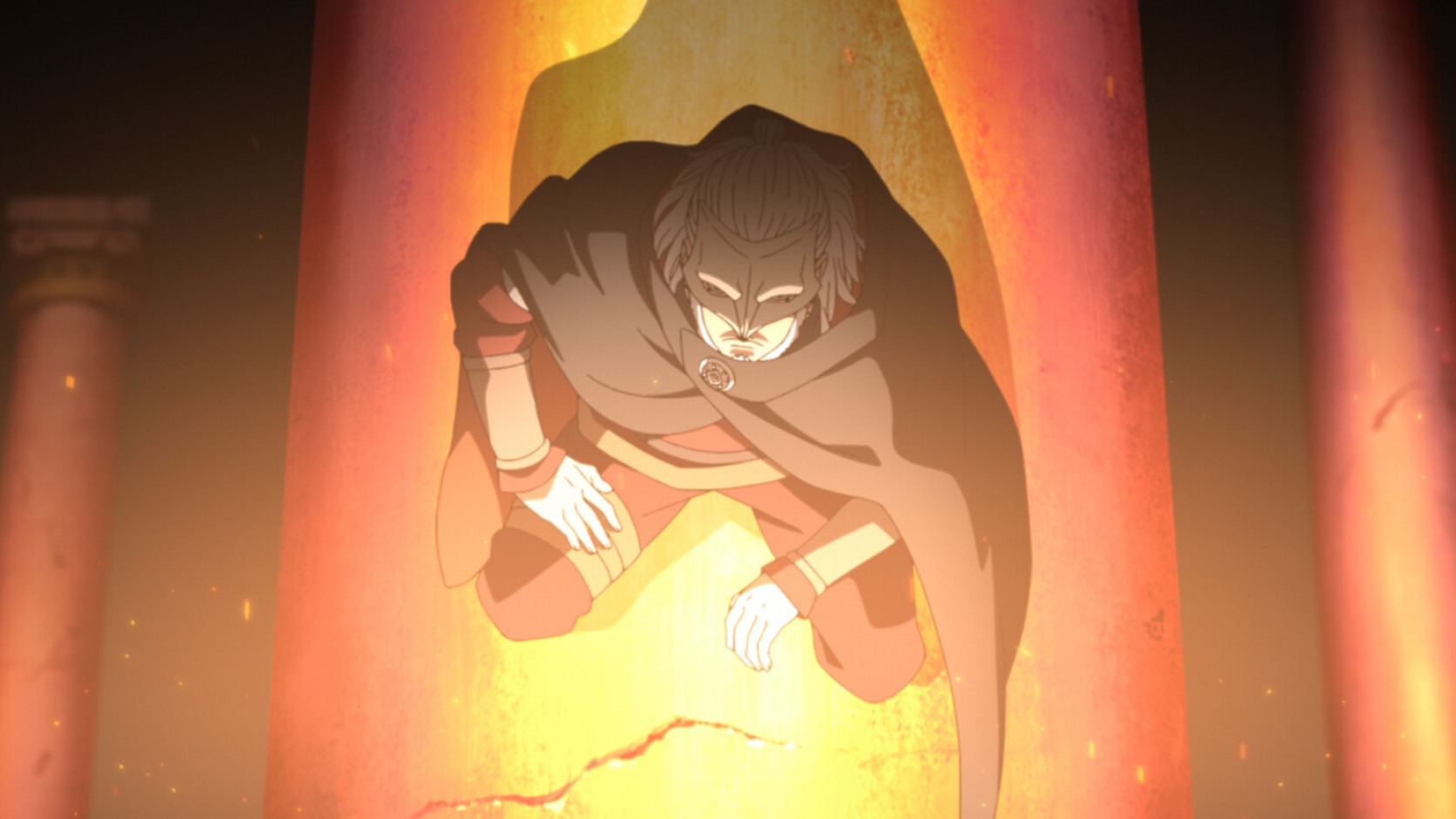
True Identity
Amado explains that Jigen is a stolen body, Karma is an Otsutsuki resurrection system, and the marks on Boruto and Kawaki are counting down toward erasure.
Series: Boruto: Naruto Next Generations
Episode: 213 · True Identity
Arc: Kawaki: Otsutsuki Awakening
Release: August 29, 2021
Previous: Episode 212 · Amado's Defection
Directory: All 293 Boruto episodes
Bottom line
Boruto Episode 213 finally explains why Jigen has always felt like a person and a container fighting for the same space. Amado tells Konoha that Isshiki Otsutsuki came to Earth with Kaguya, survived her betrayal by shrinking into the dying monk Jigen, and slowly took control of that body. Karma is not merely a power mark. Karma is compressed Otsutsuki data that rewrites a vessel until resurrection can replace the human being who carried the seal.
That explanation changes every earlier conversation about Boruto and Kawaki. Their marks are not dangerous gifts waiting for better discipline. Boruto is being rewritten into Momoshiki, and Kawaki was prepared as Isshiki’s viable replacement because Jigen’s body cannot contain the resurrection safely. Amado gives the village the truth while Koji battles Jigen on a live feed, but the truth comes from the scientist who helped build the vessel program. Useful testimony does not erase authorship, and a frightened child should never become a technical problem adults discuss around him.
The title names more than one identity
“True Identity” first points toward Jigen and the Otsutsuki living through him. The title also exposes Karma’s identity as a resurrection system rather than a mysterious source of strength.
Amado’s own identity remains unsettled. He is defector, scientist, witness, conspirator, hostage taker, and possible rescuer in the same room.
Jigen was once an ordinary person
Before Kara’s leader and before Karma, Jigen was a monk caught near a dying alien. That human origin matters because the body viewers know belonged to someone with a life before possession.
The story gives almost no space to that stolen life. Amado describes the mechanics clearly, while Jigen the person risks disappearing beneath information about Isshiki.
Kaguya’s betrayal changes old history
Kaguya did not arrive alone. She came with Isshiki, then attacked him and left him near death.
Naruto and Sasuke fought Kaguya without knowing the partnership or its fracture. Their victory solved the immediate war while leaving an older survivor hidden inside human history.
Isshiki survives through shrinking
Too injured to use Jigen as a normal vessel, Isshiki makes himself small enough to enter the monk’s body. Survival begins as invasion.
The ability sounds almost absurd until the consequence lands. A dying person loses bodily control because a more powerful being treats flesh as shelter.
Possession begins before Karma
Isshiki takes nutrients and control from inside Jigen, extending his own life while changing the host. Karma later formalizes the resurrection process.
That chronology matters. The first violation is not a willing seal or a chosen bargain. Jigen’s body becomes occupied during extreme vulnerability.
Karma is a compressed backup
Amado compares the mark to compressed data. An Otsutsuki places information into a vessel, and that information gradually extracts across the host’s body.
The metaphor makes an alien process understandable without making the process harmless. A backup that deletes the living host is a weaponized copy.
Extraction means bodily replacement
Karma spreads through cells until the vessel becomes sufficiently Otsutsuki. Resurrection completes the overwrite.
The host does not share a body equally with the returning being. The human identity faces deletion, which turns every percentage of extraction into a threat to personhood.
Boruto is not simply borrowing Momoshiki’s power
The mark gives him abilities, but those abilities accompany an ongoing transformation. Every useful burst comes from a process designed to restore Momoshiki.
That makes praise for Karma uncomfortable. Power cannot be separated from the future the mark is building inside Boruto.
Kawaki’s training was a vessel program
Jigen’s abuse, repeated Karma implantation, scientific modification, and combat testing all served one objective: creating a body Isshiki could use.
Kawaki was never being prepared for leadership or belonging. Kara treated survival through the experiments as evidence that his body could be stolen successfully.
Compatibility does not equal consent
Amado explains that a suitable vessel is rare. Kawaki’s body can accept Isshiki’s data better than Jigen’s body.
Biological compatibility gives the abuser an opportunity. Compatibility gives Kawaki no duty to surrender himself and no moral relationship to Isshiki’s survival.
Jigen’s body cannot carry full resurrection
Isshiki can revive through Jigen, but the imperfect vessel would give him a short remaining life. That limit explains why Kawaki matters so much.
The body under Kara’s robe is powerful and failing. Jigen’s apparent supremacy has always contained a deadline.
Kawaki represents stolen time
Isshiki wants a better vessel because Kawaki would restore a longer future. The boy’s remaining lifetime becomes fuel for someone else’s continuation.
Kara’s vessel language hides that theft. Saying “compatible” sounds technical. Saying “a child selected for erasure” names the human consequence.
Boruto hears a death sentence disguised as science
Amado’s explanation tells him that Momoshiki will eventually resurrect through his body if extraction continues. The room receives mechanism while Boruto receives terror.
Adults need the facts, but delivery matters. A child should have support, time for questions, and control over who learns intimate medical information.
Amado offers killing as the known stop
When Naruto asks how to prevent Momoshiki’s return, Amado identifies Boruto’s death as the available way to stop completion. The answer is technically direct and emotionally brutal.
Stating the known limit does not make death an acceptable plan. Research, delay, containment, and removal deserve urgent work before anyone converts uncertainty into execution.
Naruto has heard adults discuss a child’s death before
His own life began under calculations about Kurama, village survival, seals, and sacrifice. Leaders decided what his body would carry before he could speak.
Hearing the same cold logic around Boruto should force Naruto to confront how easily institutions repeat themselves when fear provides the excuse.
The room must not make Boruto a public weapon
Karma may create danger to others if Momoshiki gains control. That risk needs planning.
Planning should not strip Boruto of privacy or reduce him to a threat category. He remains a child seeking help with a condition imposed during battle.
Kawaki also deserves full disclosure
Amado knows how his modifications work and why Isshiki chose him. Kawaki needs access to that information without manipulation.
Disclosure should include uncertainties, remote controls, residual technology, possible treatments, and every known risk. The scientist who helped cause the harm should not control the only copy.
Amado’s analogy is effective and dangerous
Compressed files and extraction percentages make Karma legible to modern listeners. Clear language helps Konoha grasp the urgency.
The same language can make bodily erasure sound like routine data processing. Human beings are not storage devices, and the metaphor should stop before the person disappears.
Sasuke asks the necessary contradiction
If Isshiki already inhabits Jigen, why does Jigen also carry Karma? That question tests the model rather than admiring the explanation.
Sasuke’s scrutiny matters because Amado controls the lesson. A strong witness interview looks for facts that do not fit the neat version.
One Otsutsuki cannot keep duplicate resurrections
Amado explains that successful resurrection through one vessel removes other Karma marks connected to that Otsutsuki. The process prevents parallel copies.
That rule creates the plan against Isshiki. Force resurrection through the defective Jigen body, erase Kawaki’s mark, and let Isshiki’s shortened life run out.
Koji is the trigger
His battle is designed to kill Jigen and force Isshiki to resurrect before Kawaki can receive another complete mark. Koji’s mission is a timed intervention in the Karma process.
The plan uses combat as biology. Victory means creating the wrong resurrection at the right moment.
Fire matters because Jigen cannot absorb nature
Koji summons real flames rather than chakra flames Jigen can absorb through Karma. The attack targets the boundary between technique and physical phenomenon.
That distinction rewards preparation. Koji does not overpower every ability; he chooses a form of damage that bypasses the expected defense.
The flames carry historical weight
The fire comes from a place already burning rather than emerging as ordinary chakra. Koji uses summoning to bring the physical danger into Kara’s chamber.
The technique feels like a shinobi answer to alien absorption. Knowledge of rules beats a louder version of the same attack.
Jigen calls Koji a tool
He assumes Amado created or positioned Koji for one function. The insult reflects Kara’s entire approach to people.
Koji does not reject the word as cleanly as viewers may want. Shinobi history taught generations to define themselves through missions and sacrifice, giving Amado a ready-made ideology to exploit.
Calling sacrifice duty does not create consent
Koji may accept the mission and understand the likely cost. Amado also designed the circumstances and may know more about Koji’s limits than Koji knows.
Valid consent requires information, alternatives, and freedom from hidden control. A warrior embracing duty cannot excuse a planner who withholds the full price.
Naruto recognizes something familiar
Koji’s movements, techniques, and presence remind Naruto of Jiraiya before the episode confirms the full connection. The recognition arrives through embodied memory.
Naruto should be allowed uncertainty. Grief can notice a resemblance without turning resemblance into proof.
The live feed turns grief into intelligence
Naruto watches a stranger fight like someone he loved while Amado controls the camera and explanation. Personal memory becomes part of a national-security briefing.
That collision is cruel. The village needs the evidence, and Naruto needs space to process what the evidence may mean.
Amado controls what Konoha sees
The glasses provide a direct view of Koji and Jigen, but camera placement, continuity, sound, and transmission remain under Amado’s system.
The feed confirms events inside the frame. Claims about earlier history, hidden motives, and unseen mechanisms still require corroboration.
A live event can authenticate future claims
Amado predicts how the battle and resurrection process should work. If the feed matches those predictions, his technical credibility rises.
Prediction is valuable evidence because the witness commits before the outcome. One correct prediction still does not prove every unrelated statement.
The Ten-Tails belongs in the threat model
Amado connects Jigen and Isshiki to the imprisoned Ten-Tails Sasuke discovered. The creature is not a separate mystery sitting in another dimension.
Kara’s vessel program, Otsutsuki resurrection, and the Ten-Tails belong to one system aimed at planetary consumption and survival.
Planetary danger can erase individual victims
Once leaders hear about an Otsutsuki-scale threat, Kawaki, Boruto, Jigen, and Koji may become small pieces on a strategic board.
The larger risk is real. Ethical defense must protect the world without treating the people closest to the mechanism as disposable parts.
Kaguya’s history needs careful framing
Her betrayal of Isshiki may have prevented his plan and served her own ambitions. The episode gives a fact about conflict, not a full moral rehabilitation.
One action against a worse partner does not erase later harm. History can contain resistance, domination, fear, and self-interest together.
Isshiki’s survival depends on hidden labor
Jigen’s stolen body, Kawaki’s experiments, Amado’s science, Koji’s mission, Kara’s facilities, and countless unnamed workers sustain his future.
Powerful figures often appear self-made because stories hide the labor and bodies underneath them. Episode 213 begins showing the infrastructure beneath Isshiki’s authority.
Kara is a resurrection project wearing an organization
The Inners have personal goals and abilities, but Jigen’s central system exists to secure Isshiki’s return and feed the Otsutsuki plan.
Members may believe they are partners while occupying roles inside another person’s survival machine. Internal secrecy keeps them from seeing the whole design.
Amado helped make that machine
His knowledge did not come from neutral observation. He worked close enough to understand modifications, vessels, Karma, and Jigen’s condition.
Defection may help stop catastrophe. Accountability still requires a full record of what he built, whom he used, and which safeguards he removed.
Cooperation should include evidence preservation
Amado must identify laboratories, files, samples, devices, personnel, and remote systems before Kara destroys or relocates them.
Konoha should preserve copies outside his control. A witness who remains the sole gatekeeper can withdraw knowledge whenever the bargain changes.
The village needs a multidisciplinary team
Sasuke understands Otsutsuki encounters, Naruto understands jinchuriki history, Katasuke understands scientific tools, Sakura understands medicine, and intelligence staff understand networks and evidence.
No one person covers the full problem. Shared review also prevents Amado from tailoring different explanations to isolated listeners.
Medical language should protect agency
Extraction percentage, compatibility, and vessel status may help measure danger. Those labels should never replace Boruto and Kawaki’s names in decision making.
Every treatment plan needs assent where possible, clear explanation, privacy, and an advocate focused on the child rather than village advantage.
Research cannot begin with execution
Amado names death as a way to stop Momoshiki because a dead vessel cannot complete ordinary extraction. That answer establishes urgency, not the end of scientific thought.
Konoha should investigate sealing, suppression, separation, slowed extraction, consciousness protection, and information from earlier Otsutsuki encounters.
Uncertainty must remain visible
Amado may know the process better than anyone present, but his knowledge can contain gaps. Otsutsuki biology, Karma variation, and Boruto’s unusual circumstances may not follow every prior case.
Hope should not become denial. Uncertainty should keep research open and prevent a single grim claim from becoming irreversible policy.
Boruto’s earlier takeover gains context
Momoshiki’s manifestation after Boro’s defeat was not a random possession episode. The event showed extracted data asserting control when Boruto’s chakra and consciousness weakened.
That connection turns a frightening scene into medical and tactical evidence. Conditions surrounding takeover may reveal ways to reduce risk.
Exhaustion becomes a safety factor
If low chakra or severe injury increases Momoshiki’s opportunity, missions involving Boruto need new thresholds, monitoring, and extraction plans.
Safety planning should not become permanent imprisonment. The goal is reducing specific risk while preserving education, relationships, and a future worth protecting.
Kawaki’s lost Karma changes the clock
Amado’s plan aims to force Isshiki into Jigen and erase Kawaki’s mark. Success could free Kawaki from immediate resurrection while making him the target for a desperate reapplication.
Removing one mark does not end the danger. The village must protect Kawaki as a person, not merely guard a valuable empty vessel.
Protection cannot become another cage
Konoha may restrict Kawaki’s movement to keep Isshiki away. He has already lived under confinement justified by his body’s value.
Any limits need explanation, review, the least restrictive design, and meaningful participation from Kawaki. Safety without agency can repeat Kara’s abuse under a kinder symbol.
Jigen’s human death deserves recognition
Isshiki’s resurrection would consume what remains of Jigen. The monk has been absent from the story’s emotional center, but his stolen life anchors the horror.
Konoha should record him as a victim rather than only the name of a villain’s body. Naming the distinction restores a fragment of personhood.
Koji’s identity remains the next wound
Naruto’s recognition and Koji’s techniques make the question impossible to ignore. Amado knows the answer and continues controlling the timing.
Withholding may serve the battle plan. The delay also lets Amado decide when Naruto receives information tied to grief, which deepens the power imbalance in the room.
The episode rewards attentive memory
Earlier Karma resonance, Jigen’s cracked body, Momoshiki’s appearance, Kawaki’s experiments, Sasuke’s Ten-Tails discovery, and Koji’s familiarity now connect.
Exposition works here because the explanation reorganizes evidence viewers already saw. The episode answers questions while creating sharper ones about responsibility.
Exposition still needs character reaction
Terms such as backup, extraction, vessel, resurrection, and compatibility arrive quickly. Emotional response keeps the information from becoming a lecture detached from lives.
Naruto’s fear, Sasuke’s questions, Shikamaru’s suspicion, Boruto’s dread, and Kawaki’s history give each mechanism a human cost.
Amado’s clarity is part of his strategy
He explains difficult science in memorable language, anticipates questions, and offers a plan that appears internally consistent. Clear communication increases his bargaining power.
The village should value that clarity while checking whether simple metaphors hide exceptions, uncertainty, or choices Amado made during development.
A successful prediction will not settle motive
If Koji forces Isshiki’s resurrection exactly as Amado predicts, Konoha gains strong evidence that he understands Karma and Jigen.
The success cannot prove why Amado wants Isshiki dead or what he plans after asylum. Technical truth and personal agenda remain separate questions.
Konoha needs a shared Karma record
Every observation about Boruto, Kawaki, Jigen, Momoshiki, and Isshiki should enter one protected record with dates, conditions, witnesses, symptoms, and confidence levels. Fragmented notes would leave Amado’s explanation as the only complete model.
The record should distinguish direct observation from testimony and inference. Future changes can then confirm, revise, or reject parts of the model without rewriting history around the newest confident speaker.
Boruto needs an advocate outside command
Naruto is his father and Hokage, while Sasuke is his teacher and a senior defender. Both men love Boruto, but both also carry duties to the village.
An independent advocate can focus on Boruto’s questions, privacy, treatment choices, and daily life when national-security pressure dominates the room. Support should not depend on Boruto remaining brave or useful.
Kawaki needs control over his medical file
Amado may hold intimate records about procedures, implants, pain responses, failed experiments, and bodily changes. Those records concern Kawaki before they concern the village’s weapons program.
Kawaki should receive understandable copies and decide who may access details unrelated to immediate safety. Kara denied him that control for years, and Konoha should not inherit the same permission structure.
Researchers should document failed options
Amado’s claim that death is the known stop may reflect the limits of Kara’s goals rather than every possible intervention. Kara wanted successful resurrection and had little reason to develop humane reversal.
Konoha should ask which suppression, extraction, sealing, medication, surgery, and dimensional methods were attempted, abandoned, or never explored. A missing treatment can reveal institutional priorities as clearly as a failed experiment.
The village must plan for partial takeover
Momoshiki has already controlled Boruto under specific conditions. A response plan should identify early signs, safe evacuation routes, communication rules, nonlethal restraint, chakra support, and who can make urgent decisions.
Boruto should help design that plan while fully himself. Participation can reduce fear and prevent adults from creating measures he experiences only as punishment.
Family communication cannot wait for certainty
Hinata, Himawari, and the people closest to Boruto will live with the consequences of Karma. Officials may want secrecy while facts remain uncertain, but silence can leave family members unprepared for a medical or security crisis.
Disclosure should protect Boruto’s privacy and give relatives practical information rather than catastrophic speculation. Families cannot provide meaningful support when leadership treats every relevant fact as classified.
Jigen’s records may restore part of his life
Archives, temple histories, travel records, or old accounts might identify the monk before Isshiki consumed his identity. Recovery would not undo the possession.
Research could still return a name, community, practice, or relationship to someone reduced to a vessel label. Historical repair begins by refusing to let the abuser own the victim’s entire biography.
What the episode gets right
“True Identity” transforms lore into immediate consequence. Karma becomes bodily replacement, Jigen becomes a stolen person, Isshiki becomes Kaguya’s surviving partner, and Koji’s fight becomes a biological trap.
The episode also keeps skepticism alive. Sasuke tests the explanation, Shikamaru watches the bargain, and the live feed provides evidence without making Amado morally clean.
Where the episode needs care
The original monk Jigen receives little humanity beyond becoming Isshiki’s host. His life and erasure deserve more than a mechanical origin point.
Boruto and Kawaki also need agency after adults learn the truth. Their bodies cannot remain meeting-room territory where experts decide every acceptable risk.
RaeRae verdict
Boruto Episode 213 earns four and a half bowls of ramen out of five. The episode delivers a giant information dump and somehow makes the worst part easy to miss: Jigen was a dying man whose body became shelter, prison, and resurrection equipment for someone else.
Amado gives Konoha the map. The map says Boruto is being erased, Kawaki was raised as a replacement body, Koji may be walking toward planned sacrifice, and Isshiki built authority from stolen lives. The facts are valuable. The scientist’s calm delivery cannot make those facts neutral. Konoha’s next decisions must protect the children inside the mechanism instead of becoming the next institution that calls their disappearance necessary.
Before the next episode
Episode 214, “Predestined Fate,” carries Koji’s plan into its decisive stage as natural flames attack the damaged vessel and Isshiki’s resurrection clock begins to control everyone’s choices.
Watch whether destiny language protects the people making decisions, and whether Koji’s willingness to die gives Amado permission to spend him.
Sources and lawful viewing
The official Naruto site provides the Episode 213 synopsis and gallery. Crunchyroll carries “True Identity” where regional availability permits. Release and streaming details can vary by country.
Official episode reference: Naruto Official episode guide
Licensed episode route: Crunchyroll licensed series page
After watching, ask whose identity receives the least attention. Isshiki gets a name, Karma gets a mechanism, and Amado gets a bargain. The human being called Jigen receives almost no life beyond the body everyone else needed.