
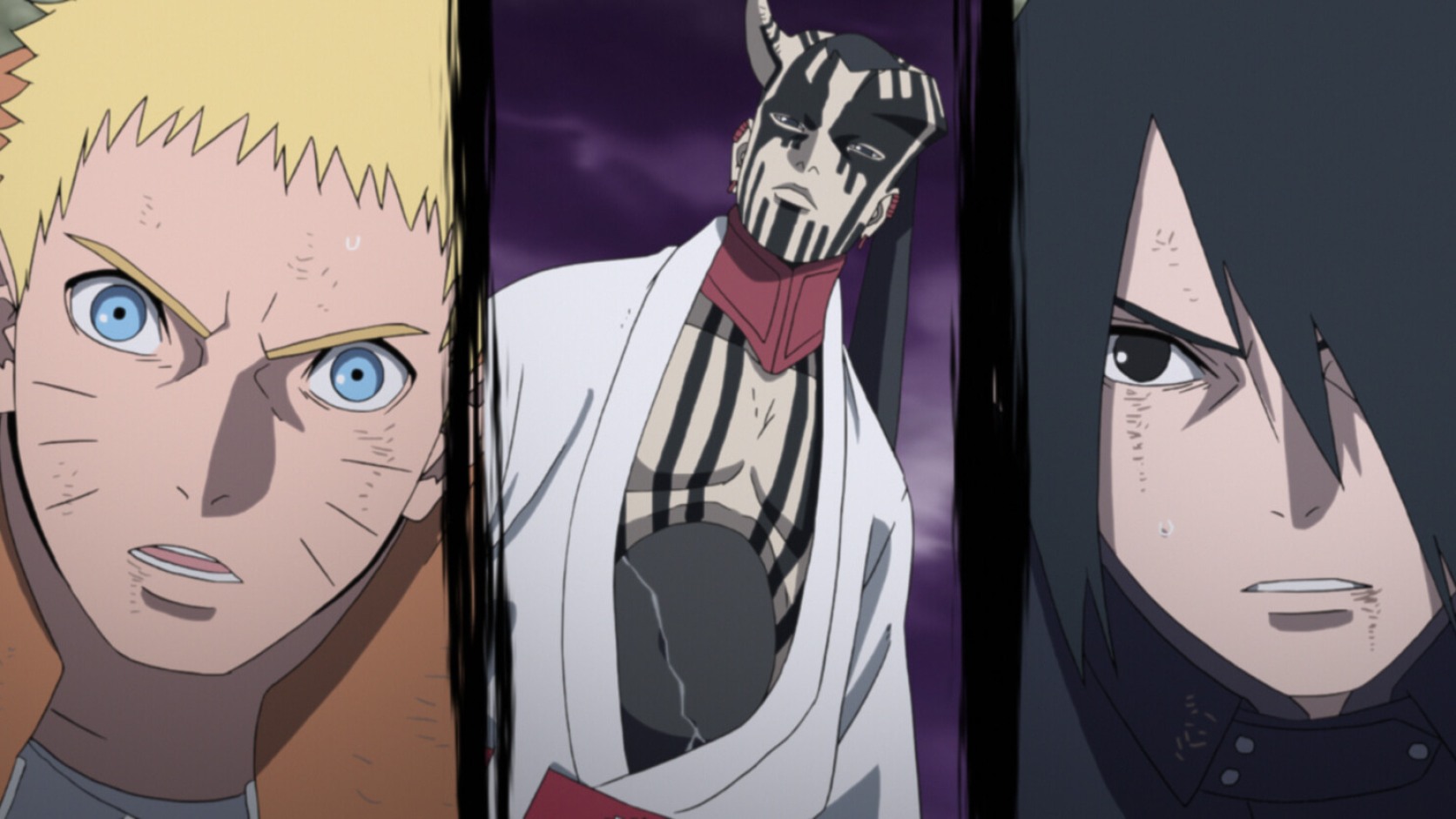
He's Bad News
Naruto and Sasuke fight like legends, yet Jigen’s preparation turns every familiar advantage into a restraint, proving that brilliant can still be insufficient.
Series: Boruto: Naruto Next Generations
Episode: 204 · He's Bad News
Arc: Kawaki: Kara Clash
Release: June 20, 2021
Previous: Episode 203 · Surprise Attack!
Directory: All 293 Boruto episodes
Bottom line
Boruto Episode 204 makes Naruto and Sasuke look mortal without diminishing either man. Jigen drags the fight into his dimension, absorbs or avoids their largest attacks, reads their coordination, and answers every escalation with frightening efficiency. The title sounds casual because Sasuke’s warning is almost absurdly understated: Jigen is not merely dangerous. He is the leader who turned Kawaki into a vessel, carries power connected to Isshiki Otsutsuki, and understands how to weaponize the heroes’ habits against them. Naruto and Sasuke fight brilliantly. Brilliant is not enough. The episode forces the franchise to sit with a truth power fantasies often dodge: protecting someone can require facing an opponent who may win.
The title uses understatement as dread
“He’s Bad News” could describe an unpleasant stranger or a messy date. Sasuke uses ordinary language while standing before a threat that has already breached dimensions, controlled a Ten Tails, and entered Naruto’s home through Kawaki’s body.
The mismatch creates dread. Sasuke rarely wastes words, and his restraint means the evidence is worse than any dramatic speech. Naruto hears a field assessment from the one person capable of following him into this place.
Jigen chose the ground
The battlefield belongs to Jigen. He controls access, understands the terrain, and knows how isolation limits Konoha’s response. Naruto and Sasuke arrive without preparation because protecting Kawaki could not wait.
Location becomes part of the attack. An opponent who chooses where a fight happens can shape distance, visibility, escape, and collateral risk before anyone moves. The heroes begin behind even before power enters the calculation.
No civilians does not mean no stakes
The empty dimension frees Naruto and Sasuke to use larger attacks without destroying homes. That tactical advantage comes with another cost: nobody can help, witness, or communicate with them.
Jigen removes the village from physical danger while removing the fighters from every support system. Isolation protects civilians and endangers protectors at the same time.
Sasuke brings evidence into combat
He knows about the Otsutsuki symbols and the captive Ten Tails. Those discoveries transform Jigen from an unknown Kara leader into part of a larger succession system.
Information cannot stop a rod, but interpretation guides every choice. Sasuke understands that ordinary criminal logic will not explain the body standing before them. The fight is also an investigation conducted under lethal pressure.
Naruto listens without surrendering initiative
Sasuke warns him, and Naruto still moves forward. That decision is not ignorance. Kawaki remains threatened, and retreat may leave Jigen free to return.
Courage here means accepting a credible warning while choosing responsibility. Recklessness would dismiss Sasuke’s evidence. Paralysis would treat danger as permission to abandon the child.
Their teamwork is earned history
Naruto and Sasuke attack from complementary angles, trade openings, and adjust without long explanations. Years of rivalry, conflict, reconciliation, and joint battle live inside that coordination.
The episode does not need to narrate every combination. Trust appears through timing. Each man moves expecting the other to understand, which lets action feel relational rather than decorative.
Jigen reads the partnership
Coordination can become predictable when an opponent studies repeated patterns. Jigen watches who pressures, who analyzes, and how each man protects the other.
Shared history remains a strength, but no strength is immune to exploitation. A practiced team needs the ability to break its own rhythm when the enemy has learned the dance.
Shrinking defeats ordinary perception
Jigen reduces himself and his weapons beyond easy sight, then restores danger at the moment of impact. Naruto’s sensory abilities and Sasuke’s visual prowess face a threat designed around disappearing from scale.
The technique attacks confidence in observation. Seeing the battlefield no longer means understanding what occupies the battlefield. Every empty space may hold a weapon.
Black rods turn openings into restraints
The rods do more than injure. They interrupt movement, pin bodies, and convert brief mistakes into controlled positions. Jigen does not merely trade blows. He manages where his opponents can exist.
Restraint reflects his larger worldview. Kawaki, Naruto, Sasuke, and the Ten Tails become resources to place, drain, or contain. Combat technique and ideology speak the same language.
Absorption punishes spectacle
Large chakra attacks usually announce seriousness. Jigen can absorb them, turning the heroes’ greatest visual statements into fuel or wasted effort.
That ability forces discipline. More power cannot answer a system built to consume power. Naruto and Sasuke must value timing, feints, physical attacks, and information over scale alone.
Power scaling becomes a moral question
Fans can measure forms, speed, chakra, and technique. The episode gives those debates excellent material, but numbers should not replace stakes. Naruto is fighting because Jigen tried to take Kawaki.
The relevant measure asks whether power protects autonomy. Jigen’s strength exists to overwrite another life. Naruto and Sasuke spend strength so another person can remain his own.
Kurama and Susanoo fill the horizon
Naruto’s transformed power and Sasuke’s armored construct make both heroes look mythic. Jigen stands before them with unnerving composure.
The scale should feel triumphant. Instead, the composition makes grandeur vulnerable. Massive forms create larger targets when an opponent can bypass their defenses.
Familiar greatness meets unfamiliar mechanics
Naruto and Sasuke helped end a world war and defeat Kaguya. Those victories cannot guarantee success against every descendant system or altered vessel.
Experience matters most when experience remains teachable. Legends become fragile when reputation hardens into an assumption that previous solutions must work again.
Jigen's body is also under strain
His power appears overwhelming, yet the vessel carrying that power has limits. Cracks and exhaustion reveal that domination damages the container Jigen currently occupies.
That vulnerability does not soften his choices. The body’s failure helps explain urgency, not excuse the search for another unwilling vessel. His solution to personal limitation is stealing Kawaki’s future.
A fragile vessel can still be terrifying
Physical instability may tempt the heroes to believe endurance alone will save them. Jigen knows his limits and fights to conclude the encounter before those limits become decisive.
Danger does not disappear because the aggressor is desperate. Desperation can increase cruelty when someone believes survival authorizes every violation.
Naruto fights as Hokage and guardian
The village title matters, but Kawaki gives the battle a face. Naruto’s promise inside the home continues across dimensions.
Protection does not end when witnesses disappear or success becomes unlikely. The commitment grows more meaningful precisely because Naruto cannot guarantee victory.
Sasuke fights as the person who found the scale
His discovery created knowledge that could have remained abstract. Joining Naruto turns information into intervention.
Sasuke understands that carrying evidence also means acting on evidence. Observation without response would leave Jigen free to use the system Sasuke uncovered.
They refuse Jigen's framing
Jigen treats Kawaki as property and the heroes as obstacles. Naruto and Sasuke answer as though a person’s freedom has independent value.
The argument does not require Kawaki to be useful, grateful, or easy. Rights do not depend on performance. Jigen cannot make ownership legitimate by winning.
Losing physically does not validate the abuser
The episode places the heroes near defeat, which can create a dangerous emotional shortcut: the strongest person must be right or inevitable.
Power determines what someone can force, not what someone deserves. Jigen’s dominance proves the urgency of resistance. Nothing about dominance creates moral authority.
Naruto and Sasuke protect each other imperfectly
Each man tries to create openings and prevent fatal blows, but Jigen can split their attention. Care becomes another demand layered onto self-preservation and mission goals.
Imperfect protection is not failed care. Under impossible conditions, partnership means continuing to notice the other person while accepting that nobody can control every consequence.
Sasuke's Rinnegan becomes a target
Space-time movement and position switching threaten Jigen’s control of terrain. An intelligent opponent identifies the ability that could enable escape or reverse an attack.
Targeting capability is practical and symbolic. Jigen wants the battlefield closed. Sasuke’s eye represents the possibility that the heroes can refuse his chosen positions.
Naruto's endurance becomes a liability
Naruto can survive punishment that would end most fights. That strength may encourage him to absorb damage while searching for another route.
Endurance should never be confused with an obligation to suffer indefinitely. A protector’s body has value beyond usefulness, and repeated sacrifice cannot replace a sustainable plan.
Legendary adults can need rescue
The franchise often positions Naruto and Sasuke as the final answer. Episode 204 reverses that comfort. Their children and village may soon need to respond to their absence.
Allowing powerful adults to need help broadens community responsibility. Protection should never depend on two people remaining unbeatable forever.
Defeat changes the village before news arrives
Naruto’s absence affects command, family safety, morale, and Kawaki’s sense of security. Sasuke’s absence removes the only investigator who has seen Kara’s dimension directly.
Institutional resilience depends on what they shared before leaving. Secrets may protect operations, but excessive concentration of knowledge creates dangerous single points of failure.
Kawaki waits with the worst possible memory
Jigen returned, used his body as access, and took Naruto away. Even without watching the full battle, Kawaki may conclude that connection caused harm to the person protecting him.
Survivor guilt can turn an abuser’s decision into self-blame. Kawaki will need repeated truth: Jigen chose the attack, Naruto chose protection, and neither choice belongs on Kawaki’s conscience.
The household may feel unsafe again
A repaired vase and shared meal cannot stop a portal. The breach may contaminate every ordinary room with expectation of return.
Recovery requires more than saying the danger is gone. The family needs information, practical planning, and permission to react differently. Safety grows through reliable response, not forced calm.
Jigen wants isolation to become despair
Defeating Naruto and Sasuke would send a message beyond tactical victory. If the strongest protectors can be removed, resistance may seem pointless.
That message must be challenged socially as well as physically. Communities survive domination when responsibility spreads instead of collapsing around one hero’s absence.
The episode denies effortless legacy
Naruto and Sasuke inherited techniques, relationships, and hard-won authority. Their children cannot assume that legacy will solve each new threat.
Honoring a previous generation means learning from its strengths and limitations. Reverence without preparation leaves the next generation helpless when legends fall.
Jigen's advantage comes from preparation
He has studied vessels, dimensions, chakra absorption, and the heroes he expects to confront. Naruto and Sasuke enter with courage and partial information.
Preparation is not glamorous, but Episode 204 shows why intelligence work, contingency planning, and technical research are forms of protection. Heroic improvisation cannot always overcome an enemy who designed the encounter.
Intelligence must travel faster than fear
Sasuke’s discoveries need to reach Konoha, and observations from this battle need to shape the next response. Every undocumented insight risks disappearing.
Fear spreads automatically after a leader vanishes. Accurate information requires deliberate channels. A community deserves truth calibrated to safety rather than rumor or false reassurance.
The fight exposes the cost of secrecy
Naruto and Sasuke often carry threats privately to avoid panic. That habit protects others from immediate burden and leaves fewer people ready when plans fail.
Secrecy should have expiration points, backups, and named recipients. Trusting a community sometimes means allowing others to prepare before the heroes become unavailable.
Spectacle works because character remains underneath
The animation offers giant forms, impossible speed, shrinking weapons, and heavy impacts. Every display connects to recognizable choices: Naruto protects, Sasuke analyzes, Jigen controls.
Action becomes empty when viewers could swap characters without changing meaning. Episode 204 resists that emptiness. Technique expresses worldview.
Jigen makes competence feel frightening
He does not win through luck or one hidden trick alone. He identifies threats, manages space, exploits openings, and understands when to escalate.
Competent villains create better stories because heroes must change rather than wait for arrogance to produce an easy mistake. Competence also makes Jigen’s ethics more condemning. He possesses enough awareness to choose differently and still chooses ownership.
Naruto's promise survives uncertainty
Protection is easy to celebrate when victory feels assured. Naruto continues when his body is pinned and options collapse.
A promise should not demand self-destruction, yet this moment reveals sincerity. Kawaki was never a temporary project Naruto would abandon when the cost rose.
Sasuke's warning becomes shared knowledge
At the beginning, “he’s bad news” belongs to Sasuke’s investigation. By the end, Naruto understands through direct experience.
Shared knowledge can strengthen future strategy if either man returns. The brutal price of that knowledge makes earlier communication even more important.
What responsible retreat would mean
Retreat is not cowardice when staying cannot protect the mission or people. The challenge lies in gaining an exit from terrain Jigen controls.
A responsible withdrawal would preserve lives, carry evidence home, and build a plan around known mechanics. Jigen works to deny all three outcomes because continued resistance threatens his vessel project.
The sealed battlefield turns time into pressure
Konoha cannot see what is happening, and Naruto cannot know how quickly Jigen may recover enough strength to return for Kawaki. Every minute carries two dangers at once: defeat inside the dimension and renewed access outside.
Pressure encourages shortcuts, yet Jigen’s abilities punish impulsive attacks. Naruto and Sasuke must think while injured, coordinate while separated, and protect information while searching for escape. The episode makes time feel like another weapon chosen by the enemy.
Chakra is not an infinite moral resource
Naruto’s reserves can appear limitless beside ordinary shinobi, which encourages everyone to treat his power as public infrastructure. He heals, protects, fights, and sustains others until exhaustion becomes expected.
Capacity does not erase bodily limits. A community that depends on one person’s constant depletion has confused heroism with planning. Naruto deserves protection even while providing protection, and Konoha needs systems that do not require his endless availability.
Sasuke's analysis carries emotional weight
His calm observations can sound detached during combat, but analysis is one way Sasuke cares. Naming mechanics gives Naruto a chance to survive and gives the village a chance to respond later.
People express urgency differently. Naruto’s visible anger and Sasuke’s compressed focus both answer the same threat. Treating one style as more sincere would misunderstand how their partnership works.
Jigen attacks the idea of mutual reliance
He separates, pins, and redirects the heroes whenever their coordination begins producing an advantage. His tactics oppose relationship because relationship makes resistance harder to control.
Kara’s vessel system moves in the other direction. One dominant will consumes another body. Naruto and Sasuke remain distinct people choosing cooperation. Their union creates strength without requiring either identity to disappear, which makes their teamwork a moral contrast as well as a tactical one.
The next generation watches the cost of protection
Boruto, Sarada, Mitsuki, and Kawaki inherit a world where the strongest adults can fall. That knowledge can mature them or push them toward reckless imitation.
Adults owe young fighters more than inspirational sacrifice. Training should include retreat, shared command, medical recovery, and permission to remain young. A legacy built only from adults nearly dying will teach children that love must always look like self-destruction.
Failure can become usable knowledge
Naruto and Sasuke do not achieve their immediate objective, but every exchange reveals how Jigen shrinks, absorbs, restrains, moves, and deteriorates. Survival could transform defeat into preparation.
That possibility does not romanticize suffering. Nobody needed this pain for growth. Usable knowledge becomes a responsibility after harm, a way to prevent repetition rather than justify what happened.
Hope should not depend on hidden power arriving
Stories often answer overwhelming villains by revealing a larger transformation. Episode 204 resists that comfort long enough for consequences to feel real. Naruto and Sasuke reach familiar peaks and remain outmatched.
The harder hope lies in community, information, and adaptation. A new technique may matter later, but no transformation should replace the work of distributing knowledge and protecting the person Kara still wants.
Hope also needs room for grief when a trusted protector falls. Honest fear does not betray Naruto or predict permanent defeat. Naming loss helps people decide what responsibility now belongs to them, which is more useful than demanding confidence nobody genuinely feels.
What the episode gets right
“He’s Bad News” respects Naruto and Sasuke by allowing them to fight intelligently and still be overwhelmed. Defeat does not come from sudden stupidity. Jigen’s preparation, abilities, and ruthlessness create the gap.
The episode also keeps Kawaki’s threatened autonomy underneath the scale. The largest fight in the arc begins with attempted abduction.
Where the episode needs care
Escalating power can consume the emotional story if later episodes treat Kawaki only as the prize. His fear, choices, and guilt need room after the battle.
Naruto and Sasuke’s suffering should not become proof that protective love requires limitless martyrdom. Communities must learn to distribute the burden those men have carried.
RaeRae verdict
Boruto Episode 204 earns five bowls of ramen out of five for letting the heroes look legendary, strategic, loyal, and terrifyingly vulnerable at once. Jigen does not cheapen their history. He exposes the danger of relying on history as a shield.
The image that stays with me is not the largest explosion. Naruto and Sasuke look up, exhausted, while Jigen remains centered and composed. Two men who have survived gods realize this opponent prepared to make gods into obstacles. That realization is the bad news.
Before the next episode
Episode 205, “Proof,” returns to the people left behind. Kawaki must confront Naruto’s disappearance, suspicion from others, and the possibility that his Kāma can help recover the person who protected him.
Watch who asks Kawaki for evidence, who believes his fear, and whether the village treats his body as a resource while trying to rescue Naruto.
Sources and lawful viewing
The official Naruto site provides the Episode 204 synopsis and gallery. Crunchyroll carries “He’s Bad News” where regional availability permits. Release and streaming details can vary by country.
Official episode reference: Naruto Official episode guide
Licensed episode route: Crunchyroll licensed series page
After watching, ask what Konoha must build if Naruto and Sasuke cannot remain the final answer forever. A stronger replacement is not enough. The village needs shared knowledge, distributed protection, and people prepared to act together.