
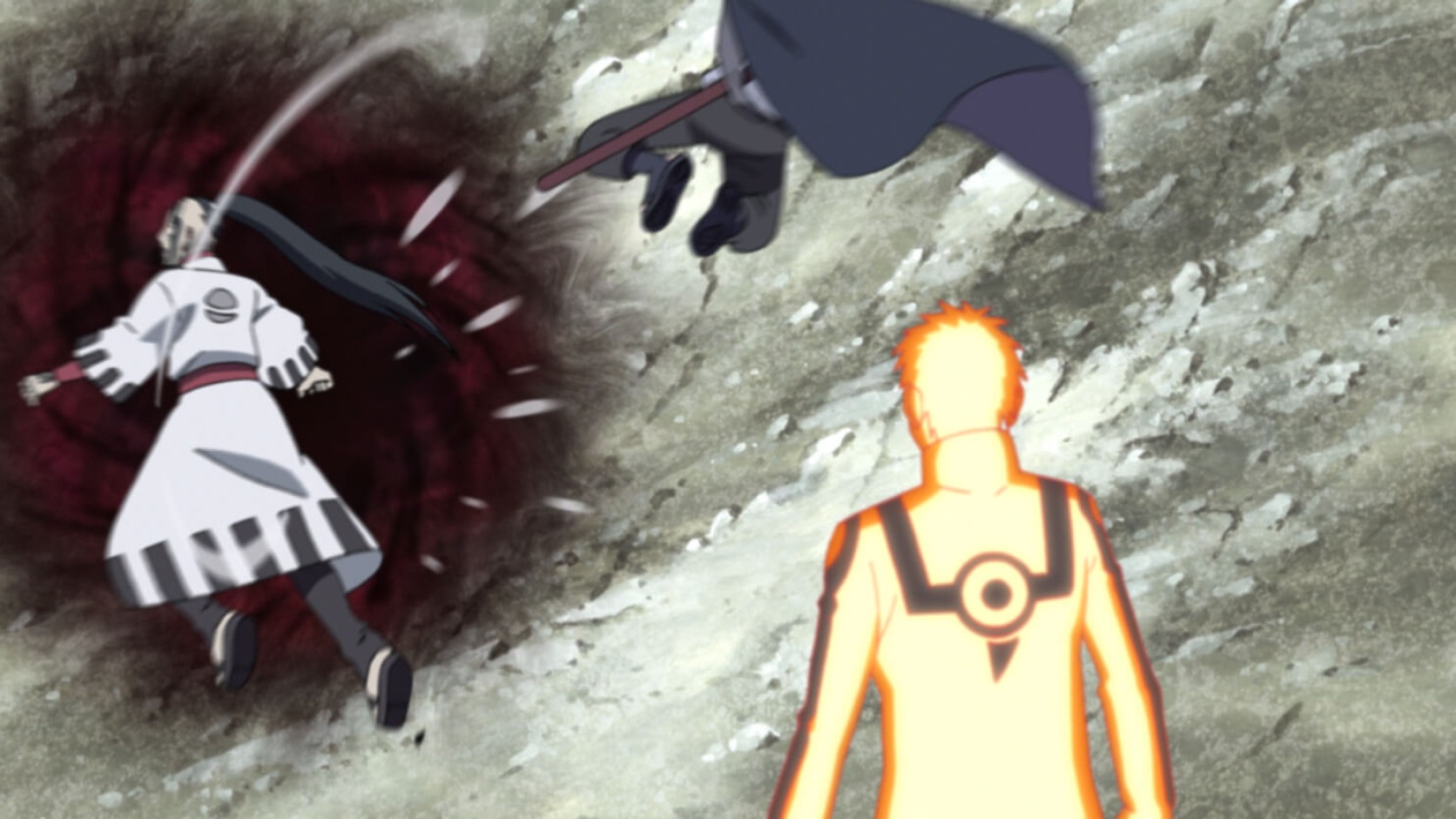
Surprise Attack!
Jigen turns Kawaki’s forced mark into a doorway, and Naruto answers the invasion with a boundary no abuser gets to negotiate: this child is not property.
Series: Boruto: Naruto Next Generations
Episode: 203 · Surprise Attack!
Arc: Kawaki: Kara Clash
Release: June 13, 2021
Previous: Episode 202 · The Cult
Directory: All 293 Boruto episodes
Bottom line
Boruto Episode 203 turns the Uzumaki home from refuge into a breach scene. Jigen appears through Kawaki’s Kāma without invitation, reaches for the child he engineered, and speaks as though ownership survived escape. Naruto refuses that premise immediately. The Hokage’s battle is not only village defense or a test of power. A guardian stands between an abuser and the person that abuser has come to reclaim. Kawaki’s terror carries the history of captivity into every second, while Naruto’s response gives protection a physical shape. Sasuke joins the fight with evidence about Kara and the Otsutsuki threat, but the emotional center remains painfully domestic: safety was real, then Jigen walked through the wall.
The title arrives without exaggeration
“Surprise Attack!” sounds almost playful until the attack begins inside a home. Jigen does not challenge Naruto at the village gate or announce war to the shinobi system. He uses Kawaki’s branded body as an entrance.
The surprise is therefore personal before the first strike lands. A mark forced onto a child becomes a route around every ordinary boundary. Kara’s technology and Otsutsuki power transform prior abuse into present access.
Daily life makes the violation sharper
The village begins in routine. People move through ordinary work, family rhythms, and conversation. No visible emergency warns anyone that a confrontation has already crossed the threshold.
Normalcy matters because recovery depends on believing danger no longer controls every room. The episode does not treat peace as filler. Peace is the achievement Jigen violates.
Kawaki feels the Kāma before anyone understands
His body recognizes danger faster than language can organize the moment. The mark reacts, and fear arrives with memory. Trauma frequently works through that order: sensation first, explanation later.
Observers may see a symbol glowing. Kawaki feels the return of a system that punished resistance and denied bodily ownership. His reaction deserves belief before a complete tactical report becomes available.
Jigen uses the body as a doorway
Kawaki’s Kāma is not simply a weapon or unusual power. Jigen treats the mark as infrastructure. The child’s body remains connected to Kara’s mobility, surveillance, and succession plan.
That function makes the invasion intimate. A locked door cannot protect someone when the abuser installed access beneath the skin. Safety planning must account for mechanisms the survivor never chose.
The home cannot prevent every breach
Naruto brought Kawaki into a loving household, watched him, fed him, trained him, and promised protection. None of those choices could erase the mark immediately.
The breach does not prove the refuge was false. Safety can be meaningful and incomplete at the same time. The failure belongs to the person exploiting access, not to the survivor who carried danger unknowingly into a safe place.
Jigen speaks like an owner retrieving property
He does not approach Kawaki as a person whose consent matters. His language assumes that investment created entitlement. Food, training, procedures, and power become items on an imaginary bill.
Abusers often rename control as care and then demand repayment. No resource given to a child can purchase that child. Jigen’s calm certainty makes the claim more chilling because he cannot imagine needing permission.
Kawaki’s fear is evidence
The episode never needs a courtroom summary of Kara’s abuse. Kawaki’s body, expression, and immediate understanding testify. He knows what Jigen’s arrival means.
Fear alone cannot establish every fact in every situation, but a known survivor reacting to a known abuser deserves protection first. Demanding composure before intervention would serve the intruder.
Naruto believes the danger in front of him
Naruto does not ask Kawaki to negotiate, prove worthiness, or explain why returning would be harmful. He recognizes coercion and places himself between Jigen and the child.
That response is one of the episode’s strongest choices. Protection begins with interrupting access. Analysis can follow after immediate safety has a chance.
The Hokage role becomes parental
Naruto has defended villages, nations, and the world. Here, enormous power answers a smaller sentence: you cannot take him.
Scale does not make the promise less political. A government leader declares that a traumatized child living under his roof is not expendable material in a larger strategy. Public duty and family care align.
Protection is not possession
Naruto’s stance could resemble competing ownership if Kawaki’s voice disappeared. The ethical difference rests on purpose. Jigen wants Kawaki’s body for a plan. Naruto wants Kawaki free to have a future.
A guardian must keep checking that distinction. Protection should widen the protected person’s agency rather than replace one controller with a kinder controller.
Jigen expects authority to settle the question
His posture suggests that resistance is an inconvenience. Kara has trained him to see command as natural and other people’s boundaries as technical obstacles.
Naruto refuses the social script before challenging the physical power. The refusal says Jigen’s claim lacks legitimacy even if Jigen wins the fight.
Power cannot create parental rights
Jigen shaped Kawaki’s Kāma, supervised brutal training, and selected him as a vessel. Those actions demonstrate abuse, not fatherhood.
Care is measured by whether a child’s personhood survives the relationship. Jigen values function. Naruto keeps discovering who Kawaki is beyond function, including the angry, frightened, difficult parts.
The fight begins inside Kawaki’s nervous system
Before Naruto throws a strike, Kawaki is already fighting collapse, conditioned obedience, and the expectation that rescue will fail. Jigen’s physical presence reactivates lessons learned through punishment.
Survival responses are not moral choices. Freezing, complying, running, or fighting can each emerge from a body calculating danger. Kawaki does not owe spectators a heroic reaction.
Naruto makes resistance visible
Kawaki has heard promises. Now he watches an adult risk injury to enforce one. Words become credible through action.
That demonstration can rewrite expectation slowly. Jigen is no longer the only powerful person in the room, and power is no longer serving only domination. One battle cannot heal trauma, but one reliable intervention can become evidence for future trust.
Jigen shrinks the terms of combat
His ability to reduce objects and manipulate size makes ordinary perception unreliable. Threats vanish from sight, then return at lethal scale or speed.
The technique suits his character. Jigen minimizes other people’s humanity while magnifying whatever serves him. His power turns that worldview into choreography.
Naruto’s strength meets a different problem
Raw force once solved impossible battles, yet Jigen’s abilities punish straightforward response. The Hokage must protect Kawaki, read unfamiliar mechanics, avoid collateral damage, and survive an opponent prepared for him.
Strength remains necessary without becoming sufficient. Experience should create adaptability, not confidence that every new danger will obey an old pattern.
A home battle creates impossible geometry
Every attack risks walls, neighbors, family, and the person being defended. Jigen benefits from choosing a location where Naruto’s care constrains movement.
Abusers frequently weaponize the target’s values. Someone committed to protecting others must spend attention on limits while the aggressor acts freely. Restraint should never be mistaken for weakness.
Kawaki becomes the battlefield without choosing combat
Both the portal and the conflict center on his body. Adults discuss extraction, retrieval, and protection while he stands inside the consequences.
The episode should keep returning to his perspective because spectacle can erase the person everyone claims to fight over. Victory means more than removing Jigen. Victory must restore Kawaki’s voice.
Sending Naruto away is strategic isolation
Jigen moves the battle into another dimension, separating the Hokage from village support. Isolation changes the odds and creates uncertainty at home.
The tactic mirrors coercive control on a larger scale. Remove the protector from witnesses, communication, and community, then redefine reality inside a closed environment.
Naruto follows because Kawaki remains at risk
Chasing an enemy across dimensions carries enormous danger, but allowing Jigen unrestricted access carries another kind. Naruto chooses engagement because retreat would leave the ownership claim unanswered.
The choice is brave and costly. Leadership must later ask whether the village has enough redundancy when one protector becomes unreachable.
Sasuke arrives with the missing context
His investigation in Episode 202 established Kara’s connection to Otsutsuki systems and another Ten Tails. Now he enters a battle where that knowledge changes interpretation.
Sasuke does not merely add another powerful body. He brings evidence, pattern recognition, and space-time capability. Teamwork begins by combining kinds of knowledge.
The reunion is tactical rather than nostalgic
Naruto and Sasuke have fought together through history large enough to invite fanfare. Episode 203 uses that history as competence. They read openings, converge, and understand stakes quickly.
Nostalgia works best when the present earns the return. Their partnership matters because Kawaki needs protection now, not because viewers deserve a familiar pose.
Two protectors still need a plan
Their combined power cannot erase Jigen’s preparation. The opponent knows the vessel system, controls the location, and has studied the shinobi world.
Mutual trust helps, but trust without information can become improvisation. Sasuke’s discovery and Naruto’s direct knowledge of Kawaki must meet before force can become strategy.
Jigen targets attachment as weakness
Naruto’s bond with Kawaki motivates intervention and creates leverage. A villain may interpret care as a predictable flaw.
That reading misses why attachment also generates resilience, information sharing, and refusal. Care creates vulnerability because people matter. A life without attachment would not be safer in any meaningful sense.
Kawaki’s panic does not cancel his growth
Recent episodes showed repair, training, tears, and hope. Jigen’s arrival can make those gains look fragile. Trauma recovery is not disproved by a severe reaction to the source of trauma.
Growth appears in what surrounds the reaction now: a family notices, a protector intervenes, and allies treat the threat as real. Progress belongs partly to the environment becoming more responsive.
Safety was never supposed to mean invulnerability
No household can promise that danger will never return. A more honest promise says nobody will face danger alone and nobody will be surrendered for convenience.
Naruto fulfills that promise under pressure. The distinction matters because impossible guarantees can produce shame after a breach. Reliable response is a stronger foundation than fantasy control.
The attack exposes institutional gaps
Konoha monitored Kawaki because Kara might pursue him, yet the village could not block space-time access through Kāma. Security planning met a threat outside familiar assumptions.
The answer should not be blaming Kawaki or turning his home into a prison. Better protection requires technical research, consent-based monitoring, rapid response, and contingency plans that preserve daily life.
Surveillance cannot become another cage
After an intrusion, institutions often respond by restricting the survivor. Kawaki could lose privacy, movement, and relationships because Jigen violated him.
That reaction would make Kara’s mark govern his life even in Jigen’s absence. Safety measures should be developed with Kawaki, reviewed regularly, and removed when no longer necessary.
The Kāma problem is medical and political
Kawaki needs protection from an external enemy and care for a bodily condition imposed without consent. Researchers may need access to sensitive information, but knowledge gathering cannot repeat Kara’s objectification.
Consent becomes complicated during emergency, not irrelevant. The village must distinguish necessary intervention from curiosity and strategic appetite.
Jigen’s calm is not emotional control
He appears composed while committing an invasion and attempted abduction. Calm presentation can make violence look rational, especially beside Kawaki’s terror and Naruto’s anger.
Morality cannot be measured by volume. Anger in defense of a boundary may be healthier than serenity while violating one. The content of an action matters more than polished delivery.
Naruto’s anger needs direction
Protective rage recognizes an intolerable wrong. Without strategy, rage can expose everyone to greater danger. Naruto must hold urgency and judgment together.
The episode lets emotion fuel refusal while Sasuke’s arrival adds analysis. Neither mode should dominate completely. Effective protection needs both moral clarity and tactical discipline.
Sasuke understands invasion from another angle
He has crossed dimensions, pursued power, threatened Konoha, and later protected the village from outside public view. His history complicates any simple hero pose.
That complexity can strengthen his judgment. Accountability does not erase past harm, but changed choices can make experience useful. Sasuke now uses access to interrupt domination rather than pursue personal supremacy.
The portal changes who controls the witness
Moving the fight away removes civilians and may reduce collateral damage, but Jigen also removes witnesses and controls return. The isolated dimension belongs to his advantage.
Witnesses matter because abuse thrives when the aggressor controls the record. Sasuke’s presence prevents the confrontation from becoming Jigen’s private version of events.
The episode makes rescue relational
Naruto protects Kawaki. Sasuke supports Naruto. Boruto, Himawari, and the household give Kawaki reasons to imagine a future worth defending. No one bond carries the entire structure.
That network contrasts with Kara, where relationships flow upward toward Jigen’s plan. Healthy connection moves support in several directions and allows people to remain distinct.
A child should not have to earn this battle
Kawaki has been suspicious, destructive, and difficult. Naruto protects him without requiring perfect gratitude or behavior first.
That choice rejects a common cruelty: help reserved for the most agreeable victim. Boundaries and accountability still matter, but neither condition basic safety on performance.
The spectacle never erases the custody question
Glowing transformations, shrinking rods, portals, and legendary fighters can dominate attention. Underneath every effect, Jigen is trying to take Kawaki against his will.
Keeping that sentence visible protects the episode from power-scaling emptiness. The fight matters because a person matters.
Boruto’s absence carries its own tension
Boruto shares Kāma’s danger but cannot stand beside Kawaki during the first breach. That absence prevents their partnership from becoming a convenient answer to every threat. The boys are connected without being interchangeable shields for one another.
Later cooperation will need honest limits. Boruto cannot promise constant presence, and Kawaki cannot build safety around one peer’s availability. Their bond matters most when supported by adults and systems willing to carry responsibility too.
Himawari’s home has been breached too
The attempted abduction centers Kawaki, yet every family member loses something when Jigen enters. Himawari’s home, already represented through shared meals and the repaired vase, becomes a location associated with sudden danger.
Care after crisis should include witnesses and siblings rather than assuming only the direct target needs support. Children can absorb fear from what they see, what adults conceal, and what nobody explains. Age-appropriate truth protects better than silence shaped as reassurance.
Koji watches control confront resistance
Kashin Koji has observed Kawaki and Konoha while pursuing his own position within Kara. Jigen’s sudden appearance disrupts whatever distance surveillance provided.
Watching an abusive leader act openly can clarify loyalties without making the observer automatically trustworthy. Koji’s knowledge may become useful, but usefulness does not erase secrecy or private motives. Naruto needs information without surrendering judgment to another Kara insider.
Rescue must continue after the dramatic moment
Blocking Jigen creates immediate safety, but Kawaki will still need sleep, explanation, bodily care, and choices after the portal closes. Spectacular rescue can attract attention that quiet recovery never receives.
The household’s earlier routines become important again. Meals, training, repairs, and ordinary boundaries tell a survivor that life remains larger than the emergency. Recovery is not an epilogue to battle. Recovery is part of what the battle was meant to protect.
Konoha must document the breach without blaming Kawaki
Investigators need to understand how Kāma enabled entry, what Jigen could perceive, and whether another route remains open. Those questions can sound accusatory when directed at someone whose body was used.
Trauma-informed investigation explains purpose, requests consent where possible, limits repetition, and separates evidence gathering from suspicion. Kawaki is the harmed person and a crucial source, not the cause of the breach. Language will determine whether village protection feels collaborative or carceral.
Winning means preserving a future
Defeating Jigen would matter, but victory cannot end with an enemy removed. Kawaki needs the freedom to choose relationships, work, rest, and identity beyond Kara. Naruto needs a village capable of protecting vulnerable people without concentrating every promise in the Hokage’s body.
The future therefore becomes the real territory under dispute. Jigen imagines continuation through possession. Naruto defends continuation through relationship. One vision consumes the next generation. The other accepts responsibility so that the next generation can become unpredictable.
What the episode gets right
“Surprise Attack!” makes Jigen’s invasion feel invasive. The home setting, Kawaki’s immediate fear, Naruto’s refusal, and the abrupt shift across dimensions preserve emotional stakes within escalating action.
The episode also uses Naruto and Sasuke as adults with responsibilities rather than icons arriving for applause. Their power serves protection, information, and relationship.
Where the episode needs care
Kawaki risks becoming a silent object while stronger characters decide his future. Later episodes must return agency to him rather than treating rescue as a complete solution.
The village response also deserves scrutiny. Increased security can easily punish the person already harmed. Protection should never reproduce confinement under a respectable name.
RaeRae verdict
Boruto Episode 203 earns four and three-quarter bowls of ramen out of five because the surprise is not merely Jigen’s timing. The shock comes from watching a forced mark defeat the ordinary promise of a locked door. Naruto answers with the clearest boundary available: Kawaki is not property, and nobody gets to collect him.
Naruto and Sasuke attacking together delivers the visual thrill, but Kawaki gives every strike meaning. This battle begins as an argument about who owns a child’s future. Jigen has already lost that argument, even before the harder question of physical victory receives an answer.
Before the next episode
Episode 204, “He’s Bad News,” traps Naruto and Sasuke in Jigen’s terrain and forces both men to confront how far his power exceeds their first estimate. Kawaki remains behind with the consequences of watching safety rupture.
Watch how the story balances battlefield strategy with the fear left inside the Uzumaki home. A portal can close while a nervous system still hears the intruder.
Sources and lawful viewing
The official Naruto site provides the Episode 203 synopsis and gallery. Crunchyroll carries “Surprise Attack!” where regional availability permits. Release and streaming details can vary by country.
Official episode reference: Naruto Official episode guide
Licensed episode route: Crunchyroll licensed series page
After watching, ask one question before debating power levels: what did Naruto’s immediate refusal teach Kawaki that another reassuring speech could never prove?