
Monsters
Delta comes to reclaim Kawaki as property, and Naruto answers by placing his own terrifying power between Kara and three children whose freedom matters.
Series: Boruto: Naruto Next Generations
Episode: 198 · Monsters
Arc: Vessel
Release: May 9, 2021
Previous: Episode 197 · Delta
Directory: All 293 Boruto episodes
Bottom line
Boruto Episode 198 asks who gets called a monster when nearly everyone on the training ground carries power capable of terrifying ordinary people. Delta invades Konoha to reclaim Kawaki as Kara property. Naruto transforms to protect Boruto, Himawari, and Kawaki. Kawaki has a weaponized body he never consented to receive. Delta has turned scientific modification into identity and authority. The episode could flatten that collision into two superpowered bodies trading attacks. Instead the emotional line remains clear: Naruto places himself between children and an adult who denies their personhood. Power looks monstrous when force becomes ownership. Power becomes protection when restraint, responsibility, and another person’s freedom govern use.
The title refuses one easy monster
“Monsters” arrives in the plural. Delta looks at Naruto’s Nine Tails power and sees a creature. Konoha sees a Kara Inner whose eyes and limbs contain weapons. Kawaki may look at both adults and measure which danger controls his future.
The plural matters because appearance cannot settle morality. A transformed body can protect. A beautiful face can threaten a child. The episode asks viewers to judge purpose, choice, and conduct rather than silhouette.
Delta crosses the boundary by force
Kashin Koji entered Konoha through a flaw in the sensory system. Delta abandons patience and forces her way toward Kawaki. Her arrival converts a security concern into an immediate household emergency.
Crossing the village boundary is more than tactical movement. Delta rejects Konoha’s authority to shelter Kawaki and rejects Kawaki’s authority to refuse return. Her mission assumes Kara’s ownership remains valid everywhere.
Kawaki recognizes danger before the others
Kawaki knows Delta’s temperament, modifications, speed, and willingness to harm bystanders. His fear carries expertise. Adults should listen rather than treating visible panic as unreliable.
Survivors often recognize patterns before people with institutional authority do. Naruto has more raw power, but Kawaki understands the specific threat. Safety improves when both forms of knowledge share the room.
The training ground becomes a hostage scene
Moments earlier, the space held supervised practice and a reconciliation ritual. Delta’s entrance changes every relationship around the same patch of earth. Himawari becomes vulnerable. Boruto becomes leverage. Kawaki becomes the stated objective. Naruto becomes the barrier.
Location does not create safety on its own. Safety comes from who controls the conditions and whether everyone present can leave without coercion.
Naruto moves in front
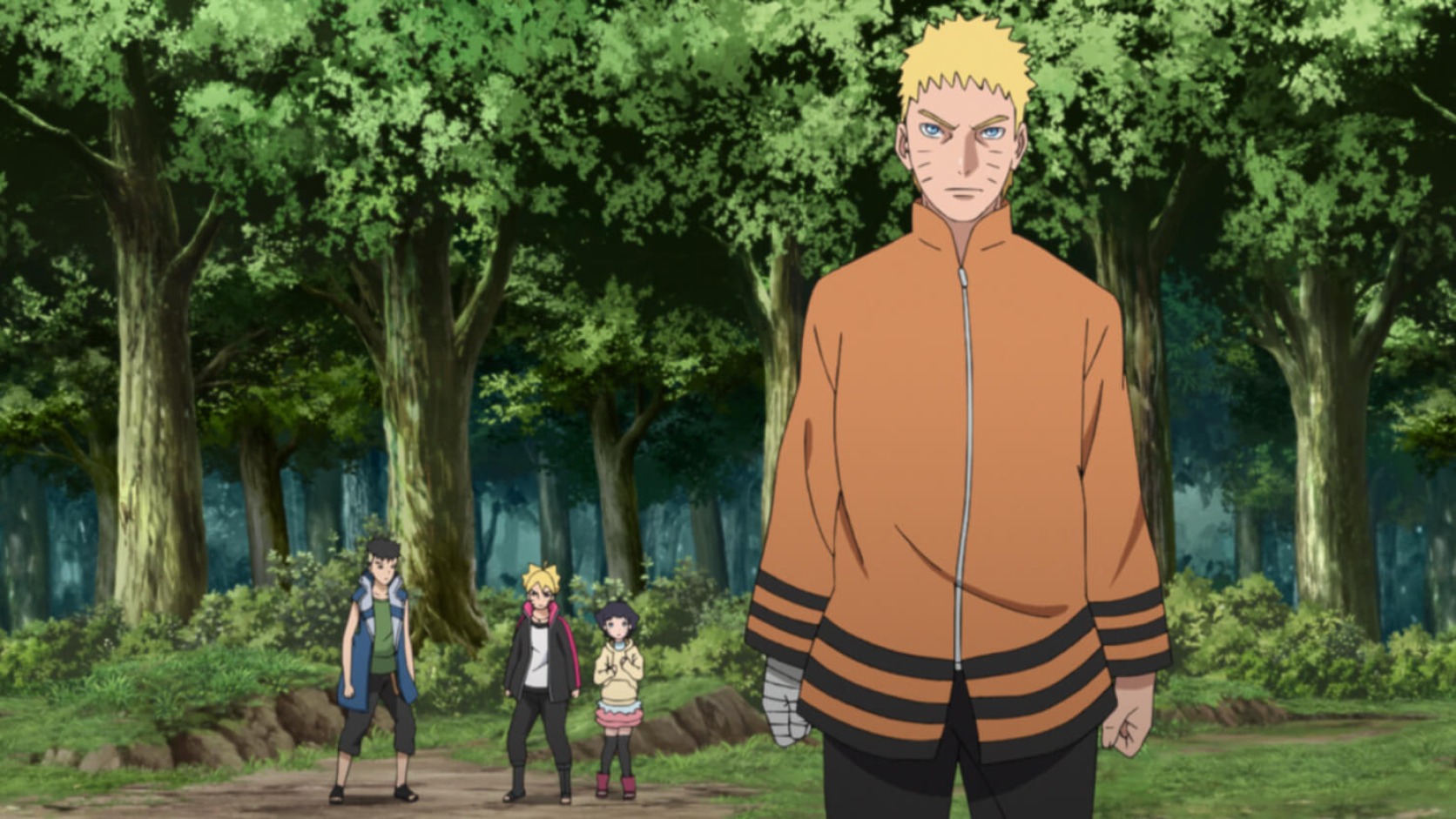
The strongest image in the episode is not an attack. Naruto places his body between Delta and the three children behind him. Position communicates policy before any speech.
Kawaki has watched adults stand over him, restrain him, and use him as cover for ambition. Naruto stands in front of him and accepts the first line of danger. Protection becomes physical evidence.
Boruto sees the Hokage become a father
Naruto’s public office and private role meet on the training ground. He is defending village security, but Boruto and Himawari are not abstract citizens. His children are behind him.
That personal stake does not weaken his judgment. The moment reveals why public duty should protect individual lives rather than consume them. The Hokage title gains meaning through the father who refuses to surrender any child.
Kawaki is included in the word family
Naruto protects Kawaki beside Boruto and Himawari. No blood test, adoption paper, or perfect behavior is required before danger arrives. The practical decision comes first: Kawaki will not be handed back.
Belonging becomes real when protection costs something. Warm meals were evidence. Facing Delta is stronger evidence because Naruto cannot perform care cheaply now.
Himawari should not be standing this close
The scene needs immediate evacuation thinking. Himawari has no role in a battle between modified adults. Keeping her close raises the chance that Delta can use her as leverage.
Naruto’s protective power is immense, but responsible planning should never treat strength as a substitute for distance. One adult needs to move the children while another contains the threat whenever possible.
Delta announces ownership
Delta comes to take Kawaki back, not to ask whether he feels safe or wants contact. Her language treats his absence as missing property.
That claim exposes Kara’s moral structure. Investment supposedly creates rights over a child’s body. Escape becomes theft. Resistance becomes malfunction. Naruto rejects that entire premise simply by asking what Kawaki wants and guarding his answer.
Kawaki expects his presence to endanger everyone
Delta’s arrival confirms one of Kawaki’s deepest fears: sheltering him brings Kara to the door. A traumatized child can turn that fact into self-blame and decide disappearance is the only way to protect others.
Adults must separate cause from responsibility. Kara chose pursuit. Delta chose invasion. Kawaki did not create their violence by accepting safety.
Naruto does not negotiate the child away
Political leaders sometimes call surrender pragmatic when the person being surrendered has less power. Naruto refuses that convenience.
Negotiation cannot be ethical when one side’s opening demand is ownership of a person. The village may still need strategy, intelligence, and restraint, but Kawaki’s bodily autonomy cannot become the bargaining chip.
Delta’s body is a scientific weapons platform
Her eyes, legs, sensory abilities, and regenerative systems turn combat into an encounter with advanced engineering. Scientific Ninja Tools are not separate gadgets she chooses from a pouch. Modification has been integrated into her body.
That fact complicates every attack Naruto makes. He is not only striking armor. He is confronting a person whose physical form has become military technology.
Modification does not erase personhood
Calling Delta a machine would repeat Kara’s habit of reducing bodies to functions. She chooses cruel actions and deserves accountability. Her altered body does not make her less human or less responsible.
The ethical question concerns conduct, consent, and power. Technology can expand agency or serve an abusive hierarchy. Appearance alone cannot answer which relationship exists.
Beauty and brutality occupy the same frame
Delta’s polished styling, bright hair, heels, and controlled expression refuse the usual visual shorthand for a monster. She looks glamorous while threatening children.
That contrast matters for fandom. Harm does not always arrive looking ugly, disordered, or visibly inhuman. Aesthetic appeal should not soften the facts of coercion.
Naruto’s transformation looks frightening too
Nine Tails power surrounds Naruto with intense light, markings, and force. Someone without franchise history could read the image as monstrous.
Viewers know the relationship behind that form. Naruto and Kurama moved from imprisonment and hatred toward chosen partnership. The visual remains powerful because history changes what the power means.
Kurama’s presence carries an old argument
Naruto was once treated as a container for a dangerous being. Villagers feared the child because adults sealed power inside him. Kawaki now faces a related reduction as Kara’s vessel.
Naruto protecting Kawaki therefore reaches beyond sympathy. He knows what happens when a community confuses the person with the power imposed on their body.
A vessel can still choose
Kara defines Kawaki through the future use of Kāma. Naruto responds to the person making choices in the present.
That difference is the moral center of the arc. A body can carry dangerous technology and remain self-owned. Risk may justify safeguards, but risk never converts a child into property.
Delta tests Naruto’s restraint
Naruto has enough power to devastate the training ground. The children behind him make reckless force impossible. Delta knows protection limits his options.
Restraint is not weakness. Restraint is the advanced skill of achieving safety without destroying everyone the fight exists to protect.
The children become tactical terrain
Boruto, Himawari, and Kawaki are people, yet Delta treats their positions as leverage against Naruto. She can redirect his attention by threatening whoever has the least defense.
That tactic reveals why evacuation matters. An opponent willing to target children turns every protective bond into an attack surface.
Naruto has to fight and parent simultaneously
He must read Delta’s modifications, contain force, watch three children, listen to Kawaki’s warnings, and decide how much power the environment can survive.
The mental workload deserves recognition. Hero stories often treat protection as a feeling. Effective protection requires logistics, communication, and delegation under pressure.
Boruto wants to participate
Boruto is a trained shinobi with Kāma and a strong instinct to help his father. Remaining behind Naruto may feel humiliating or passive.
Still, another fighter does not always improve safety. A child’s responsibility during an overwhelming threat can be retreat, observation, and protecting a younger sibling. Courage includes following a plan.
Kawaki wants to solve the danger himself
Because Delta came for him, Kawaki may believe surrender or direct confrontation belongs to him. That response fits a history where he handled adult violence alone.
Naruto’s intervention teaches a different rule. Receiving help does not make Kawaki responsible for every consequence of being helped. Adults can share the danger without demanding repayment.
Himawari’s fear should stay visible
Himawari is not accustomed to Kara’s violence. Her terror grounds the spectacle in civilian consequence.
The battle cannot become only a showcase of transformations and beams. Every missed attack changes the world around a child who expected to watch family training. Power must answer to that fear.
Delta attacks with anti-regeneration beams
Her eye beams threaten more than ordinary injury because they can negate the body’s ability to recover. Against Naruto, the weapon targets one of his most reliable advantages.
Technology becomes frightening through specialization. Delta does not merely have greater force. She has a tool designed to defeat the systems that normally keep opponents alive.
A beam changes the geography instantly
Long-range destructive power collapses safe distance. Trees, open ground, and Naruto’s position can stop being adequate barriers in a second.
The children need movement plans, not only faith in Naruto. Visual spectacle should never hide the geometry of risk.
Naruto refuses panic
Delta wants him angry, rushed, and easier to read. Naruto maintains enough control to study her attacks and keep the children behind him.
Emotional regulation becomes combat intelligence. Calm does not mean a lack of fear or fury. Calm means those feelings do not choose the next move alone.
Delta mistakes restraint for inferiority
An aggressor used to domination can misread controlled force as weakness. Naruto’s first priority is not proving the size of his power.
That misreading may become strategically useful, but the deeper point remains: protective people often look less aggressive because they carry more constraints. Constraints can reflect ethics rather than incapacity.
The Nine Tails form resets the scale
Naruto’s transformation tells Delta that Konoha’s protector is not a ceremonial leader. The energy changes the visual balance and gives the children a moment of confidence.
Power alone does not settle the fight because Delta’s tools are built around absorption, regeneration, and targeted destruction. The episode ends inside an escalating problem rather than offering an easy victory.
Scientific Ninja Tools remain morally neutral
Delta’s modifications can kill. Katasuke’s tools can protect, replace lost function, or expand access. The category cannot carry one moral verdict.
Design purpose, consent, ownership, maintenance, and use determine the ethical relationship. Kara’s problem is not science. Kara builds science around expendable bodies and concentrated control.
Kawaki embodies the cost of Kara’s research
Delta presents the polished result of advanced modification. Kawaki carries scars, fear, and a body changed through procedures he could not meaningfully refuse.
Standing in the same scene makes the institutional cost visible. Innovation celebrated without examining who endured development is propaganda.
Naruto protects without pretending knowledge
He listens when Kawaki warns him about Delta’s abilities. Strength does not require performing omniscience.
Good leadership combines authority with the humility to use local expertise. Kawaki’s knowledge came through abuse, but he decides to direct that knowledge toward protecting the people beside him.
Information becomes Kawaki’s contribution
Kawaki cannot match Naruto’s power, yet his warnings change the fight. He becomes more than the object everyone wants.
Contribution can support dignity when adults do not make safety conditional on usefulness. Naruto would protect him even without intelligence about Delta. That unconditional baseline keeps expertise from becoming another price.
Delta cannot imagine voluntary loyalty
She assumes fear, manipulation, or ignorance explains why Kawaki stays. Kara’s structure leaves little room for chosen attachment.
The Uzumaki household has not perfected trust, but Kawaki is already sharing information because he wants the people around him to survive. Voluntary loyalty grows where ownership ends.
The fight is also a custody dispute
Behind every strike sits a question: who has the right to decide where Kawaki lives? Kara answers Jigen. Naruto answers Kawaki, within safeguards required for everyone’s safety.
That difference separates custody from captivity. Protective adults can impose temporary limits, but those limits must serve the child rather than extract value.
Konoha’s security failure reaches the family
Koji’s infiltration and Delta’s entry show that village defenses did not contain Kara before danger reached Naruto’s children.
The Hokage’s personal strength becomes the last barrier because institutional layers failed earlier. After the fight, Konoha needs a serious review of detection, response time, evacuation, and insider assumptions.
One powerful leader cannot be the whole system
Naruto can protect this field, but the village contains thousands of people. A public safety plan built around one exceptional person remains fragile.
Redundant teams, communication routes, medical readiness, and civilian shelter matter. Heroism should never excuse missing infrastructure.
The word monster often protects institutions
Calling Delta a monster can focus outrage on one frightening body while Kara’s research network, hierarchy, and financing disappear from view.
She is responsible for her choices. The organization that designed, authorized, and rewarded those choices also requires scrutiny. Individual villainy should not become institutional camouflage.
Naruto knows dehumanization personally
He grew up hearing whispers that confused him with the Nine Tails. That history should make him cautious about calling any modified person less than human.
He can condemn Delta’s attack, stop her forcefully, and defend the children without denying her personhood. Accountability becomes stronger when nobody needs dehumanization to justify protection.
Gender does not soften Delta’s responsibility
Delta’s glamour and femininity may tempt viewers to treat cruelty as attitude or entertainment. Threatening children and claiming ownership of Kawaki remain serious actions.
Equal accountability means judging what she does without sexist insults about appearance, age, or womanhood. Criticism has plenty of material in her conduct.
Power should be measured by who remains safe
The most impressive technique is not necessarily the largest. Naruto’s success must be judged by whether Boruto, Himawari, Kawaki, and nearby civilians survive without becoming collateral damage.
That measure challenges spectacle culture. Destruction can look powerful while revealing poor control. Protection often looks quieter because the avoided harm never appears onscreen.
The battle continues beyond the episode
Episode 198 establishes Delta’s tools, Naruto’s transformed response, and the children’s vulnerable position. The fight does not resolve here.
That boundary matters. Episode 199 will push absorption and force further. “Monsters” is the opening argument about what each combatant believes power allows.
Kawaki should not have to prove the threat
The terror on Kawaki’s face and the urgency in his warnings come from direct experience with Delta. Naruto responds before demanding a polished report. That choice respects the reality that people under threat may not present evidence in calm chronological order.
Later debriefing still matters. Konoha needs names, capabilities, routes, and patterns. Immediate protection comes first, while detailed documentation can happen after Kawaki is physically secure and able to speak without the attacker standing nearby.
The children need instructions they can follow
“Stay back” means little when long-range beams can cross the entire field. Boruto, Kawaki, and Himawari need a clear direction, a destination, and an adult assigned to move with them.
Emergency communication should match each child’s capacity. Boruto and Kawaki can help with defense under defined limits. Himawari needs evacuation and reassurance. Treating every child identically would ignore the different risks they face.
Protection after the fight will matter too
Even if Naruto wins, the family will carry the encounter home. Himawari may fear another attack. Boruto may feel guilty for staying back. Kawaki may blame himself for drawing Kara closer. Naruto may focus on the next threat before processing his children’s fear.
Recovery should include honest explanation, medical checks, restored routines, and permission to react differently. Surviving danger is not the final step of protection.
Delta exposes Kara’s idea of motherhood and family
Kara can build bodies, implant marks, and speak about inheritance without practicing care. The organization creates dependency while denying mutual responsibility.
The Uzumaki household offers the opposite model. Family is not the adult who made or purchased access to a child. Family is the network that feeds, listens, sets boundaries, protects, apologizes, and remains answerable for how power is used.
The hero image captures the real hierarchy
Naruto stands forward while Boruto, Himawari, and Kawaki remain grouped behind him. The image does not need an explosion to explain the stakes.
Delta wants one child as property. Naruto protects all three as people. Every later technique should be read through that arrangement.
RaeRae’s verdict
“Monsters” works because the title never settles on anatomy. Delta’s body contains frightening technology, Naruto’s body carries the Nine Tails, and Kawaki’s body was engineered as a vessel. None of those facts decides who behaves monstrously. The decision lives in relationship to power.
Delta crosses a village boundary, threatens children, and denies Kawaki’s right to choose. Naruto uses terrifying strength to become a barrier between her and those children. His protection is not perfect planning, especially with Himawari so close, but his moral position is unmistakable. Kawaki sees an adult risk himself without demanding ownership in return. That sight may matter as much as any attack. The battle continues, but Kara has already lost one argument: a child can carry dangerous power and still belong to himself.
Sources and lawful viewing
Official episode reference: Naruto Official episode guide
Licensed episode route: Crunchyroll licensed series page
The official guide identifies Episode 198 as “Monsters” and summarizes Delta entering Konoha to take Kawaki, Naruto protecting Boruto, Himawari, and Kawaki, and the Hokage activating Nine Tails power against the Kara Inner. Crunchyroll lists the licensed episode with a May 9, 2021 release date. Availability and language options can vary by region.