
Memory, Sorrow, and Thorn · Canonical Character Profile
Count Stréawe
Count Stréawe rules Perdruin from crippled legs, a decaying palace, trained birds, paid eyes, hidden passages, polite debts, and the unnerving confidence of a man who knows every crisis will eventually need a dock. He is not physically imposing. That is why everyone who mistakes strength for muscle discovers him too late.
At a Glance
The island ruler who makes neutrality pay rent
- Title
- Count of Perdruin and master of Ansis Pelippé
- Physical condition
- Elderly, white-haired, tall, age-seamed, and unable to walk without being carried
- Power base
- Ports, docks, brokers, trained birds, servants, debts, wealth, and information
- Signature mask
- A fox face worn during the Perdruin festival
- Political method
- Turns protection, delay, rescue, and neutrality into transactions
- End status
- Alive; holding Vorzheva and the twins while bargaining through the postwar transition
The Visual Receipt
Elegant weakness is still power when the whole harbor answers to it
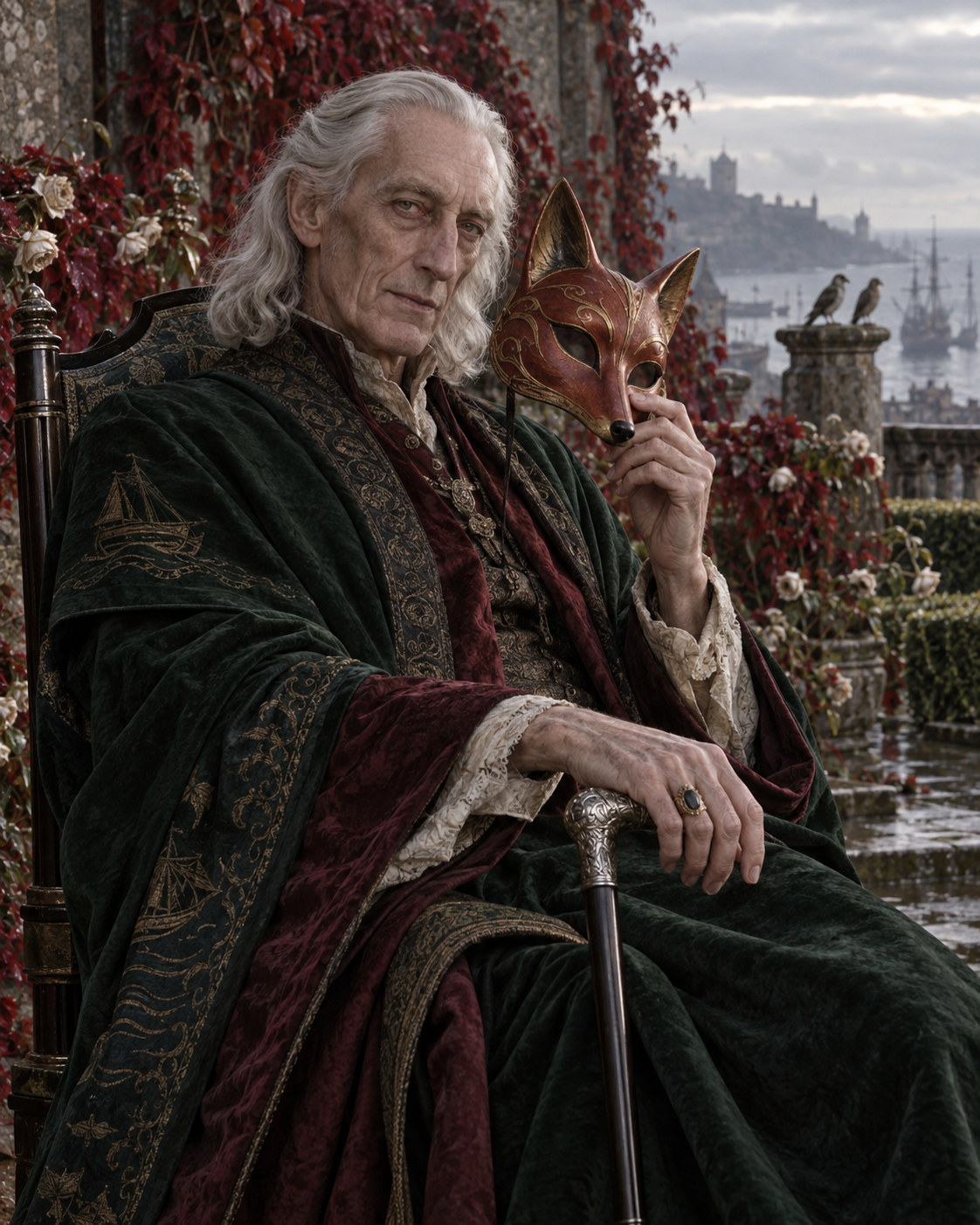
Stréawe is a tall, white-haired, elderly man with an age-seamed face and crippled legs. He must be carried. His first reveal comes beneath a fox mask after servants dressed as Death, sailor, and peasant remove Miriamele and Cadrach from the festival crowd. The physical contrast is the point: the frail body at the center commands every stronger body in the room.
The approved identity preserves an attractive, age-correct, dangerous aristocrat seated with his long disabled legs supported beneath layered island-court robes. His shoulder-length white hair, long narrow age-seamed face, pale watchful eyes, controlled mouth, refined hands, russet-and-gold fox mask, and dark-green maritime wardrobe now form one continuity map across the childhood-host memories, garden captivity, Nabban rooftop politics, Benigaris’s velvet detention, and the bargain with Josua. Later art must not “fix” his legs for a powerful pose.
The novels establish his height, white hair, advanced age, seamed face, disabled legs, need to be carried, fox disguise, decaying palace, high-walled garden, roses, vines, trained birds, wealth, and maritime information network. His exact age, facial structure, eye color, hair length, clothing, chair, cane, mask ornament, birds, harbor architecture, and coastal lighting are editorial reconstruction—not a recovered likeness hidden between the pages.
The Complete Journey
He keeps surviving stronger rulers because they eventually need what only an island can sell
Book 2 · Stone of Farewell
The childhood host turns refuge into a beautiful cage
Perdruin first feels like freedom to Miriamele because she remembers visiting with Hylissa. The festival masks widen that illusion. A skull-faced Death removes her and Cadrach from the Red Dolphin and delivers them to a fox-masked host who reveals himself as Count Stréawe, her old family acquaintance and the island’s master from the moment she landed.
Stréawe’s network tracked her departure from Naglimund before she reached Greenwade. Ports are information markets; birds and brokers move news faster than secret travelers. He admits he considered selling Miriamele’s location or person to Elias or Josua. Instead, an unnamed religious ally calls in a debt and orders him to prevent her reaching Nabban.
He locks her in his aging castle while insisting he is protecting her freedom. The walled garden, open sky, and free birds make the contradiction visible. Stréawe brings calamint tea, tells her Leobardis has died, then holds her while she sobs after reporting Naglimund’s fall. His care need not be false to remain captivity. Affection makes coercion more confusing, not less real.
His servant Lenti supplies knives and obedience; Alespo helps carry out orders. Stréawe eventually moves Miriamele and Cadrach through a hidden tunnel to a boat and transfers them toward an unnamed creditor. He calls the arrangement an honorable debt and delicate balance. Their choices are the currency balancing it.
Book 3 · To Green Angel Tower, Part I
Information reaches Sesuad’ra before the count does
Stréawe’s influence continues through objects and messengers. Cadrach carries money stamped with his mark, helping Miriamele reconstruct the monk’s betrayal. Lenti later brings Josua a sealed offer concerning Nabban. Josua recognizes the messenger as a fool and the sender as dangerously clever, yet the offer creates enough possibility to call the Raed on Josua’s timetable.
In Nabban, Stréawe sits with Nessalanta and Benigaris while the astrologer interprets the Conqueror Star. After servants leave, he supplies intelligence about Elias and Josua, converting an ornamental rooftop garden into a private control room. His body arrives carried; his information rearranges the people standing around it.
Book 4 · To Green Angel Tower, Part II
The broker becomes a prisoner and keeps bargaining anyway
Stréawe delays the Perdruinese riverboats and troops Benigaris demanded, then blames servants and proposes returning personally to Ansis Pelippé. Benigaris responds by turning concern for the count’s health into a velvet threat: Stréawe must remain in Nabban until the ships and soldiers arrive. The captor from Perdruin recognizes confinement when it is done politely to him.
He accepts with weaponized courtesy and survives the reversal. Benigaris later admits he chose a land battle partly because Stréawe controls the docks. After defeat, Josua confronts the count for exploiting unrest Pryrates helped create. Stréawe defends Perdruin through vulnerability and wealth, then offers ships and sailors for the Erkynland crossing. His price is knowledge rather than simple gold.
The bargain is infuriating because the need is real. Sea ice and maddened kilpa are closing the route. Josua can condemn neutrality as leverage and still require Stréawe’s harbor. After the war, Josua plans to retrieve Vorzheva and the twins from the count, confirming that Stréawe remains alive and positioned inside whatever comes next.
The People Around Him
Everybody becomes a debt, a route, a buyer, or a reason to pretend the door is locked lovingly
Miriamele
He knew her as a child and may genuinely care for her. He still considers selling her, confines her, and transfers her without meaningful consent.
Cadrach
Stréawe’s silver and private knowledge turn the monk’s weakness into intelligence. “Padrec” becomes another name the count can spend.
Lenti
The servant’s knives, masks, fear, and obedience are portable versions of Stréawe’s authority.
Nessalanta and Benigaris
They need his information and ships, then attempt to imprison the broker inside their own court. Dependence keeps reversing the apparent hierarchy.
Josua
The prince recognizes exploitation and still must negotiate. Moral clarity does not create boats.
Perdruin
Stréawe treats the island’s vulnerability as both responsibility and inexhaustible justification. Every compromise is presented as survival.
Why He Works
He is frightening because the cage comes with tea and accurate news
Stréawe works because coercion and care remain capable of sharing a room. He does not need to fake every tenderness for imprisonment to be wrong. His affection, intelligence, and physical vulnerability prevent the character from becoming a simple spider metaphor while making his transactions harder to dismiss.
He also demonstrates that neutrality is active policy. Delaying ships, moving information, pricing rescue, withholding names, and deciding who may leave are choices with casualties. Stréawe’s clean gloves never mean clean hands.
Disability and Power
The books do not cure his body before allowing him to dominate a political room
Stréawe’s crippled legs are neither secret weakness waiting for a villain reveal nor an inspirational obstacle the plot makes him conquer. He has built a form of rule that assumes physical dependence and converts it into organization. Servants carry him; birds carry news; brokers carry offers; Lenti carries knives; ships carry everyone who eventually needs his island. The count’s body has limits. His network is the answer he designed, not proof those limits were imaginary.
That makes Benigaris’s detention especially pointed. The duke cannot neutralize Stréawe by defeating him in combat, so he uses the language of health and hospitality to keep the count physically within reach. Stréawe recognizes the maneuver because it resembles his own treatment of Miriamele: a locked choice polished until the captor can call it care.
The parallel does not redeem him. Experiencing velvet confinement does not produce a confession or suddenly return agency to everyone he manipulated. It does expose the political grammar he shares with stronger rulers. They all translate another person’s vulnerability into custody and then rename custody necessity.
His survival through that reversal reinforces the real source of his authority. Perdruin sits where routes meet. Bodies, armies, messages, and winter plans must move, and Stréawe prices movement. Even Josua’s justified anger cannot sail soldiers across a closing sea. The disabled old man remains powerful because geography and information answer to arrangements he made long before the heroes arrived.
On the Record
Scope, spoilers, and identity continuity
This is Count Stréawe’s one canonical full-spoiler profile across Books 2, 3, and 4. It is grounded in the completed owned-edition reading ledger and corrects his omission from the earlier Book-1-centered registry. Franchise and volume directories must filter this post rather than duplicate his biography.
Josua’s postwar intention to retrieve Vorzheva and the twins establishes Stréawe’s continuing custody role, but it does not authorize invented scenes, motives, or conditions beyond that stated plan.
Visual state: approved and locked. One age-correct, elegant, dangerous, disabled elderly man with shoulder-length white hair, a long age-seamed face, stable seated or carried posture, and one consistent russet-and-gold fox mask governs every milestone. The same local attachment must remain the WordPress featured image, visible hero, directory card, and Rank Math social image; scene art may change setting and costume only while preserving this face, body, disability, and mask design.