
STITCH! · BROADCAST SEASON 2 · EPISODE 10 · REACT
Stitch! Season 2 Episode 10: Herbivorous Stitch Transformation!
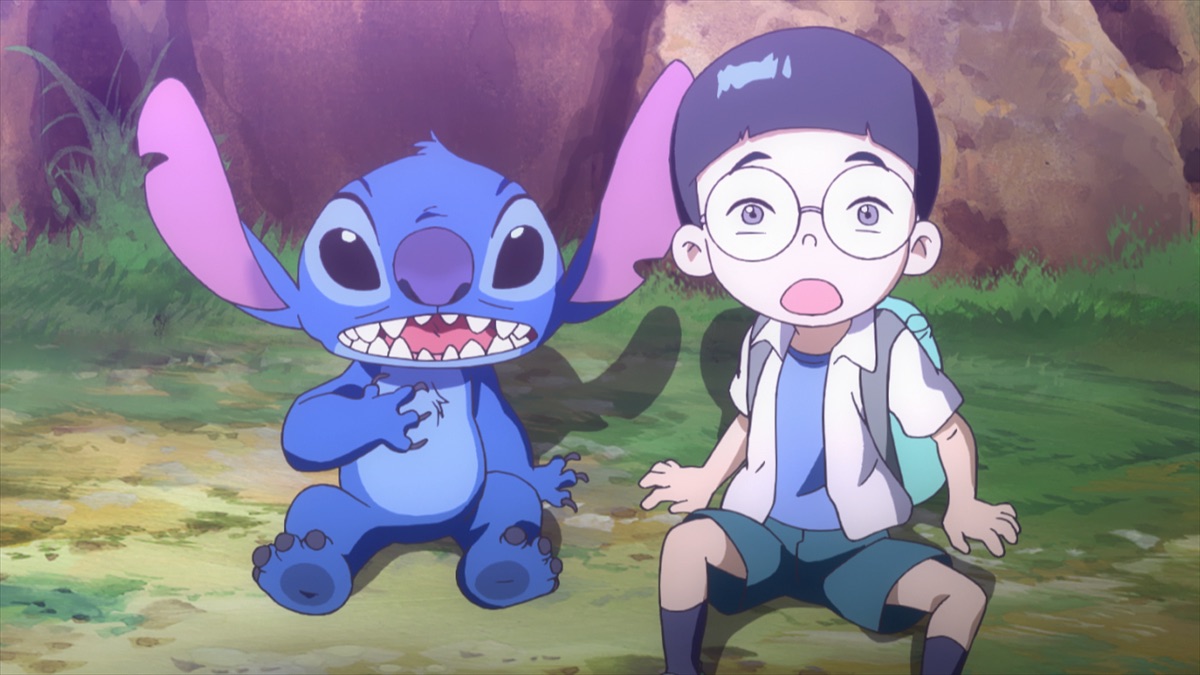
Stitch got Taro’s body and called it weak. Taro got Stitch’s body and kept his fear. Muscle never carried the lesson either one expected.
The episode record before one body becomes somebody else’s lesson
Episode: Broadcast Season 2, Episode 10
Japanese title: 草食系スティッチに変身!
English card title: Herbivorous Stitch Transformation!
Apple TV display number: Season 2, Episode 10
Production branch: Stitch! Itazura Alien no Daibōken
Japanese voices central here: Kōichi Yamadera as Stitch and Motoko Kumai as Yuna Kamihara
Where to watch: Apple TV Japan carries an official episode listing. Availability changes by region.
Taro and Stitch disturb the sleep of a forest yōkai called Mabu Itokkae. The angry yōkai swaps their souls. Stitch wakes inside Taro’s physically weaker human body and becomes furious with its limits. Taro gains Stitch’s powerful body but remains frightened and tearful. Stitch decides to train Taro’s courage while Yuna and the others search the forest for the yōkai who can return them to themselves.
My first reaction: the punishment makes sense, but the consent absolutely does not
Taro and Stitch disturb a sleeping forest being. They owe an apology and repair. Mabu Itokkae responds by taking control of both bodies and identities. The swap forces empathy through violation, which gives the episode a useful premise and a morally messy teacher.
Learning how another person experiences the world can change judgment. Nobody should have to surrender bodily autonomy to provide that education. The episode needs both truths. Stitch and Taro can learn from the swap while still naming the yōkai’s action as disproportionate.
The forest is somebody’s home before it becomes a playground
Stitch and Taro enter a space inhabited by yōkai and interrupt sleep. The disturbance may look minor to children seeking adventure. Rest, territory, and ritual carry meaning they do not understand. Curiosity does not make the forest empty or available.
Yuna and Obaa should teach local protocols: announce presence, respect marked areas, avoid taking objects, and leave sleeping beings alone. Those rules protect visitors and residents. A supernatural punishment often appears only after ordinary boundaries have already been ignored.
Repair begins with learning what the disturbance caused. Mabu Itokkae may need restored shelter, quiet, or a promise about future access. Returning the bodies cannot be treated as the only harm worth addressing.
Stitch experiences physical limitation and calls the body weak
Stitch is accustomed to extraordinary strength, durability, speed, and sensory capacity. Taro’s human body feels restrictive by comparison. Frustration is predictable. Calling the body pathetic turns difference into failure and directs anger toward the person who lives there every day.
Taro’s body has kept him alive, carried him through school, and adapted to his environment. It was never designed to perform Stitch’s feats. Judging it by alien standards is like calling a boat defective because it cannot climb a tree.
Stitch needs to learn pacing, leverage, tools, and help. Adaptation is not surrender. It is intelligence applied to the body actually available instead of punishing that body for not matching memory.
Taro receives power and keeps his fear
The swap proves that courage does not live in muscle. Taro gains a body capable of lifting enormous weight and surviving attacks, yet his nervous system, expectations, and learned responses remain. Physical capacity changes what he can do. It does not automatically change what danger feels like.
That does not make Taro fraudulent or hopeless. Fear is information and a body response. He can learn how to act while afraid, assess real risk, and use Stitch’s power without pretending the feeling vanished.
The episode becomes cruel if it treats tears as proof that Taro does not deserve strength. A powerful body in frightened hands needs support, not ridicule. Shame will make control worse.
The title’s “herbivorous” joke carries gender baggage
The Japanese phrase evokes a stereotype of a gentle, passive, nonaggressive man. Applying it to Stitch makes his altered behavior sound like a failed version of masculinity. Taro’s sensitivity becomes the opposite of what a strong male character should be.
The episode can challenge that binary. Gentleness is not absence of courage, and aggression is not proof of it. Stitch’s usual force solves some problems while creating others. Taro’s caution can notice risks Stitch ignores. Both need a wider range of responses.
Training should expand choice. It should not convert Taro into a louder boy so everybody feels comfortable calling him brave.
Stitch cannot train courage by recreating panic
Stitch wants to toughen Taro quickly because the powerful alien body seems wasted on fear. Throwing him into danger may produce compliance or shutdown rather than skill. Effective training needs consent, graduated difficulty, clear goals, and a way to stop.
Taro can practice grounding, movement, strength control, and decision-making in safe conditions. He should understand what Stitch’s body can do before testing limits near other people. Power without proprioception can injure bystanders even when Taro is trying to retreat.
A courage lesson succeeds when Taro chooses one meaningful action despite fear, not when he performs Stitch’s personality convincingly.
Taro’s body cannot be used recklessly because Stitch expects to leave it
Stitch may push the human body into falls, exhaustion, or injury while searching for the yōkai. The consequences will remain with Taro after the swap ends. Temporary control creates a duty of care toward the future occupant.
He needs to avoid unnecessary risk, report pain, eat and rest appropriately, and tell Taro about any injury or medication. The body is borrowed under coercion. It is never disposable equipment.
The same obligation applies to Taro. Stitch’s alien body belongs to Stitch. Taro should not test destructive abilities without permission simply because the body can survive them.
Identity persists through more than appearance
Friends may see Stitch’s shape and assume the person inside remains Stitch. Behavior, language, memories, and consent reveal the mismatch. Yuna should verify identity through knowledge only each person would possess rather than relying on performance stereotypes.
The swap also raises privacy concerns. Each occupant may notice bodily information the owner never intended to share. They should agree not to disclose it. Comedy does not grant permission to turn another person’s body into gossip after restoration.
Yuna’s search for Mabu Itokkae needs respect, not another intrusion
Yuna and the others rush into the forest because reversal feels urgent. Charging through the yōkai’s home and demanding service could repeat the original offense. They need Obaa’s guidance, an offering or apology if culturally appropriate, and a request that acknowledges harm on both sides.
Mabu Itokkae may refuse until repair occurs. The children can explain medical and safety risks without threatening the being. Negotiation should aim for restoration and a boundary agreement, not defeat.
The adults need to monitor both bodies medically
A soul swap may alter coordination, stress, sleep, nutrition, and access to abilities. Jumba should evaluate both without treating Taro’s body as a disappointing control sample. He needs baseline information and must explain uncertainty.
Taro’s caregivers should be informed in a way that protects privacy and secures consent where possible. If either body requires medicine or has a condition, the temporary occupant needs accurate instructions. Magical incidents do not suspend ordinary health responsibilities.
Taro’s fear may have a history the episode should hear
Calling him timid describes behavior without explaining it. He may have experienced bullying, injury, family pressure, sensory overwhelm, or repeated failure when adults demanded bravery. Training built without that history can recreate the conditions that taught him to freeze.
One honest conversation would deepen the plot. Ask what Taro fears will happen. Separate likely danger from remembered danger. Choose a challenge connected to his own goal rather than Stitch’s impatience.
Courage belongs to the person taking the risk. Taro gets to define what progress looks like.
Stitch needs humility more than gratitude for his normal body
The easy lesson has Stitch celebrate his strength after restoration. Appreciation matters, but humility matters more. He learns that Taro navigates daily life without alien advantages and that human limitation requires planning Stitch rarely practices.
He should carry those lessons forward when judging friends. People who cannot keep up are not necessarily lazy. A task designed around Stitch’s body may exclude everybody else. Strength creates responsibility to adapt the environment rather than demanding bodies adapt to him.
The swap can build empathy only if each person listens afterward
Living in another body provides sensation, not complete understanding. Stitch experiences a short crisis under unusual conditions. He does not automatically know Taro’s whole life. Taro experiences alien power while frightened. He does not know every pressure attached to being Stitch.
After restoration, they need to compare experiences and correct assumptions. Empathy grows through conversation around the embodied glimpse. Claiming total knowledge would create a new kind of arrogance.
Bodies carry skills that do not transfer with consciousness
Stitch remembers how he normally jumps, balances, and uses four arms, but Taro’s body lacks the same proportions and practiced movement. Taro inherits alien muscles without years of learning how much force a small gesture can produce. Both face a gap between intention and motor control.
That gap makes ordinary actions risky. Walking, eating, opening doors, and touching another person require recalibration. The episode should value slow practice before combat. A person is never merely a mind operating interchangeable equipment. Habit, sensation, reflex, and body knowledge participate in identity.
The lesson also changes how Stitch reads Taro’s performance. What looks effortless from outside may depend on skills invisible to the observer. Taro has competencies Stitch notices only after losing access to his own.
Punishment produced the situation, but teaching determines what survives it
Mabu Itokkae can force the swap and still fail to create understanding. Pain does not automatically organize itself into wisdom. Yuna, Obaa, Jumba, Stitch, and Taro have to interpret what happened, identify harmful assumptions, and choose changed behavior.
If the ending celebrates the yōkai’s clever lesson without that work, coercion receives credit for growth other people built. The children can accept responsibility for disturbing the forest while rejecting the idea that every punishment imposed by a powerful being is inherently educational.
Mabu Itokkae needs accountability too
The children disturbed the yōkai. The yōkai took bodily control and created risks neither child agreed to bear. A balanced ending should not frame supernatural authority as automatically wise. Power can enforce a boundary and still exceed what repair required.
Mabu Itokkae can reverse the swap, explain the forest rule, accept an apology, and acknowledge the danger caused. Mutual accountability makes coexistence possible. Fear of punishment alone teaches children to avoid discovery, not to understand the boundary.
Restoration needs verification and recovery time
Returning to the correct bodies should include medical checks, memory confirmation, and rest. Coordination may feel strange after hours of adapting elsewhere. Neither child should be pushed immediately into a physical test proving everything is normal.
They also need a private debrief about what each body experienced. Injuries, exposures, and emotional distress should be disclosed without blame. Restoration returns ownership. It does not erase events that occurred during the loss of it.
What the episode gets right
“Herbivorous Stitch Transformation!” makes physical power insufficient. Taro remains afraid inside the strongest body on the island, while Stitch cannot force a human body to obey alien expectations. Each confronts an assumption that seemed obvious from the outside.
The forest yōkai also ties the swap to a violated boundary rather than random magic. The children’s behavior has consequences, and the route home requires returning to the being whose rest they dismissed.
What I wanted pushed further
I wanted Taro’s fear treated as information instead of a flaw Stitch must train away. Give him a history, a chosen goal, and a gradual practice. Let caution contribute to the rescue rather than waiting for him to imitate aggression.
I also wanted explicit bodily agreements. No reckless testing, no disclosure of private information, and full reporting of injuries after restoration. A body-swap comedy becomes stronger when it understands how much trust the premise removes.
The receipt I am keeping
The receipt is Stitch furious that Taro’s body cannot do what he demands. The body is not failing. His expectations are. Every improvised tool or request for help becomes a lesson in adaptation he normally skips through strength.
Taro’s receipt is the opposite. Stitch’s power does not silence fear, proving courage cannot be transferred through muscle. His meaningful victory begins when he chooses one action while still feeling everything the story wants him to outgrow.
Final verdict
“Herbivorous Stitch Transformation!” works when the swap dismantles the idea that strength and courage are the same trait. Stitch needs respect for limitation. Taro needs support that expands agency without shaming sensitivity. Both need their bodies returned with privacy and care.
The episode earns its forest lesson if Mabu Itokkae also answers for coercion and the children repair the disturbance they caused. Empathy cannot be forced cleanly through violation. It can still grow afterward when everybody stops treating another body as a tool for proving a point.
Keep watching
Return to Season 2 Episode 9 or open the complete Stitch! episode directory.