
STITCH! · PRODUCTION SEASON 2 · EPISODE 7 · REACT
Stitch! Season 2 Episode 7: The Rivals Are Stuck Together!
Yuna and Piko did not need a friendship speech. They needed a count-off, a pain boundary, and one shared decision about which direction to run.
The episode record before five experiments become one emergency
Episode: Production Season 2, Episode 7
Japanese title: ライバルがくっついた!
English card title: The Rivals Are Stuck Together!
Production branch: Stitch! Itazura Alien no Daibōken
Japanese voices central here: Kōichi Yamadera as Stitch and Motoko Kumai as Yuna Kamihara
Where to watch: Apple TV Japan and VideoMarket carry official Japanese episode listings. Availability changes by region.
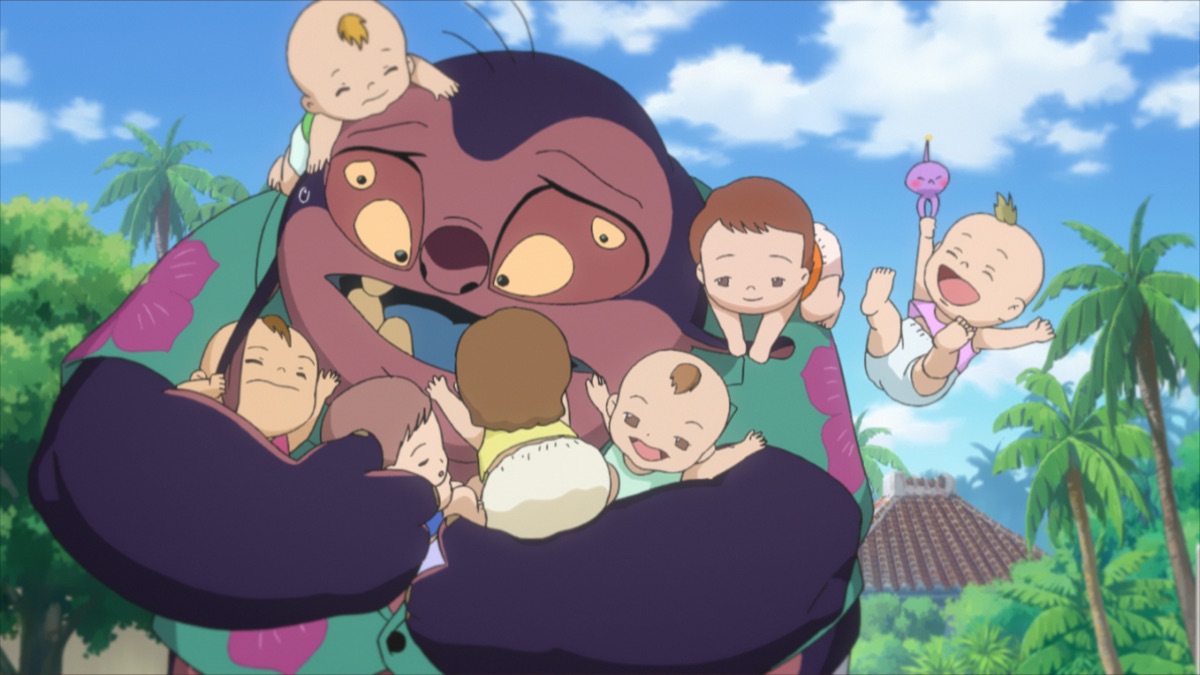
Hämsterviel tries to defeat Stitch by sending five experiments to Izayoi Island at once. Babyfier turns everyone except Stitch into infants. Link physically joins people who dislike each other, leaving Yuna and Piko stuck back-to-back. Stitch faces a care crisis and a multi-experiment attack while the rivals must coordinate movement and help the community despite their ongoing hostility.
My first reaction: Hämsterviel finally discovered project management
One experiment causes chaos. Five create overlapping failures that prevent the heroes from solving problems in their usual order. Babyfier removes adult capacity. Link disrupts movement and forces rivals to share one physical space. Stitch becomes fighter, rescuer, and caretaker while the island’s normal support network is literally too young to function.
The plan works because the experiments combine effects. Hämsterviel is usually too impatient to build coordination into his attacks. Here he treats abilities like a system, and the island pays for having no multi-incident protocol.
Babyfier does more than make everybody adorable
Turning people into infants removes language, mobility, memory access, judgment, and the ability to consent. The visual joke hides a mass dependency event. Stitch suddenly has residents who need warmth, food, protection, identification, and continuous supervision while active threats remain nearby.
Infants cannot be placed together and assumed safe because the plot needs Stitch elsewhere. Jumba’s lab, roads, water, stairs, and alien equipment become immediate hazards. The unaffected hero needs secure zones and reliable helpers before engaging the experiments.
The episode can enjoy baby versions without treating care as effortless. Competent caregiving is work. Stitch’s difficulty should reveal the amount of labor adults usually perform rather than suggesting babies are funny objects waiting for the spell to end.
Stitch becomes the only functional adult without becoming an adult
Immunity places Stitch in charge, but it does not give him training or emotional maturity. He has to make triage decisions beyond what anybody prepared him to handle. The island should recognize that burden after restoration instead of praising him and resetting.
He can prioritize immediate danger, create a safe gathering place, and use technology to contact outside help. He should not be expected to provide individual care and fight five experiments simultaneously. A responsible plan reduces the number of roles resting on one person.
The episode also mirrors how families sometimes assign adult responsibility to the child who appears most capable during crisis. Survival does not prove the assignment was fair.
Link’s power creates forced bodily intimacy
Yuna and Piko do not choose to touch. Being joined back-to-back removes personal space, independent movement, privacy, and control over basic bodily needs. Comedy comes from mismatched direction, but the condition should still be treated as a violation caused by Link’s ability.
Neither girl has permission to use the situation as a chance for physical retaliation. They need verbal coordination before standing, turning, or fighting. Pain and panic increase when one moves without warning. Cooperation begins with describing what each body needs.
The forced proximity does not grant emotional access either. Piko cannot demand forgiveness because Yuna is unable to leave. Yuna cannot use the crisis to interrogate Piko. Consent remains relevant even when physical separation is impossible.
Rivalry does not mean equal responsibility for every conflict
The synopsis calls Yuna and Piko rivals, which can flatten a pattern of harm into mutual bickering. Piko repeatedly creates contests, humiliates people, and targets Yuna’s insecurity. Yuna responds sharply and sometimes escalates, but the history is not automatically symmetrical.
Working together to survive does not rewrite that history. The girls can coordinate against the experiments and still address specific wrongdoing later. “Both sides learned friendship” would be a convenient ending for everyone except the person expected to forget repeated harm.
A fair repair names conduct rather than relying on the rival label. Who initiated each conflict? Who had social power? Who apologized, changed behavior, or repeated it? Cooperation provides new evidence. It does not erase old receipts.
Back-to-back coordination requires trust in small units
Yuna and Piko do not need sudden emotional closeness to move together. They need count-offs, clear direction, and agreed goals. One calls the turn. The other confirms. They stop when either feels pain. Practical trust can begin before personal trust returns.
That distinction helps the episode avoid sentimental shortcuts. People who dislike each other can perform excellent emergency cooperation because the situation demands it. Respect earned during crisis may open a future conversation, but nobody owes intimacy as payment for teamwork.
Five experiments require identification before force
Each experiment has a different function and level of agency. Treating them as one enemy crowd wastes information. Jumba should identify names, triggers, ranges, and countermeasures. Stitch needs to know which effect creates the greatest immediate risk and which experiment may be willing to disengage.
Hämsterviel sends them as tools. The heroes should not repeat his framing. Some may be coerced, confused, or seeking belonging. Rescue and containment can occur alongside defense. An experiment causing harm still deserves an individual account of choice and control.
Babyfier exposes the island’s dependence on adult memory
When adults become infants, knowledge disappears from active use. Obaa’s folklore, Jumba’s technical expertise, Pleakley’s records, and ordinary caregiving experience become inaccessible. The community needs documentation that survives a person’s incapacity.
Emergency guides, labeled countermeasures, contact lists, and secure experiment records would allow Yuna or Stitch to respond without reconstructing everything under attack. The island repeatedly relies on experts being physically present and mentally available. Babyfier proves how fragile that arrangement is.
Caring for transformed adults raises dignity questions
Residents who return to normal may remember being handled, fed, changed, or frightened while unable to control their bodies. Caregivers should protect privacy during the incident and avoid sharing embarrassing details afterward. The transformation does not make people public entertainment.
Stitch may need to make urgent decisions without consent, but he can choose the least intrusive option and explain what happened later. Dignity is part of safety, even when the person cannot request it in the moment.
The transformed children need triage before Stitch chases a single attacker
Not every transformed resident carries the same risk. Somebody near water, traffic, fire, medication, or unstable equipment needs immediate intervention. Others may remain safe inside a secured room with supervision. Stitch has to sort location and danger before emotion pulls him toward the loudest crisis.
Identification matters because infants cannot reliably explain who they are. Clothing tags, photographs, and a checked roster prevent separation and mistaken handoffs after reversal. The island should assign one protected location and record every arrival, departure, and caregiver. Chaos becomes more dangerous when nobody knows who is missing.
Yuna and Piko, despite being attached, can help with the count if their movement is safe. Their value does not depend on defeating an experiment. Accurate information may save more people than another fight.
Hämsterviel uses overload because the island keeps solving one problem at a time
Previous episodes often isolate an experiment, discover the ability, and find a counter. Sending five at once breaks that rhythm. One crisis becomes cover for another, and rescuers lose attention faster than they lose strength.
The island needs incident command. One person tracks threats, one protects civilians, one researches counters, and one communicates. Stitch can remain the strongest responder without becoming the entire response system. Coordination is how a community stops being defeated by volume.
Yuna and Piko helping everyone can reveal character without declaring them friends
The girls’ choices while joined matter. Piko can prioritize vulnerable people instead of status. Yuna can listen instead of assuming command. Each can notice the other’s useful skills. Those moments complicate rivalry without resolving it cheaply.
After separation, they may still argue. Growth can appear as a changed boundary, a specific thank-you, or one conflict they no longer repeat. Friendship is possible later. The episode does not need to manufacture it before their backs are even free.
The school will remember what they did after the emergency
Public rivalry creates reputations, and public cooperation can alter them. Classmates may start telling a simplified story where Yuna and Piko secretly liked each other all along. That version would erase the discomfort and the work. The girls should be allowed to describe the event themselves.
Piko can acknowledge that Yuna protected people without surrendering every disagreement. Yuna can recognize Piko’s contribution without minimizing prior cruelty. A truthful account leaves room for respect, boundaries, and future evidence. It does not force either child into a friendship performance for an audience that enjoys neat endings.
Link needs a safe home and a consent-based purpose
An experiment designed to attach incompatible people creates obvious risk. Link may have a useful role in rescue anchoring, industrial work, or controlled therapy only if participants consent and the effect can be ended safely. Using involuntary attachment to teach lessons is unethical.
Jumba should determine how activation works and whether Link understands the harm. Training can help the experiment choose contexts where connection protects rather than traps. Family means finding a place where ability does not become destiny.
Babyfier needs more than containment after the reversal
Babyfier’s power can destabilize whole institutions while producing victims unable to advocate for themselves. A safe home requires strict activation controls, supervision, and a reliable reversal method. The experiment should not be discarded because Hämsterviel used the ability strategically.
The island also needs medical follow-up. Transformation may affect nutrition, medication, injuries, or memory. Assuming everybody is fine because their body looks restored would be careless. Jumba should monitor residents and explain uncertainty honestly.
The other three experiments cannot remain anonymous equipment
The premise advertises five experiments, yet Babyfier and Link dominate the synopsis. The remaining three still shape the threat and deserve identification. If the audience cannot tell what they did, the attack becomes noise instead of a coordinated plan.
Naming each one also supports the franchise’s family claim. Cousins should not disappear into a villain’s inventory. Stitch’s victory includes understanding who was sent, how they were controlled, and what future they receive after the fight.
Repair begins when everybody returns to their own body
The end of the powers restores capacity but does not restore lost time, damaged property, or trust. Residents need information about what happened while transformed. Yuna and Piko need medical evaluation after forced attachment. Stitch needs rest and acknowledgment for carrying the island through an impossible workload.
The experiments need individual plans. Hämsterviel’s access route must be closed. Emergency documentation must be updated while the failures remain fresh. A happy reversal should start repair rather than replace it.
What the episode gets right
“The Rivals Are Stuck Together!” scales the threat through interaction instead of inventing one stronger monster. Babyfier removes support, Link compromises mobility, and multiple experiments divide Stitch’s attention. Hämsterviel finally attacks the community structure around the hero.
Yuna and Piko’s predicament also creates cooperation that cannot rely on affection. They must communicate because every movement affects both bodies. The setup gives practical trust room to appear before emotional reconciliation.
What I wanted pushed further
I wanted the episode to name all five experiments and show how their abilities interlock. A coordinated attack deserves a coordinated response, and viewers need enough information to understand why one counter cannot solve everything.
I also wanted the rivalry handled with precision. Yuna and Piko cooperating should earn mutual respect without turning repeated cruelty into harmless banter. Crisis can reveal new character. It cannot issue forgiveness on somebody else’s behalf.
The receipt I am keeping
The receipt is Yuna and Piko counting movement while stuck back-to-back. They do not have to like each other. They have to believe the other will say when a step hurts and stop when asked. That small trust carries more weight than a sudden friendship speech.
Stitch’s receipt is the crowd of infants behind him and five experiments ahead. Strength cannot occupy every role. His success depends on protecting, prioritizing, and accepting help from the two rivals learning how to move as one temporary unit.
Final verdict
“The Rivals Are Stuck Together!” works because forced proximity creates a logistical problem before an emotional lesson. Yuna and Piko must coordinate bodies they did not consent to share. Cooperation can change how they see each other while leaving past harm available for an honest conversation later.
The bigger episode belongs to community preparedness. Babyfier removes adult capacity, five experiments overload the usual response, and Stitch becomes the last functional center. Saving Izayoi Island should produce protocols, care plans, and homes for every experiment involved. Otherwise, Hämsterviel learned how to coordinate before the heroes did.
Keep watching
Return to Season 2 Episode 6 or open the complete Stitch! episode directory.