
STITCH! · ORIGINAL SERIES · EPISODE 3 · REACT
Stitch! Episode 3: The Forest’s Strongest Yōkai, Kijimunaa
Kijimunaa lost his tree through a rigged contest. Please stop asking the harmed person to win again before returning what was stolen.
The episode record
Episode: 3
Japanese title: 森の最強妖怪キジムナー
English card title: The Forest’s Strongest Yōkai, Kijimunaa
Original Japanese broadcast: October 15, 2008
Production branch: Stitch!, first Japanese television season
Japanese voices central here: Kōichi Yamadera as Stitch, Motoko Kumai as Yuna Kamihara, and Kappei Yamaguchi as Kijimunaa
Where to watch: Search the official Disney+ listing available in your country, then verify the Japanese production title because regional streaming order is packaged differently.
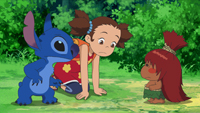
Stitch wears Jumba’s good deed counter and searches for another chance to move the number. Yuna tells him about Kijimunaa, described in the episode as the island’s strongest yōkai, and the promise of strength immediately hooks him. At the banyan tree, they find Tatitchu occupying the home. Tatitchu claims he defeated Kijimunaa in sumo. The Kijimunaa who eventually appears is a small, frightened red-haired spirit, not the intimidating champion Stitch expected. When Yuna and Stitch learn the match was won through cheating, they help Kijimunaa demand a fair rematch.
My first reaction: the “strongest” person is hiding because power without fairness broke him
Stitch arrives wanting to meet a legend and probably test himself against it. Instead he finds the consequences of a rigged contest. Kijimunaa is frightened, displaced, and embarrassed. The title calls him strongest while the image on screen refuses the easy visual proof. I like that contradiction. Strength can survive inside someone who has stopped performing it after humiliation. A stolen home does not become legitimate because the thief can tell a cleaner victory story.
The episode understands something fandom debates routinely forget. Losing publicly changes how people narrate your identity. If Kijimunaa was supposed to be the great forest champion, defeat becomes evidence that the legend was false. Nobody asks whether the rules were manipulated. The winner occupies the tree and controls the account of what happened. Yuna and Stitch do the important work of listening after the official-looking result has already been accepted.
Kijimunaa belongs to Okinawan tradition before he belongs to this franchise
Kijimunaa is not a creature Disney invented for a cute sidekick slot. The name points toward Okinawan and Ryukyuan oral tradition, especially stories of small spirits associated with old banyan trees. Accounts vary across islands, storytellers, periods, and retellings. That variation matters. Folklore is not a character database with one official model sheet. It lives through community memory, warning, humor, place, and repeated telling.
The anime creates its own Kijimunaa character from that larger tradition. He has a specific personality, voice, friendship with Yuna, wrestling conflict, and role in a commercial television story. Viewers should not reverse the direction and treat every series detail as an authoritative explanation of Ryukyuan belief. The episode can be an invitation to learn. It cannot become the source that replaces the people and histories it borrows from.
The banyan tree is a home, not set decoration
Tatitchu’s occupation matters because the tree is not an interchangeable apartment. In the episode’s folklore logic, Kijimunaa’s identity, safety, and place are connected to it. Taking the tree severs more than possession. It interrupts a relationship between spirit and landscape. The story becomes sharper when I read the rematch as a dispute over belonging rather than a sports plot with supernatural costumes.
Stitch should understand this, even if he does not have the vocabulary yet. He has repeatedly been treated as movable property. Institutions capture him, transport him, assign him, and decide where he belongs. Landing on Izayoi repeats that displacement. When he helps Kijimunaa reclaim the tree, he is defending a right he also needs: the right of a person to have a home that power cannot casually reassign.
Yuna knows the island has a history Stitch did not bring with him
Yuna is essential because she enters the forest with cultural context. Stitch hears “strongest yōkai” and converts the phrase into a challenge. Yuna knows the name belongs to local stories, a place, and a relationship with the island. She does not exist merely to admire his strength. She interprets a world that was present before his crash landing and will remain meaningful when he leaves the frame.
The series needs to protect that role from becoming exposition labor. Yuna should have her own feelings about Kijimunaa, the tree, Tatitchu’s cheating, and what justice requires. Episode 3 mostly gives her that agency. She recognizes the wrong, believes the smaller spirit, and helps create conditions for a fairer contest. Stitch supplies force. Yuna supplies the reason force should be used at all.
Stitch mistakes reputation for evidence
Stitch wants to meet the strongest creature because hierarchy is still his favorite language. Jumba built him to dominate, and Stitch keeps looking for rankings that confirm where he belongs. Strongest, fastest, most dangerous, most good deeds. A title gives him an immediate map. Then Kijimunaa arrives looking nothing like the winner Stitch imagined, and the map fails.
That failure is useful. Appearance cannot prove capacity. Fear after abuse cannot prove weakness. A public result cannot prove fairness. Stitch has to update his judgment after hearing what happened. The lesson is bigger than “do not underestimate the little guy.” Kijimunaa should not need to win the rematch to deserve his home. His rights do not depend on satisfying Stitch’s definition of strength.
Tatitchu’s cheating is an abuse of process
Cheating in a children’s wrestling match can look simple: bad character breaks rule, good characters expose rule-breaking, fair contest restores order. The deeper problem is process laundering. Tatitchu uses the appearance of a recognized competition to make seizure look legitimate. If everyone accepts the result, the stolen home becomes the winner’s prize rather than evidence of coercion.
Real institutions do this constantly. A process can be formal, scored, witnessed, and still designed to produce one party’s victory. Rules may be selectively enforced. Information may be hidden. The vulnerable person may consent under pressure because refusal means immediate loss. Episode 3 gives children a readable version of that pattern. Fairness is not guaranteed by calling something a contest.
A rematch feels satisfying, but Kijimunaa never owed one
I enjoy the rematch because animation loves a clean confrontation and Tatitchu needs the confidence knocked out of him. Still, I keep circling the premise. Why must Kijimunaa risk another loss to recover a home taken through fraud? Once the cheating is established, restoration should follow. Requiring another performance makes the harmed person prove worthiness under the same framework that failed him.
The story chooses a rematch because Kijimunaa also needs to recover confidence. That personal goal can coexist with the rights question. He may want to wrestle again for himself. He should not have to wrestle because everyone else refuses to return stolen property without a dramatic finish. Healing and restitution are related, but they are not identical jobs.
Stitch’s help becomes better when it follows somebody else’s need
Episode 2 showed the danger of treating people as opportunities for counter points. Here, Stitch starts with selfish curiosity about strength, then confronts a specific injustice. Kijimunaa wants his home and a fair chance. Helping means supporting that stated goal rather than inventing a flashy task. The counter may record the outcome, but the relationship provides the moral information.
This is the direction I wanted. Stitch does not become ethical because the device knows more. He becomes more useful because he listens longer. He still enjoys conflict. He still wants to see strength proved. The motive is mixed. Yet his power begins serving a person who was pushed aside rather than serving his wish alone. Imperfect growth still counts when another life becomes more visible.
Kappei Yamaguchi gives Kijimunaa fear without making him empty
Kappei Yamaguchi’s performance carries the episode’s difficult balance. Kijimunaa must sound small and frightened enough to contradict the legend, but he cannot become a joke whose only purpose is disappointing Stitch. The voice keeps quickness, sensitivity, and personality alive under the anxiety. When courage returns, it feels like the same person expanding rather than a coward being replaced by a hero.
That continuity matters for character writing. Courage is often treated as a personality transplant. Someone fears, receives a speech, then behaves as if the fear never existed. Kijimunaa’s strength works better when fear remains part of the scene. He acts while knowing what Tatitchu did before. The rematch has emotional weight because memory stays present.
The episode makes room for a friendship that does not orbit Stitch
Yuna already knows of Kijimunaa through island stories, and their relationship will matter beyond one plot. That gives her a connection not imported from Stitch’s earlier franchise. Kijimunaa can care about Yuna, the forest, his tree, and local spirit society without functioning as another experiment cousin. The Japanese branch needs those independent relationships to become a real ensemble.
Stitch benefits too. A friend who is neither human nor one of Jumba’s experiments breaks his usual categories. Kijimunaa is a person with power and vulnerability whose existence does not begin in Jumba’s laboratory. Stitch cannot rely on experiment hierarchy, Galactic Federation rules, or human assumptions. He has to meet a different kind of being on that being’s ground.
Folklore becomes weaker when every mystery gets a power ranking
The phrase “strongest yōkai” hooks Stitch and the audience, but it also compresses folklore into battle statistics. Fandom culture loves asking who wins. That question can erase why a spirit appears in stories, what behavior the story warns against, how place shapes the encounter, and which community carries the telling. Kijimunaa becomes more interesting when the tree matters as much as the wrestling ability.
The episode partially escapes its own ranking trap. Strength turns out to involve home, truth, friendship, and the courage to challenge a fraudulent result. Still, viewers should take the next step and research beyond the cartoon. The anime’s Kijimunaa is one adaptation. Okinawan and Ryukyuan traditions hold many accounts that do not exist to explain a Disney television character.
The good deed counter is learning the wrong lesson if it only counts the win
What exactly earns Stitch credit here? Encouraging Kijimunaa? Exposing Tatitchu? Helping arrange the rematch? Supporting fairness? If the number rises only when the conflict resolves, it hides the listening that made useful action possible. It also risks equating victory with goodness. Kijimunaa could lose a fair rematch and Stitch’s support could still be morally valuable.
The device cannot hold that nuance, which keeps proving my Episode 2 point. Metrics love completed outcomes. Relationships contain effort, consent, uncertainty, and partial repair. Stitch needs to learn that helping somebody does not guarantee a triumphant result. A good action may fail. A successful action may be selfish or harmful. The counter is a prompt, not a conscience.
What the episode gets right
Episode 3 gives the Japanese branch its first strong fusion of franchise character and local folklore-shaped plot. It lets Yuna know things Stitch does not know. It introduces Kijimunaa as a person rather than a collectible creature. It connects displacement to home, cheating to legitimacy, and strength to the ability to return after humiliation. Those ideas fit the larger Stitch story without copying an earlier Hawaiian episode.
The humor also helps. Stitch expects a terrifying champion and meets a little red spirit hiding from a bully. The reversal lands, then the story refuses to leave Kijimunaa as the punchline. He gets history, grievance, choice, and a continuing relationship. That is the difference between using a folklore reference as decoration and allowing the adapted character to carry emotional weight.
What I am watching carefully
I want the series to keep distinguishing its fictional island mythology from living Ryukyuan traditions. I want Obaa and Yuna’s knowledge to have specificity instead of becoming a generic “mystical island people” shortcut. I want Kijimunaa’s later stories to include his own wants, not only requests for Stitch to solve problems. I want the banyan tree to remain a relationship rather than a recognizable background prop.
I also want the story to remember that reclaiming confidence is not the same as earning basic rights. Kijimunaa deserves his home before he proves strength. The rematch can belong to his healing, pride, and desire for public truth. It should never become evidence that weaker spirits may be displaced fairly. That line is easy for a competition plot to blur.
Final verdict
“The Forest’s Strongest Yōkai, Kijimunaa” is the first episode that convinces me the Japanese branch has a reason to exist beyond moving Stitch into a new market. Yuna brings local knowledge, Kijimunaa brings a relationship between folklore and place, and Stitch’s power becomes useful after he stops chasing a reputation and listens to an injustice. The episode is funny, emotionally clear, and much richer than its wrestling setup suggests.
I am giving it credit with conditions. The anime adaptation is not a folklore textbook. A fair rematch is satisfying but should not be the price of returning a stolen home. Strength should not become the only language through which Kijimunaa earns respect. With those receipts kept visible, Episode 3 works. Stitch finds another kind of cousin, not by experiment number, but by recognizing a displaced person who deserves somewhere safe to belong.
Keep watching
Return to Episode 2, read the Izayoi and Ryukyuan context guide, or continue to Episode 4: The Paint Yōkai Muun when published.