
Memory, Sorrow, and Thorn · Canonical Historical Profile
Prince Sinnach
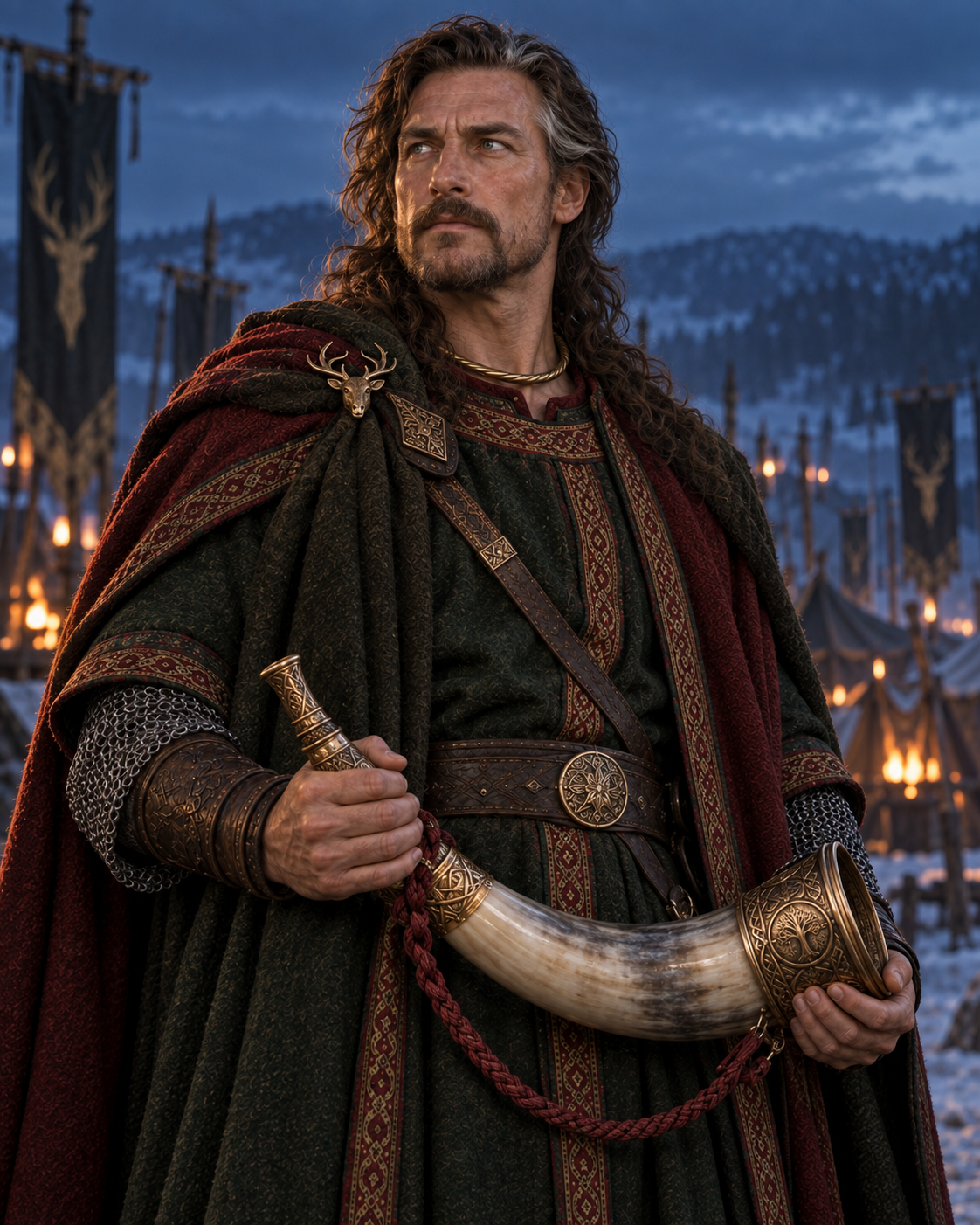
Prince Sinnach is the Hernystiri war-leader who keeps faith with the Sithi while Fingil’s conquest closes around them. He receives the dragon-tooth horn Ti-tuno, fights at the Knock, loses ten thousand countrymen at Ach Samrath after a Thrithings flank betrayal—and leaves a promise so binding that five centuries later the Fair Ones ride west to pay the debt.
At a Glance
The prince whose alliance outlives his army by five centuries
- People
- Hernystiri
- Role
- Prince and commander allied with the Sithi against Fingil
- Key battles
- The Knock and Ach Samrath, the Summerfield
- Relic
- Ti-tuno, the horn made from Hidohebhi’s tooth
- Legacy
- The Fox’s Bargain and the Sithi’s five-century debt
- Status
- Dead at Ach Samrath with the routed Hernystiri host
The Evidence Problem
Sinnach survives through battlefield names, songs, gifts, and other people’s memory
Sinnach is a historical figure rather than a present-tense viewpoint character. The books reconstruct him through Morgenes’s conquest history, Binabik’s account of Saint Hoderund, Hernystiri song, Sithi repayment, the route of Ti-tuno, and Eolair’s encounter with the old battlefield.
Those sources agree on the structural facts: Sinnach commands Hernystiri forces allied with the Sithi, opposes Fingil’s invasion, fights in the catastrophe leading to Ach Samrath, and becomes the mortal figure whose faithfulness the Fair Ones promise not to forget.
The record does not supply a reliable physical description, private dialogue, exact age, spouse, children, or internal monologue. This profile can be rich in historical consequence without dressing silence as recovered biography.
The Alliance
A mortal prince chooses the Fair Ones before the word “ally” becomes safe or simple
The Rimmersman advance pushes against both Hernystiri land and the dwindling Sithi world. Sinnach’s forces fight beside the Zida’ya rather than treating the ancient people as decorative legend or automatic enemy.
That loyalty becomes “faithfulness” in the surviving song. The word matters because the later promise is not payment for a commercial bargain alone. It remembers a mortal house that stood with the Sithi when conquest made that position catastrophically dangerous.
Jarnauga later warns the Naglimund Raed not to turn old wounds into fresh ethnic hatred. Sinnach’s alliance belongs inside that distinction. Historical betrayal should illuminate present danger, not provide an unlimited license against every descendant of an enemy people.
Ereb Irigú · Du Knokkegard · The Knock
Three names for one landscape—and none of them neutral
Sinnach commands a Hernystiri and Sithi force against Fingil Redhand at the battlefield later called the Knock. The Sithi name connects it to Ereb Irigú, the Western Gate. Rimmersmen call it Du Knokkegard, the Boneyard. Thousands lie beneath the ground.
Saint Hoderund’s story overlays another battle on the same landscape. A Rimmersman convert to Aedonite faith tries to prevent slaughter between Fingil’s forces and Sinnach’s alliance. Fingil rejects the appeal. Hoderund runs between armies carrying the Tree, calls for peace, and is killed.
Later Church authority declares Hoderund a martyr and places an abbey over a ground already holding mass death. Binabik emphasizes competing cultural readings rather than presenting canonization as universal closure. Sinnach becomes part of the buried history beneath a saint’s cleaner institutional story.
Ti-tuno Before the Summerfield
The Sithi give Sinnach a dragon-tooth call—and the object keeps moving after he cannot
Ti-tuno’s true Making-name belongs to a horn fashioned from the tooth of Hidohebhi, the black mother-worm slain by Hakatri and Ineluki. Iyu’unigato gives the horn to Prince Sinnach before Ach Samrath.
The gift places Sinnach inside Sithi royal memory and Making, not merely beside a temporary military contingent. A dragon’s tooth becomes an instrument of calling carried by a mortal prince into the last great alliance against Fingil.
After Sinnach, the horn passes through mortal dynasties: King Lluthinn includes it in Ebekah’s bridal dowry; Prester John gives it to her protector Camaris; it eventually returns to Amerasu, who sends it back with Simon. The object’s journey proves that Sinnach’s alliance is not forgotten even when its political world collapses.
Ach Samrath · Founding-year 663
Five days of resistance, one night attack, and ten thousand Hernystiri dead
At Ach Samrath, the Summerfield north of the Gleniwent, Hernystiri and Sithi forces resist Fingil’s host for five days. On the sixth, Thrithings fighters who covet Erkynland and Sithi wealth attack the unprotected flank under darkness.
The White Stag of Hern is trampled. Hernystiri chariots break. An in-world count places ten thousand Hernystiri dead on the field; Sithi losses are uncounted but grievous. Survivors retreat, and Ach Samrath becomes a living Hernystiri name for hatred and loss.
Later evidence identifies Sinnach among the dead. His status is not merely “legendary or unknown.” He falls with the alliance whose faithfulness becomes the basis of the Sithi promise.
The White Stag and the Flank
The defeat is remembered as betrayal because military collapse and cultural wound arrive together
The Thrithings attack does more than alter tactics. It attacks the exposed side of an alliance already holding for five days and converts shared resistance into rout. The trampling of the White Stag turns political defeat into an image of Hernystir itself crushed under the night assault.
That memory later shapes how Eolair reads the present. Passing Ach Samrath during a new catastrophe, he measures the older slaughter against the war now gathering. The field remains an active instrument of judgment.
Jarnauga’s warning remains necessary: remembering treachery accurately is not the same as assigning inherited guilt to every Thrithings person. The series repeatedly distinguishes evidence from ethnic destiny.
Book 3 · The Fox’s Bargain
The Sithi finally ride west because “never forget” has a due date
Eolair wakes in the Stagwood as an uncanny singing force approaches. He recognizes an old Hernystiri song promising that the Fair Ones would never forget Prince Sinnach’s faithfulness before Ach Samrath.
The Sithi ride toward Hernysadharc to discharge the five-century debt. Likimeya’s force destroys the fortification Skali built on Hern’s Hill because it stands in the way, defeats the occupiers, and restores the possibility of Hernystiri resistance. Jiriki formally identifies the purpose as repayment to Sinnach.
The repayment is not sentimental pageantry. It arrives as military intervention when Sinnach’s descendants and country face occupation. An alliance remembered only in song becomes people, horses, weapons, and liberated ground.
Skali’s Head
Five centuries preserve a promise—and a much older idea of what proof looks like
Likimeya later presents Skali Sharp-nose’s severed head as proof that the Sithi have completed Hernystir’s liberation. Eolair recoils. Likimeya recalls Sinnach’s older customs.
The exchange shows that repaying an ancient debt does not erase cultural distance. The Sithi remember the alliance faithfully, but their remembered idiom of victory does not automatically match Eolair’s present ethics. Five hundred years can preserve obligation while changing the people on both sides of it.
Sinnach’s legacy therefore produces alliance, not sameness. The Fair Ones come because they remember him; the living Hernystiri are still allowed to be unsettled by how that memory is performed.
Connections
The prince stands at the intersection of conquest, memory, and repayment
Iyu’unigato
Sithi Erl-king who gives Sinnach the Hidohebhi-tooth horn Ti-tuno before Ach Samrath.
Fingil Redhand
Invading Rimmersman conqueror whose forces fight Sinnach’s alliance at the Knock and Summerfield.
Saint Hoderund
Rimmersman-born priest killed while trying to stop slaughter between Fingil and Sinnach’s forces.
Jiriki
Sitha prince who explicitly names the westward campaign as repayment of the debt owed to Sinnach.
Likimeya
Commander whose intervention frees Hernystir and whose presentation of Skali’s head invokes older custom.
Eolair
Hernystiri witness who recognizes the song, receives the Sithi repayment, and measures old slaughter against the new war.
Why Sinnach Matters
He proves that history can obligate without becoming a permission slip for hatred
Sinnach turns an ancient alliance into one of the trilogy’s rare debts that is actually paid. The promise survives conquest, dynastic change, song, and Sithi retreat. When it matures, it changes the present war.
Yet the series refuses the simple lesson that ancient loyalty makes every old custom correct. Eolair welcomes liberation and recoils from the severed head. Jarnauga honors the wound and rejects inherited ethnic vengeance. Ti-tuno moves between Sithi and mortal hands rather than belonging permanently to one bloodline.
The profile’s rabbit hole is therefore larger than battlefield heroism. Sinnach is the test case for whether memory can become responsible action instead of endless grievance. The Fox’s Bargain says yes—but only if the living continue interpreting what faithfulness requires.
On the Record
Scope, death, visual boundaries, and unresolved biography
This is Prince Sinnach’s one canonical full-spoiler historical profile. Books 1–3 retain scope through conquest history, the Knock, Ach Samrath, Ti-tuno, Hernystiri cultural memory, and the Sithi’s repayment. He is dead by the main chronology.
The evidence confirms his Hernystiri princely rank, command beside the Sithi, opposition to Fingil, receipt of Ti-tuno, death at Ach Samrath, and the promise attached to his faithfulness. It does not provide a direct physical description, exact age, private speech, romance, descendants, or a complete tactical biography.
The approved visual identity presents Sinnach as a handsome, weather-tested Hernystiri commander of about forty, with a tall lean-muscular build, gray-blue eyes, fair wind-reddened skin, shoulder-length dark-chestnut hair, a silver temple streak, and a short beard. Those bodily details—as well as his forest-green and oxblood clothing, mail, stag clasp, torque, Ti-tuno fittings, alliance camp, and dusk light—are editorial reconstruction, not quoted canon. This exact identity now governs every future portrait, Knock, Ach Samrath, Ti-tuno, song-memory, directory, social, and historical scene.