
Memory, Sorrow, and Thorn · Canonical Devotional Profile
Qinkipa of the Snows
Qinkipa is the Qanuc goddess of snow and cold whose name touches three different kinds of care: Binabik’s responsibility for an orphaned wolf pup, a community’s risky pardon of Sludig, and Sisqi’s dream of children protected in Mintahoq. The goddess never visibly appears. Her protection remains culturally real even where metaphysics stays open.
At a Glance
The snow goddess invoked around wolves, judgment, family, and the dangerous hope of protection
- Name
- Qinkipa of the Snows
- Tradition
- Qanuc devotional figure
- Domain
- Snow and cold goddess
- Book 1 connection
- Binabik is warned that taking orphaned Qantaqa from Qinkipa makes him responsible as a parent
- Book 2 connection
- Invoked during Sludig’s unprecedented Croohok pardon
- Book 3 connection
- Sisqi imagines future children and Qinkipa’s protection in Mintahoq
- Physical appearance
- Not confirmed
- Status
- Legendary/devotional; literal manifestation unresolved
Taking Qantaqa from Qinkipa
Book 1 frames rescue as the beginning of parental responsibility, not possession
Qantaqa begins as a white orphan wolf pup whose mother has died or vanished.
Binabik rescues her. His still-unnamed master warns that taking the pup from Qinkipa the Snow Maiden makes Binabik responsible as a parent.
The devotional language does not mean the text shows Qinkipa physically holding the wolf or surrendering custody.
It places the orphan within a sacred natural order. Removing her from that order creates obligation.
Binabik raises and trains Qantaqa as an unprecedented wolf mount, but he treats her as a friend rather than property. Her white pup coat becomes gray as she matures.
Qinkipa’s name therefore enters one of the trilogy’s clearest ethics of care: rescue does not grant ownership. Intervention creates responsibility.
The warning also resists sentimental heroism. Saving a baby animal is not one beautiful moment. It is food, training, danger, companionship, and years of accountability.
Snow Maiden or Snow Goddess?
The record preserves both devotional language and a stable canonical identity
The Book 1 scene calls Qinkipa the Snow Maiden, while the character registry identifies Qinkipa of the Snows as the Qanuc goddess of snow and cold.
These forms belong to one canonical devotional figure, not separate entities.
“Maiden” is a title or translation choice; it does not establish literal age, virginity, unmarried status, youthful anatomy, or a human life stage.
Likewise, “of the Snows” and the snow-and-cold domain do not prove control over every winter event.
The wider unnatural cold threatening Osten Ard is associated with Ineluki and the Norns, but the books do not narrate Qinkipa causing it, failing to stop it, or fighting it directly.
The profile should retain both known forms while refusing to build an unsupported biography from the word “maiden.”
Invoked at the Croohok Pardon
Book 2 places Qinkipa among the sacred witnesses to mercy that might be wrong
In Yiqanuc, Ookekuq’s sealed death-song changes Binabik’s trial.
The dead Singing Man names Binabik his student and successor, warns about the darkness spreading from Vihyuyaq, and asks his people to honor Binabik in his place.
Nunuuika recognizes that tradition can become a shackle when it refuses new evidence. Binabik is freed.
Sludig is also freed, becoming the first Croohok pardoned since Huqinka Valley.
The community invokes Sedda, Qinkipa, Morag Eyeless, Chukku, and the high-place spirits in case its judgment is wrong.
Qinkipa’s presence in that invocation does not establish a special office as goddess of law, mercy, or pardon.
It establishes her as one of the powers or revered figures whose witness matters when the living accept responsibility for a dangerous decision.
No visible sign confirms approval. The humility of the invocation depends on acting without guaranteed divine endorsement.
Sisqi’s Future in Mintahoq
Book 3 moves Qinkipa from crisis ritual into the imagined protection of children
Later, Sisqi speaks with Binabik about the shape of their commitment and future.
She says the night she rode to free him was already their marriage, even without formal words.
She considers remaining with the lowlanders because shared resistance may protect the Qanuc people. At the same time, she imagines children, Mintahoq, and Qinkipa’s protection in the mountains.
The future is not yet accomplished. The scene confirms hope, not children already born or a final decision to return.
Qinkipa’s protection belongs to the home Sisqi can still imagine after betrayal, judgment, rescue, and war.
This extends the goddess’s profile beyond environmental cold. She is invoked within the emotional architecture of Qanuc family continuity.
The text does not specify what protection involves, whether a rite is required, or whether Sisqi believes Qinkipa guarantees safety.
The wish is meaningful precisely because safety cannot be guaranteed.
Protection Is Not Immunity
Every Qinkipa connection carries danger rather than magical insulation
Qantaqa is orphaned despite belonging to Qinkipa’s snow world.
Sludig’s pardon remains risky despite the invocation.
Sisqi imagines protected children while the Qanuc prepare migration because the Ice House remains frozen and the wider world is at war.
None of these scenes presents devotion as a transaction guaranteeing good outcomes.
Qinkipa’s protection functions as relationship, hope, accountability, and sacred witness inside uncertainty.
A profile that promises miraculous safety would contradict the emotional structure of every receipt.
The goddess can matter deeply without operating as fantasy insurance.
Snow, Cold, and the Unnatural Winter
A domain overlap must not become an invented causal claim
Qinkipa is associated with snow and cold. The trilogy is overtaken by unnatural winter.
That juxtaposition invites questions the text does not answer.
Does Qanuc tradition distinguish ordinary sacred snow from weaponized cold? Do worshippers ask Qinkipa to resist the Storm King? Does the frozen Ice House change devotion?
The verified receipts do not supply those answers.
We can say that Qinkipa belongs to a culture built in intimate relationship with snow and mountains, while Ineluki’s spreading cold threatens that world.
We cannot write a divine war between them, blame her for the freeze, or call her powerless because winter worsens.
This distinction should govern Novel 101 coverage as well as the character card.
Belief and Manifestation
Three books confirm devotion; none confirms a walking goddess
Book 1 confirms sacred language around Qinkipa and Binabik’s obligation to Qantaqa.
Book 2 confirms communal invocation during judgment.
Book 3 confirms Sisqi’s hope for protection.
No book in these receipts shows Qinkipa physically appearing, speaking, sending an independently identified omen, or performing a miracle.
Status is legendary/devotional; literal manifestation unresolved.
That does not reduce the belief to trivia. Across three volumes, the name shapes responsibility, justice, family, and home.
Connections
The wolf, adoptive parent, future mother, pardoned outsider, and sacred company around Qinkipa
Qantaqa
The orphan wolf pup Binabik is warned he has taken from Qinkipa’s snow-world care.
Binabik
Becomes responsible as Qantaqa’s parent and later stands inside the judgment invoking Qinkipa.
Sisqi
Imagines future children protected by Qinkipa in Mintahoq.
Sludig
The first Croohok pardoned since Huqinka Valley during the sacred invocation.
Sedda, Morag Eyeless, and Chukku
Named beside Qinkipa as the community acknowledges uncertainty around its decision.
Mintahoq
The mountain home where Sisqi imagines family life under Qinkipa’s protection.
Why Qinkipa Matters
The goddess connects care for one wolf to the survival ethics of an entire people
Qinkipa matters because the same devotional identity appears across intimate and communal scales.
One orphaned pup creates parental duty. One unprecedented pardon asks the high-place powers to witness human fallibility. One woman’s imagined children place the future of a threatened people under hoped-for protection.
These are not three unrelated trivia entries. Together they show Qanuc devotion woven into decisions about who must be cared for, who may be forgiven, and what future remains imaginable.
The profile also repairs an important backend truth: Qinkipa belongs in Books 1, 2, and 3, not only the appendix-derived Book 1 shelf.
One canonical post now carries all three contexts without duplication or scope leakage.
Devotional Image Continuity
One disclosed snow-goddess interpretation across three volumes
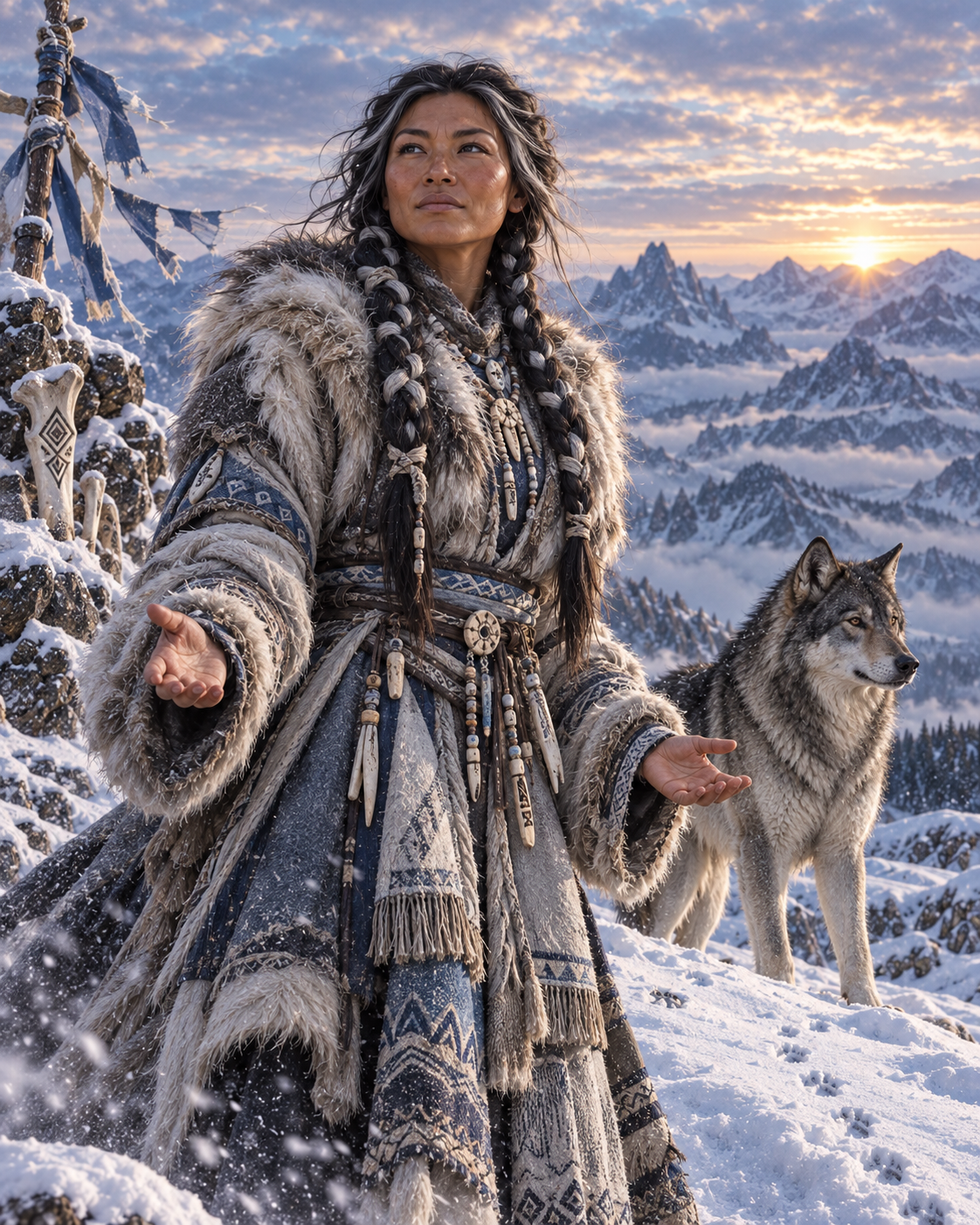
The approved hero visualizes Qinkipa as a beautiful, ageless adult Qanuc-featured woman on Mintahoq, with black-and-frost braids, layered cold-weather textiles, open protective hands, and Qantaqa standing independently beside her.
None of those bodily or costume details is a canonical manifestation. The image is devotional interpretation: a visual expression of the snow, mountain, protection, responsibility, and Qanuc cultural contexts the books actually provide.
“Snow Maiden” does not make her a child, prove sexual status, or give us a literal human life stage. The portrait therefore uses adult dignity rather than ingénue coding.
Qantaqa is neither collared nor placed at Qinkipa’s feet. The wolf keeps her own stance because the Book 1 lesson centers responsibility and relationship, not divine ownership.
This exact concept now governs franchise and Books 1–3 directory cards, profile hero, Qantaqa history, Sludig’s judgment, Sisqi’s future, and Qanuc 101 imagery.
On the Record
Books 1, 2, and 3—corrected from the earlier Book 1-only scope
This is Qinkipa of the Snows’ one canonical, full-spoiler devotional profile.
Book 1 confirms Qinkipa as a Qanuc snow-and-cold goddess or Snow Maiden and places her in the warning that rescuing orphaned Qantaqa makes Binabik responsible as a parent.
Book 2 confirms Qinkipa is invoked with Sedda, Morag Eyeless, Chukku, and high-place spirits during Sludig’s unprecedented Croohok pardon.
Book 3 confirms Sisqi imagines children, Mintahoq, and Qinkipa’s protection as part of a possible future with Binabik.
The record does not confirm physical appearance, origin, exact powers, rites, clergy, temples, control of the unnatural winter, literal ownership of wolves, answer to the pardon, fulfillment of Sisqi’s hope, or manifestation.
Status is legendary/devotional; literal manifestation unresolved. The approved image is explicitly a devotional interpretation. Her adult face, complexion, proportions, eyes, black-and-frost hair, braid construction, clothing, ornaments, open-hand pose, mountain setting, prayer markers, and dawn light are editorial reconstruction. Qantaqa retains her separately approved canonical wolf identity.