
Memory, Sorrow, and Thorn · Canonical Character Profile
Vindaomeyo the Fletcher
Vindaomeyo is the ancient maker who inscribed Words of Making on the Sithi White Arrow Jiriki gives Simon. Book 1 treats the arrow as a family treasure and life-debt token. Book 4 lets the dwarrows recognize the deeper receipt: Vindaomeyo shaped it for one of the Zida’ya who taught their people craft, using a blue-gray fragment of a Master Witness as its point.
At a Glance
The name behind the arrow that refuses to remain “just a pretty lucky thing”
- Name
- Vindaomeyo
- Epithet or craft title
- The Fletcher
- Era
- Deep ancient past, before Jiriki’s House of Year-Dancing held the arrow
- Confirmed work
- The Sithi White Arrow / Staja Ame carried by Simon
- Inscription
- Words of Making
- Arrowhead material
- A blue-gray piece of a Master Witness
- Original recipient context
- Made for one of the Zida’ya who taught the dwarrows craft
- Status
- Ancient historical figure; life and death status unrecorded
Book 1 · The White Arrow
Simon receives Vindaomeyo’s work before he has any idea how much history fits inside it
Simon frees a trapped Sitha from a woodsman who intends to kill the captive. After the encounter, a white arrow appears embedded in a nearby tree as a token of debt.
The object is visually precise: an unpainted bone-white shaft, snow-white feathers, a milky blue or blue-gray stone point, and minute intricate designs along its length.
Binabik recognizes it as a Sithi White Arrow and explains that it marks an obligation the Sithi honor seriously. He associates its ancient style with Tumet’ai, a lost Sithi stronghold beneath northern ice.
At this stage, nobody names Vindaomeyo. The maker enters later, after Jiriki identifies himself as the rescued Sitha and the arrow’s family history becomes personal.
The sequence matters. Simon first understands the arrow socially: it means a life is owed. Only later does he begin to understand it materially and historically.
Vindaomeyo’s work therefore reaches the protagonist through action, not museum display. A crafted object carries gratitude across language, distance, culture, and time.
The profile must not claim Vindaomeyo witnessed Simon’s rescue, foresaw him, selected him, or created the arrow specifically for a mortal hero. The arrow’s later journey grows from decisions by Jiriki and others.
Words of Making
Jiriki names the craft without pretending Simon can read what the maker wrote
At Naglimund, Jiriki returns to claim kinship with the White Arrow and then gives it back to Simon.
He holds the shaft so that the tiny designs are visible and explains that the writing consists of Words of Making inscribed by Vindaomeyo the Fletcher.
The phrase does not mean decorative labeling. Elsewhere in the series, Words of Making belong to deep creative knowledge connecting craft, material, identity, and power.
The text does not reproduce the inscription, translate every mark, explain its grammar, or state which specific operation the words perform.
We should not invent a magical sentence such as “always strike true” or “bind life to life.” Nor should we flatten the writing into runes merely because fantasy art likes glowing alphabets.
What is safe is that Vindaomeyo both made or finished the arrow as fletcher and scribed Words of Making onto it. Craft and inscription belong together.
The name “Fletcher” may function as an occupation, translated title, or epithet. The record does not tell us whether it was unique office, guild rank, hereditary name, or the nearest mortal rendering of a different Sithi concept.
A Life for a Life
Jiriki makes Vindaomeyo’s ancient work part of a living family obligation
Simon initially tries to return the White Arrow to Jiriki, saying it belongs to the prince.
Jiriki refuses the simple transfer. He says it is not his until he earns it back: a life for a life.
He describes the arrow as part of his family as surely as if made from his own bone and sinew. Few mortals have ever held a Staja Ame.
That language gives Vindaomeyo’s object more than rarity. The arrow has entered kinship, memory, and reciprocal obligation. It is valuable because of what it has carried among people, not merely because the materials are ancient.
The record does not provide the full chain between Vindaomeyo’s original recipient and Jiriki. It does not say whether the object passed by inheritance, gift, office, adoption, or a longer sequence of debts.
Nor does Jiriki surrender family meaning when he gives the arrow to Simon. The gift extends relationship. Simon’s rescue places him inside an obligation older and larger than his understanding.
Vindaomeyo cannot be credited with choosing that later relationship. The maker’s achievement is different: the work remains capable of bearing meaning without breaking under centuries of use.
The Arrow Keeps Moving
Debt token, rescue marker, lost object, recovered object—the artifact has a biography after its maker
Simon carries the White Arrow through Book 1 as protection, proof, and emotional anchor.
He nearly loses it in the Aelfwent after dismissing its importance in front of Miriamele. It remains caught in his clothing after the river rescue.
It later accompanies his journey north and marks his connection to Jiriki and the Sithi even when those relationships are not physically present.
Across the wider series, the arrow is lost, recovered, stored among Miriamele’s belongings, and recognized by the dwarrows.
These events belong to the artifact’s later biography. They are not additional actions performed by Vindaomeyo.
Maintaining that distinction keeps maker and object connected without treating the ancient figure as a ghostly agent controlling every bearer. Vindaomeyo’s craft gives the arrow durability and legibility; living characters decide where it goes and what they risk for it.
A future White Arrow Story 101 page should link the full ownership and custody chain. Vindaomeyo’s profile should remain the canonical maker node inside that larger map.
Book 4 · The Master Witness Receipt
The dwarrows recognize a material history nobody in Book 1 can yet explain
In Book 4, Yis-hadra produces Simon’s White Arrow from Miriamele’s possessions.
The dwarrows recognize it as Vindaomeyo’s work. Their identification is not based merely on Jiriki’s family story. They connect the object to their own craft history.
They say Vindaomeyo made it for one of the Zida’ya who taught their people craft. They also identify the blue-gray arrowhead as a piece of a Master Witness.
This expands the arrow from Sithi debt token into the Witness network running through Tinukeda’ya history, responsive stone, lost making knowledge, and the Three Swords.
The exact original recipient remains unnamed in the surviving receipt. “One of the Zida’ya” does not authorize selecting Amerasu, Jiriki’s ancestor, or another famous Sitha because the directory would prefer a tidy relationship.
The dwarrows’ statement also does not mean they forged the whole arrow. Vindaomeyo is named as maker; the blue-gray point comes from Master Witness material; the recipient belonged to the Zida’ya who taught dwarrows craft. Multiple cultural and material histories meet in one object.
The Book 4 recognition corrects the scope. Vindaomeyo is not a Book 1-only glossary figure. The maker’s work becomes direct evidence again in the final published volume.
A Piece of the Witness Network
The arrowhead makes the small object part of the same world-scale craft crisis as the swords
Master Witnesses are not ordinary gemstones. They belong to a system of seeing, resonance, memory, communication, and making whose fragments remain active across Osten Ard.
Vindaomeyo’s use of a fragment as an arrowhead shows ancient craft operating at a scale where powerful material can become intimate and portable.
The record does not state that Vindaomeyo broke the Master Witness personally, chose the fragment’s original source, or understood every later property the dwarrows perceive.
It does establish deliberate making. The point is integrated into a crafted Staja Ame bearing Words of Making.
That combination helps explain why the arrow survives as more than a weapon. It can function as marker, debt token, family treasure, proof of connection, and material clue.
Do not overstate combat powers. The text does not say the arrow cannot miss, pierces any armor, returns to the bearer, grants visions, or kills supernatural enemies automatically.
Its confirmed power is partly social and historical: people who know what it is respond to it.
Connections
The prince, mortal bearer, dwarrow witnesses, and ancient recipient around Vindaomeyo’s work
Prince Jiriki
Identifies Vindaomeyo by name, calls the arrow family, and gives it to Simon under the life-for-life debt.
Simon / Seoman Snowlock
Rescues Jiriki, receives the arrow, carries it through the series, and repeatedly discovers that its meaning exceeds his first understanding.
Yis-hadra
Helps identify the arrow in Book 4 through dwarrow knowledge of craft and Witness material.
Ys-fidri and the dwarrows
Recognize Vindaomeyo’s work, its original Zida’ya recipient context, and the Master Witness fragment.
The unnamed Zida’ya teacher
The ancient recipient for whom Vindaomeyo made the arrow; the record does not safely supply a personal name.
Miriamele
Carries the recovered arrow among her possessions before the dwarrows produce and identify it.
Character Image Continuity
An ancient maker at work, not a random elf holding Simon’s arrow
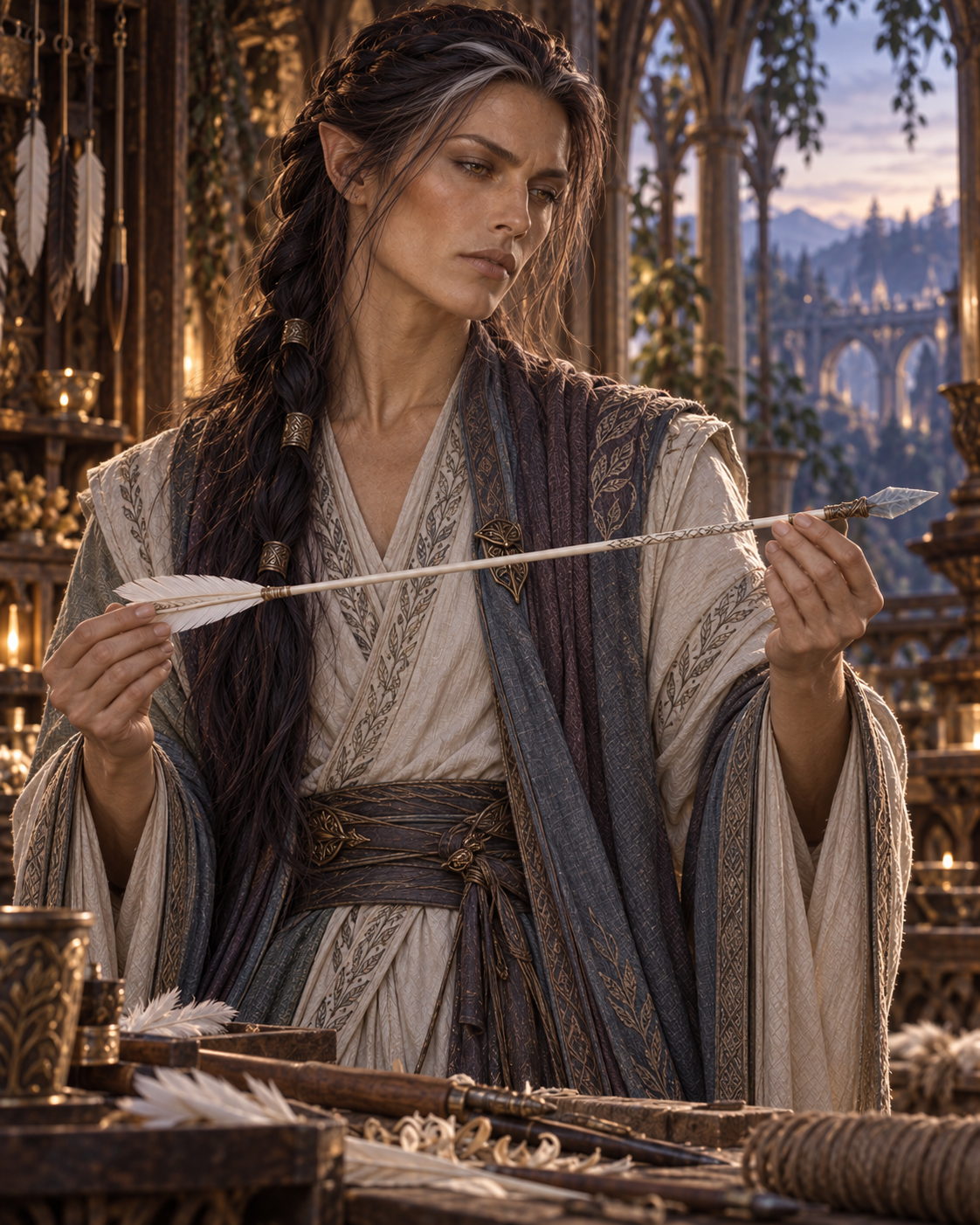
The approved historical interpretation gives Vindaomeyo an androgynous adult Sitha identity with an ageless mature presence, a long heart-diamond face, warm pale-bronze skin, smoky teal-gray eyes, and deep auburn-black hair marked by one narrow silver streak. A practical crown braid joins a low segmented workshop braid.
This is explicitly CVM editorial reconstruction. Canon supplies no gender, pronouns, exact age, face, skin, hair, eyes, body, clothing, house affiliation, workshop, tools, or personal relationship with Jiriki’s known relatives.
The portrait centers mastery rather than glamorized archery posing: Vindaomeyo examines the finished Staja Ame across both hands in an ancient fletcher’s workspace.
The White Arrow remains consistent: bone-white unpainted shaft, white feathers, minute complex non-glowing inscriptions, and a milky blue-gray stone point later identified as Master Witness material.
This exact face, body, coloring, braid map, craft palette, and artisan presence now govern every profile, directory, White Arrow 101, Jiriki-family, Witness-history, and making-era image.
Do not give Vindaomeyo Simon’s modern custody context, Jiriki’s lavender-blue hair, Norn coloring, glowing generic runes, royal regalia, a bow, or a warrior pose. Later workshop compositions may change tools and angle without recasting the maker.
Why Vindaomeyo Matters
The maker turns one beautiful prop into an index of the entire series’ craft history
Vindaomeyo matters because the White Arrow keeps getting larger without changing size.
In Book 1 it marks gratitude and debt. Jiriki adds family history and Words of Making. Book 4 adds the Zida’ya–dwarrow teaching relationship and Master Witness material.
The arrow becomes a compact map of the series: Sithi survival, mortal contact, Tinukeda’ya craft, broken Witnesses, lost knowledge, family obligation, and objects whose meanings outlive every single owner.
A shallow profile would say “ancient fletcher who made Simon’s arrow.” The complete record shows why the maker’s name returns when the final volume begins reconnecting histories everyone had treated as separate.
On the Record
Books 1 and 4, exact spelling repaired, with maker and later bearer kept distinct
This is Vindaomeyo the Fletcher’s one canonical, full-spoiler character profile.
Book 1 confirms that Vindaomeyo inscribed Words of Making on the ancient Sithi White Arrow. Jiriki identifies the maker, calls the Staja Ame part of his family, and gives it to Simon under a life-for-life obligation.
Book 4 confirms that dwarrows recognize the arrow as Vindaomeyo’s work, say it was made for one of the Zida’ya who taught their people craft, and identify the blue-gray point as a piece of a Master Witness.
The owned Kindle edition spells the name Vindaomeyo. The earlier registry form “Vindaoemeyo” is retained only as a search alias and must not remain the display name.
The record does not confirm gender, appearance, birth, death, house, full biography, original recipient’s name, complete custody chain, source of the Witness fragment, inscription text, or automatic combat powers.
Status: ancient historical figure; life and death status unrecorded.
The approved editorial reconstruction is CVM’s canonical historical portrayal: one breathtakingly attractive, androgynous ancient Sitha master fletcher with warm pale-bronze skin, smoky teal-gray eyes, deep auburn-black hair, one silver streak, and a practical braided workshop style. Exact gender presentation, age, body, face, coloring, hair, braids, clothing, workshop, tools, arrow decoration, architecture, landscape, pose, and light are reconstruction.
One local attachment powers the featured image, visible hero, every directory card, and Rank Math social metadata.