
Memory, Sorrow, and Thorn · Canonical Character Profile
Bishop Domitis
Bishop Domitis begins as the senior Erchester churchman summoned to examine dying King John’s soul. He declares the king dead, becomes one of the advisers Lector Ranessin distrusts, and presides over a cathedral physically divided against royal occupation. By Book 4, Saint Sutrin’s gold has been stripped for survival and Domitis has shrunk into a dirty-robed, forgetful old man performing the Night Mass for ravens. His story is the institutional collapse of Erchester made painfully human.
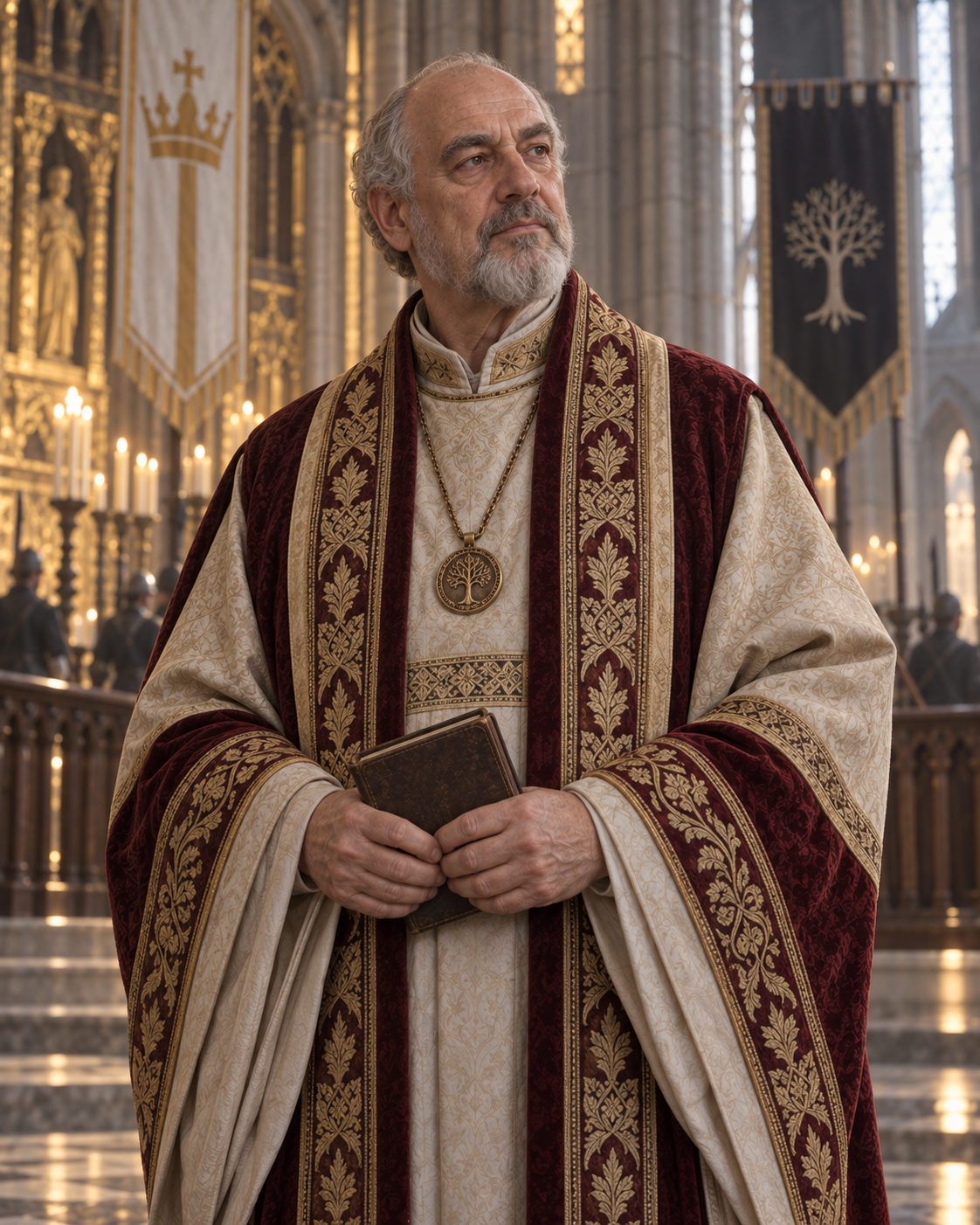
At a Glance
The bishop whose cathedral and mind survive the kingdom in damaged form
- Name
- Domitis
- Office
- Bishop of Saint Sutrin’s Cathedral in Erchester
- Royal duty
- Examines King John’s spiritual condition and declares his death
- Political reputation
- Privately considered foolish by Lector Ranessin
- Institutional conflict
- Associated with priestly resistance to Breyugar’s occupation
- Book 4 condition
- Shrunken, forgetful, dirty-robed, conducting mass for ravens
- Last confirmed state
- Alive in ruined Saint Sutrin’s
At the King’s Bedside
He is called to measure a soul while physicians work on a failing body
As King John declines, the Hayholt gathers physicians, churchmen, servants, sons, nobles, and rival expectations around his darkened chamber. Domitis comes from Saint Sutrin’s in Erchester to examine the king’s soul.
The wording places him inside the official machinery of death. Physicians bleed and treat; attendants repeatedly wake John; the bishop tests spiritual readiness. John bears pain and priest with the same stoicism.
Domitis later declares him dead. Deornoth carries that announcement to Josua, and the news converts a private medical crisis into completed succession. Before public mourning, burial rites, and political redistribution can begin, an authorized voice must state that the king’s living reign has ended.
The record does not preserve Domitis’s exact prayers, bedside questions, diagnostic theology, or emotional response. It does not say he caused John additional suffering or acted maliciously. John’s endurance may make the repeated examinations feel intrusive, but the bishop is performing a recognized religious office.
This first function matters when compared with Book 4. Domitis begins as someone empowered to certify a king’s passage from life into sacred memory. He ends performing ritual for birds in a city where institutions can no longer guarantee an audience.
A Bishop in the Wrong Court
Ranessin wants Elias protected from advisers like him
After John’s death, Lector Ranessin considers the character of the coming reign. He hopes Elias’s courage and decisiveness may serve kingship but recognizes the prince’s temper, carelessness, and attraction to violent young nobles.
Ranessin wants a trustworthy adviser placed near Elias. He thinks of Velligis and Dinivan, then hesitates to surrender Dinivan. He also wants a counterweight to Bishop Domitis, whom he privately considers foolish.
That judgment is authoritative as Ranessin’s opinion, not omniscient proof that every act by Domitis lacks value. The Lector is assessing institutional danger: an unstable heir surrounded by reckless favorites and a bishop Ranessin does not trust to supply wise restraint.
The profile should therefore preserve the distinction between office and reputation. Domitis is senior enough to attend John and consequential enough to worry Ranessin. If he were irrelevant, no counterweight would be required.
The books do not provide the conversation or policy that caused Ranessin’s contempt. They do not identify Domitis as Pryrates’s ally or establish that he supports every action taken in Elias’s name. Calling him “foolish” is fair when attributed to Ranessin; turning it into a complete political biography would exceed the record.
Saint Sutrin’s Divided
Three banners share the doorway while soldiers control who may cross the room
Under Elias, Count Breyugar’s constables occupy Saint Sutrin’s Cathedral. The entrance displays the king’s green dragon, Mother Church’s Pillar and Tree, and Erchester’s white-and-gold coronet.
The symbols suggest shared authority. The furniture tells the truth. Boards and stools divide priests from soldiers inside the chapel, royal troops guard the doors, and the cathedral functions as constabulary headquarters.
Simon and Jeremias enter carrying Morgenes’s altered letter while white-robed priests prepare for Eliasmas. The guards appear designed not only to exclude outsiders but to contain clergy. Domitis’s church has become an operational site controlled by armed men.
The record says the priests under Domitis resist permanent military occupation. It does not place the bishop personally in Simon’s confrontation with Breyugar or preserve his orders to the clergy. His institutional position still matters: Saint Sutrin’s is his seat, and resistance occurs within the body he leads.
This keeps his profile complicated. Ranessin may consider Domitis foolish, but the cathedral associated with him is not smoothly absorbed into Elias’s state. The priest-soldier partition makes opposition architectural.
Domitis cannot prevent the takeover. That failure is not unique to him. Across Erchester, legitimate symbols remain in place while coercive control changes hands underneath them. The cathedral’s occupation foreshadows the larger collapse in which façades, rites, and offices survive after their public guarantees disappear.
The Golden Façade
By Book 4, sacred beauty has become emergency currency
When Miriamele and Binabik return to Erchester, the city has emptied into hunger, fear, scavenging, and shuttered rooms. Saint Sutrin’s famous golden façade has been stripped. Its reliefs are smashed.
The cathedral once looked like holy flame. Now beauty has become portable wealth because institutions are no longer feeding people. Gold can be pried loose, carried away, exchanged, or fought over. Symbolic radiance cannot remain untouched in a starving city.
Several dozen refugees shelter silently inside the damaged chapel. The building still provides enclosure, candles, an altar, burial passages, and the memory of public worship. It no longer commands the city around it.
Domitis mirrors that condition. He survives, but survival has reduced neither building nor bishop to an intact version of the past. The gold is gone from the church; authority, memory, and ordinary self-care appear stripped from its prelate.
Mansa Nictalis
The bishop performs the Night Mass for ravens while refugees watch in silence
Book 4 presents Domitis as dramatically shrunken and forgetful, dressed in a dirty robe. He conducts the Mansa Nictalis, the Night Mass, before ravens gathered in the ruined cathedral.
The scene can look absurd from a distance: a once-powerful churchman preaching to birds. Up close, it is one of the series’ bleakest portraits of ritual persistence. Domitis continues the shape of his office after the public world that once answered it has collapsed.
The ravens may be his imagined congregation, opportunistic animals, or both within his damaged perception. The record does not authorize a supernatural interpretation. It does confirm several dozen human refugees silently sharing the chapel while he performs.
Calling the scene merely “madness” would miss what remains functional. The bishop remembers enough liturgy to conduct the mass. The damaged cathedral remains a sacred coordinate. Ritual supplies continuity even when audience, hierarchy, vestments, and civic order have decayed.
Calling it noble triumph would also be false. Domitis is forgetful, diminished, dirty, and afraid. He is not serenely choosing a poetic ministry to birds. The image hurts because devotion and cognitive collapse occupy the same body.
His fearful glance toward the wall behind the altar confirms the bishops’ catacombs to Miriamele and Binabik. After Domitis sleeps, they take candles and enter the burial passages, seeking the dwarrow route beneath Erchester.
Even in decline, his reaction communicates. The man who once declared a king dead now wordlessly indicates the place where generations of church leaders are buried—and where living protagonists can pass into older layers of Asu’a.
Two Death Thresholds
John’s bed and the catacomb wall frame Domitis as a keeper of crossings
Domitis’s two major appearances sit at thresholds. In Book 1, he attends John between life and death and provides the declaration that opens succession. In Book 4, he remains near the cathedral catacombs where the dead bishops lie and where Miriamele and Binabik enter the buried world.
The first threshold is official. It contains attendants, recognized authority, and a kingdom waiting for an announcement. The second is broken. The bishop communicates through fear, sleeps in ruin, and cannot supervise what follows.
Together, the scenes chart more than one man’s aging. They show the collapse of mediation. Once, Church office translated a king’s death into public order. Later, a damaged bishop cannot protect the boundary behind his own altar.
Yet the second scene is not empty. Domitis’s glance still helps the living. The cathedral’s burial geography still leads somewhere. Ruined institutions retain knowledge, though retrieving it may require reading gestures instead of decrees.
Connections
The king, Lector, occupier, and travelers around Saint Sutrin’s bishop
Prester John
Domitis examines his spiritual condition and supplies the formal declaration of death.
Lector Ranessin
Privately considers Domitis foolish and wants a wiser counterweight near Elias.
King Elias
The new ruler whose violent court and militarized city reshape Domitis’s institutional world.
Count Breyugar
Commands the constables occupying Saint Sutrin’s and turning it into armed headquarters.
Miriamele
Finds the diminished bishop in Book 4 and reads his fear as evidence of the catacomb entrance.
Binabik
Enters ruined Saint Sutrin’s with Miriamele and follows the bishops’ burial route beneath Erchester.
Why Domitis Matters
His body becomes the before-and-after photograph of Erchester’s collapse
Domitis is never granted the moral clarity of Ranessin or the intimate warmth of Dinivan. The series lets a respected Lector think him foolish and leaves the reasons only partially visible.
That imperfection makes his survival more affecting. The ruined old bishop is not a saint imported at the end to symbolize pure faith. He is the same compromised institutional figure who occupied a powerful office when power still existed.
His decline parallels Saint Sutrin’s without reducing either to metaphor. The cathedral loses gold, public control, and ordinary congregation. Domitis loses stature, memory, clean vestments, and command of context. Both continue holding fragments of their former function.
A complete fandom profile should keep all of that together: foolish in Ranessin’s judgment, part of a clergy resisting occupation, cognitively diminished, still liturgically active, frightened by the catacombs, and alive. Contradiction is the character.
On the Record
Books 1 and 4, with decline treated as tragedy rather than visual comedy
This is Bishop Domitis’s one canonical full-spoiler profile. Book 1 places him at John’s deathbed, makes him the official who declares the king dead, records Ranessin’s negative judgment, and associates his cathedral with priestly resistance to Breyugar’s occupation. Book 4 returns to him inside stripped Saint Sutrin’s, conducting the Night Mass for ravens and revealing the catacomb boundary through fear. No direct Domitis receipt appears in Books 2 or 3.
The record confirms that Domitis is Bishop of Saint Sutrin’s, examines John’s soul, declares his death, is privately considered foolish by Ranessin, survives into Book 4 as a dramatically shrunken and forgetful old man in a dirty robe, performs the Mansa Nictalis, and fears the catacomb wall. It does not confirm his exact age, face, hair, birthplace, earlier career, private allegiance to Elias, responsibility for each priestly action, medical diagnosis, later fate, or supernatural relationship with ravens.
The approved intact Book 1 identity presents Domitis at about sixty-eight: tall with a once-broad frame, distinguished long-oval face, heavy expressive brows, hooded hazel-brown eyes, prominent slightly bulbous nose, warm fair-olive skin, high bald crown, close iron-gray hair, and short neatly trimmed iron-gray beard. His exact age, face, body, eyes, coloring, hair, beard, cream-burgundy-gold vestments, medallion, prayer book, banners, cathedral detail, soldiers, and light are editorial reconstruction. This exact identity governs John’s bedside, Saint Sutrin’s occupation, directory, hero, social, and later Book 4 milestone imagery. Deprivation may shrink and soil him, and cognitive decline may alter focus and posture, but must never recast his face, corpse-code him, or turn the Night Mass into comic grotesquerie.